Custom Heat Sink Cost 2026: Price Factors and Manufacturing Estimates
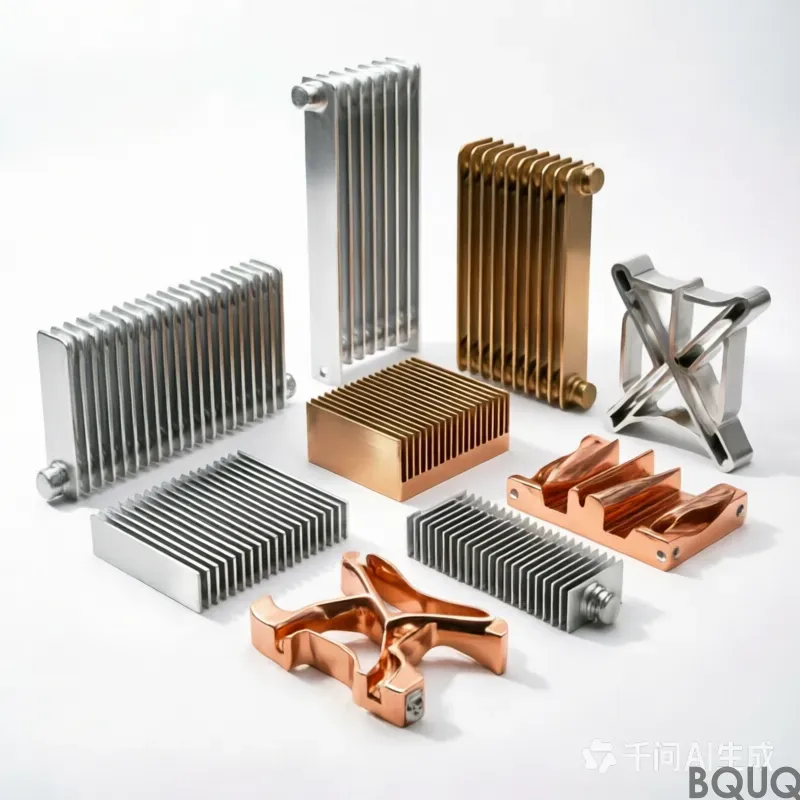
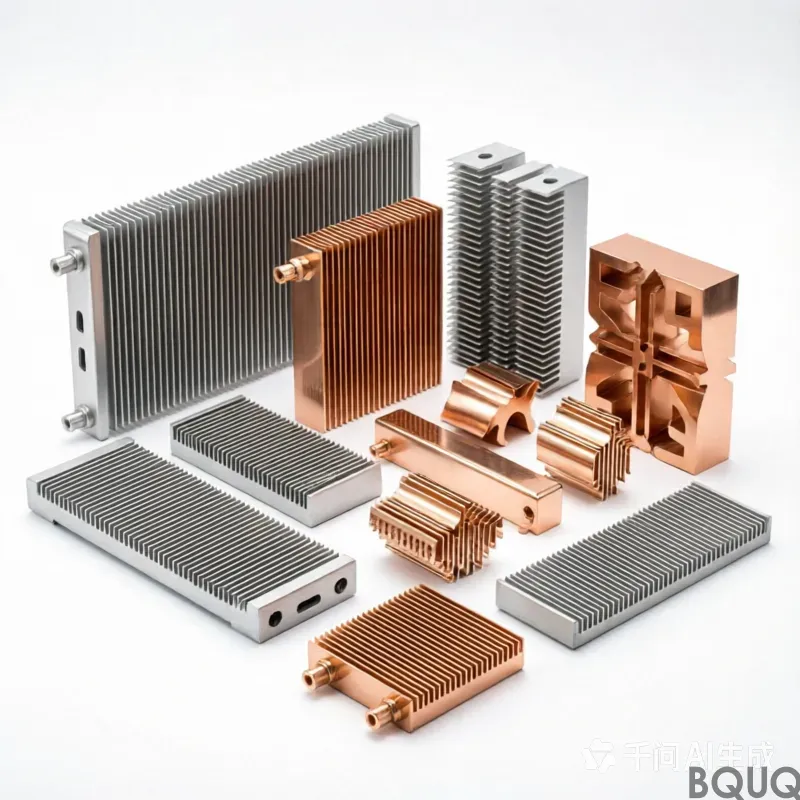
A custom heat sink in 2026 typically costs between $2.50 and $45.00 per unit for extruded aluminum, $8.00 to $120.00 for CNC machined copper, and $15.00 to $200.00 for skived or bonded fin assemblies, depending on complexity, material, and volume. The final price is driven by four dominant factors: material choice (6063-T5 aluminum vs. C1100 copper), manufacturing process (extrusion, CNC, stamping, or skiving), surface treatment (anodizing or nickel plating), and order quantity, with tooling amortization often representing 15% to 40% of the first-year cost. For a typical 100x100x25mm aluminum heat sink with 10 fins, production tooling runs $800 to $3,500, and piece prices drop by 35% to 55% when moving from 100 to 5,000 units.
Material Selection and Cost per Kilogram
The raw material bill typically constitutes 20% to 35% of the total heat sink price. In Q1 2026, 6063-T5 aluminum billet is trading at $3.80 to $4.50 per kilogram in China, while C1100 copper cathode is $9.50 to $11.20 per kilogram. Copper's thermal conductivity (385 W/mK) versus aluminum (201 W/mK) justifies its use only when space constraints force a smaller footprint or when the junction-to-ambient thermal resistance must stay below 1.5°C/W.
For high-volume production (over 10,000 pieces), material cost becomes the dominant variable. A 200g aluminum heat sink has a raw material cost of $0.76 to $0.90, while the same geometry in copper costs $1.90 to $2.24. However, copper's density (8.96 g/cm³) means a copper heat sink of equal thermal performance is often 40% smaller by volume, partially offsetting the per-kilogram premium.
| Material | Thermal Conductivity (W/mK) | Density (g/cm³) | Price per kg (2026) | Typical Application |
| 6063-T5 Aluminum | 201 | 2.70 | $3.80 - $4.50 | LED, IGBT, general cooling |
| 6061-T6 Aluminum | 167 | 2.70 | $4.20 - $5.00 | Machined prototypes, structural |
| C1100 Copper | 385 | 8.96 | $9.50 - $11.20 | High-power laser, EV inverters |
| C1020 Oxygen-Free Copper | 391 | 8.94 | $12.00 - $14.50 | RF amplifiers, aerospace |
| A360 Die-Cast Aluminum | 147 | 2.68 | $5.50 - $6.80 | Complex geometries, mass production |
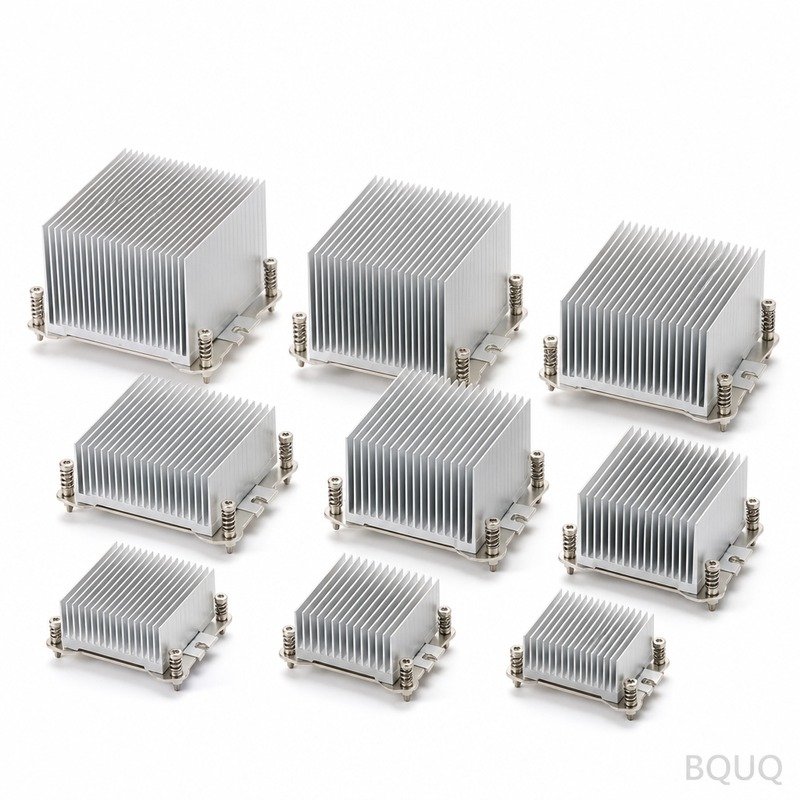
Manufacturing Process and Tooling Costs
The process choice determines both the achievable fin density and the upfront tooling investment. Extrusion is the most economical for straight, uniform cross-sections, with dies costing $800 to $2,500 for profiles up to 200mm wide. The maximum fin height-to-gap ratio for 6063-T5 is 8:1, meaning a 2mm gap can support fins up to 16mm tall. Piece prices for extruded heat sinks range from $2.50 to $15.00 for 100 to 500 units, dropping to $1.20 to $6.00 at 5,000 pieces.
CNC machining from solid billet eliminates tooling costs entirely but increases per-piece cost by 3 to 5 times. A typical 100x100x25mm aluminum heat sink with 8 fins requires 12 to 18 minutes of machining time. At a shop rate of $45 to $65 per hour in Dongguan, this translates to $9.00 to $19.50 per piece before material. Tolerances for CNC machined heat sinks are ±0.05mm on fin thickness and ±0.1mm on overall dimensions, compared to ±0.15mm for extruded profiles.
Skived fin heat sinks (cut from solid copper or aluminum) achieve fin densities of 15 to 30 fins per inch, superior to extrusion's 4 to 8 fins per inch. Tooling for skiving is minimal (fixtures only, $300 to $800), but per-piece costs are high: $18 to $45 for aluminum and $35 to $90 for copper at 500-piece quantities. Stamped fin assemblies, using 0.2mm to 0.4mm sheet metal, are cost-effective for high volume, with piece prices of $1.50 to $8.00, but require a stamping die costing $4,000 to $15,000.
Surface Treatment and Finishing Costs
Anodizing is standard for aluminum heat sinks, providing a corrosion-resistant layer with emissivity of 0.80 to 0.90, which improves radiative heat transfer by up to 30%. Black anodizing costs $0.80 to $2.50 per square decimeter, while clear anodizing is 20% cheaper. The anodizing layer thickness is typically 8 to 25 microns per MIL-A-8625 Type II standards. For copper heat sinks, nickel plating (electroless or electrolytic) is required to prevent oxidation, costing $1.50 to $4.00 per square decimeter.
Additional surface treatments that affect cost include: - Chemical conversion coating (Alodine): $0.30 to $0.80 per square decimeter, used where electrical conductivity is required. - Powder coating: $1.00 to $3.00 per square decimeter, but reduces thermal performance by 5% to 10% due to added thickness. - Micro-textured surfaces (for enhanced boiling or condensation): $5.00 to $15.00 per piece, typically only for two-phase cooling applications.
Quantity Discounts and Lead Time Impact
Order quantity has the largest single impact on unit price. Tooling amortization alone can account for 40% of the first-order cost at 100 pieces. At 1,000 pieces, tooling cost per unit drops to 8% to 15%. The table below shows representative 2026 pricing for a standard 100x100x25mm extruded aluminum heat sink with 10 fins, 2mm fin thickness, 6mm fin pitch, and black anodized finish.
| Quantity | Tooling Cost (Die + Anodize) | Unit Price (Extruded) | Unit Price (CNC Machined) | Unit Price (Skived) | Lead Time |
| 100 | $1,200 - $2,800 | $8.50 - $14.00 | $22.00 - $38.00 | $45.00 - $80.00 | 5 - 8 days |
| 500 | $1,200 - $2,800 | $4.80 - $8.50 | $15.00 - $25.00 | $28.00 - $55.00 | 8 - 12 days |
| 1,000 | $1,200 - $2,800 | $3.20 - $5.80 | $11.00 - $18.00 | $19.00 - $38.00 | 12 - 18 days |
| 5,000 | $1,200 - $2,800 | $2.10 - $3.80 | $8.50 - $14.00 | $14.00 - $28.00 | 18 - 25 days |
| 10,000 | $1,200 - $2,800 | $1.60 - $2.90 | $7.00 - $12.00 | $11.00 - $22.00 | 25 - 35 days |
The price breaks are steeper for extrusion than for CNC machining because the extrusion process has lower variable labor costs. For quantities under 200 pieces, CNC machining is often more economical because it avoids the $800 to $2,500 die cost. A common break-even point is 300 to 500 pieces, above which extrusion becomes the cost leader.
Thermal Performance Requirements and Their Cost Impact
Tighter thermal specifications directly increase cost. A heat sink specified for a 60°C temperature rise at natural convection (0.5 m/s airflow) costs 20% to 40% less than one specified for a 30°C rise at the same airflow, because the latter requires either 40% more surface area or forced airflow with a fan. Increasing fin density from 6 fins per inch to 12 fins per inch improves thermal resistance by 25% but increases extrusion cost by 35% due to higher die complexity and slower extrusion speeds.
For applications requiring thermal resistance below 0.5°C/W, copper or vapor chamber heat sinks become necessary. A 100x100x20mm vapor chamber with copper fins costs $35 to $85 per unit at 1,000 pieces, while a solid copper heat sink of similar performance costs $28 to $60. Heat pipe assemblies (3 to 5 pipes embedded in a base) add $4 to $12 per heat pipe, plus assembly labor of $2 to $6 per unit.
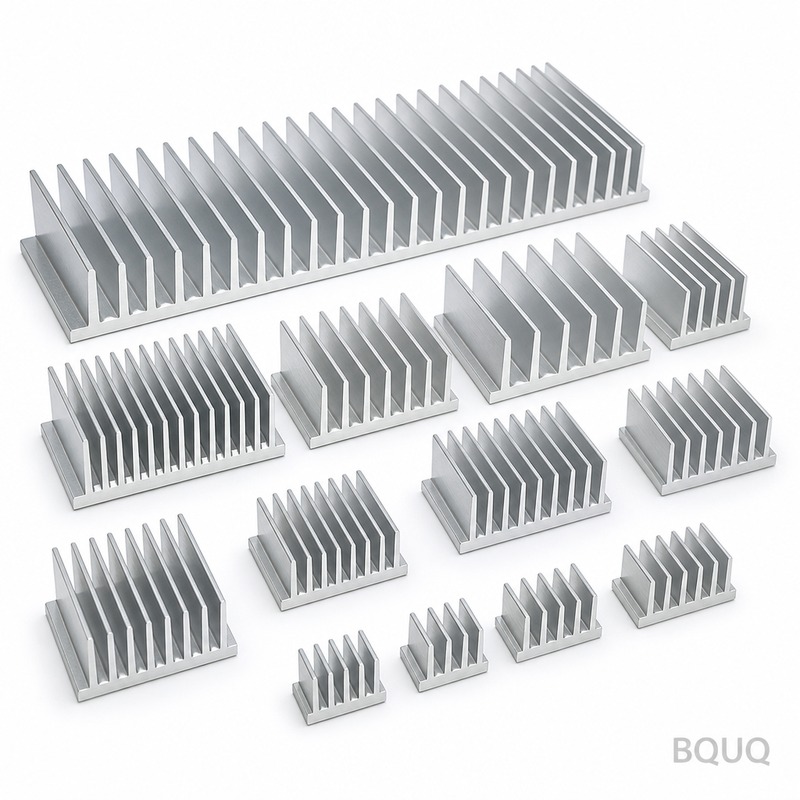
Practical Recommendations for 2026 Procurement
Engineers should specify tolerances that match the manufacturing process. Extruded profiles hold ±0.15mm on fin thickness and ±0.3mm on overall length, while CNC machining achieves ±0.05mm. Requiring tighter tolerances than necessary increases cost by 15% to 25% without thermal benefit. Similarly, specifying 6061-T6 instead of 6063-T5 adds $0.40 to $1.00 per kilogram but provides no thermal advantage; 6063-T5 has higher thermal conductivity and better extrudability.
For prototype quantities, request CNC machined samples from the same alloy and finish as production. This ensures thermal test data matches production parts. Avoid specifying "gold" or "rainbow" anodizing colors, as these require additional dye steps and add $0.50 to $1.50 per piece. Standard black or clear anodizing is sufficient for emissivity above 0.80.
When comparing quotes, request pricing at three quantities: 100, 1,000, and 5,000 units. This reveals the supplier's tooling amortization strategy and allows accurate cost modeling for your production ramp. Also request the fin efficiency calculation, which should be above 85% for well-designed aluminum heat sinks. If the supplier cannot provide thermal simulation data (CFD or FEA), that is a red flag.
FAQ-Style Cost Reduction Tips
Q: What is the cheapest way to make a custom heat sink for 50 pieces? A: CNC machining from 6063-T5 aluminum bar stock. No tooling cost, lead time 3 to 5 days, unit price $18 to $35 for 100x100x25mm. Extrusion would be more expensive because the $1,200 die cost amortizes to $24 per piece at 50 units.
Q: How much can I save by using a standard profile instead of custom? A: Standard extruded profiles (available from stock) cost 30% to 50% less than custom dies. A 100x100mm standard profile with 10 fins costs $1.80 to $2.50 per unit at 1,000 pieces, compared to $3.20 to $5.80 for a custom die. The tradeoff is non-optimized fin height and base thickness.
Q: Does black anodizing actually improve thermal performance? A: Yes, but only in natural convection. Black anodizing increases emissivity from 0.10 (bare aluminum) to 0.85, improving radiative heat transfer by 15% to 30% when the temperature difference to ambient is above 40°C. In forced convection with airflow above 2 m/s, the effect is negligible.
Q: What is the minimum wall thickness for an extruded heat sink base? A: The practical minimum for 6063-T5 extrusion is 1.0mm base thickness, but 2.0mm is recommended for structural rigidity. Thinner bases risk deformation during anodizing and mounting. For CNC machined parts, 0.8mm is achievable in aluminum, 0.5mm in copper.
Q: How do lead times vary by season? A: Chinese factories close for Chinese New Year (typically late January to mid-February). Lead times extend by 2 to 3 weeks in this period. June to August is the slow season, offering 10% to 20% lower prices for flexible schedules. Plan custom tooling orders to land before CNY to avoid delays.
Conclusion
The 2026 custom heat sink market offers clear cost tiers: $1.60 to $6.00 for high-volume extruded aluminum, $7.00 to $25.00 for medium-volume CNC machined parts, and $22.00 to $90.00 for skived or copper assemblies. The optimal choice depends on your quantity, thermal resistance target, and tolerance requirements. Always request a DFM (Design for Manufacturing) review from your supplier before finalizing drawings, as minor changes in fin pitch or base thickness can reduce cost by 20% without sacrificing thermal performance. Accurate thermal simulation at the design stage, combined with realistic tolerance specifications, is the most effective cost control measure.
At BQUQ, our engineering team provides free DFM feedback and thermal simulation within 24 hours of receiving your CAD files. We offer CNC machining, extrusion, stamping, skiving, and heat pipe assembly under one roof, with 20 years of manufacturing experience serving automotive, telecom, and power electronics clients. For a detailed quote with tooling breakdown and quantity pricing, send your drawings to sc@bquq.com or contact us via WhatsApp at +86 13713157787. Visit www.bquq.com to download our heat sink design guide and standard profile catalog. We respond to all quoting requests within 12 hours.
Related Articles
- Heat Sinks for Battery Packs: Prevent Thermal Runaway
- How to Attach a Heat Sink Without Screws: Thermal Adhesive Guide
- Best Copper Heat Sinks for CPU Overclocking in 2025
Frequently Asked Questions
How much does a custom heat sink cost in 2026?
Extruded aluminum heat sinks cost $2.50 to $45.00 per unit, CNC machined copper runs $8.00 to $120.00, and skived or bonded fin assemblies range from $15.00 to $200.00. Final pricing depends on material, process, surface treatment, and order volume.
What factors most affect the final price of a custom heat sink?
Four dominant factors drive pricing: material choice (6063-T5 aluminum vs. C1100 copper), manufacturing process (extrusion, CNC, stamping, or skiving), surface treatment (anodizing or nickel plating), and order quantity. Tooling amortization can represent 15% to 40% of first-year cost.
How much does tooling cost for a typical aluminum heat sink?
For a standard 100x100x25mm aluminum heat sink with 10 fins, production tooling runs $800 to $3,500. Extrusion dies cost $800 to $2,500 for profiles up to 200mm wide. Piece prices drop by 35% to 55% when moving from 100 to 5,000 units.
What are the material costs for aluminum vs. copper heat sinks?
In Q1 2026, 6063-T5 aluminum billet trades at $3.80 to $4.50 per kg, while C1100 copper cathode is $9.50 to $11.20 per kg. A 200g aluminum heat sink has raw material cost of $0.76 to $0.90; the same geometry in copper costs $1.90 to $2.24.