Custom Heat Sink Cost 2026: Pricing Factors, Tolerances, and Lead Times
A custom heat sink in 2026 typically costs between $2.50 and $45.00 per unit, with the final price determined by manufacturing process, material, thermal performance requirements, and order volume. For a standard extruded aluminum heat sink with 0.10 mm flatness tolerance, expect tooling fees of $800 to $3,500 and piece prices of $3 to $12 at 1,000 units. This article breaks down every cost driver with 2026 pricing data, including CNC machining, skiving, forging, and liquid cold plates, to help you budget accurately for your next thermal management project.
Cost Breakdown by Manufacturing Process
The manufacturing method is the single largest cost driver for custom heat sinks. In 2026, the five primary processes used by BQUQ and other Dongguan factories have distinct price ranges based on tooling complexity, cycle time, and material utilization.
| Process | Tooling Cost (USD) | Unit Price at 1,000 pcs (USD) | Lead Time (days) | Max Fin Height (mm) | Min Fin Thickness (mm) | Typical Tolerances (mm) |
| Extrusion | $800 - $2,500 | $3.00 - $8.50 | 15 - 25 | 100 | 1.2 | +/- 0.10 |
| CNC Machining | $0 - $500 | $8.00 - $25.00 | 7 - 15 | 80 | 0.8 | +/- 0.02 |
| Skiving | $1,500 - $4,000 | $6.50 - $18.00 | 20 - 35 | 60 | 0.5 | +/- 0.05 |
| Die Casting | $5,000 - $15,000 | $4.50 - $12.00 | 30 - 45 | 40 | 2.0 | +/- 0.15 |
| Forging | $3,000 - $8,000 | $7.00 - $20.00 | 25 - 40 | 50 | 1.5 | +/- 0.10 |
| Liquid Cold Plate | $2,000 - $6,000 | $25.00 - $45.00 | 30 - 60 | N/A | N/A | +/- 0.05 |
Extrusion remains the most economical choice for high-volume, simple geometries. At BQUQ, a standard 200 mm by 100 mm extruded heat sink with 10 fins at 1.5 mm thickness costs $4.20 per unit at 5,000 pieces. CNC machining becomes viable for low-volume prototypes and complex geometries, with a machined copper base and aluminum fin assembly costing $18 to $35 per unit at 100 pieces. For 2026, we recommend skiving for applications requiring fin pitches below 2 mm, as it achieves 0.5 mm fin thickness at a lower cost than CNC machining.
Material Selection and Its Impact on Price
Material cost accounts for 30% to 50% of the total heat sink price. In Q1 2026, the base material prices from Chinese suppliers are as follows: 6063-T5 aluminum alloy at $3.20 per kilogram, 6061-T6 at $3.40 per kilogram, and C1100 copper at $12.80 per kilogram. The thermal conductivity difference justifies the price gap: 6063-T5 offers 201 W/mK, while copper provides 385 W/mK.
For a 300-gram extruded heat sink, the raw aluminum material cost is $0.96, while the same design in copper would cost $3.84 before machining. However, copper's higher density (8.96 g/cm3 versus 2.70 g/cm3) means a copper heat sink of the same volume weighs 3.3 times more and costs significantly more due to increased material and machining time. In 2026, hybrid designs are gaining traction: a copper base plate (5 mm thick) combined with aluminum fins provides 85% of the thermal performance of pure copper at 60% of the cost.
Surface treatment also affects material cost. Black anodizing adds $0.15 to $0.40 per unit depending on surface area, while nickel plating on copper adds $0.50 to $1.20 per unit. For high-volume orders above 10,000 units, electroless nickel plating on aluminum is becoming cost-effective at $0.80 per unit, offering corrosion resistance and improved solderability.
Dimensional Tolerances and Machining Complexity
Tighter tolerances exponentially increase machining time and scrap rate, directly raising the unit price. A standard extruded heat sink with a flatness tolerance of 0.15 mm requires no secondary machining, costing $4.50 per unit. Tightening the flatness to 0.05 mm requires a CNC fly-cut operation, adding $1.80 to $2.50 per unit in machining costs and increasing lead time by 3 to 5 days.
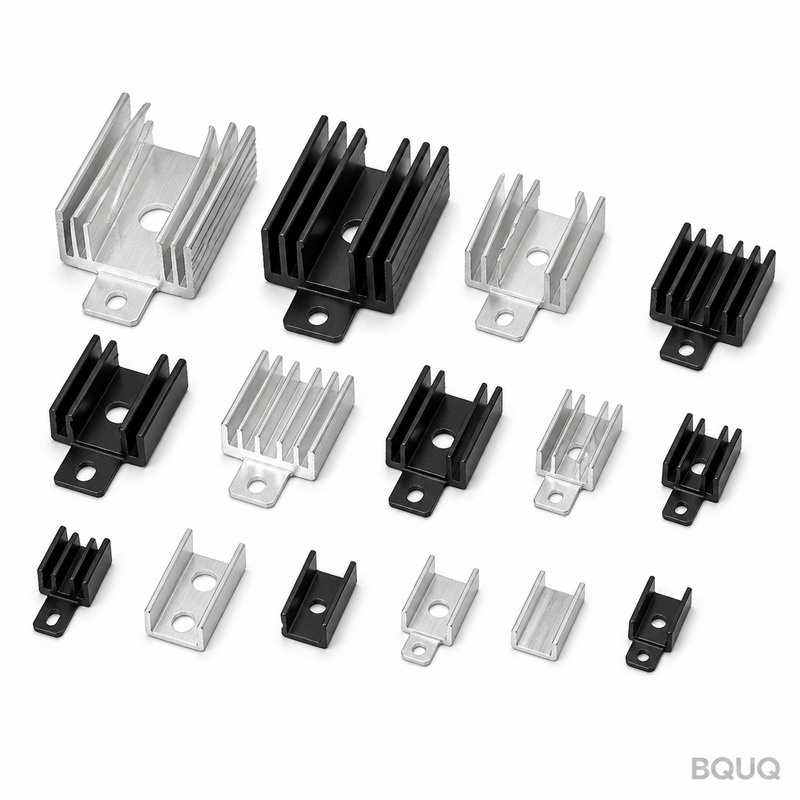
In 2026, BQUQ observes the following tolerance-to-cost relationships for a 150 mm by 100 mm base plate:
| Tolerance Requirement | Additional Cost per Unit (USD) | Machining Time Added (min) | Typical Application |
| +/- 0.15 mm flatness | $0.00 | 0 | General purpose, LED cooling |
| +/- 0.08 mm flatness | $0.80 - $1.20 | 1.5 | IGBT modules, power electronics |
| +/- 0.04 mm flatness | $2.00 - $3.00 | 4 | CPU/GPU direct contact |
| +/- 0.02 mm flatness | $4.50 - $6.00 | 8 | Laser diodes, precision optics |
| Hole position +/- 0.05 mm | $0.50 - $1.00 | 1 | Heatsink mounting, screw holes |
| Surface roughness Ra 0.8 | $0.30 - $0.60 | 0.5 | Thermal interface material bonding |
For 2026, we advise specifying only the tolerances that your application requires. A common mistake is requesting +/- 0.02 mm flatness for a heat sink that will be mounted with a 0.2 mm thick thermal pad. In that case, the 0.02 mm tolerance adds unnecessary cost. Specify a flatness of 0.10 mm for thermal pad applications and reserve 0.05 mm or better for direct die contact with thermal paste.
Order Quantity and Volume Pricing Tiers
Volume is the second-largest cost factor after manufacturing process. In 2026, Chinese heat sink factories including BQUQ structure pricing in five tiers. For an extruded aluminum heat sink measuring 200 mm by 120 mm with 12 fins, the price breaks down as follows:
| Order Quantity | Unit Price (USD) | Tooling Amortized Per Unit (USD) | Total Cost per Unit (USD) | Lead Time (days) |
| 1 - 10 | $25.00 - $35.00 | $100.00 - $300.00 | $125.00 - $335.00 | 7 - 10 |
| 11 - 50 | $12.00 - $18.00 | $20.00 - $60.00 | $32.00 - $78.00 | 10 - 15 |
| 51 - 200 | $8.00 - $11.00 | $5.00 - $15.00 | $13.00 - $26.00 | 15 - 20 |
| 201 - 1,000 | $5.50 - $7.50 | $1.00 - $3.00 | $6.50 - $10.50 | 20 - 30 |
| 1,001 - 5,000 | $4.20 - $5.80 | $0.20 - $0.80 | $4.40 - $6.60 | 25 - 35 |
| 5,001 - 20,000 | $3.50 - $4.50 | $0.05 - $0.15 | $3.55 - $4.65 | 30 - 45 |
For 2026, the price inflection point is at 500 units. Below 500 units, the tooling cost dominates and CNC machining from a solid block is often more economical than extrusion because it avoids the $800 to $2,500 die cost. Above 2,000 units, extrusion becomes clearly superior. For quantities between 500 and 2,000, we recommend requesting quotes for both processes, as the crossover point depends on the specific geometry.
If you are in the prototyping phase, order 5 to 10 units from a CNC machining service at a higher unit price, then verify performance before committing to extrusion tooling. BQUQ offers a prototyping-to-production program where 50% of the prototype machining cost is credited toward the final extrusion tooling fee.
Thermal Performance Requirements and Testing Costs
The required thermal resistance (Rth) directly determines the heat sink size, fin density, and material. A natural convection heat sink for a 10 W LED needs a thermal resistance of approximately 5.0 K/W, achievable with a small 100 mm by 60 mm extruded profile costing $2.80. A forced convection heat sink for a 200 W IGBT module requires 0.25 K/W, demanding a larger 250 mm by 150 mm unit with high fin density, costing $15 to $25.
In 2026, thermal testing is an additional cost that many buyers overlook. A basic thermal resistance test using a thermocouple and power supply costs $150 to $400 per design. A full CFD simulation followed by experimental validation costs $800 to $2,000. We recommend budgeting for at least one round of thermal testing, as a 10% error in thermal resistance estimation can lead to field failures costing far more than the test itself.
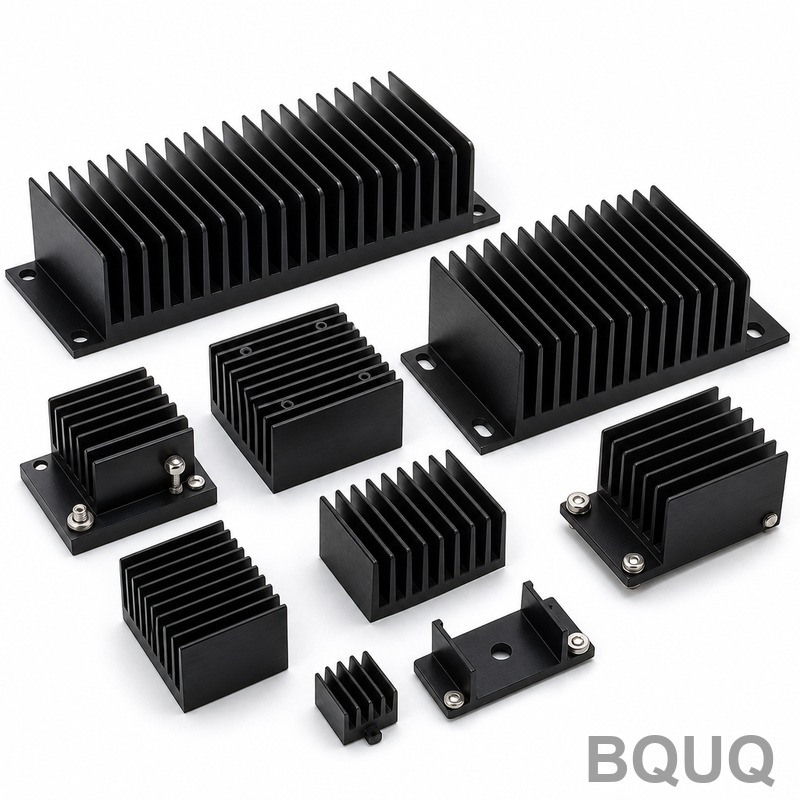
For high-reliability applications such as electric vehicle inverters or aerospace electronics, thermal cycling testing (-40°C to +125°C for 500 cycles) adds $500 to $1,500 per design. This testing validates the interface between the heat sink and the component, particularly for copper-aluminum joints which can suffer from coefficient of thermal expansion mismatch.
Additional Cost Factors for 2026
Packaging and logistics account for 5% to 15% of the total cost for international orders. A heat sink weighing 1 kg shipped from Dongguan to Los Angeles by air freight costs $4.50 to $6.00 per unit at 100 units, dropping to $1.20 to $2.00 per unit by sea freight. For 2026, consider consolidating orders to fill a 20-foot container (approximately 15,000 to 20,000 units of medium-sized heat sinks) to reduce per-unit shipping costs below $0.80.
Custom packaging for delicate fin structures adds $0.10 to $0.30 per unit. Anti-static foam trays are recommended for heat sinks with fins thinner than 1 mm to prevent bending during transit. Secondary operations such as tapping holes ($0.05 to $0.15 per hole), installing spring clips ($0.10 to $0.20), and applying thermal tape ($0.20 to $0.50) also add to the final price.
In 2026, the cost of compliance documentation is also rising. RoHS and REACH declarations are typically free, but a full conflict minerals report adds $200 to $500 per order. For EU or North American customers, we recommend requesting the compliance documents at the quoting stage to avoid delays in customs clearance.
Practical Recommendations for Cost Optimization
To minimize your custom heat sink cost in 2026, first specify the maximum allowable thermal resistance and ambient temperature, not the dimensions. This allows the factory to optimize the design for manufacturing. Second, keep the fin pitch above 3 mm for extrusion or above 1.5 mm for skiving to reduce tooling wear and increase production speed. Third, design for standard billet sizes; a heat sink length of 300 mm or 600 mm avoids material waste and reduces cost by 8% to 12%.
Fourth, combine multiple heat sink designs into one extrusion profile and cut to different lengths. This spreads the tooling cost across multiple products. Fifth, consider using 6063-T5 instead of 6061-T6 if the application does not require high mechanical strength, as 6063-T5 extrudes faster and has lower die wear. Finally, request a tolerance review from the factory. BQUQ engineers will flag unnecessarily tight tolerances that add cost without functional benefit.
For 2026 budgets, plan for a 5% to 8% annual price increase in aluminum due to global supply chain pressures. Locking in a 12-month volume agreement with a factory can stabilize prices and secure production slots, particularly during the peak season from August to November.
Frequently Asked Questions on Heat Sink Pricing
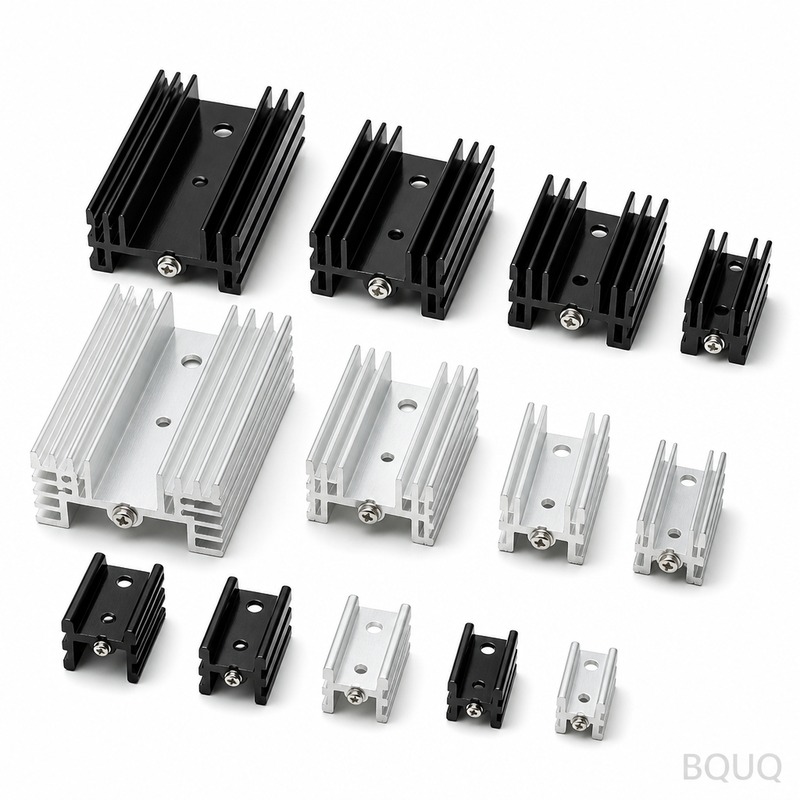
What is the minimum order quantity for a custom heat sink? At BQUQ, the MOQ is 10 pieces for CNC machining and 500 pieces for extrusion. For extrusion, the tooling cost of $800 to $2,500 is paid once and remains valid for future orders.
How much does heat sink tooling cost in 2026? Extrusion dies range from $800 to $2,500 depending on complexity. Skiving tooling costs $1,500 to $4,000. Die casting molds are the most expensive at $5,000 to $15,000. CNC machining requires no tooling fee.
Can I get a custom heat sink in 2 weeks? Yes, for CNC machined prototypes up to 50 pieces, BQUQ offers 7 to 10 day lead times. For extruded production quantities, the minimum lead time is 15 days excluding surface treatment and shipping.
How do I calculate the cost of my specific heat sink design? Send the 3D model (STEP or IGES format) along with your thermal requirements, annual volume, and target price to sc@bquq.com. BQUQ will provide a detailed quotation within 12 hours, including tooling, unit price, and lead time breakdowns.
Conclusion and Next Steps for Your 2026 Project
The cost of a custom heat sink in 2026 ranges from $3.50 to $45.00 per unit, with the final price driven by manufacturing process, material, tolerances, volume, and testing requirements. For most applications, an extruded 6063-T5 aluminum heat sink with 0.10 mm flatness tolerance and black anodized finish offers the best balance of thermal performance and cost. Plan your order quantity above 1,000 units to achieve the lowest price points, and specify only the tolerances that your thermal interface material can actually benefit from.
To get an accurate quote for your specific heat sink design, send your 3D model or 2D drawing to the BQUQ engineering team. We respond to all quoting requests within 12 hours, and our 20 years of CNC machining, metal stamping, spring manufacturing, and heat sink production experience in Dongguan ensures you receive manufacturable, cost-optimized solutions.
Email your design to sc@bquq.com or contact us on WhatsApp at +86 13713157787. Visit www.bquq.com for more information on our capabilities and to download our 2026 heat sink design guide. We will review your thermal requirements and provide a detailed cost breakdown within one business day.
Related Articles
- Thermal Management for High Brightness LEDs with Heat Sinks
- Stamped Metal vs Die Cast Heat Sinks: Cost & Quality Comparison
- New energy vehicle IGBT heat dissipation, heat sink reliability engineering, heat pipe and temperature plate integrated heat sink, surface treatment and heat radiation enhancement: anodic oxidation, black coating and micro-nano structure, graphene/3D printing/intelligent thermal management: 2030 heat sink technology roadmap
Frequently Asked Questions
What is the typical price range for a custom heat sink in 2026?
A custom heat sink in 2026 typically costs between $2.50 and $45.00 per unit. The final price depends on manufacturing process, material, thermal performance requirements, and order volume. For example, a standard extruded aluminum heat sink with 0.10 mm flatness tolerance costs $3 to $12 per piece at 1,000 units, with tooling fees of $800 to $3,500.
Which manufacturing process is most economical for high-volume simple heat sink geometries?
Extrusion is the most economical choice for high-volume, simple geometries. At BQUQ, a standard 200 mm by 100 mm extruded heat sink with 10 fins at 1.5 mm thickness costs $4.20 per unit at 5,000 pieces. Tooling costs range from $800 to $2,500, with unit prices of $3.00 to $8.50 at 1,000 pieces and lead times of 15 to 25 days.
How does material choice affect heat sink cost and thermal performance?
Material cost accounts for 30% to 50% of total heat sink price. In Q1 2026, 6063-T5 aluminum costs $3.20/kg (201 W/mK), while C1100 copper costs $12.80/kg (385 W/mK). For a 300-gram extruded heat sink, aluminum raw material costs $0.96 versus $3.84 for copper. Copper weighs 3.3 times more due to higher density, increasing machining costs.
When should I choose skiving over CNC machining for my heat sink?
Skiving is recommended for applications requiring fin pitches below 2 mm, as it achieves 0.5 mm fin thickness at a lower cost than CNC machining. Skiving has tooling costs of $1,500 to $4,000 and unit prices of $6.50 to $18.00 at 1,000 pieces, with tolerances of +/- 0.05 mm. CNC machining offers tighter tolerances of +/- 0.02 mm but costs $8.00 to $25.00 per unit.