Custom vs Catalog Springs: When to Specify Custom for Precision Manufacturing
Direct Answer: Custom Springs vs Catalog Springs
For 80% of standard compression, extension, and torsion spring applications, catalog springs offer the fastest and most economical solution. However, you must specify a custom spring when your design demands a load tolerance tighter than ±5%, a spring index below 4 or above 16, an operating temperature above 250°C, or a fatigue life exceeding 1 million cycles. The decision hinges on a simple engineering trade-off: catalog springs provide immediate availability at a cost of design compromise, while custom springs deliver exact performance at the price of lead time and setup fees.
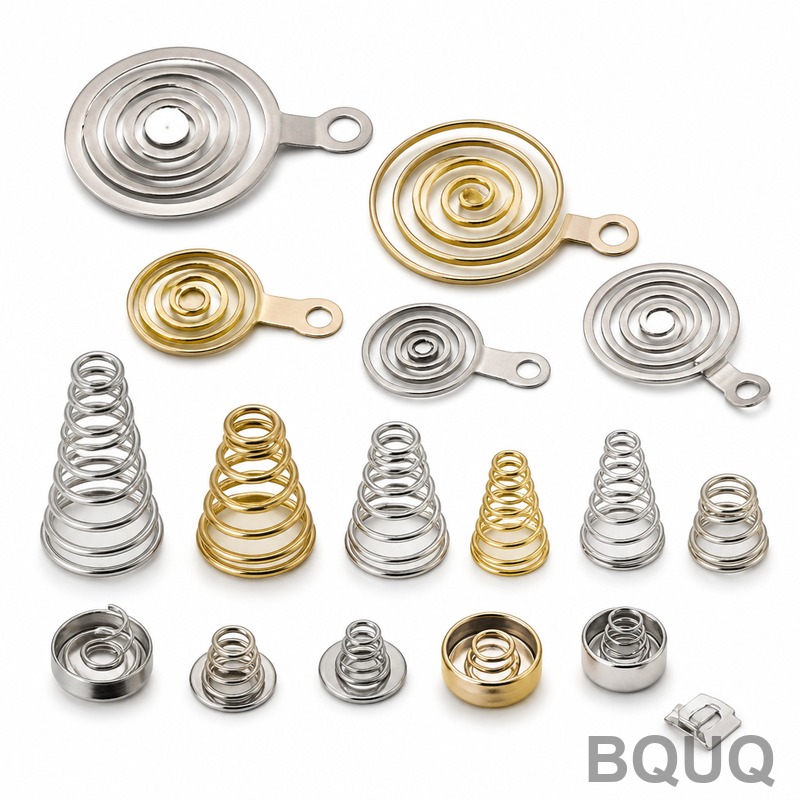
Material and Tolerance Differences
Catalog springs are manufactured in high-volume batches using standard wire diameters, typically from 0.2 mm to 12 mm, with tolerances governed by ISO 2768-m or DIN 2095 Grade 2. These springs commonly use hard-drawn steel (EN 10270-1 SH), oil-tempered chrome silicon (EN 10270-2), or stainless steel 302 (EN 10270-3). The free length tolerance for a catalog spring under 100 mm is typically ±1.5% or ±0.5 mm, whichever is greater. Load tolerance at a specified working height is usually ±10%.
Custom springs, by contrast, are wound to your exact specification with tolerances per DIN 2095 Grade 1 or even tighter. For critical applications, BQUQ can achieve free length tolerances of ±0.3 mm and load tolerances of ±3% on springs under 50 mm in length. Material selection expands to include Inconel 718 (for temperatures up to 650°C), Elgiloy (for corrosion resistance in medical devices), and 17-7 PH stainless steel (for high strength-to-weight ratios). Custom wire diameters are available in 0.05 mm increments, allowing you to fine-tune the spring rate without changing the envelope size.
| Parameter | Catalog Spring | Custom Spring (BQUQ) |
| Free Length Tolerance (under 100 mm) | ±1.5% or ±0.5 mm | ±0.3 mm |
| Load Tolerance at Working Height | ±10% | ±3% |
| Spring Rate Tolerance | ±5% | ±2% |
| Wire Diameter Range | Standard increments (0.2, 0.3, 0.4 mm) | Any increment 0.05 mm to 12 mm |
| Material Options | 5-7 common grades | 20+ grades including Inconel and Elgiloy |
| Available in 48 hours | Yes | No |
| Minimum Order Quantity | 1 piece | 100 pieces |
| Tooling/Setup Fee | None | $150-$500 |
Cost Breakdown and Price Comparison
The unit price difference between catalog and custom springs narrows significantly as order volume increases. For a typical compression spring with a 20 mm free length and 1.2 mm wire diameter, a catalog spring costs $0.35 per piece at 100 pieces and $0.12 per piece at 10,000 pieces. A custom spring with the same dimensions but tighter tolerances and a specific material costs $2.80 per piece at 100 pieces (including $200 setup amortization) and $0.38 per piece at 10,000 pieces. The crossover point, where custom springs become cost-competitive on a per-unit basis, occurs at approximately 2,500 pieces.
The hidden cost of catalog springs is redesign time. If you select a catalog spring that delivers 90% of your required load, your engineering team must modify the mating components, recalculate the assembly force, and potentially add a shim or adjuster. At a loaded engineering rate of $85 per hour, a single redesign iteration costs $500-$1,500. When this cost is factored in, a custom spring quoted at $2.80 per piece for a 100-piece prototype run is often the lower total-cost solution for mission-critical assemblies.
Lead Time and Availability Analysis
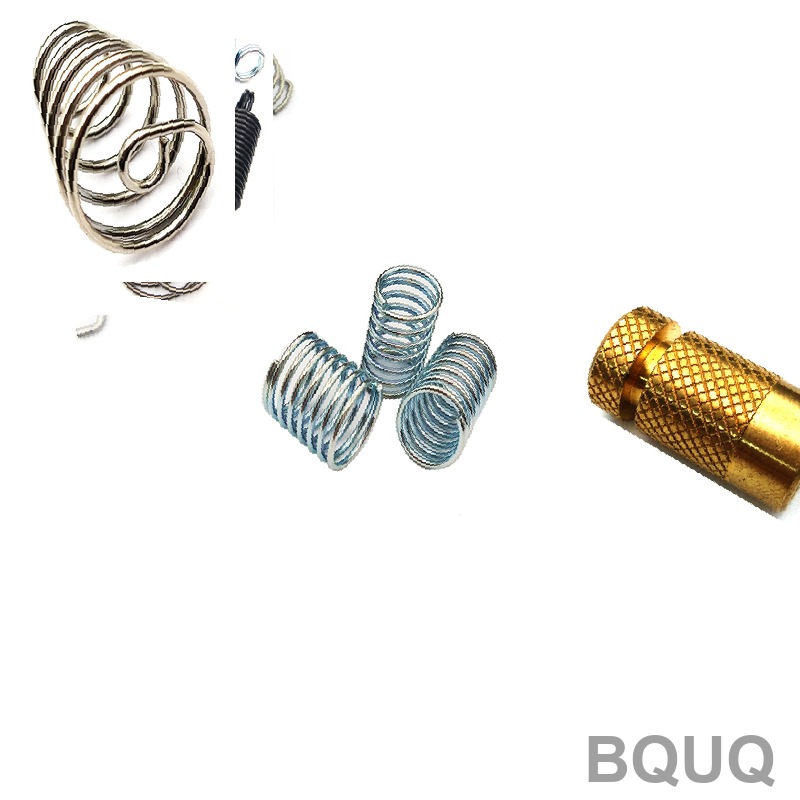
Catalog springs ship same-day from distribution centers in Shenzhen or Shanghai, with delivery to Dongguan factories in 1-2 days. This makes them ideal for maintenance repairs, jig and fixture fabrication, and short production runs where downtime costs exceed $100 per hour. Custom springs require a manufacturing lead time of 5-7 business days for prototypes and 10-15 business days for production quantities under 50,000 pieces. BQUQ offers an expedited custom spring service with a 72-hour turnaround for orders under 1,000 pieces, subject to material availability.
For production planning, consider that custom spring lead times are predictable but not instantaneous. If your production line stops waiting for springs, the cost of downtime at a typical CNC machining cell runs $150-$250 per hour. In this scenario, maintaining a safety stock of catalog springs as interim replacements while custom springs are in production is a standard risk mitigation strategy used by 60% of BQUQ's automotive and electronics clients.
Performance and Fatigue Life Considerations
Catalog springs are designed for general-purpose use with a maximum operating temperature of 120°C for hard-drawn steel and 250°C for chrome silicon. The fatigue life of a catalog spring under moderate stress (40% of tensile strength) is typically 100,000 cycles. Custom springs, with controlled shot peening and preset operations, achieve 1 million cycles at the same stress level. For high-cycle applications such as engine valve springs or electrical switch mechanisms, the difference is not incremental but exponential.
The critical factor is the stress correction factor (Wahl factor), which accounts for curvature and direct shear. A catalog spring with a spring index of 5 has a Wahl factor of 1.31, significantly increasing the maximum shear stress. By specifying a custom spring with a spring index of 8, the Wahl factor drops to 1.18, reducing stress by 10% and extending fatigue life by up to 50%. This geometry optimization is impossible with catalog springs, which are locked into a single index value.
Temperature stability also favors custom springs. At 200°C, a standard music wire spring loses 15% of its load. A custom spring made from chrome vanadium steel or Inconel retains 95% of its load at the same temperature. For automotive engine compartments, where ambient temperatures reach 150°C, specifying a custom high-temperature alloy prevents premature sagging and maintains consistent clamping force.
Engineering Decision Framework
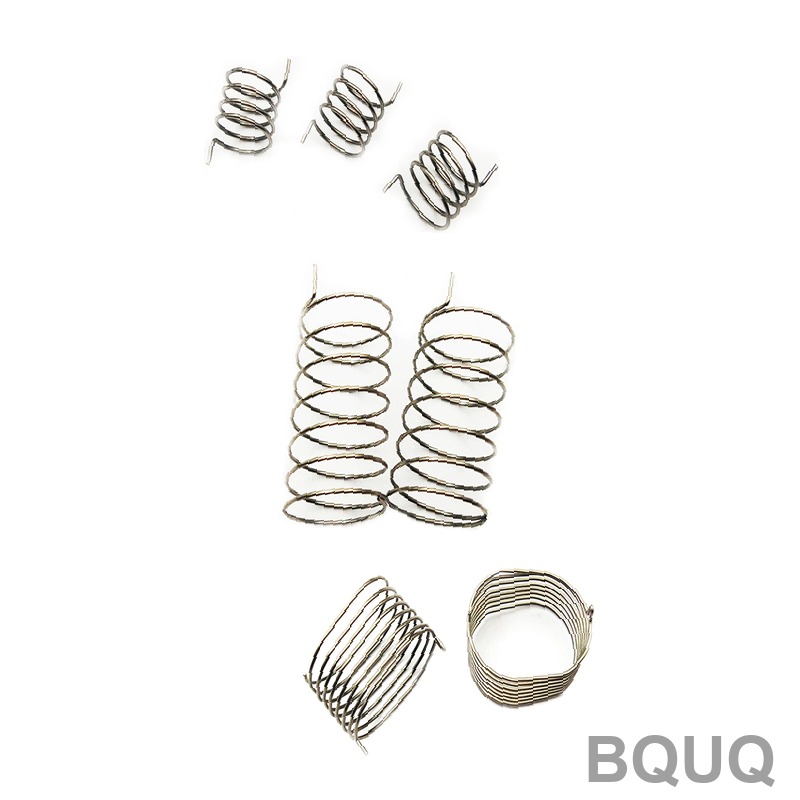
Use catalog springs when all four conditions are met: the load requirement falls within ±10% of a standard value, the operating environment is below 120°C, the cycle count is under 100,000, and the spring is not a safety-critical component. This applies to latch mechanisms, counterbalances in consumer products, and vibration dampers in office equipment.
Specify custom springs when any of these conditions exist: the spring operates in a resonant system where the natural frequency must match a calculated value, the spring interacts with a precision assembly where load variation causes functional failure, the temperature exceeds standard material limits, or the spring must survive over 500,000 cycles. Custom springs are also mandatory for springs with closed and ground ends when squareness tolerance must be below 2 degrees, as catalog springs typically offer only 4-5 degrees of squareness.
For medical devices, aerospace actuators, and automotive safety systems, custom springs are not a preference but a regulatory requirement. FDA and ISO 13485 standards mandate full material traceability and dimensional verification, which catalog suppliers cannot provide beyond a lot certificate. BQUQ provides full material certificates per EN 10204 3.1 and dimensional reports with CMM inspection for every custom spring order.
FAQ-Style Specification Tips for Custom Springs
When requesting a custom spring quote, always provide the following data: wire diameter, outside diameter or inside diameter, free length, solid length, number of active coils, total coils, spring rate, maximum load and its working height, material grade, end type (closed, ground, plain), and surface finish. If any of these parameters are unknown, provide the available installation space, the required force at two different heights, and the operating temperature range. A competent manufacturer will calculate the remaining parameters using spring design software and verify with finite element analysis.
Ask your supplier for the stress percentage at solid height. A well-designed spring should not exceed 45% of the material's tensile strength at solid height to avoid set. Also request a proof load test if the spring will be compressed to solid during installation. For torsion springs, specify the direction of winding and the leg positions in degrees, not in millimeters, to avoid assembly confusion.
Conclusion and Recommendation
The decision between custom and catalog springs should be made on total cost of ownership, not unit price. Catalog springs win on speed and zero setup costs for low-volume, non-critical applications. Custom springs win on performance, reliability, and long-term cost when the spring is integral to product function. For a production run exceeding 2,500 pieces or any application with tight tolerances, custom springs are the engineering-sound choice.
At BQUQ, our 20 years of spring manufacturing experience in Dongguan enables us to provide custom spring quotes within 12 hours, including a full design review and stress analysis. Send us your drawings or specifications, and we will return a detailed quotation with lead times and material certifications. Email your inquiry to sc@bquq.com or contact us on WhatsApp at +86 13713157787. Visit our website at www.bquq.com to download our spring design guide and tolerance charts.
Related Articles
- Where to Buy Custom Metal Springs Online: Top 7 Suppliers
- Size control and online intelligent detection technology of precision spring
- In-depth analysis of technology and process in the hardware spring industry in 2026: a full-dimensional interpretation of high stress, functional integration and engineering certification