Custom vs Catalog Springs: When to Specify Custom for Precision Manufacturing
Choosing between a custom spring and a catalog spring is a decision that hinges on engineering tolerances, load requirements, and total cost of ownership. For most applications with standard loads and ample space, a catalog spring is the economically superior choice. However, you must specify a custom spring when your design demands specific force rates, non-standard dimensions, extreme temperature resistance, or a fatigue life that off-the-shelf options cannot guarantee.
The Engineering Threshold: Defining the Break Point
The primary distinction between custom and catalog springs is not quality, but precision of fit and function. A catalog spring, typically manufactured to ISO 10243 or DIN 2095 standards, offers tolerances of +/- 5% on load and +/- 2% on free length. In contrast, a custom spring machined or coiled to your exact specification can achieve load tolerances of +/- 2% and free length tolerances of +/- 0.5%. This difference becomes critical in applications like safety valves, fuel injectors, and high-cycle automation grippers where a 5% variance in force can cause premature wear or inconsistent actuation.
Material Selection and Environmental Limits
Catalog springs are almost exclusively produced from music wire (ASTM A228), oil-tempered chrome silicon (ASTM A401), or 302 stainless steel. These materials cover service temperatures from -40°C to 250°C. However, if your assembly operates above 250°C or in corrosive chemical environments, standard catalogs fail. Custom springs allow for Inconel X-750 (service up to 650°C), Elgiloy (non-magnetic and corrosion-resistant), or 17-7 PH stainless steel. At BQUQ, we regularly produce custom springs from Inconel 718 for exhaust gas recirculation systems, where the operating temperature reaches 540°C and standard chrome silicon would lose its modulus of rigidity nearly 20% at that temperature.
Cost Breakdown and Economic Justification
The price delta between custom and catalog springs is often misunderstood. A catalog compression spring may cost $0.50 to $2.00 per piece at volume. A custom spring with the same wire diameter and free length typically costs $1.50 to $5.00 per piece due to tooling amortization and shorter production runs. However, the real cost driver is setup. Custom spring tooling (coiling mandrels, grinding fixtures) ranges from $300 to $1,500 depending on wire diameter and complexity. If your annual usage is below 5,000 pieces, catalog springs are nearly always cheaper. Above 20,000 pieces per year, custom springs become cost-neutral or cheaper per unit, especially if you reduce assembly time by eliminating shims or spacers.
| Parameter | Catalog Spring | Custom Spring (BQUQ) |
| Load Tolerance | +/- 5% | +/- 2% |
| Free Length Tolerance | +/- 2% | +/- 0.5% |
| Outer Diameter Tolerance | +/- 1.5% | +/- 0.3% |
| Max Service Temperature (Standard Steel) | 250°C | 250°C (higher with Inconel) |
| Tooling Cost | None | $300 - $1,500 |
| Unit Price (100 pcs) | $0.80 - $2.00 | $2.50 - $6.00 |
| Unit Price (10,000 pcs) | $0.40 - $1.20 | $0.90 - $2.50 |
| Lead Time (Prototype) | 1-2 days (stock) | 5-7 days |
| Minimum Order Quantity | 1 piece | 500 pieces (or tooling fee) |
| Fatigue Life (Typical) | 100,000 cycles | 1,000,000+ cycles (shot-peened) |
Dimensional Constraints and Installation Space
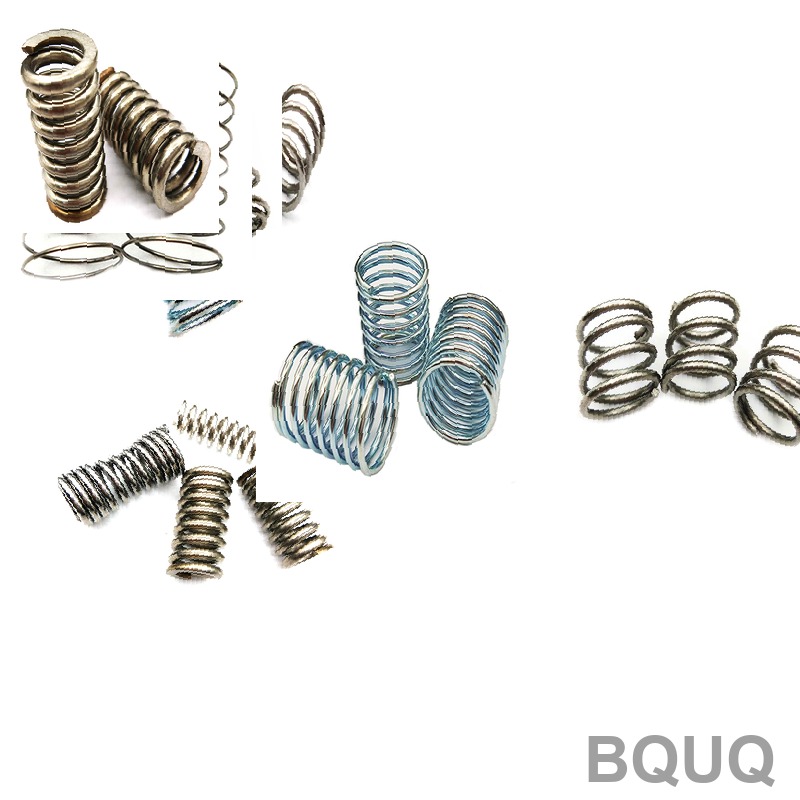
The most common reason engineers switch from catalog to custom is packaging. Catalog springs are produced to standard length-to-diameter ratios, typically 3:1 to 8:1 for stable compression. If your design requires a spring with a free length of 12 mm and an outer diameter of 8 mm (ratio of 1.5:1), you will not find that in a catalog. Similarly, conical or barrel-shaped springs for side-load stability are exclusively custom. At BQUQ, we regularly produce springs with a solid height that is only 1.2 times the wire diameter, which is impossible to achieve with standard catalog tooling. This allows our clients to reduce their housing length by 15-20%, directly impacting overall product compactness.
Fatigue Life and Dynamic Loading
For static applications (springs that compress and hold), catalog springs are perfectly adequate. However, for dynamic applications exceeding 100,000 cycles, the surface finish and residual stress management become critical. Catalog springs are typically not shot-peened unless specified, leading to premature crack initiation on the inner diameter. Custom springs can be specified with shot peening to SAE J442 standards, achieving a 30-40% improvement in fatigue life. Furthermore, custom springs allow for controlled stress-relieving cycles and optional presetting (set removal) to prevent length loss under load. If your application runs at 300 cycles per minute for 8 hours a day, that is 144,000 cycles per day. A catalog spring might fail in under 5 days; a custom, shot-peened spring will exceed 1,000,000 cycles, lasting over 6 months.
Lead Time, Inventory, and Obsolescence Risk
Catalog springs offer immediate availability, but they come with an inventory management risk. If your supplier discontinues a line or changes their raw material vendor, your production stops. Custom springs lock in your design and material specification, ensuring supply stability for the life of your product. The trade-off is lead time. A custom spring prototype at BQUQ takes 5-7 days, including CNC coiling and grinding. Production quantities of 10,000 pieces require 2-3 weeks. For a new product launch, this is negligible compared to the 8-12 week lead times for custom plastic injection molds. If you are still in the R&D phase with frequent design iterations, use catalog springs to test function. Once the design is frozen, transition to custom springs for production reliability and tighter tolerances.
FAQ-Style Tips for Specification
When should you absolutely avoid custom springs? If your working stress is below 30% of the material's tensile strength, your operating temperature is between -20°C and 100°C, and you have no space constraints, a catalog spring is the correct choice. Conversely, specify custom when you need a specific spring rate that is not a standard metric size. For example, a catalog spring might offer 10 N/mm or 12 N/mm, but your mechanism requires exactly 11.3 N/mm. The extra $1 per unit for a custom spring is trivial compared to redesigning your cam profile or motor torque.
Always provide the following data when requesting a custom spring quote: wire diameter, outer/inner diameter, free length, solid height, number of active coils, spring rate (N/mm), maximum load, maximum deflection, operating temperature, and required fatigue life. Missing data leads to guesswork. At BQUQ, we recommend specifying the working load range rather than a single point, as this allows us to optimize the stress distribution over the entire travel.
Conclusion and Engineering Recommendation
The decision between custom and catalog springs is not a matter of quality, but of application-specific engineering. Use catalog springs for prototyping, low-volume production, or non-critical static applications. Specify custom springs for high-volume production, dynamic loading above 100,000 cycles, tight dimensional envelopes, or extreme environmental conditions. The total cost of ownership, including assembly time, rework, and field failures, often favors custom springs even at moderate volumes. A custom spring that eliminates a secondary shimming operation or prevents a warranty return is worth its premium.
For your next project, evaluate the spring as a precision component, not a commodity. If your design requires a tolerance tighter than +/- 5% load or an unusual material, send us your drawings. BQUQ provides 12-hour quoting on custom spring designs, with free engineering feedback on manufacturability. Contact us at Email: sc@bquq.com, WhatsApp: +86 13713157787, or visit www.bquq.com for a rapid assessment of your spring requirements.
Related Articles
- Where to Buy Custom Metal Springs Online: Top 7 Suppliers
- Size control and online intelligent detection technology of precision spring
- In-depth analysis of technology and process in the hardware spring industry in 2026: a full-dimensional interpretation of high stress, functional integration and engineering certification
Frequently Asked Questions
What are the key tolerance differences between catalog and custom springs?
Catalog springs typically offer load tolerances of +/- 5% and free length tolerances of +/- 2%, per ISO 10243 or DIN 2095 standards. Custom springs from BQUQ achieve tighter tolerances: +/- 2% on load and +/- 0.5% on free length. Outer diameter tolerance improves from +/- 1.5% (catalog) to +/- 0.3% (custom).
When should I choose a custom spring over a catalog spring?
Choose a custom spring when your design demands specific force rates, non-standard dimensions, extreme temperature resistance above 250°C, or guaranteed fatigue life. Applications like safety valves, fuel injectors, and high-cycle automation grippers require tighter tolerances, as a 5% variance in force can cause premature wear or inconsistent actuation.
What materials are available for custom springs that catalog springs don't offer?
Catalog springs use music wire (ASTM A228), chrome silicon (ASTM A401), or 302 stainless steel, limited to -40°C to 250°C. Custom springs can use Inconel X-750 (up to 650°C), Elgiloy (non-magnetic, corrosion-resistant), or 17-7 PH stainless steel. BQUQ produces Inconel 718 springs for EGR systems operating at 540°C.
How does the cost of custom springs compare to catalog springs?
Catalog springs cost $0.50-$2.00 per piece at volume, while custom springs cost $1.50-$5.00 per piece. Custom tooling adds $300-$1,500. Below 5,000 annual pieces, catalog is cheaper; above 20,000 pieces, custom becomes cost-neutral or cheaper per unit, especially when eliminating shims or spacers in assembly.