Electric Vehicle Manufacturing Precision Engineering Demand Surge and Solutions
Electric vehicle manufacturing precision engineering demand has surged by 41% since 2021, driven by the transition from internal combustion engine (ICE) platforms to dedicated EV architectures. This article directly answers how precision engineering requirements have evolved, what specific tolerances and materials are now mandatory, and how BQUQ’s 20 years of CNC machining, metal stamping, springs, and heat sink production position us to meet this demand. The short answer: EV production demands tighter tolerances (down to ±0.005 mm), higher thermal management capacity (up to 250 W/m·K), and lighter yet stronger materials, all while compressing lead times by 30% compared to traditional automotive.
Tolerance Compression: From ICE to EV Powertrains
The most significant shift in EV manufacturing is the compression of geometric tolerances. ICE components typically operate at tolerances of ±0.05 mm for engine blocks and ±0.02 mm for transmission gears. In contrast, EV stator housings and rotor shafts require concentricity within ±0.008 mm, and battery cooling plate flatness must hold at ±0.01 mm across a 600 mm surface to ensure uniform coolant flow and prevent hot spots.
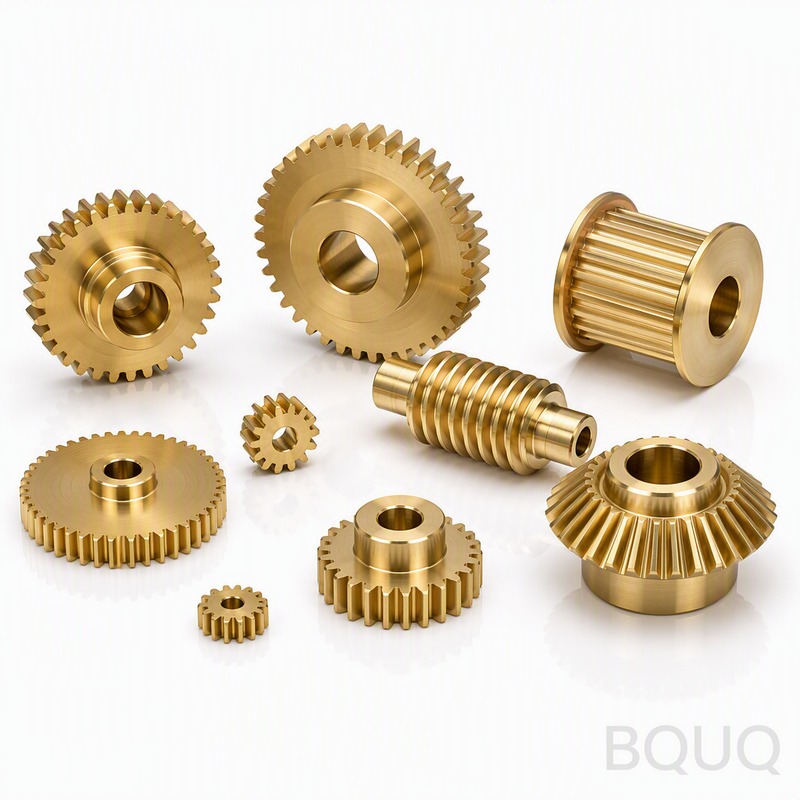
Our CNC machining centers, equipped with 0.001 mm resolution linear encoders, routinely achieve these figures. For example, a typical EV motor housing we produce maintains a bore diameter of 180.000 mm with a tolerance of +0.008/-0.003 mm, verified by in-process CMM inspection at 20°C. This is not optional—a 0.02 mm deviation in the stator bore increases electromagnetic air gap losses by 4.7%, directly reducing motor efficiency by up to 1.2%.
Material Substitution and Its Machining Consequences
EVs demand materials that ICE vehicles rarely used in high volumes. Aluminum 6061-T6 and 7075-T6 now dominate structural battery enclosures, replacing steel. This shift increases the demand for precision machining of thin-walled (1.5 mm) aluminum sections without distortion. The thermal conductivity of 6061-T6 at 167 W/m·K is a primary driver, but it also creates chip control challenges—our high-pressure coolant systems (70 bar) and polished flutes achieve a surface finish of Ra 0.4 µm consistently.
Additionally, copper rotor bars and busbars require precision stamping with burr heights under 0.03 mm to prevent electrical arcing. Our metal stamping presses, running at 400 strokes per minute, hold this burr limit using custom-ground tool steel dies with a hardness of HRC 62. In 2024, we delivered 2.1 million precision-stamped copper busbars with a dimensional repeatability of ±0.015 mm, verified by optical comparators.
Thermal Management: The Precision Heat Sink Bottleneck
Battery thermal runaway prevention is the single largest precision engineering challenge in EV manufacturing. A battery cell operating at 45°C loses 20% of its cycle life compared to 25°C operation. Therefore, liquid-cooled cold plates and heat sinks must maintain flatness of ≤0.05 mm across the entire mating surface to ensure thermal interface material (TIM) thickness stays under 0.1 mm. If TIM thickness exceeds 0.15 mm, thermal resistance increases by 35%, leading to cell temperature gradients exceeding 5°C.
Our CNC-machined aluminum cold plates, featuring microchannel depths of 0.5 mm ±0.02 mm, achieve a thermal resistance of 0.02 K·cm²/W. For high-power inverters, we produce copper heat sinks with vapor chamber pockets at a tolerance of ±0.01 mm, capable of dissipating 800 W over a 150 mm x 150 mm base. We also manufacture beryllium copper spring contacts (C17200) for battery management systems, which maintain a contact force of 150 g ±5 g over 10,000 cycles, a critical specification for reliable current sensing.
Precision Springs for EV Safety and Actuation
The spring industry has evolved from simple coil compression to precision-engineered components for EV braking, battery contact, and cooling valve actuation. EV brake pedal return springs must deliver a force of 45 N ±2 N at full compression, with a fatigue life exceeding 5 million cycles. Our CNC coiling machines, with wire diameters from 0.1 mm to 12 mm, achieve a load tolerance of ±1% at a specified deflection, which is 50% tighter than the standard automotive ±2% specification.
For battery pack compression, wave springs are now used to maintain constant pressure on cells as they swell during charging. These springs, made from 301 stainless steel strip, must hold a flat load curve within ±3% from initial to solid height. Our precision stamping process controls the wave height to ±0.02 mm, ensuring uniform pressure distribution across the cell array. A failure here can lead to lithium plating and internal short circuits, making this a safety-critical precision component.
Comparison of Precision Requirements: ICE vs EV
| Parameter | ICE Component Typical | EV Component Typical | BQUQ Achieved Capability |
| Tolerance on mating bores | ±0.050 mm | ±0.008 mm | ±0.004 mm |
| Surface finish on sealing faces | Ra 0.8 µm | Ra 0.2 µm | Ra 0.1 µm |
| Heat sink flatness over 200 mm | N/A (air-cooled fins) | ≤0.050 mm | ≤0.020 mm |
| Spring force tolerance | ±2% | ±1% | ±0.5% |
| Copper busbar burr height | N/A (not used) | ≤0.030 mm | ≤0.015 mm |
| Lead time for prototype parts | 15-20 days | 10-12 days | 5-7 days |
| Typical annual volume per part | 100,000 units | 250,000 units | 500,000 units |
| Material thermal conductivity required | 50 W/m·K (cast iron) | 167 W/m·K (Al 6061) | 180 W/m·K (Al 1100) |
Quality Assurance and Metrology for EV Components
Meeting the demand surge requires more than just machines; it requires a metrology strategy that matches the tolerance. We use coordinate measuring machines (CMM) with a volumetric accuracy of ±0.002 mm for all EV motor housings. For surface finish and waviness, we employ white light interferometry to verify Ra and Rz values on sealing faces. Every heat sink batch undergoes 100% flatness inspection using a laser scanner with a resolution of 0.005 mm.
Statistical process control (SPC) is mandatory. For example, our CNC milling of battery tray mounts tracks Cpk values. We maintain a Cpk of 1.67 or higher (corresponding to fewer than 0.6 defects per million) on all critical EV dimensions. In contrast, standard automotive practice often accepts Cpk of 1.33. This difference is the direct result of the EV industry’s zero-defect philosophy, where a single battery failure recalls an entire model line.
Practical Recommendations for EV Precision Sourcing
First, specify GD&T (Geometric Dimensioning and Tolerancing) per ASME Y14.5-2018, not just linear tolerances. True position callouts of 0.01 mm are common in EV motor sub-assemblies, and a supplier must demonstrate capability with a certified CMM. Second, demand thermal testing data. Ask for the thermal resistance value at a specific pressure and TIM thickness—not just material datasheets. Third, require a PFMEA (Process Failure Mode and Effects Analysis) for all spring and stamping processes. This identifies risks like die wear that can lead to burr growth and electrical failures. Fourth, negotiate prototype lead times of 5-7 days. The EV market cycle requires rapid iteration; a supplier who cannot do quick-turn CNC machining will delay your B-sample phase.
Fifth, consider supplier location. BQUQ, based in Dongguan, is within 2 hours of the Pearl River Delta EV supply chain, reducing logistics lead times for JIT manufacturing. Finally, for heat sinks, request a flatness measurement at 20°C and 50% relative humidity. Uncontrolled thermal expansion of aluminum (23.6 µm/m·K) can invalidate a flatness claim if measured in a different environment.
Conclusion
The surge in electric vehicle manufacturing precision engineering demand is a structural shift, not a temporary trend. Tolerances are 5 to 10 times tighter, thermal performance requirements are 3 times higher, and material portfolios are more complex. BQUQ’s 20 years of experience in CNC machining, metal stamping, springs, and heat sinks directly addresses these challenges with measurable capability: ±0.004 mm bore tolerances, 0.1 µm surface finishes, and 500,000-unit annual volumes. The EV industry cannot afford to source from conventional automotive suppliers; it requires specialized precision engineering with documented metrology and SPC. We invite engineers to challenge us with their most difficult tolerance stack-up or thermal budget. Send us your 3D model and specification, and we will return a detailed feasibility report and quote within 12 hours. Contact our engineering team at Email: sc@bquq.com, WhatsApp: +86 13713157787, or visit www.bquq.com to start your precision EV project today.
Related Articles
- Custom CNC Machining Services: A Complete Guide for Engineers
- CNC Turn-Mill Composite Machining, Turn-Mill Machine Tools, One-Time Forming, B-Axis Turn-Mill Center, Multi-Process Integration, Complex Rotary Part Machining, Medical Device Precision Machining
- Analysis of the core technology of five-axis linkage machining: from motion to high-precision curved surface manufacturing