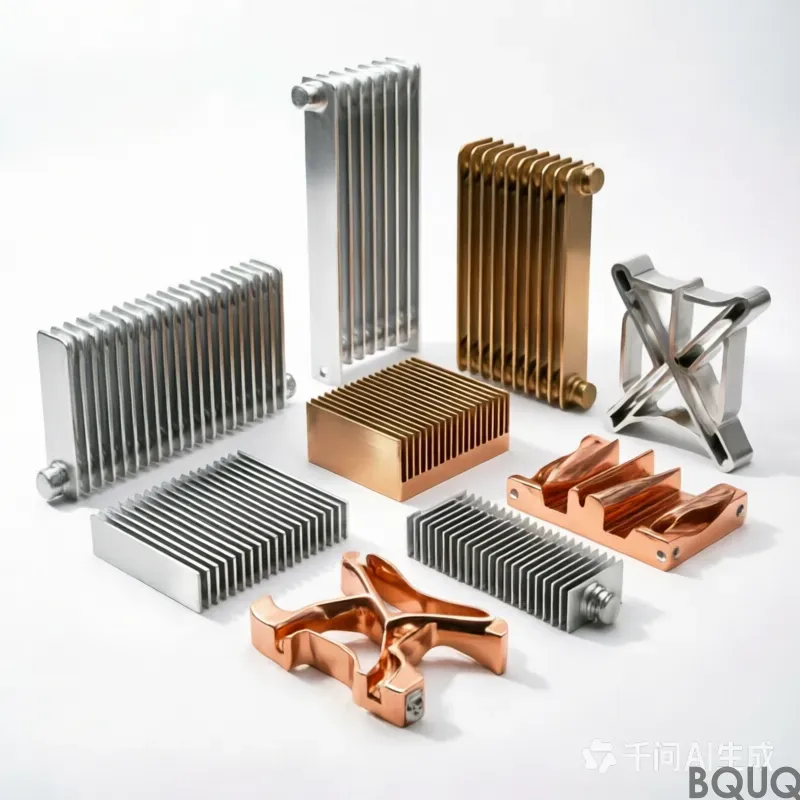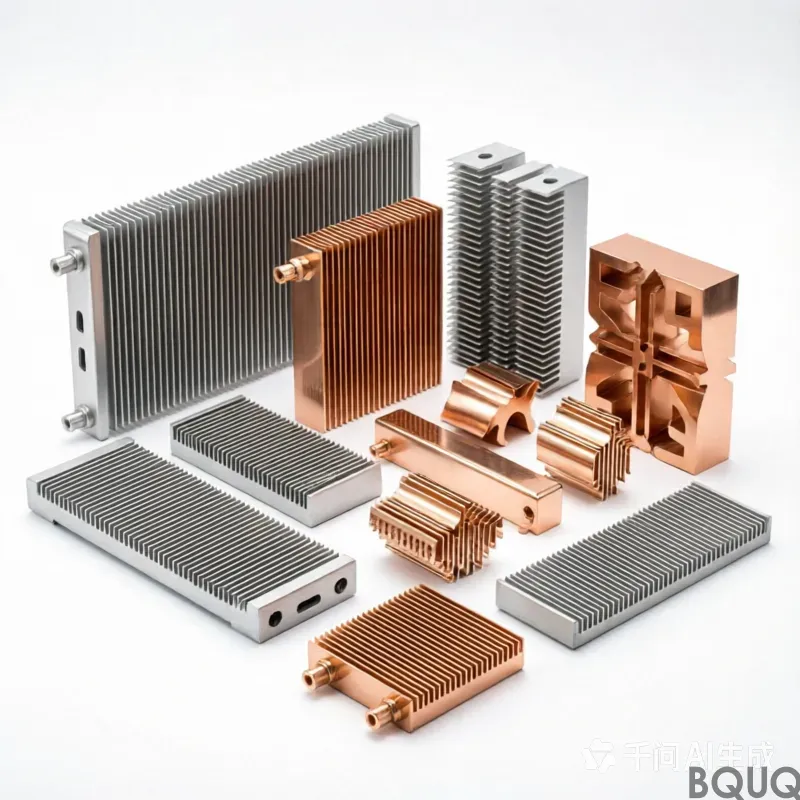
Extruded vs Stamped Heat Sinks: Which Offers Better Performance for the Cost?
For most high-volume applications requiring thermal dissipation below 150 W, stamped heat sinks offer a lower upfront cost (tooling from USD 2,000 to USD 8,000) but are limited to a maximum fin height of 25 mm and a fin thickness of 0.4 mm, whereas extruded heat sinks provide superior thermal performance (thermal conductivity of 180–200 W/m·K) with higher tooling costs (USD 1,500 to USD 5,000) but significantly lower per-unit pricing at scale. The decision hinges on your required fin density, airflow direction, and annual volume: choose stamping for LED lighting or consumer electronics with flat base plates, and choose extrusion for high-power IGBT modules or CPU coolers requiring tall, continuous fins. This article provides a quantified comparison of thermal resistance, material utilization, and total cost of ownership to guide your engineering procurement decision.
How Do Extruded and Stamped Heat Sinks Differ in Manufacturing Process?
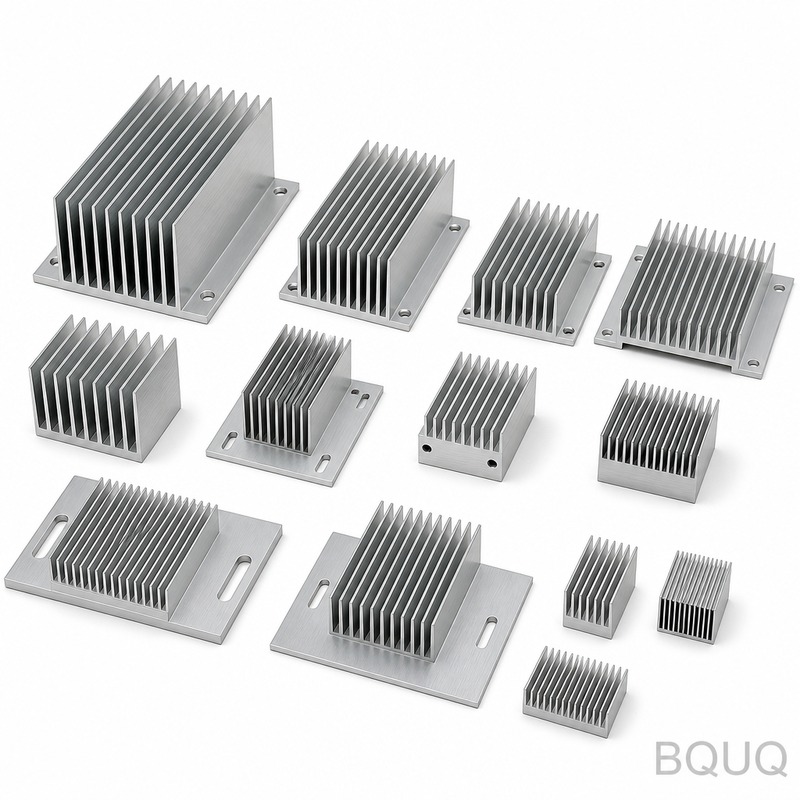
Extrusion involves forcing heated aluminum billet (typically 6063-T5 or 6061-T6) through a steel die under pressures of 15 to 35 MPa. The process yields a continuous profile with fins running the entire length of the part, which is then cut to length. Maximum profile width is limited to 250 mm, and the fin aspect ratio (height-to-gap) is typically 6:1 for standard dies, with a minimum fin thickness of 1.0 mm and minimum gap of 1.5 mm.
Stamping, in contrast, uses progressive dies on mechanical presses (50 to 300 tons) to blank and form sheet aluminum, usually 5052-H32 or 1100-H14, in thicknesses from 0.4 mm to 3.0 mm. The process creates fins by bending or lancing the sheet, which limits fin height to 25 mm and forces a maximum fin aspect ratio of 3:1. Stamped heat sinks are inherently two-dimensional, meaning they require a separate base plate if you need a flat mounting surface, or they must be formed into a folded-fin array.
The key process difference impacts geometry freedom: extrusion allows for complex cross-sections (e.g., dovetail slots, multiple fin blocks), while stamping is limited to planar or single-bend geometries. For a 100 mm by 100 mm footprint, an extruded part can achieve 25 fins, whereas a stamped part can achieve 40 fins but with reduced fin height and lower per-fin thermal efficiency.
What Are the Thermal Performance Limits of Each Technology?
Thermal resistance is the primary performance metric. A standard extruded heat sink (6063-T5, 100 mm x 100 mm x 25 mm base, 20 mm fins) in natural convection at 75 W input will achieve a thermal resistance of 1.8 °C/W to 2.5 °C/W, depending on fin pitch. In forced convection with 3 m/s airflow, resistance drops to 0.8 °C/W to 1.2 °C/W.
A stamped heat sink of the same footprint (0.8 mm thick 5052-H32, 15 mm fins, 5 mm base) in natural convection yields 3.5 °C/W to 5.0 °C/W, which is roughly 40% to 60% worse than extrusion. This degradation occurs because 5052 aluminum has a thermal conductivity of only 138 W/m·K (vs. 200 W/m·K for 6063-T5), and the thin fins (0.4–0.8 mm) suffer from poor heat spreading across the fin height.
For high-power applications above 100 W, extrusion is mandatory. For example, a 200 W IGBT module requires a thermal resistance of 0.5 °C/W or less, which only a 40 mm tall extruded profile with a 6 mm base can achieve. Stamped heat sinks cannot exceed 25 mm fin height, so they are unsuitable for power densities above 0.5 W/cm².
How Much Does Tooling Cost for Extrusion vs Stamping?
Tooling cost is the first decision gate. For extrusion, a standard solid die costs USD 1,200 to USD 2,500, and a hollow die (for complex shapes) costs USD 3,000 to USD 5,000. Die life is 50,000 to 100,000 meters of profile, so tooling amortizes quickly. Set-up and first-article inspection add USD 500 to USD 1,000 per run.
For stamping, a progressive die for a simple flat heat sink costs USD 2,000 to USD 4,000. A complex die with lancing, bending, and coining operations costs USD 6,000 to USD 12,000. Die life is 500,000 to 2,000,000 strokes, but die maintenance (sharpening, re-coating) costs 10% of tooling value per year. You also need a stamping press with a minimum 50-ton capacity, which is usually included in the supplier's overhead but adds to part cost.
At an annual volume of 10,000 units, extrusion tooling amortizes to USD 0.25 per unit, while stamping tooling amortizes to USD 0.60 per unit. At 100,000 units annually, extrusion tooling is USD 0.025 per unit, and stamping is USD 0.06 per unit. Stamping tooling only becomes cost-competitive if you have multiple cavities in one die, but that increases die cost by 2x to 3x.
What Is the Per-Unit Cost Comparison at Different Volumes?
Per-unit cost includes material, labor, finishing, and packaging. For a 100 mm x 100 mm x 25 mm heat sink, the extruded version weighs approximately 350 g (including fins and base), while the stamped version weighs 180 g (0.8 mm sheet with folded fins). At an aluminum price of USD 2.50 per kg, material costs are USD 0.88 (extruded) and USD 0.45 (stamped).
Extrusion labor and overhead add USD 0.15 to USD 0.30 per part (cutting, deburring, anodizing). Stamping adds USD 0.20 to USD 0.40 per part (blanking, forming, deburring, and additional assembly if a base plate is required). Here is the total cost breakdown:
| Volume (units/year) | Extruded Unit Cost (USD) | Stamped Unit Cost (USD) | Extruded Tooling (USD) | Stamped Tooling (USD) |
| 5,000 | 1.35 | 1.65 | 2,000 | 4,000 |
| 20,000 | 1.05 | 1.25 | 2,000 | 4,000 |
| 50,000 | 0.92 | 0.98 | 2,000 | 4,000 |
| 100,000 | 0.85 | 0.85 | 2,000 | 4,000 |
| 250,000 | 0.78 | 0.68 | 2,000 | 4,000 |
At 100,000 units, the cost curves cross. Above 250,000 units, stamping becomes 13% cheaper per unit, but only if the thermal performance requirement is met. Below 50,000 units, extrusion is 6% to 20% cheaper. For volumes under 5,000 units, consider a standard extruded profile from stock to avoid tooling costs entirely.
When Should You Choose a Stamped Heat Sink Over Extrusion?
Choose stamping when your thermal budget is loose (junction-to-ambient below 40 °C/W) and your geometry is flat. Typical applications include LED driver boards (5–15 W), small DC-DC converters, and consumer power adapters. Stamping is also preferred for high volume (above 200,000 units per year) where the lower material weight reduces shipping costs and the thin fins offer 30% more surface area per footprint for low-power natural convection.
Stamping is mandatory when you need a heat sink integrated into a bracket or chassis. For example, a stamped aluminum plate with lanced fins can serve as both structural support and heat spreader, eliminating a separate assembly step. In these cases, the stamped heat sink can be 20% to 30% lighter than an extruded equivalent, reducing total system weight for portable electronics.
However, stamped heat sinks fail in vibration environments above 50 Hz if the fins are longer than 15 mm. The thin fins resonate and crack. If your product undergoes MIL-STD-810G vibration testing, specify a minimum fin thickness of 1.2 mm, which requires a heavier stamping press and increases tooling cost by 30%.
Why Does Extrusion Offer Better Thermal Efficiency per Kilogram?
Extruded 6063-T5 aluminum provides a thermal conductivity of 200 W/m·K, which is 45% higher than stamped 5052-H32 (138 W/m·K). This difference directly impacts fin efficiency. For a 20 mm fin at 1.0 mm thickness, fin efficiency in natural convection is 82% for extrusion and 64% for stamping. In forced convection at 3 m/s, efficiency rises to 91% (extrusion) and 78% (stamping).
Base plate thickness is another factor. Extrusion allows a solid base of 5–10 mm, which spreads heat laterally across the entire footprint. Stamped bases are limited to the sheet thickness (0.8–3.0 mm), causing a hot spot directly under the heat source. For a 25 W LED array on a 100 mm x 100 mm base, the temperature gradient across the base is 8 °C for extrusion (6 mm base) and 22 °C for stamping (1.5 mm base). This 14 °C difference can reduce LED lifespan by 30% due to accelerated L70 lumen depreciation.
If you require thermal resistance below 1.0 °C/W, extrusion is the only viable option without adding heat pipes or vapor chambers. The maximum heat flux for a stamped heat sink in forced convection is 2.5 W/cm², while extrusion can handle 6.0 W/cm². For natural convection, the limits are 0.8 W/cm² (stamped) and 1.5 W/cm² (extruded).
Which Finishing and Post-Processing Options Are Available for Each?
Both technologies can be anodized (Type II or Type III) to increase emissivity from 0.05 to 0.85 and provide corrosion resistance. However, stamped parts with thickness below 0.6 mm may warp during anodizing due to residual stress from forming. To avoid distortion, use Type II anodizing (5–10 µm) at 18 °C, not Type III hard anodizing (25–50 µm) which requires 0 °C and causes more stress.
Extruded profiles can be cut, milled, drilled, and tapped. You can machine mounting bosses, threaded inserts, or a stepped base for component placement. Stamped parts are limited to post-stamping operations like roll forming, punching of mounting holes, and spot welding. You cannot easily machine a stamped heat sink because the thin fins lack structural rigidity.
Surface area enhancement is also different. Extrusion allows for pin-fin or skew-fin designs with secondary operations, but these add cost (USD 0.50 to USD 1.00 per part). Stamping can create louvered fins (slits in the fin) which increase surface area by 15% without additional machining, but louvers reduce fin strength and are only recommended for fins above 1.0 mm thickness.
For corrosion protection in outdoor applications, both require a chromate conversion coating (USD 0.10 per part) or powder coating (USD 0.30 per part). Powder coating is not recommended for stamped thin fins because the curing temperature (200 °C for 20 minutes) can anneal the aluminum and reduce its yield strength from 200 MPa to 100 MPa.
How Do Lead Times Compare for Prototypes and Production Runs?
Extruded prototypes can be produced in 3–5 business days if you use a stock profile and machine it to length. A custom extrusion die adds 2–3 weeks for die manufacturing and first-article inspection. Production runs of 10,000 units take 5–7 business days after die approval, with a typical extrusion speed of 10–20 meters per minute allowing 2,000 parts per day.
Stamped prototypes can be made in 2–3 days using a soft tool (machined aluminum die) for up to 500 parts. A hard tool (tool steel progressive die) takes 4–6 weeks to build and try out. Production runs of 10,000 units take 3–5 business days, with stamping speeds of 60–200 strokes per minute yielding 5,000 parts per day per press.
For urgent requirements, stamped heat sinks are faster for prototypes (2 days vs. 5 days), but extrusion is faster for production scale-up because no additional die maintenance is needed. If you need 100 units in one week, both technologies can deliver, but stamping requires a minimum order of 500 parts to amortize the soft tool. Extrusion suppliers can often ship 100 machined pieces from stock profile within 5 days at a 20% premium over bulk pricing.
How Should You Select Between Extrusion and Stamping for Your Application?
First, calculate your maximum junction temperature and allowable thermal resistance. If the required resistance is below 1.5 °C/W, select extrusion regardless of volume. Second, determine your annual quantity. If below 50,000 units, extrusion is almost always cheaper per unit. Third, assess your weight budget. If you need to save weight and your power is below 20 W, stamping with 0.5 mm sheet can reduce mass by 40% compared to a 5 mm extruded base.
Fourth, consider assembly integration. If your heat sink must also act as a structural bracket, stamping is preferable. Fifth, evaluate your vibration environment. Above 30 Hz with 1 g acceleration, choose extrusion or reinforce stamped fins with a stiffening rib. Finally, confirm your supplier's capabilities: not all factories offer both processes. BQUQ has 20 years of experience in both extruded and stamped heat sink manufacturing, with in-house tooling shops for rapid die modifications.
A practical selection matrix: For power above 100 W, use extrusion. For power 20–100 W and volume above 100,000 units, run a cost-benefit analysis using the table above. For power below 20 W and volume above 200,000 units, use stamping. For any application requiring a flat base over 5 mm thick, extrusion is the only option. For any application requiring fins shorter than 10 mm with dense pitch (below 1.5 mm gap), stamping is the only option.
FAQ
What Is the Maximum Fin Height for a Stamped Heat Sink?
The maximum fin height for a stamped heat sink is 25 mm, but this requires 3.0 mm thick aluminum sheet and a specialized lancing die. For standard 0.8 mm sheet, the practical limit is 15 mm. Exceeding this height causes fin tearing or excessive springback, which degrades thermal contact with the base.
Can Stamped Heat Sinks Be Used for High-Power LED Applications?
Stamped heat sinks are suitable for LED applications up to 15 W per module. Above this power, the thin base plate creates a hot spot that accelerates LED degradation. For 20–50 W LED modules, use an extruded heat sink with a 5 mm base or combine a stamped fin array with a copper base plate (added cost of USD 1.50 per part).
What Is the Thermal Conductivity Difference Between 6063-T5 and 5052-H32?
6063-T5 extruded aluminum has a thermal conductivity of 200 W/m·K, while 5052-H32 stamped sheet has only 138 W/m·K. This 45% difference means that for the same fin geometry, an extruded heat sink has 30% lower thermal resistance. If you need the highest thermal performance, specify 6063-T5 extrusion or switch to copper (385 W/m·K) for stamping, though copper costs 4x more per kilogram.
How Long Does a Stamping Die Last Compared to an Extrusion Die?
A stamping die lasts 500,000 to 2,000,000 strokes before requiring major refurbishment, while an extrusion die lasts for 50,000 to 100,000 meters of profile (approximately 250,000 to 500,000 parts at 200 mm length). Stamping dies require more frequent maintenance (every 100,000 strokes) due to wear on cutting edges and bending sections.
Which Heat Sink Type Is Better for Natural Convection Cooling?
Extrusion is better for natural convection due to thicker fins and a solid base. At 10 W input, an extruded heat sink (60 mm x 60 mm x 20 mm) achieves a temperature rise of 25 °C, while a stamped heat sink of the same footprint achieves 40 °C. The thicker extruded fins radiate heat more efficiently, and the solid base spreads heat uniformly across all fins.
Can Stamped Heat Sinks Be Anodized Without Warping?
Yes, but only with Type II anodizing at a coating thickness of 5–10 µm and a bath temperature of 18 °C. For stamped fins below 0.6 mm thickness, you must also stress-relieve the parts at 150 °C for 2 hours before anodizing. Hard anodizing (Type III) is not recommended for stamped parts because the low temperature process induces residual stress that causes curling.
What Is the Minimum Order Quantity for Custom Extruded Heat Sinks?
Most extrusion suppliers require a minimum of 500 kg per profile, which equals approximately 1,500 units of a 100 mm x 100 mm x 25 mm heat sink. Below this quantity, you will pay a small-run surcharge of 20–30%. BQUQ offers a low minimum order of 200 kg for standard profiles and 500 kg for custom dies, with a 12-hour quotation turnaround.
For your next thermal management project, send your CAD file and target thermal resistance to BQUQ for a free engineering review and quotation. Our team of 20-year veterans will recommend the optimal manufacturing process based on your volume, performance, and budget. Request your quote within 12 hours: Email sc@bquq.com, WhatsApp +86 13713157787, or visit www.bquq.com.