Extrusion Heat Sink Profile Design: Standard Shapes and Custom Options for Optimal Thermal Management
For 90% of forced-air and natural convection applications, standard extrusion heat sink profiles—such as flat-back, single-fin, and dual-channel designs—deliver adequate thermal performance at the lowest tooling cost. Custom extrusion profiles become necessary only when space constraints, airflow direction, or high-density fin requirements exceed the geometric limits of standard dies, typically above 250 W/cm² heat flux or when envelope dimensions are non-standard. The decision hinges on balancing die costs (USD 800 to USD 3,500), minimum order quantities (500 kg), and achievable tolerances (±0.1 mm on critical dimensions) against thermal resistance targets.
Standard Extrusion Heat Sink Shapes and Their Thermal Limits
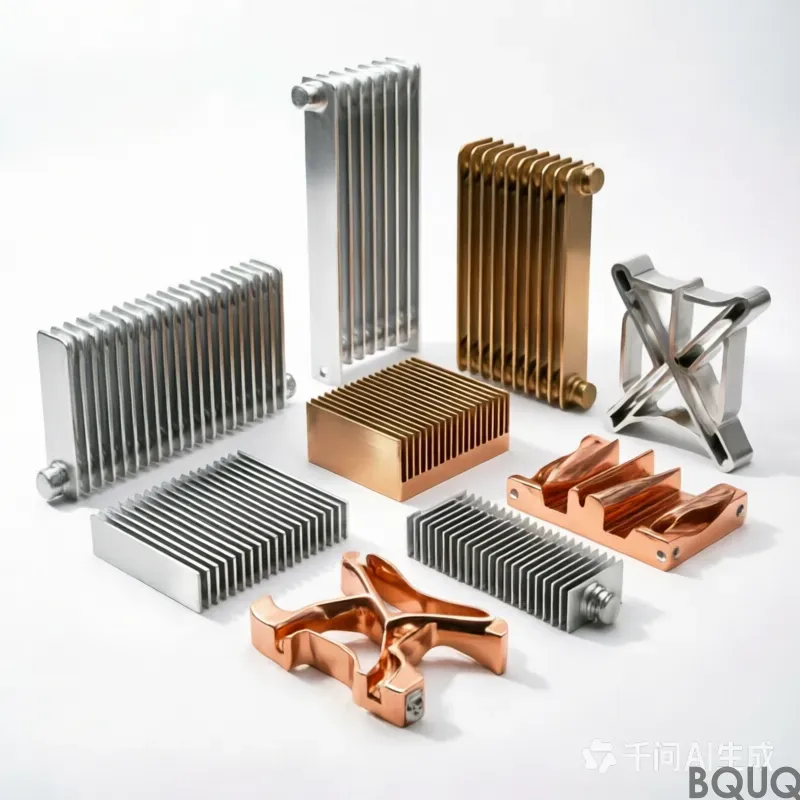
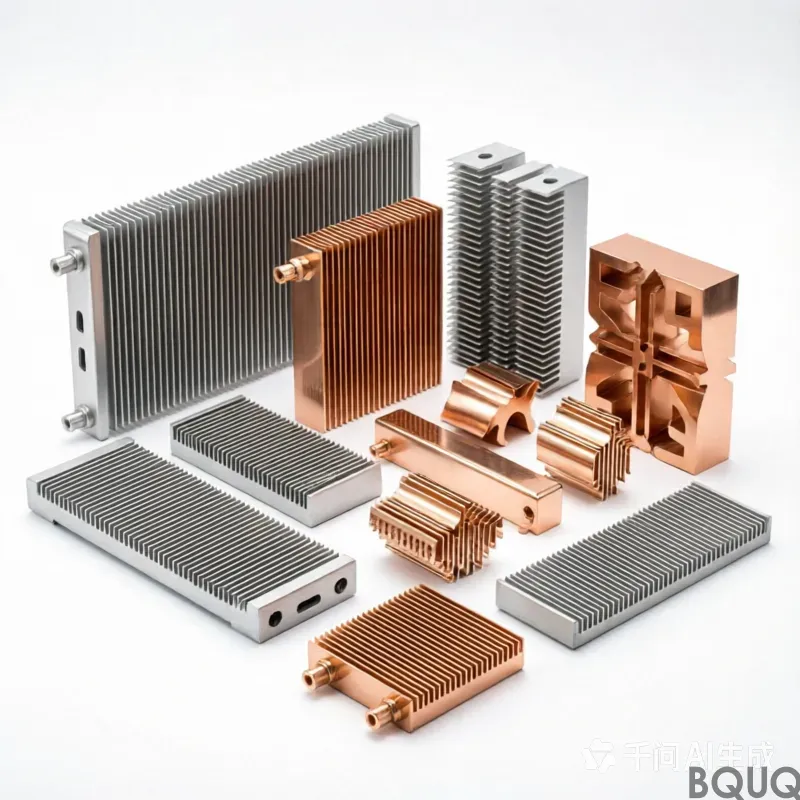
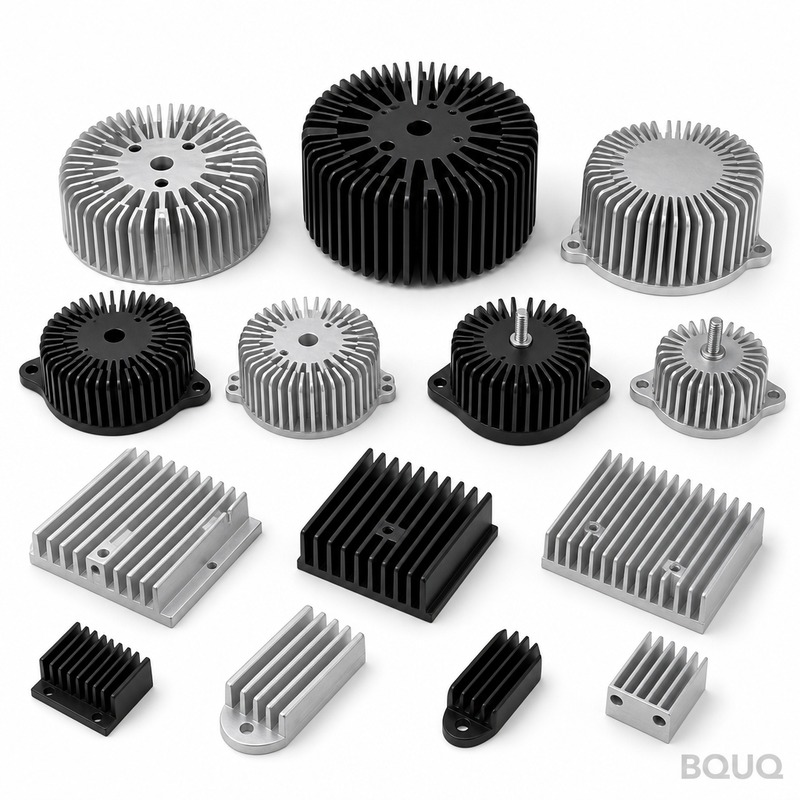
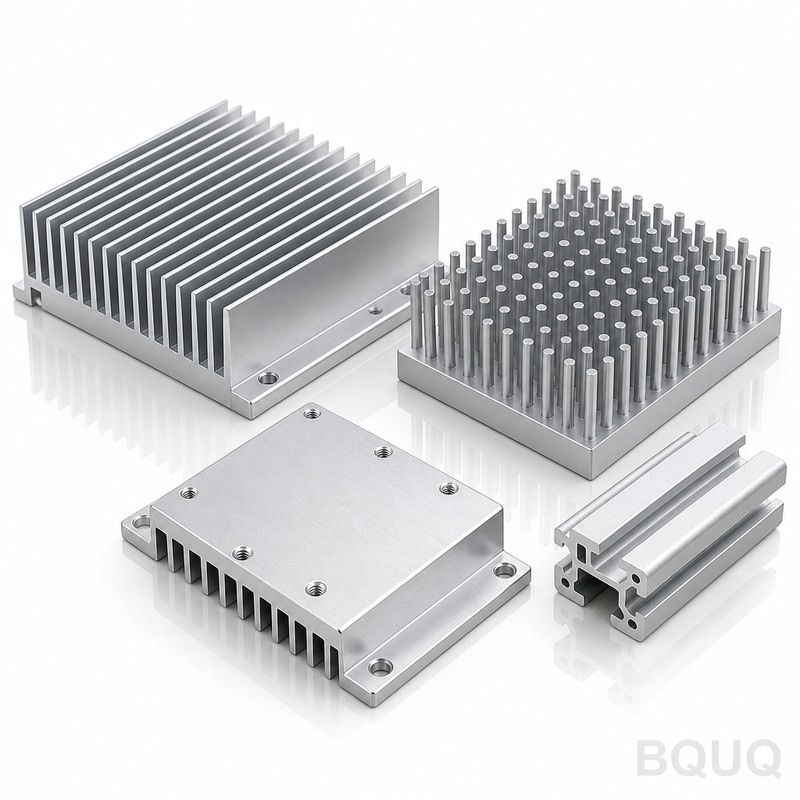
Standard profiles are defined by common die geometries that have been optimized over decades of aluminum extrusion practice. The most widely used shapes include:
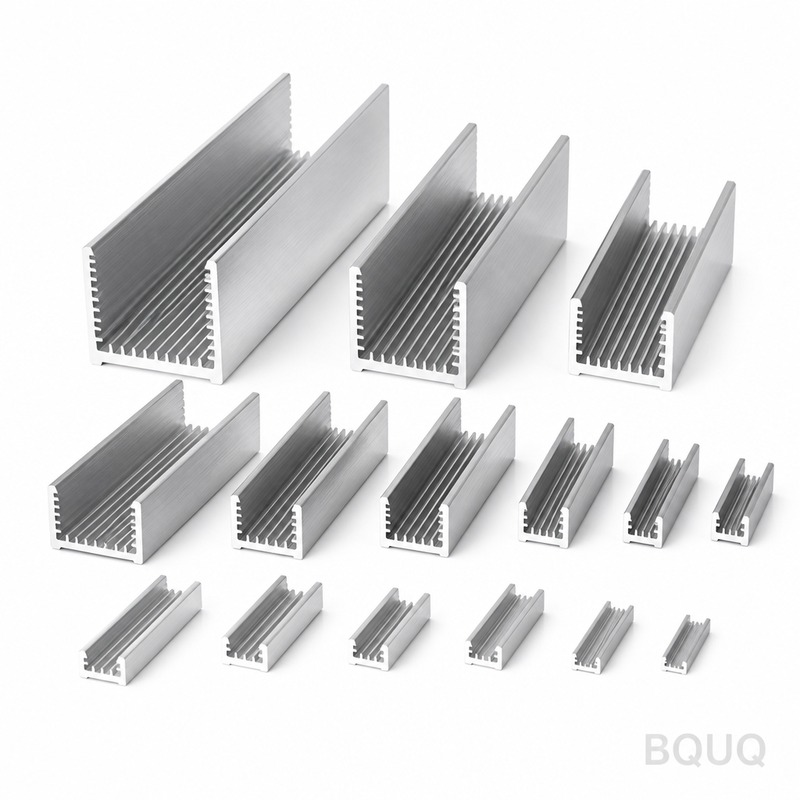
- Flat-back single fin: A flat base with parallel vertical fins, best for downward airflow or component mounting on one side. Fin height-to-gap ratio typically ranges from 4:1 to 8:1. Thermal resistance for a 100 mm long, 40 mm wide profile with 10 fins is approximately 0.85 °C/W at 2 m/s airflow. - Flat-back dual channel: Two fin arrays separated by a central gap, used for dual-component cooling or to reduce pressure drop. The central channel allows airflow to bypass the fin tips, improving performance in low-static-pressure fans. - T-slot and groove profiles: Designed for mounting clips or PCBs directly onto the heat sink, these add mechanical functionality without compromising thermal paths. - Radial and pin-fin profiles: These are technically extruded but require post-machining to create pins. True pin-fin arrays are not achievable in a single extrusion pass; they require skiving or CNC drilling, increasing cost by 30% to 50% over standard extrusions.
Typical extrusion ratios (billet area to profile area) for standard shapes range from 10:1 to 30:1. Higher ratios yield thinner fins but increase die wear and dimensional variability. A standard 6063-T5 aluminum profile with 1.5 mm fin thickness and 3.0 mm gap achieves a fin efficiency of 92% at a 25 mm fin height.
Custom Extrusion Heat Sink Profiles: When and Why
Custom profiles are justified when your application violates at least one of three constraints: envelope dimensions (height or width), fin geometry (thickness below 1.2 mm or height above 80 mm), or mounting features (non-standard holes, clips, or standoffs). For example, a 1U server chassis limits heat sink height to 14.5 mm. A standard profile with 12 mm fin height and 2 mm base will not fit; a custom profile with 10 mm fin height and 3 mm base can be extruded with a specific die.
Custom tooling costs in 2025 at Dongguan factories range from USD 1,200 for a simple flat-back die to USD 3,500 for a complex multi-void die with undercuts. Lead time for custom dies is 10 to 15 working days, compared to 24 to 48 hours for standard stock profiles. The minimum order for a custom profile is typically 500 kg (about 1,500 meters for a 100 g/m profile). At a typical extrusion price of USD 3.2 to USD 4.5 per kg for 6063-T5, this translates to a minimum investment of USD 1,600 in material alone, excluding die cost and finishing.
Material Grades and Thermal Conductivity Impact
The choice of aluminum alloy directly affects thermal resistance and cost. While 6063-T5 is the default for most heat sinks due to its good extrudability and moderate conductivity, 6061-T6 offers higher strength but 10% lower thermal conductivity. For maximum thermal performance, 1050A or 1350 alloys provide conductivities of 222 W/m·K and 234 W/m·K respectively, but they are softer and more expensive to extrude, increasing die wear by 20% and reducing achievable tolerance to ±0.2 mm.
| Alloy | Thermal Conductivity (W/m·K) | Yield Strength (MPa) | Relative Extrusion Cost | Typical Application |
| 6063-T5 | 201 | 145 | 1.0x | Standard heat sinks, enclosures |
| 6061-T6 | 167 | 276 | 1.15x | Structural heat sinks with vibration |
| 1050A | 222 | 85 | 1.35x | High-performance CPU coolers |
| 1350 | 234 | 55 | 1.5x | Power electronics, IGBT modules |
| 6060-T5 | 193 | 140 | 1.05x | Anodized decorative profiles |
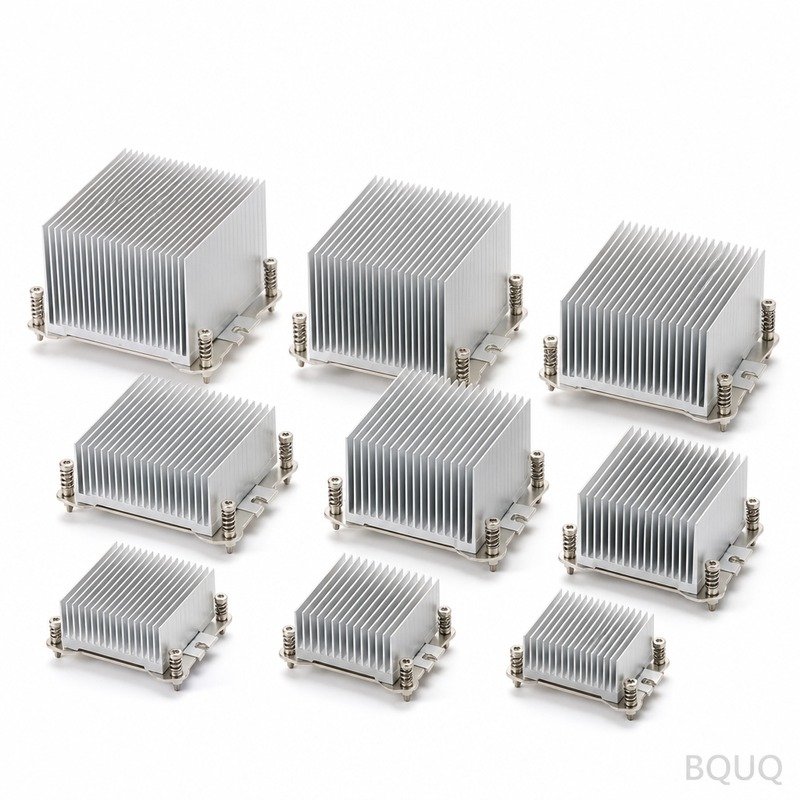
For a 50 mm x 50 mm x 30 mm heat sink with a 25 W heat load and 40 °C ambient, switching from 6063-T5 to 1350 reduces the thermal resistance from 0.72 °C/W to 0.58 °C/W (a 19% improvement), but increases the unit cost from USD 1.85 to USD 2.70 at 1,000-piece quantities.
Tolerance Capabilities and Dimensional Control
Extrusion tolerances follow the EN 755-9 standard, with specific classes for heat sink profiles. For critical dimensions such as fin thickness and base thickness, achievable tolerances are:
- Fin thickness (1.0 mm to 3.0 mm): ±0.15 mm for standard dies, ±0.10 mm with custom calibration - Fin height: ±0.20 mm per 25 mm of height - Base thickness: ±0.10 mm for profiles under 100 mm wide - Twist and straightness: 1.0 mm per meter, reducible to 0.5 mm with stretching - Cut length tolerance: ±0.50 mm for saw cuts, ±0.20 mm for CNC-machined ends
For thermal interface surfaces (where the component mounts), a flatness of 0.05 mm per 100 mm is achievable with a post-extrusion machining step (fly-cutting or grinding). This operation adds USD 0.15 to USD 0.30 per piece for typical sizes. Without machining, the as-extruded flatness is 0.20 mm, which requires a thicker thermal interface material (TIM) and increases thermal resistance by 10% to 15%.
Surface Finishing and Its Effect on Thermal Performance
Anodizing is the most common finish for extrusion heat sinks, offering corrosion protection and electrical insulation. A standard black anodize (20 to 25 microns) increases the emissivity from 0.1 (bare aluminum) to 0.85, improving radiation heat transfer by up to 30% in natural convection applications. However, anodizing adds a cost of USD 1.2 to USD 2.5 per square meter of surface area and extends lead time by 3 to 5 working days.
For forced-air cooling, the anodized layer's thermal resistance is negligible (less than 0.01 °C/W), but it does reduce the fin gap by 0.04 to 0.05 mm total (both sides), which can affect airflow in tight-pitch designs. If your fin gap is 2.0 mm or less, specify the anodize thickness as 10 microns or use a clear conversion coating (chromate or trivalent) at USD 0.5 per square meter instead.
Cost Breakdown: Standard vs Custom Profiles
At BQUQ, we quote custom extrusion heat sinks with a transparent breakdown. For a typical custom profile (100 mm length, 60 mm width, 35 mm height, 12 fins at 1.5 mm thickness), the cost structure at 2,000 pieces is:
| Cost Component | Standard Profile | Custom Profile with Die |
| Die cost (amortized per piece) | USD 0.00 | USD 0.60 |
| Extrusion material (0.45 kg at USD 3.8/kg) | USD 1.71 | USD 1.71 |
| Cutting and deburring | USD 0.08 | USD 0.08 |
| CNC machining (mounting holes, base flattening) | USD 0.35 | USD 0.45 |
| Black anodize | USD 0.22 | USD 0.22 |
| Packaging and logistics | USD 0.10 | USD 0.12 |
| Total unit cost | USD 2.46 | USD 3.18 |
The 29% premium for a custom profile is justified only if it eliminates a separate bracket, reduces assembly time, or improves thermal performance beyond what a standard profile can achieve. For production volumes above 5,000 pieces per year, the die cost amortization drops below USD 0.24 per piece, making custom profiles increasingly attractive.
Practical Recommendations for Profile Selection
Start by modeling your thermal load and airflow. If the required thermal resistance is above 0.8 °C/W, a standard flat-back profile will likely suffice. If you need below 0.5 °C/W, consider a custom profile with higher fins and tighter gaps. Always verify the fin height-to-gap ratio: exceeding 10:1 causes the boundary layers to merge, reducing heat transfer efficiency by 15% to 20%. For natural convection, keep the fin spacing above 6 mm to avoid air stagnation.
For vibration-prone applications (automotive, aerospace), specify 6061-T6 and design the base thickness at least 30% of the fin height to prevent resonance. For high-voltage applications (over 1 kV), request a 25-micron anodize to meet creepage distance requirements. For lead-free solder reflow, ensure the profile is free of silicone-based lubricants from the extrusion process; BQUQ uses water-soluble lubricants that are fully removed during degreasing.
FAQ-Style Tips for Engineers
- What is the minimum fin thickness for extrusion? For 6063-T5, 1.0 mm is the safe minimum. Below this, the fin tip may tear or the die may crack. For 6061-T6, the minimum increases to 1.5 mm due to higher flow stress. - Can I get a heat sink with a base thicker than 15 mm? Yes, but the extrusion pressure rises significantly, increasing die cost by 20% and lead time by 5 days. Consider a standard profile with a separate cold-forged or machined base plate instead. - What is the maximum length of an extruded heat sink? Continuous extrusion can produce 6-meter lengths, but shipping and handling limits most orders to 3 meters. For lengths above 1 meter, specify straightness as 0.5 mm/m to avoid bowing during anodizing. - How fast can I get standard profiles? BQUU stocks over 40 standard profiles in 6063-T5. We can cut, machine, and anodize within 5 working days for quantities up to 500 pieces. For immediate samples, we ship 200 mm cut lengths within 48 hours.
Conclusion
Standard extrusion heat sink profiles solve most thermal problems at the lowest cost and shortest lead time. Custom profiles become economically viable when your geometric or thermal requirements exceed standard limits, and the die cost can be amortized over a sufficient production volume. At BQUQ, with 20 years of CNC machining and metal stamping experience, we recommend starting with a standard profile for prototyping, then transitioning to a custom die only after validating thermal performance in your actual airflow conditions.
For an engineering review of your heat sink requirements, send us your 2D or 3D CAD file and thermal specifications. Our team will respond with a thermal simulation, a standard profile recommendation, and a custom die quote within 12 hours. For pricing and delivery, contact us at Email: sc@bquq.com, WhatsApp: +86 13713157787, or visit www.bquq.com.