How to Calculate Spring Load: Compression, Tension and Deflection
The load a spring exerts is determined by multiplying its spring rate (k) by the deflection distance (x), expressed as F = k × x, where F is force in Newtons or pounds-force. For compression and tension springs, this linear relationship holds within the elastic limit, meaning the spring rate is constant per unit of travel. To calculate the load at a specific working height, measure the free length, subtract the loaded length to find deflection, and multiply that deflection by the spring rate provided by the manufacturer or derived from the material and geometry.
What Is the Basic Formula for Spring Load Calculation?
The fundamental equation for calculating spring load is Hooke’s Law: F = k × x, where F is the applied load, k is the spring rate (stiffness), and x is the deflection from the free length. For a compression spring, if the free length is 50 mm and the spring rate is 10 N/mm, compressing it to 40 mm produces a load of (50 - 40) × 10 = 100 N. For a tension spring, the same formula applies, but you must account for the initial tension built into the coil, meaning the formula becomes F = k × x + F₀, where F₀ is the initial preload force that must be overcome before deflection begins.
How Do You Calculate Deflection for Compression Springs?
Deflection is the change in length from the spring’s free state to its loaded state, calculated as x = L₀ - L₁, where L₀ is the free length and L₁ is the loaded length. For a compression spring with a free length of 75 mm and a spring rate of 5 N/mm, deflecting it to 55 mm yields x = 20 mm and a load of 100 N. Ensure the deflection does not exceed 85% of the maximum travel, because coil binding occurs when adjacent coils touch, causing the spring rate to spike non-linearly and potentially leading to premature fatigue failure. The maximum safe deflection for music wire springs (ASTM A228) is typically 80-85% of the solid height, while stainless steel (ASTM A313) can tolerate up to 90%.
How Do You Determine Load for Tension Springs with Initial Tension?
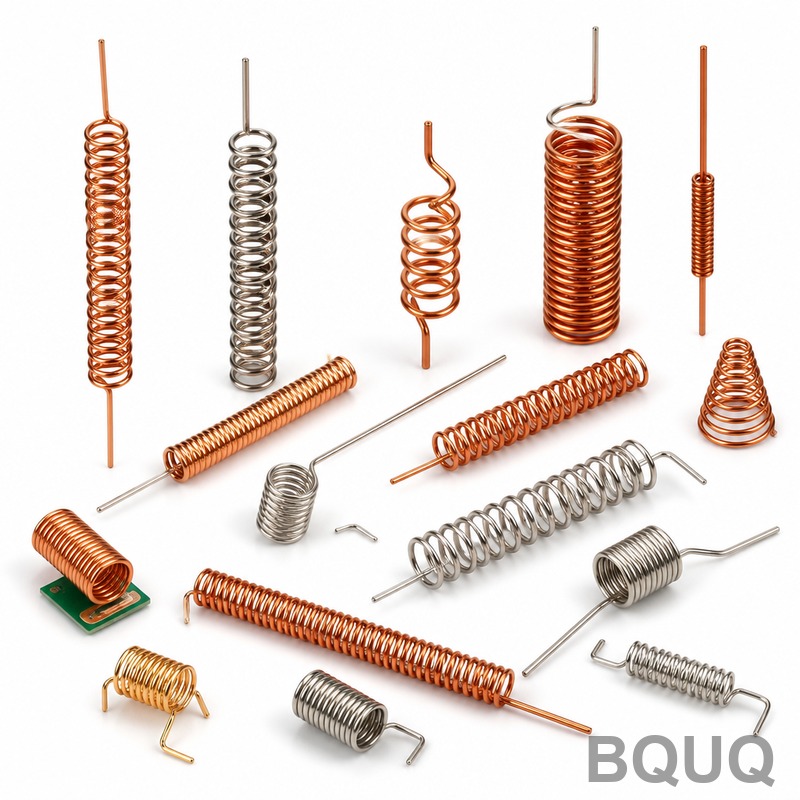
Tension springs are manufactured with coils closed together, creating an initial tension (F₀) that must be overcome before the spring extends. The load calculation is F = k × x + F₀, where x is the extension beyond the free length. For example, a tension spring with a rate of 3 N/mm, initial tension of 15 N, and an extension of 30 mm yields F = (3 × 30) + 15 = 105 N. Initial tension typically ranges from 10% to 25% of the maximum load for round wire springs, and it varies based on the spring index (D/d), where D is mean coil diameter and d is wire diameter. A spring index below 4 creates excessive initial tension variability, so design for a spring index between 4 and 12 for consistent results.
Which Material Properties Affect Spring Load Calculations?
The material’s shear modulus (G) directly determines the spring rate, calculated as k = (G × d⁴) / (8 × D³ × Nₐ), where d is wire diameter, D is mean coil diameter, and Nₐ is the number of active coils. Music wire (ASTM A228) has a shear modulus of 79.3 GPa, stainless steel 302 (ASTM A313) has 71.7 GPa, and chrome silicon (ASTM A401) has 79.3 GPa with higher fatigue resistance. Temperature also shifts the modulus: for every 100°C above room temperature, stainless steel loses approximately 5% of its shear modulus, while music wire becomes unusable above 120°C due to stress relaxation. If you operate at 150°C, reduce the calculated load by roughly 8% for stainless steel and 15% for music wire to avoid premature sag.
How Do You Calculate Spring Rate from Physical Dimensions?
The spring rate formula k = (G × d⁴) / (8 × D³ × Nₐ) requires precise dimensional inputs, where tolerances directly affect the result. A wire diameter tolerance of ±0.01 mm on a 1.0 mm wire changes the rate by the fourth power, meaning a 1% variation in d causes a 4.1% variation in k. For a compression spring with G = 79.3 GPa, d = 2.0 mm, D = 12 mm, and Nₐ = 6, the rate is k = (79,300 × 16) / (8 × 1728 × 6) = 1,268,800 / 82,944 = 15.3 N/mm. Always specify the spring rate tolerance as ±5% for standard manufacturing, or ±2% if you are willing to pay for grinding and custom tooling, which adds approximately 15-20% to the piece price.
Why Does Deflection Limit Matter for Spring Load Accuracy?
Exceeding the elastic limit causes permanent set, meaning the spring no longer returns to its free length, rendering all load calculations invalid. The maximum safe stress for a spring is typically 45-50% of the tensile strength for static applications, and 30-35% for dynamic applications with more than 10,000 cycles. For example, a music wire spring with 2,000 MPa tensile strength should not exceed 900 MPa in static service; at that stress, the maximum deflection is calculated using the Wahl factor to correct for curvature stress concentration. If the calculated load at full deflection produces stress above 50% of tensile strength, increase the wire diameter or reduce the number of active coils to redistribute stress.
How Do You Validate Spring Load Calculations with Physical Testing?
After calculating the theoretical load, verify with a spring testing machine that measures force at specified heights, typically at 25%, 50%, and 75% of total travel. The measured load should fall within ±5% of the calculated value for standard springs, and ±2% for precision springs used in automotive fuel injectors or medical devices. For production validation, test a sample of 5 pieces from each lot of 1,000, recording the load at the working height; if any sample exceeds the tolerance, reject the entire lot and inspect the wire diameter and coil spacing. Always measure at the operating temperature, because a spring rated at 20°C will show a 3-5% lower load at 80°C due to modulus reduction.
What Is the Cost Impact of Tight Load Tolerances?
Tighter load tolerances increase manufacturing cost because they require precision wire grinding, additional testing, and slower production speeds. The table below shows typical pricing and lead times for custom compression springs at BQUQ, based on a 10,000-piece order with wire diameter between 0.5 mm and 5.0 mm.
| Tolerance Class | Load Tolerance | Price per Piece (USD) | Tooling Cost (USD) | Lead Time (Days) |
| Standard | ±10% | 0.08 - 0.25 | 300 - 800 | 7 - 10 |
| Precision | ±5% | 0.15 - 0.40 | 800 - 1,500 | 10 - 14 |
| Ultra-Precision | ±2% | 0.30 - 0.70 | 1,500 - 3,000 | 14 - 21 |
For a 50 mm free length compression spring with 15 N/mm rate, a ±10% tolerance means the load at 20 mm deflection ranges from 270 N to 330 N, while ±2% narrows it to 294 N to 306 N. Choose precision tolerance only when the application requires it, such as valve springs or safety mechanisms, because the cost increase is 50-100% over standard.
FAQ Section
What Is Initial Tension in a Tension Spring?
Initial tension is the force holding the coils together at free length, typically 10-25% of the maximum load. It is created during coiling by winding the wire with a specific pitch angle, and it must be overcome before the spring extends. Calculate total load by adding initial tension to the product of spring rate and extension.
How Does Temperature Affect Spring Load Calculations?
Rising temperature reduces the shear modulus of spring materials, lowering the spring rate and the load at a given deflection. Music wire loses about 2% of its modulus per 50°C above room temperature, while stainless steel loses about 2.5% per 50°C. For high-temperature applications above 200°C, use Inconel X-750, which retains 90% of its modulus at 400°C.
Can I Calculate Spring Load for a Non-Linear Spring?
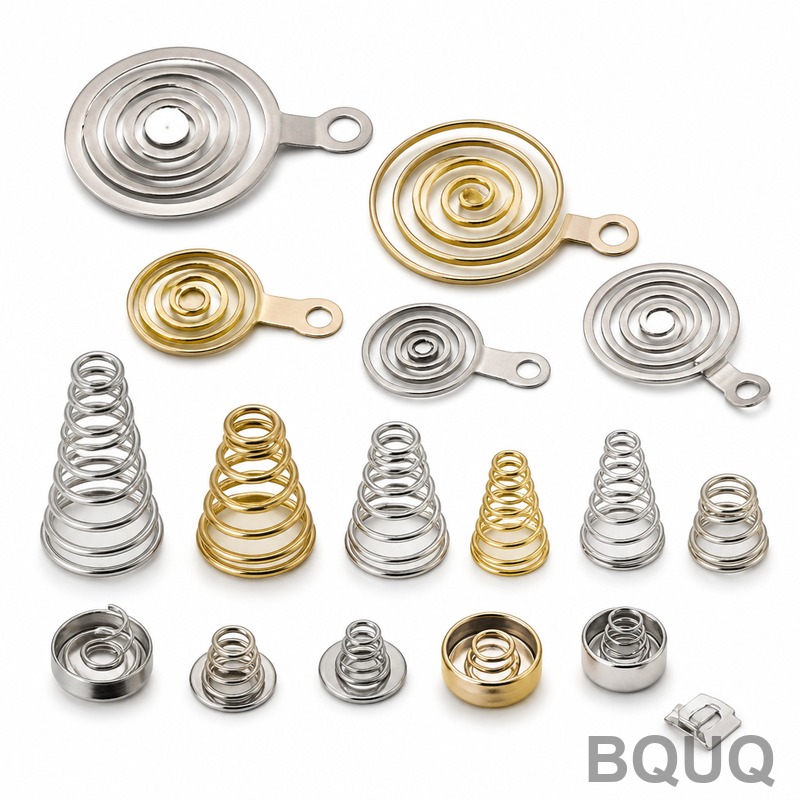
Non-linear springs, such as conical or variable-pitch designs, require piecewise calculation because the spring rate changes with deflection. You must measure the load at multiple heights using a test fixture, then plot a load-deflection curve for accurate values. BQUQ provides free load-deflection curves for any custom spring design within 48 hours.
Which Spring Rate Should I Specify for My Application?
Specify the rate based on the required load at the working height and the available space for deflection. For example, if you need 200 N at 25 mm deflection, the rate is 8 N/mm. Always include a tolerance of ±5% to balance cost and performance, and verify the maximum stress does not exceed 45% of the material tensile strength.
When Do I Need to Consider Spring Surge in Load Calculations?
Spring surge occurs in dynamic applications when the operating frequency approaches the spring’s natural frequency, causing resonance and load spikes. Calculate the natural frequency as f = (d / (π × D² × Nₐ)) × √(G / (2 × ρ)), where ρ is material density; for steel, this is approximately 7,850 kg/m³. If the operating frequency exceeds 70% of the natural frequency, redesign with a larger wire diameter or add damping to prevent failure.
Conclusion
Calculating spring load is a straightforward process using F = k × x for compression and F = k × x + F₀ for tension, but accuracy depends on precise dimensions, material modulus, and deflection limits. Always verify calculations with physical testing and specify tolerances that match your application’s functional requirements, not theoretical ideals. For production-grade springs with guaranteed load accuracy, BQUQ offers 20 years of CNC machining and spring manufacturing experience, with 12-hour quoting on custom designs. Email your drawings to sc@bquq.com or contact us on WhatsApp at +86 13713157787 for a free engineering review, and visit www.bquq.com for more technical resources.
Related Articles
- Where to Buy Custom Metal Springs Online: Top 7 Suppliers
- Size control and online intelligent detection technology of precision spring
- In-depth analysis of technology and process in the hardware spring industry in 2026: a full-dimensional interpretation of high stress, functional integration and engineering certification