How to Design Heat Sinks for Forced Air Cooling: Fan and Duct Selection?
Forced air cooling is the most effective and economical method for dissipating heat from high-power electronics, but its success depends entirely on the heat sink geometry, fan performance, and duct design working as a single integrated system. The direct answer to the design challenge is to match the fan’s operating point to the heat sink’s pressure drop curve, ensuring the airflow (CFM) at the system’s static pressure provides the required thermal resistance (C/W) for your component’s junction temperature. This article provides the engineering formulas, real-world data, and selection criteria you need to design a reliable forced-air cooling solution, based on BQUQ’s 20 years of CNC machining and thermal management experience in Dongguan.
What Is the First Step in Calculating Required Airflow for a Heat Sink?
The design process begins with a thermal budget calculation, not with choosing a fan. You must first determine the maximum allowable thermal resistance of your entire cooling system using the formula: Rth(total) = (Tj_max – Ta_max) / P, where Tj_max is the maximum junction temperature (typically 125°C for silicon), Ta_max is the maximum ambient temperature (often 40°C to 50°C in enclosures), and P is the heat load in watts. For example, if a processor dissipates 100W, Tj_max is 125°C, and Ta_max is 50°C, the total system resistance must be 0.75°C/W or less. This total resistance includes the junction-to-case resistance (Rth_jc), the thermal interface material resistance (Rth_tim), and the heat sink-to-air resistance (Rth_sa). You subtract the first two from the total to find the required heat sink resistance, which directly dictates the required airflow.
How Do You Calculate the Pressure Drop of a Heat Sink for Fan Selection?
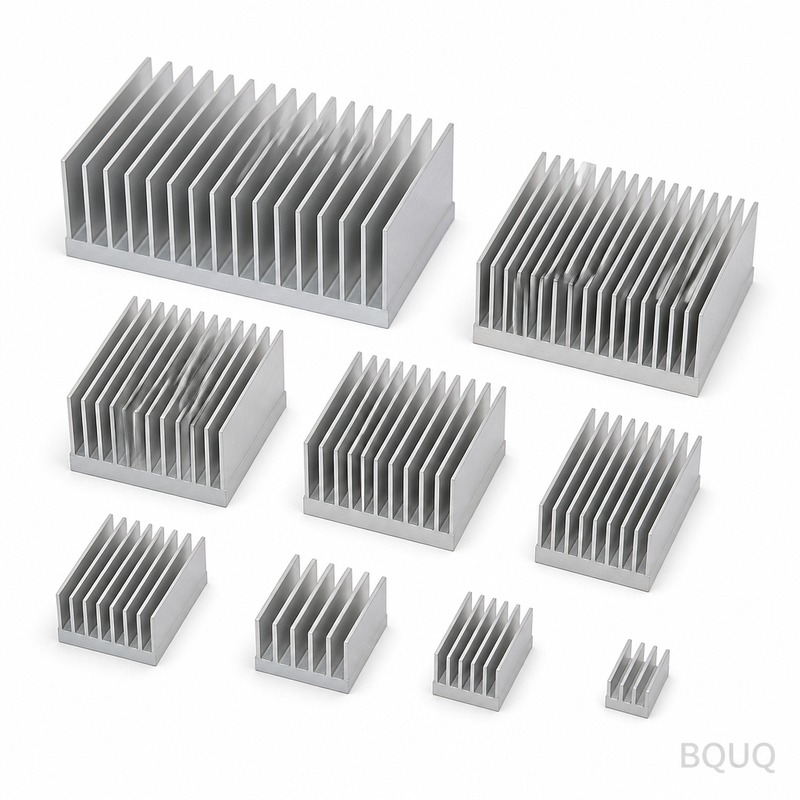
Pressure drop, measured in Pascals (Pa) or inches of water (inH2O), is the resistance the heat sink offers to airflow, and it is the critical factor that determines which fan will work. For a plate-fin heat sink, the pressure drop can be estimated using the Darcy–Weisbach equation adapted for fin channels, but a practical rule of thumb is that a standard extruded heat sink with 2mm fin spacing will have a pressure drop of 25 to 75 Pa at an airflow velocity of 2 m/s. Denser fin spacing (1.0 mm) increases surface area but also increases pressure drop exponentially, often exceeding 200 Pa at the same velocity, which requires a high-static-pressure fan like a blower. To calculate the actual system curve, use fan manufacturers’ software or perform a simple CFD analysis; for prototype validation, measure the pressure drop with a manometer across the heat sink at various flow rates. Remember that the operating point is where the fan’s pressure-flow curve intersects the system resistance curve, and you must design for that intersection, not for the fan’s maximum free-air CFM.
Which Fan Type Is Best for High-Density Heat Sink Fins?
The choice between an axial fan and a centrifugal blower depends on the fin density and the allowable footprint. Axial fans provide high airflow (50 to 200 CFM) but very low static pressure (typically 5 to 15 mmH2O or 50 to 150 Pa), making them suitable only for heat sinks with fin spacing greater than 2.5 mm. Centrifugal blowers generate high static pressure (up to 50 mmH2O or 500 Pa) but lower airflow, making them ideal for heat sinks with fin spacing below 2.0 mm or for ducted systems with bends and restrictions. For most server and industrial applications, a 40mm to 60mm axial fan running at 4000 to 8000 RPM provides a good balance; for example, a 60x60x25mm fan at 6000 RPM delivers approximately 40 CFM at 120 Pa of static pressure. When selecting a fan, always check the P-Q curve (pressure vs. airflow) and ensure your operating point is at a high-efficiency region, typically between 50% and 80% of the free-air flow rate.
How Do Duct Design and Fan Placement Affect Cooling Performance?
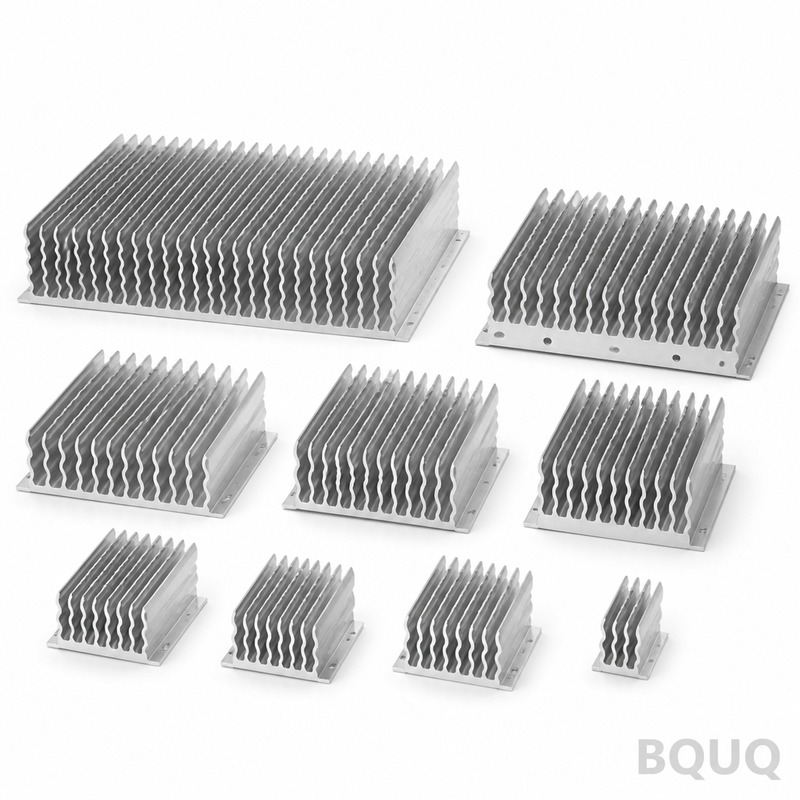
Ducting is not an optional accessory; it directly controls where the airflow goes and prevents recirculation of hot air, which can reduce cooling efficiency by up to 30%. The best configuration is a shroud that seals the fan outlet directly to the heat sink inlet, creating a plenum that forces 100% of the fan’s airflow through the fins, rather than allowing air to bypass around the edges. The duct cross-sectional area should match the heat sink face area within 10% to avoid abrupt expansion or contraction losses; a sudden change in duct area can create turbulence that increases pressure drop by 20 to 40%. For pull configurations (fan on the outlet side), the duct should be at least one fan diameter long to allow the airflow to straighten before entering the heat sink. Always maintain a minimum clearance of 5 mm between the fan blade tips and the duct walls to minimize noise and efficiency loss from tip clearance effects.
Why Does Fin Spacing and Thickness Matter for Forced Air Cooling?
Fin geometry is the primary lever you control to optimize thermal performance for a given fan. For forced convection, the optimal fin spacing for maximum heat transfer at a given fan power is typically between 1.5 mm and 3.0 mm, depending on air velocity. At a velocity of 3 m/s, reducing fin spacing from 4 mm to 2 mm can decrease thermal resistance by up to 25% because the boundary layers merge and increase heat transfer coefficient, but it also doubles the pressure drop. Fin thickness should be between 1.0 mm and 1.5 mm for aluminum extrusions to ensure structural rigidity and adequate heat conduction from the base to the fin tip; thinner fins (0.5 mm) are possible with skived or bonded fin technology but have lower fin efficiency. The fin height-to-gap ratio is also critical: for extruded heat sinks, a ratio of 5:1 to 10:1 is typical, but ratios above 10:1 require higher pressure fans to push air down the full fin channel. BQUQ manufactures heat sinks with tolerances of ±0.05 mm on fin pitch and ±0.1 mm on height, which is crucial for maintaining consistent airflow and predictable thermal performance in high-volume production.
How Do You Calculate Thermal Resistance and Verify the Design?
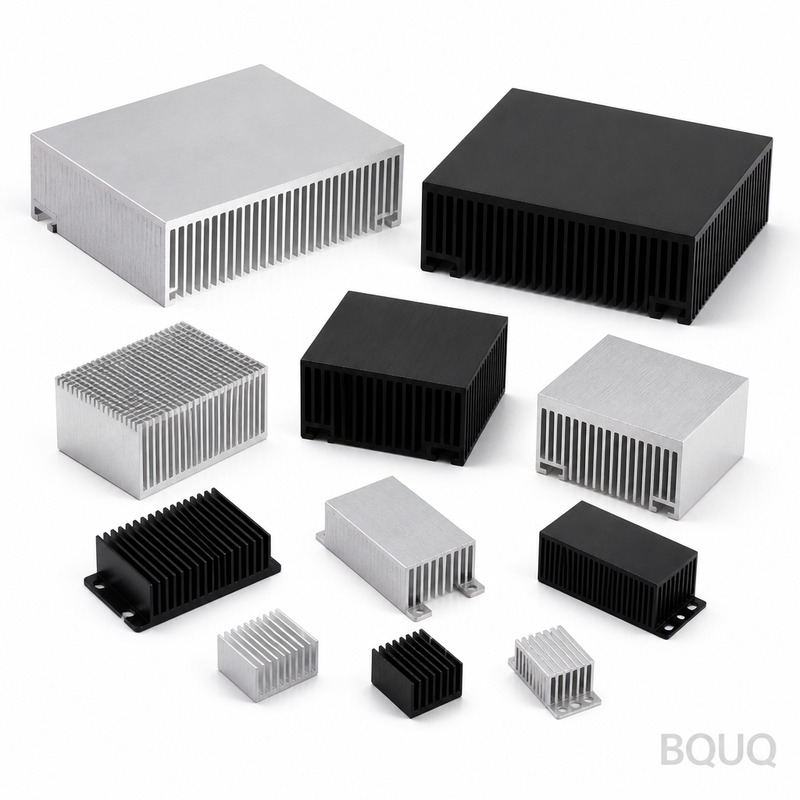
The total heat sink thermal resistance (Rth_sa) can be calculated using the formula Rth_sa = 1 / (h * A * η_fin), where h is the convective heat transfer coefficient (W/m²·K), A is the total wetted surface area, and η_fin is the fin efficiency. For forced air with velocities between 2 and 5 m/s, the heat transfer coefficient for aluminum ranges from 30 to 100 W/m²·K, which is significantly higher than natural convection (5 to 10 W/m²·K). To validate your design, measure the temperature rise (ΔT) between the heat sink base and the ambient air under the specified power load; the measured thermal resistance should be within 10% of the calculated value. For example, a typical extruded heat sink measuring 100mm x 100mm x 40mm with 2mm fins and a 60mm axial fan at 30 CFM will achieve a thermal resistance of approximately 0.25 to 0.35°C/W. If your measured value is higher, check the thermal interface material (TIM) thickness and the mounting pressure; the optimal TIM bond line is 25 to 50 micrometers, and the recommended mounting pressure for a pad is 50 to 100 psi.
What Are the Real-World Cost and Performance Trade-offs for Different Heat Sink Types?
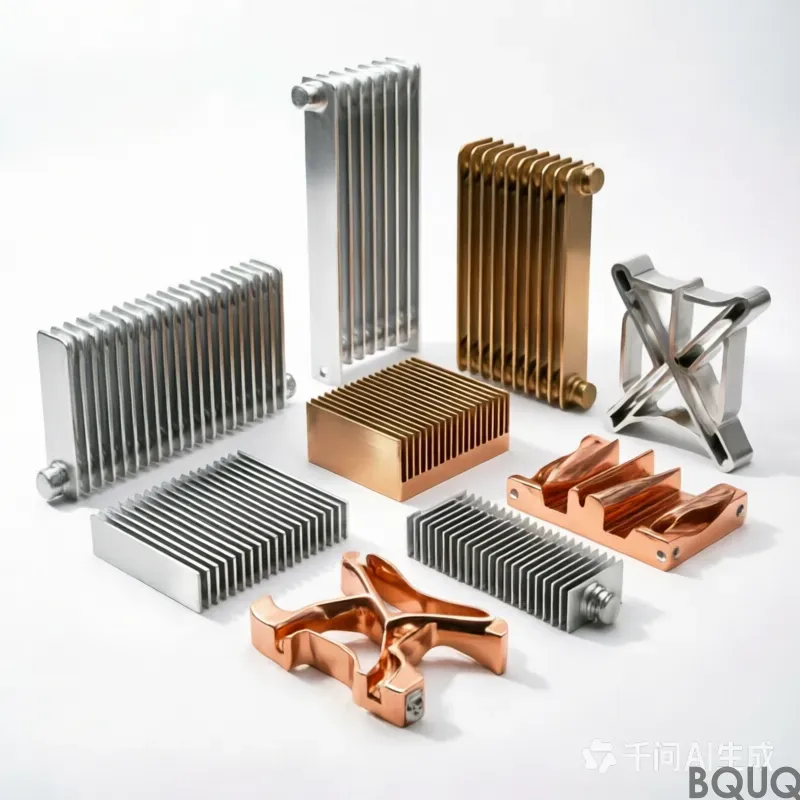
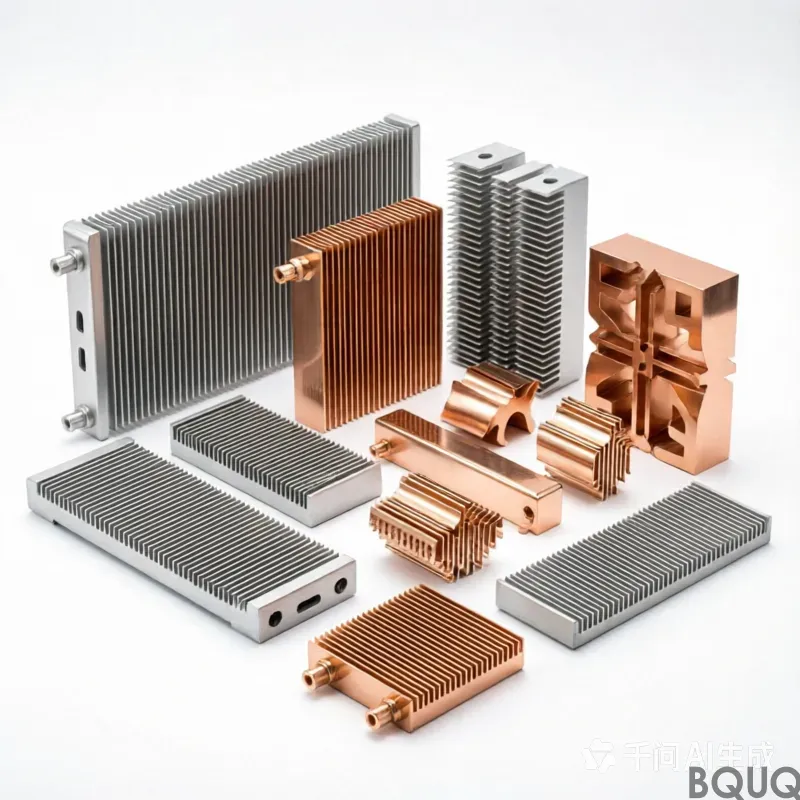
The manufacturing method determines your cost, lead time, and achievable fin density. Extruded aluminum heat sinks are the most cost-effective for production volumes above 500 pieces, with prices ranging from $2 to $15 per unit depending on size and finishing. Skived heat sinks offer fin spacing as low as 0.5 mm and are used for high-performance applications, but they cost 30% to 50% more than extrusions. Bonded fin heat sinks combine a machined base with separate fins, allowing for the highest fin density and aspect ratios, but they are the most expensive and are typically used for IGBT modules and high-power inverters. The table below provides a comparison of typical specifications for common heat sink types used in forced air cooling.
| Heat Sink Type | Fin Pitch (mm) | Max Aspect Ratio (Height/Gap) | Thermal Resistance (C/W, 100mm x 100mm base, 3 m/s) | Relative Cost | Typical Lead Time (weeks) |
| Extruded Aluminum | 1.8 - 4.0 | 8:1 | 0.30 - 0.50 | 1.0x | 2 - 3 |
| Skived Aluminum | 0.8 - 2.0 | 15:1 | 0.20 - 0.35 | 1.3x | 3 - 4 |
| Bonded Fin (Al) | 1.0 - 2.5 | 20:1 | 0.15 - 0.25 | 1.8x | 4 - 6 |
| Forged Heat Sink | 2.0 - 3.5 | 6:1 | 0.40 - 0.60 | 1.2x | 4 - 5 |
| CNC Machined (Copper) | 1.5 - 3.0 | 10:1 | 0.12 - 0.20 | 3.0x | 2 - 3 |
How Do You Account for Altitude and Ambient Temperature Variations in Fan Selection?
Forced air cooling performance degrades at high altitude because air density decreases, reducing the mass flow rate and heat transfer coefficient. At an altitude of 3000 meters, the air density is approximately 30% lower than at sea level, which means the fan delivers less cooling; you must either increase the fan speed, use a larger fan, or increase the heat sink surface area by 20% to compensate. Similarly, the fan’s performance curve shifts at higher ambient temperatures because air viscosity increases with temperature, slightly reducing airflow. For industrial applications with ambient temperatures above 50°C, consider using fans with higher-rated operating temperatures (up to 85°C) and ensure the fan’s bearings (ball bearings are preferred over sleeve bearings) can handle the thermal load. Always derate the fan’s airflow by 10% for every 20°C above the standard operating temperature of 25°C to ensure reliable performance over the product’s lifetime.
What Are the Common Mistakes in Heat Sink and Fan Design?
The most frequent error is selecting a fan based on free-air CFM without considering the system’s static pressure; this results in the fan operating at a point far from its peak efficiency, often delivering only 50% of the expected airflow. Another common mistake is ignoring the thermal interface material (TIM) resistance; a poor TIM application can add 0.1 to 0.3°C/W to the total resistance, which can be the difference between a passing and failing thermal test. Additionally, placing the fan too close to an inlet vent or obstruction creates acoustic noise and reduces airflow; maintain at least 10 mm of clearance between the fan inlet and any solid surface. Finally, failing to conduct a thermal simulation or prototype test before mass production leads to costly redesigns; always validate with a thermocouple measurement at the hottest spot on the heat sink base.
FAQ
What Is the Optimal Air Velocity Range for Forced Air Heat Sinks?
The optimal air velocity for most aluminum heat sinks is between 2 and 5 meters per second. Below 2 m/s, the airflow is insufficient to break the thermal boundary layer, and above 5 m/s, the pressure drop and noise increase significantly without a proportional improvement in heat transfer.
Can I Use a Standard Axial Fan for a Heat Sink with 1mm Fin Spacing?
No, a standard axial fan will not work effectively because it cannot generate the static pressure needed to push air through such dense fins. You should use a centrifugal blower or increase the fin spacing to at least 2.5 mm for axial fan compatibility.
How Much Quieter Is a Larger Fan Compared to a Smaller Fan for the Same Airflow?
A larger fan is significantly quieter because it moves the same volume of air at a lower rotational speed. For example, a 120mm fan at 2000 RPM can move the same airflow as a 60mm fan at 6000 RPM, but with 10 to 15 dB(A) less noise, which translates to a perceived loudness reduction of about 50%.
Should I Push or Pull Air Through the Heat Sink?
Pushing air (fan on the inlet side) is generally preferred because it creates positive pressure and reduces the chance of drawing hot air from other components into the heat sink. Pulling air (fan on the outlet side) can be used for maintenance access but is less efficient due to the fan’s motor blocking the airflow path.
What Is the Maximum Fin Height I Can Use with a Standard Extrusion Process?
For standard aluminum extrusions, the maximum fin height is typically limited to a 10:1 height-to-gap ratio, and the overall profile width is limited to about 200mm. For taller fins, you must use skived or bonded fin technology, which can achieve height-to-gap ratios of 20:1 or more.
How Do I Choose Between Aluminum and Copper for a Forced Air Heat Sink?
Aluminum is the default choice due to its low cost, light weight, and adequate thermal conductivity (180 W/m·K). Copper is used only when space is extremely limited or when the thermal resistance must be minimized, as it offers 400 W/m·K conductivity but costs three to five times more and is much heavier.
What Is the Recommended Thermal Interface Material (TIM) for High-Power Applications?
For high-power applications with power densities above 50 W/cm², use a phase-change material or a high-performance thermal grease with a thermal conductivity of 5 to 8 W/m·K. For lower power, a thermal pad is easier to assemble but has higher thermal resistance.
Conclusion
Designing a heat sink for forced air cooling is a systematic process that requires a clear understanding of thermal resistance, pressure drop, and fan performance curves. To succeed, always start with a thermal budget calculation, select the fan based on the actual system pressure drop, and optimize the fin geometry for the specific air velocity available. For production, choose a manufacturing method that balances cost and performance; CNC machining and skiving are excellent for high-performance prototypes, while extrusion is the most economical for mass production. At BQUQ, we combine 20 years of precision manufacturing experience with thermal simulation capabilities to deliver heat sinks and cooling solutions with tolerances down to ±0.05 mm. If you need assistance with your forced air cooling design, send us your power dissipation, ambient temperature, and space constraints. We respond with a detailed engineering review and a quotation within 12 hours. Contact us at Email: sc@bquq.com, WhatsApp: +86 13713157787, or visit www.bquq.com.
Related Articles
- How to Attach a Heat Sink Without Screws: Thermal Adhesive Guide
- Thermal Management for High Brightness LEDs with Heat Sinks
- New energy vehicle IGBT heat dissipation, heat sink reliability engineering, heat pipe and temperature plate integrated heat sink, surface treatment and heat radiation enhancement: anodic oxidation, black coating and micro-nano structure, graphene/3D printing/intelligent thermal management: 2030 heat sink technology roadmap