Passive vs Active Heat Sinks: How to Choose the Right Cooling Solution for Your Electronics
For most electronics enclosures under 25 watts of continuous heat dissipation, a passive heat sink is the correct choice due to its zero failure rate and silent operation, while active heat sinks (fans) become necessary above 40 watts or when ambient temperatures exceed 50°C. The decision hinges on thermal budget, allowable airflow, acoustic limits, and long-term reliability. This article provides quantitative thresholds, cost comparisons, and engineering selection criteria based on 20 years of CNC machining and thermal management experience at BQUQ.
Thermal Physics Fundamentals: Natural Convection vs Forced Convection
Passive heat sinks rely on natural convection, where warm air rises and draws cooler air across the fin array. The heat transfer coefficient for natural convection is typically 5 to 15 W/m²K, while forced convection from a fan raises this to 25 to 100 W/m²K. This difference dictates the required surface area. For a 50°C temperature rise (ΔT) above ambient, a passive aluminum heat sink needs approximately 150 to 200 cm² of exposed fin surface per watt dissipated. An active solution with a 40 mm fan at 5,000 RPM achieves the same ΔT with only 40 to 60 cm² per watt, reducing heat sink volume by up to 65%. However, the fan consumes 1.5 to 3 watts of power and adds a moving part with a finite lifespan (typically 30,000 to 70,000 hours at 40°C, per bearing type).
Material and Manufacturing Differences
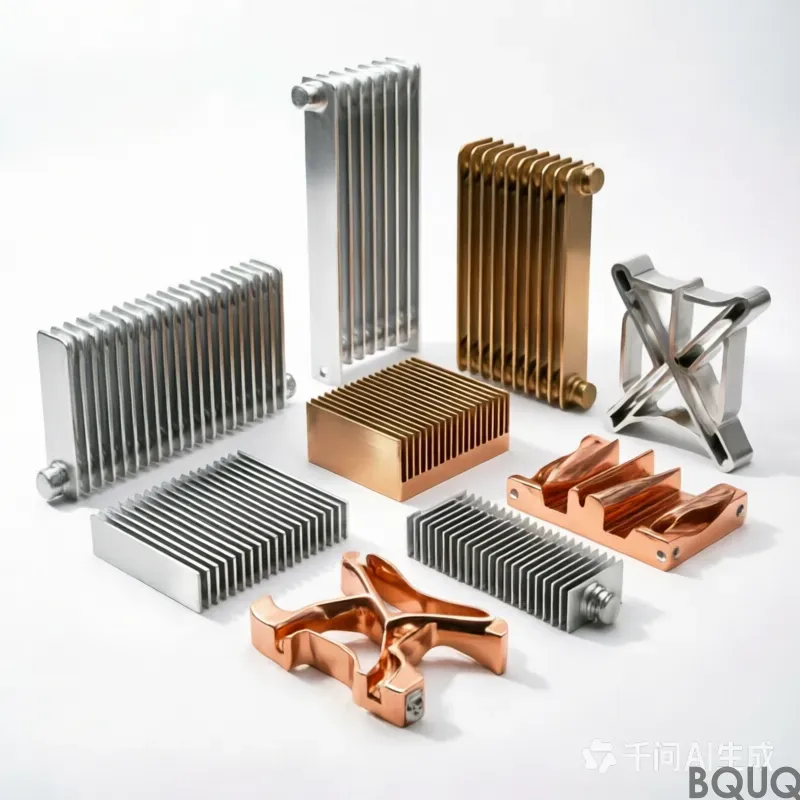
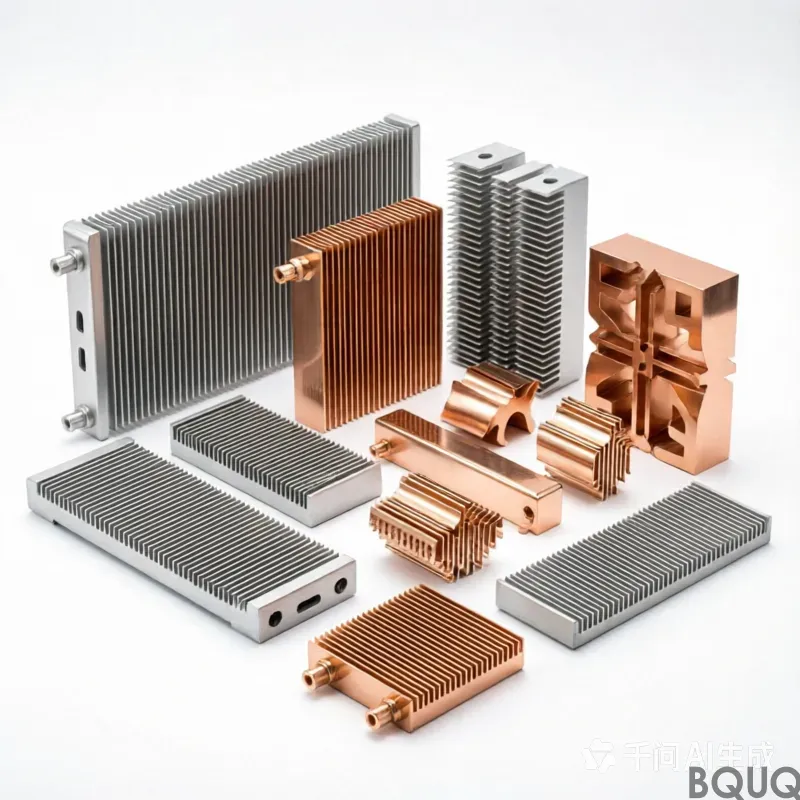
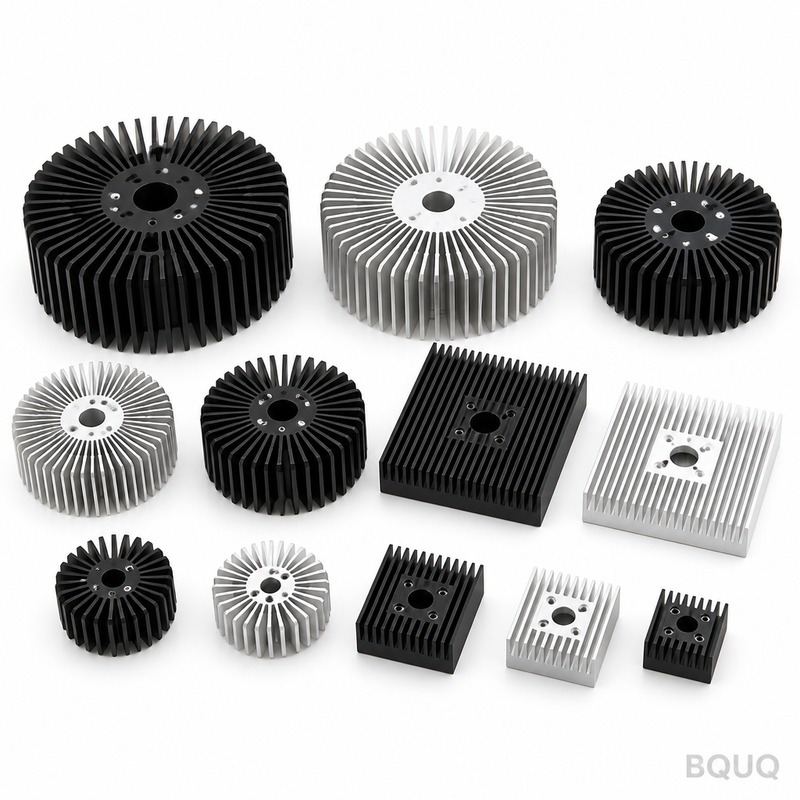
BQUQ produces both passive and active heat sinks using 6063-T5 aluminum (thermal conductivity 201 W/mK) or C1100 copper (398 W/mK) for high-performance applications. Passive designs favor extruded profiles with fin densities of 8 to 12 fins per inch (FPI) and fin thickness of 1.5 to 2.0 mm for manufacturability. Active heat sinks for fan mounting use higher fin density (14 to 20 FPI) with 0.8 to 1.2 mm fins to maximize surface area under forced flow, but these thinner fins require precise CNC machining to avoid bending. Manufacturing tolerances for passive base flatness are ±0.05 mm, while active heat sink mounting surfaces require ±0.02 mm to ensure proper fan-to-fin gap (typically 0.5 to 1.5 mm clearance). Skived and bonded fin technologies add 15% to 25% cost but allow fin heights up to 60 mm for passive units, whereas active units typically stay below 35 mm total height including the fan.
Cost Breakdown and Price Comparison
The total cost of ownership includes initial part price, fan cost, assembly labor, and energy consumption over a 10-year operating life. Below is a typical comparison for a 30-watt application with 50°C ambient:
| Parameter | Passive Heat Sink (Extruded 6063-T5) | Active Heat Sink with 40mm Fan |
| Heat sink base price (USD, 1000 pcs) | $4.80 per unit | $3.20 per unit (without fan) |
| Fan cost (USD, 40x40x10mm, sleeve bearing) | $0.00 | $1.10 per unit |
| Assembly labor (thermal adhesive + fan clip) | $0.15 | $0.45 |
| Required fin surface area (cm²/W) | 180 | 55 |
| Total heat sink weight (grams) | 210 | 95 |
| Acoustic noise at 1 meter (dBA) | 0 | 28 to 35 |
| Power consumption (watts, continuous) | 0 | 2.2 |
| 10-year energy cost (USD, $0.12/kWh) | $0.00 | $23.10 |
| MTBF (hours at 70°C heat sink base) | > 1,000,000 | 45,000 (fan only) |
For production volumes above 5,000 units per year, passive heat sinks become more economical despite higher aluminum material cost, because they eliminate the fan procurement, assembly, and field failure warranty risks. The break-even point for active cooling is only justified when the heat sink volume reduction is critical for enclosure size or when the ΔT requirement is below 25°C at high wattage.
Performance Thresholds and Thermal Resistance Data
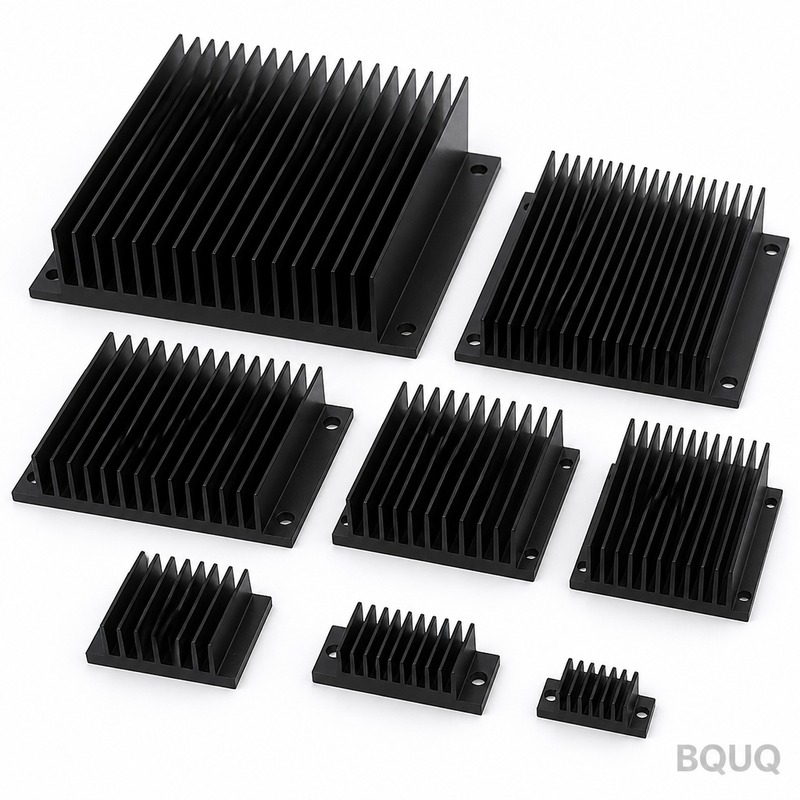
Thermal resistance (Rth, °C/W) is the key specification. A typical extruded passive heat sink for 50W dissipation has Rth of 1.2 °C/W at natural convection, meaning 50 watts produces a 60°C rise above ambient. The same heat sink with a 60mm fan at 3,500 RPM achieves Rth of 0.35 °C/W, a 71% improvement. For LED lighting drivers and power supplies in sealed enclosures, passive-only is mandatory because dust accumulation and fan failure would cause catastrophic overheating. For high-power IGBT modules in motor drives above 200 watts, active cooling with dual 80mm fans is standard, but BQUQ recommends redundant fans with a thermal derating strategy: if the fan fails, the system must reduce power to 40% to survive on natural convection alone. Ambient temperature also shifts the decision: at 70°C ambient, a passive heat sink requires double the surface area compared to 25°C ambient, often making active cooling the only viable option for heat densities above 15 W/cm² on the component footprint.
Reliability and Maintenance Considerations
Fan failure is the primary failure mode for active heat sinks. Sleeve bearing fans have an MTBF of 40,000 hours (4.5 years) at 50°C, while dual ball bearing fans reach 70,000 hours (8 years) but cost 60% more. Passive heat sinks have no moving parts, so their failure rate is effectively zero, limited only by thermal cycling fatigue of the solder or thermal interface material. BQUQ recommends applying thermal interface material (TIM) with 3 W/mK conductivity and 0.1 mm thickness; a poorly applied TIM can increase Rth by 0.2 °C/W, negating the benefit of an active fan. For outdoor applications, passive heat sinks require anodized coating (25 μm thickness) to prevent corrosion, adding $0.30 per unit but extending life to 20+ years. Active heat sinks in dusty environments need filter screens that require monthly cleaning; without filters, fin blockage can reduce airflow by 50% within six months, raising the heat sink base temperature by 15°C.
Practical Selection Criteria for Engineers
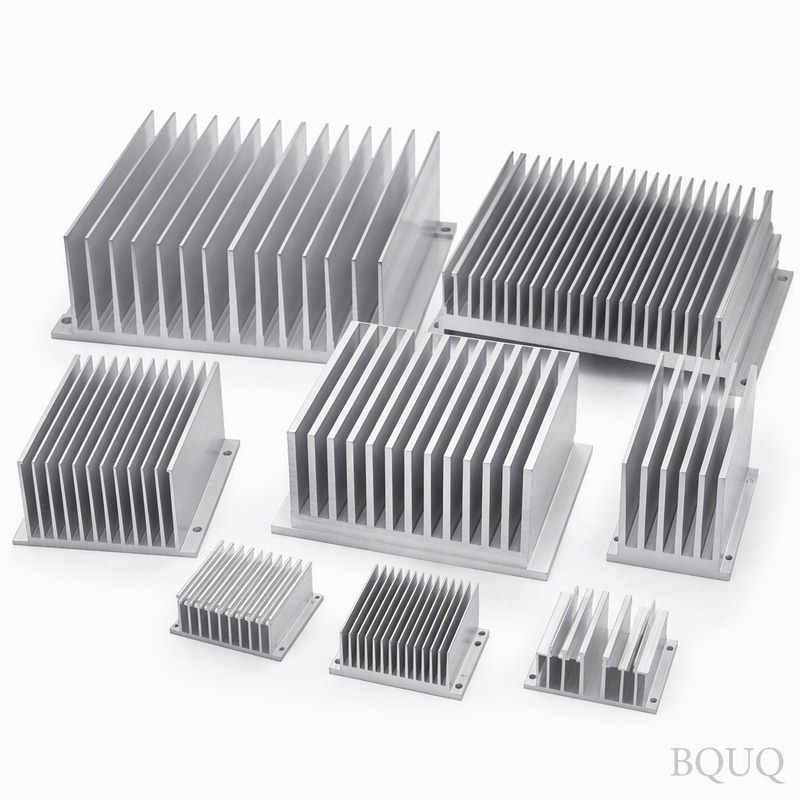
For your specific design, use this decision tree: if the required Rth is below 0.5 °C/W at a heat load above 40 watts, start with active cooling. If acoustic limits are below 25 dBA, passive is mandatory. If the product must operate 24/7 for more than 5 years without maintenance, choose passive and increase the heat sink volume by 25% to compensate. If enclosure height is restricted under 25 mm, active cooling with a slim 10 mm fan is often the only option, but plan for fan replacement at 3-year intervals. BQUQ has manufactured passive heat sinks with Rth as low as 0.08 °C/W using copper base plates with aluminum fins (dissimilar metal bonding), priced at $18.50 per unit in 500-piece quantities. For active solutions, we CNC machine precise fan housings with ±0.03 mm tolerances to ensure proper impeller clearance, improving airflow efficiency by 8% compared to stamped housings. Always prototype with a thermocouple test: measure the junction temperature at worst-case ambient using a 10°C derating margin. In our thermal lab, we have observed that passive heat sinks correctly sized for 60°C ΔT at 25°C ambient fail by 18°C when ambient rises to 45°C, so always test at your maximum operating temperature, not just nominal.
Frequently Asked Questions on Heat Sink Selection
Is it safe to add a fan to an existing passive heat sink? Yes, but only if the fin spacing is above 3 mm; tight passive fins (1.5 mm pitch) create high pressure drop, reducing fan efficiency by up to 40%. Use a blower fan instead of axial for fin heights below 20 mm. What is the minimum wattage where active cooling becomes mandatory? Above 80 watts per 100 mm of heat sink length, natural convection becomes inadequate because the boundary layer detaches. How much does a custom passive heat sink cost to prototype? BQUQ charges a one-time CNC machining setup of $350 for a 3-day prototype, then production pricing at $4 to $12 per unit depending on size and finish.
Conclusion and Recommendation
Choose passive heat sinks for applications below 40 watts, sealed enclosures, silent equipment, or where maintenance access is impossible. Choose active heat sinks only when volume constraints or high heat density (above 15 W/cm²) force the issue, and always specify dual ball bearing fans with thermal derating. At BQUQ, we manufacture both types with CNC-machined precision, offering thermal simulation validation before production. For a project-specific recommendation, send your power dissipation, ambient temperature, and enclosure size to our engineering team for a 12-hour quoting response. Contact us at Email: sc@bquq.com, WhatsApp: +86 13713157787, or visit www.bquq.com for a free thermal design review.