Progressive Die vs Single Hit Stamping: Cost Analysis for Production Volumes
Introduction
For high-volume metal component manufacturing, progressive die stamping is cheaper per part, typically reducing unit costs by 30-50% compared to single hit stamping once annual volume exceeds 50,000 pieces. However, single hit stamping remains more economical for low-volume production, prototype runs, or parts requiring frequent design changes, with total cost advantages up to 60% below 10,000 units annually.
Cost Breakdown: Tooling Investment and Unit Economics
The fundamental cost difference lies in tooling complexity and cycle efficiency. A progressive die for a medium-complexity part (e.g., 4-6 stations with bending, piercing, and blanking) costs between $8,000 and $25,000, depending on material thickness and feature tolerances. In contrast, a single hit stamping die for the same geometry costs $2,500 to $6,000. The break-even point typically occurs between 20,000 and 50,000 parts, driven by the progressive die's ability to complete multiple operations per press stroke.
| Parameter | Single Hit Stamping | Progressive Die Stamping |
| Tooling cost (medium part) | $2,500 - $6,000 | $8,000 - $25,000 |
| Tooling lead time | 2-4 weeks | 6-10 weeks |
| Cycle rate (parts per minute) | 15-30 | 60-200 |
| Typical tolerance (linear) | ±0.10 mm | ±0.05 mm |
| Minimum recommended volume | 500 | 50,000 |
| Unit cost at 10,000 pcs | $0.45 - $0.80 | $0.90 - $1.50 |
| Unit cost at 100,000 pcs | $0.32 - $0.55 | $0.18 - $0.35 |
| Unit cost at 1,000,000 pcs | Not recommended | $0.12 - $0.22 |
| Scrap rate typical | 5-8% | 2-4% |
Production Efficiency and Cycle Time Comparison
Progressive die stamping excels in throughput because each press stroke produces a complete part. A 60-ton press running a progressive die at 150 strokes per minute yields 9,000 parts per hour. Single hit stamping requires multiple press setups, each performing one operation. For a part requiring four operations (blank, pierce, form, and trim), the same press produces only 375 parts per hour at 25 strokes per minute, accounting for part transfer time.
This efficiency gap directly impacts labor cost. Single hit stamping requires one operator per press station, often maintaining work-in-progress buffers between operations. Progressive die stamping typically runs with one operator monitoring two to three presses. For a 100,000-piece order, labor cost per part for single hit stamping averages $0.08-$0.12 versus $0.02-$0.04 for progressive die operations.
Material Utilization and Waste Analysis
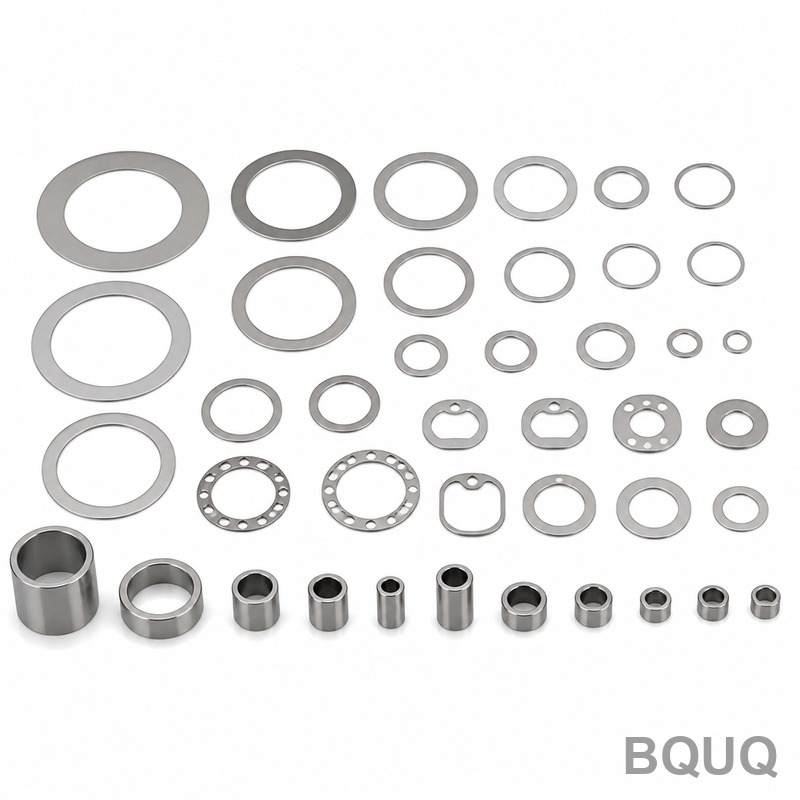
Material cost represents 40-60% of total stamping cost. Progressive dies achieve superior material utilization through optimized strip layout, allowing nesting of parts with minimal carrier scrap. Typical material yield for progressive dies ranges from 65-85%, while single hit stamping using individual blanks yields 50-70% due to manual blank placement and edge allowance.
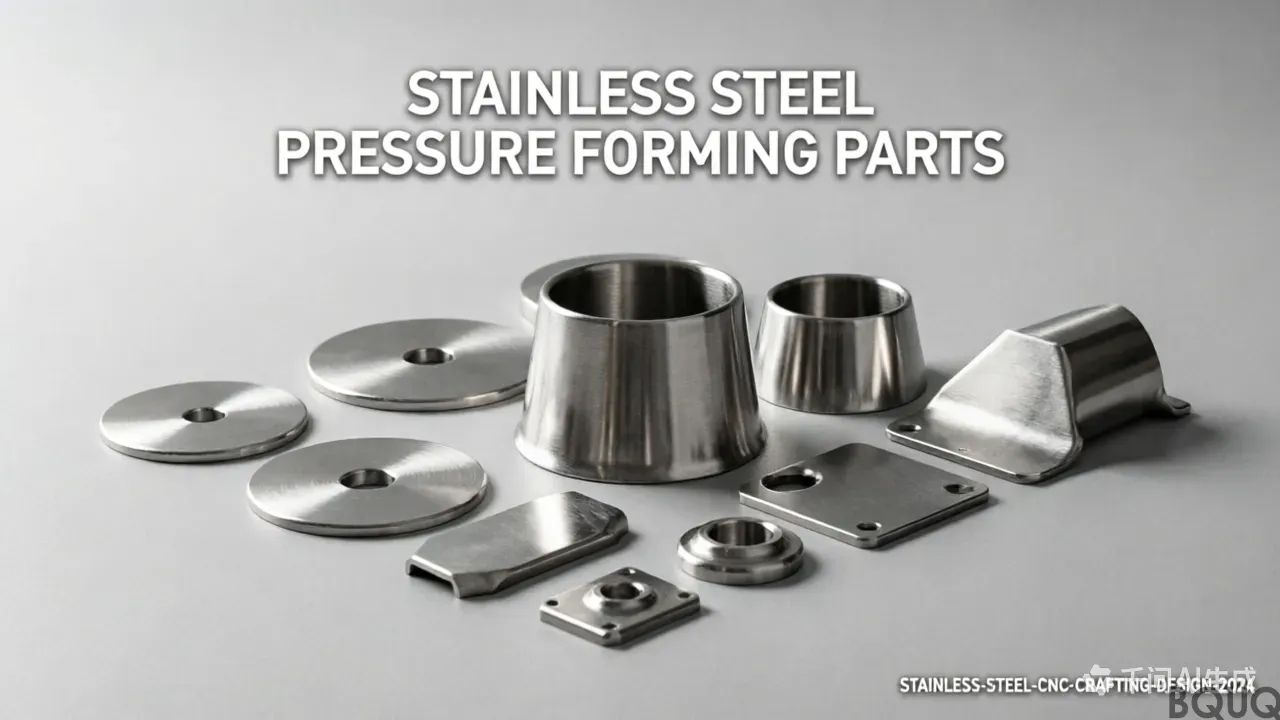
For example, stamping a 50 mm diameter washer from 1.5 mm thick stainless steel (SS304 at $3.20/kg): A progressive die with a 42 mm strip pitch produces 24 parts per meter with 20% scrap. Single hit stamping using pre-cut blanks produces 18 parts per meter with 35% scrap. Over 500,000 parts, this material difference saves $1,150 in stainless steel alone, plus reduced waste disposal costs.
Tolerance and Quality Consistency
Progressive die stamping maintains tighter tolerances because all operations occur in a fixed, hardened die set with consistent registration. Achievable tolerances are ±0.05 mm for hole-to-hole spacing and ±0.08 mm for bend angles. Single hit stamping is limited to ±0.10 mm for most features, with higher variation due to manual part positioning between operations.
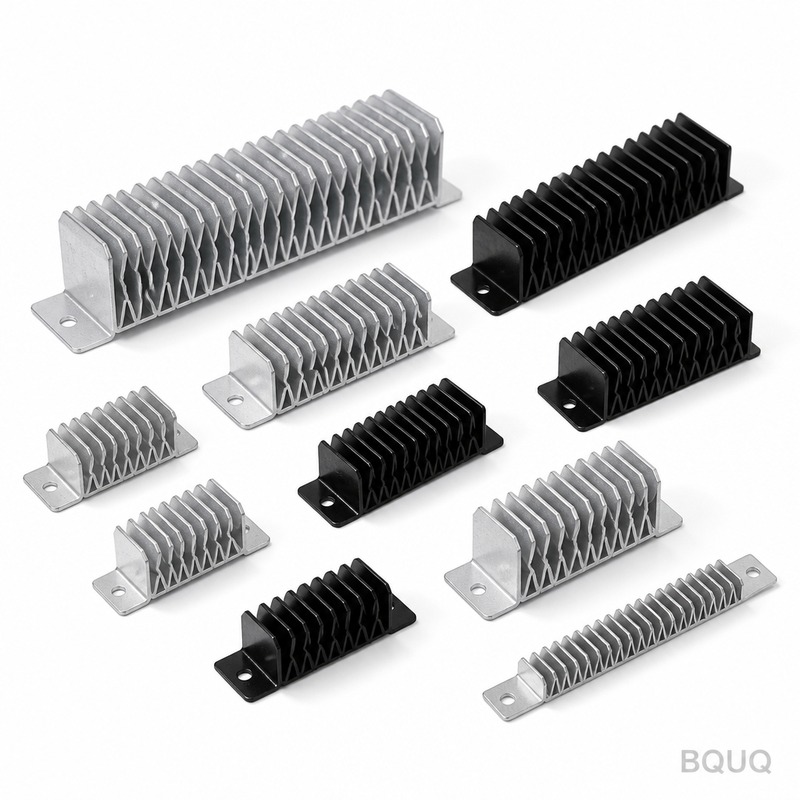
For heat sink production, a common BQUQ application, flatness tolerance of 0.10 mm across a 100 mm surface is achievable with progressive dies but difficult to hold consistently with single hit stamping. The progressive die's pilot pins ensure each station maintains precise alignment, preventing cumulative error. This quality consistency reduces downstream inspection costs and customer rejections, often saving 3-5% of total manufacturing cost.
Practical Recommendations for Volume Selection
Choose progressive die stamping when your annual volume exceeds 50,000 units, especially for parts with multiple features requiring tight tolerances. The higher tooling investment pays back through reduced cycle time, lower labor, and better material yield. For volumes between 20,000 and 50,000, calculate the break-even point using your specific part geometry and material—simpler parts with fewer operations may favor single hit stamping up to 80,000 units.
Single hit stamping remains the correct choice for prototyping, design validation, and low-volume production below 10,000 units. It also suits parts with frequent engineering changes, where progressive die modification costs $2,000-$5,000 per station versus $500-$1,500 for single hit die adjustments. For mixed low-volume batches of similar parts, consider a split approach: use single hit stamping for initial 5,000-piece validation, then transition to progressive die once the design is frozen.
FAQ-Style Tips for Cost Optimization
What volume justifies progressive die tooling? For a typical sheet metal part with 4-6 operations, the break-even is 25,000-40,000 parts. Above 100,000 parts, progressive die is always cheaper by 40% or more. Always request a cost breakdown from your supplier showing tooling amortization across your projected volume.
Can single hit stamping match progressive die tolerances? No. If your drawing specifies ±0.05 mm, single hit stamping will struggle to maintain consistency. Consider loosening tolerances to ±0.10 mm for low-volume runs, or accept a higher reject rate of 3-5%, which adds cost.
How does material thickness affect the decision? Thicker materials above 3.0 mm require heavier presses and stronger dies, increasing progressive die costs disproportionately. For thick parts, single hit stamping remains competitive up to 80,000 units. Thin materials below 0.5 mm favor progressive dies even at 20,000 units due to handling difficulties in single hit operations.
What about secondary operations? If your part requires tapping, countersinking, or assembly, progressive dies can integrate these at $0.01-$0.03 per part, while single hit stamping requires separate secondary machines at $0.05-$0.10 per operation. Include all secondary costs when comparing.
Should I split production between both methods? For uncertain demand, start with single hit stamping for the first 5,000-10,000 units. Once volume is confirmed, invest in progressive tooling. This staged approach minimizes risk while capturing long-term savings.
Conclusion
The cost differential between progressive die and single hit stamping is not a fixed value but a function of your specific volume, part complexity, tolerance requirements, and material. As a rule, progressive die stamping delivers 40-60% lower unit costs above 50,000 parts, while single hit stamping protects your cash flow below 20,000 parts. For volumes between 20,000 and 50,000, request detailed quotes for both methods and calculate the break-even point using your actual part geometry. BQUQ provides both manufacturing routes with full cost transparency. For a comparison quote on your specific part, send your drawing to sc@bquq.com or WhatsApp +86 13713157787. We respond with detailed tooling and unit pricing within 12 hours. Visit www.bquq.com for our capability matrix and material specs.
Related Articles
- custom stamped metal power contact spring battery clip factory
- Intelligent online inspection and closed-loop quality control: creating a zero-defect production line for stamped parts
- Stamping digital factory and simulation-driven design: from virtual prototype to digital twin operation
Frequently Asked Questions
At what annual volume does progressive die stamping become more cost-effective than single hit stamping?
Progressive die stamping typically reduces unit costs by 30-50% compared to single hit stamping once annual volume exceeds 50,000 pieces. The break-even point occurs between 20,000 and 50,000 parts, driven by the progressive die's ability to complete multiple operations per press stroke.
What are the tooling cost and lead time differences between single hit and progressive die stamping?
For a medium-complexity part, a single hit die costs $2,500-$6,000 with a 2-4 week lead time, while a progressive die costs $8,000-$25,000 with a 6-10 week lead time. Progressive dies achieve tighter linear tolerances of ±0.05 mm versus ±0.10 mm for single hit stamping.
How do production cycle rates compare between the two stamping methods?
Progressive die stamping runs at 60-200 parts per minute, producing 9,000 parts per hour on a 60-ton press at 150 strokes per minute. Single hit stamping runs at 15-30 parts per minute, and for a four-operation part, yields only 375 parts per hour at 25 strokes per minute including transfer time.
What material utilization rates can be expected from each stamping process?
Progressive dies achieve 65-85% material yield through optimized strip layout, while single hit stamping yields 50-70% due to manual blank placement. For a 50 mm washer from 1.5 mm SS304, a progressive die with 42 mm strip pitch produces 24 parts per meter with 20% scrap.