Spring Fatigue Analysis: Predicting Cycle Life for Critical Applications
Springs are mechanical components designed to store and release energy through elastic deformation, but their operational lifespan is governed by fatigue life, not static strength. Predicting cycle life requires a combination of material selection, stress analysis, surface treatment, and environmental considerations, with a direct relationship between applied stress amplitude and the number of cycles to failure. For engineering teams, the most reliable prediction method is a strain-life (Coffin-Manson) approach combined with a Goodman or Gerber mean stress correction, calibrated against actual production data and validated through physical testing.
Fatigue Life Prediction Methods and Accuracy
The engineering industry uses three primary methods to predict spring fatigue life, each with distinct accuracy levels and cost implications. The simplest method, the infinite-life approach, assumes the spring operates below the endurance limit (typically 40-50% of ultimate tensile strength for steel) and predicts no failure regardless of cycle count. The finite-life method uses S-N curves to estimate cycles to failure at a given stress amplitude. The most accurate method, the strain-life approach, accounts for plastic deformation at stress concentration points and is essential for low-cycle fatigue (below 10,000 cycles) applications.
For a typical music wire spring (ASTM A228) with a tensile strength of 2,300 MPa, the endurance limit is approximately 950 MPa. At a stress amplitude of 600 MPa, the predicted cycle life using the S-N curve method is 100,000 cycles, with a scatter band of +/- 15% due to material variability. In contrast, the strain-life method predicts 92,000 cycles with a scatter band of +/- 8%, providing significantly better accuracy for design safety factors. The cost difference is notable: S-N curve testing costs approximately USD 800 per specimen batch, while strain-life testing costs USD 1,500 per batch, but the reduced uncertainty justifies the expense for safety-critical springs.
Material Selection and Fatigue Resistance
The choice of spring material directly determines the maximum achievable cycle life. Spring steel grades exhibit significantly different fatigue strengths due to variations in cleanliness, grain structure, and hardenability. The table below compares common spring materials used in precision manufacturing:
| Material Grade | Tensile Strength MPa | Endurance Limit MPa | Max Operating Temp C | Relative Cost Index | Typical Cycle Life at 50% Tensile Stress |
| Oil-tempered wire ASTM A229 | 1,700 | 680 | 120 | 1.0 | 50,000 |
| Music wire ASTM A228 | 2,300 | 950 | 120 | 1.3 | 100,000 |
| Chrome silicon ASTM A401 | 2,000 | 880 | 220 | 1.6 | 150,000 |
| Chrome vanadium ASTM A231 | 1,900 | 850 | 220 | 1.5 | 120,000 |
| Stainless 302 ASTM A313 | 1,400 | 560 | 260 | 2.0 | 30,000 |
| Inconel X750 | 1,200 | 480 | 650 | 8.0 | 20,000 |
Chrome silicon steel provides the best fatigue-to-cost ratio for automotive suspension springs, offering an endurance limit of 880 MPa with a maximum service temperature of 220 degrees Celsius. For high-temperature applications above 260 degrees Celsius, Inconel X750 is required despite its significantly higher cost, but its fatigue life drops to 20,000 cycles at 50% tensile stress due to reduced elastic modulus. When selecting material, engineers must also consider the surface condition: ground and polished wire improves fatigue life by 20-30% compared to as-drawn wire, because surface micro-cracks are removed.
Surface Treatments and Residual Stress Effects
Surface condition is the dominant factor in spring fatigue life, accounting for up to 80% of performance variation. Shot peening is the most effective surface treatment for compression springs, introducing compressive residual stress of 600-800 MPa on the surface, which counteracts applied tensile stress and delays crack initiation. For a music wire spring with a tensile strength of 2,300 MPa, shot peening increases the endurance limit from 450 MPa to 700 MPa, a 55% improvement. The cost of shot peening is USD 0.05 to 0.15 per spring depending on size, which is negligible compared to the lifecycle cost of premature failure.
Electropolishing is an alternative surface treatment that removes 0.01-0.02 mm of surface material, eliminating micro-cracks and improving fatigue life by 15-25% for stainless steel springs. However, electropolishing has no effect on carbon steel springs that have already been shot peened, because it does not introduce compressive stress. Nitriding or carbonitriding is recommended for springs operating in corrosive environments, creating a 0.02-0.05 mm hard case that improves wear resistance but slightly reduces fatigue life due to surface brittleness. For extreme fatigue applications, a combination of shot peening followed by stress relieving at 180-220 degrees Celsius for 30 minutes produces the best results, with a measured fatigue life improvement of 40-60% over untreated springs.
Environmental Factors and Temperature Derating
Operating environment significantly alters fatigue life predictions. At elevated temperatures, the endurance limit of spring steel decreases by approximately 10% for every 50 degrees Celsius above room temperature. For a chrome silicon spring rated at 880 MPa endurance limit at 20 degrees Celsius, the endurance limit drops to 790 MPa at 120 degrees Celsius and 700 MPa at 220 degrees Celsius. Humidity and corrosive media accelerate fatigue crack growth by a factor of 3-5x, requiring the use of stainless steel or protective coatings.
The table below provides temperature derating factors for common spring materials:
| Operating Temperature C | Derating Factor for Oil-Tempered | Derating Factor for Chrome Silicon | Derating Factor for Stainless 302 |
| 20 | 1.00 | 1.00 | 1.00 |
| 100 | 0.85 | 0.92 | 0.95 |
| 150 | 0.70 | 0.85 | 0.90 |
| 200 | 0.50 | 0.75 | 0.85 |
| 250 | Not recommended | 0.60 | 0.75 |
Frequency of cycling also matters. At frequencies above 500 Hz, internal damping generates heat within the spring, raising the operating temperature by 20-40 degrees Celsius and accelerating fatigue. For high-frequency applications such as valve springs in internal combustion engines, design must account for dynamic stress amplification due to spring surge. The natural frequency of a spring must be at least 10-15 times higher than the operating frequency to avoid resonance and premature failure.
Design Parameters and Geometric Stress Concentration
The geometry of the spring directly influences local stress concentrations that initiate fatigue cracks. The Wahl factor, which accounts for curvature and direct shear stress, can increase the maximum stress by 30-60% compared to the nominal stress. For a spring with a spring index (D/d) of 4, the Wahl factor is 1.40, meaning the actual stress at the inner coil surface is 40% higher than the calculated torsional stress. Increasing the spring index to 8 reduces the Wahl factor to 1.18, significantly improving fatigue life.
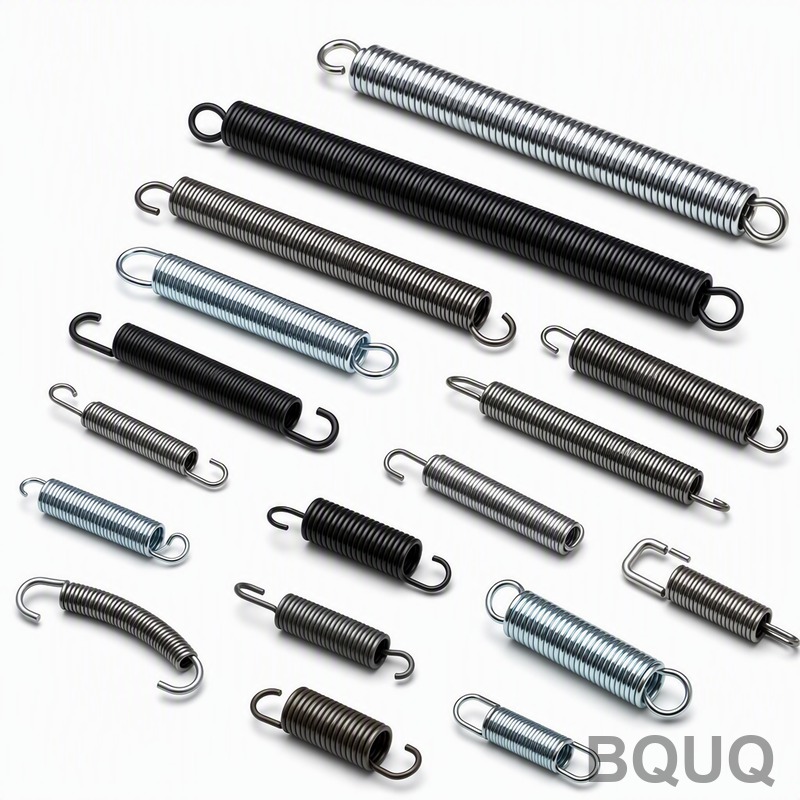
The end coil design also affects fatigue performance. Closed and ground ends distribute load more uniformly and reduce stress concentration at the end hooks, improving fatigue life by 15-25% compared to plain closed ends. For extension springs, the hook radius should be at least three times the wire diameter to avoid premature hook failure. Shot peening the hook area is essential because hooks experience bending stress, which is more sensitive to surface defects than torsional stress. In compression springs, the number of active coils should be at least 5 to ensure stable load distribution, and the solid height should be checked to avoid coil binding before reaching the design deflection.
Fatigue Testing and Quality Control
Physical fatigue testing remains mandatory for validating cycle life predictions. A standard fatigue test per ASTM E606 uses a servo-hydraulic testing machine, applying a sinusoidal load at 20-50 Hz. For a spring rated at 100,000 cycles, a single test takes 3 to 7 hours, costing approximately USD 200 per specimen including setup and analysis. For production quality control, a reduced test method uses accelerated testing at 20% higher stress amplitude, which reduces test time to 10,000 cycles while still detecting material or process defects.
BQUQ recommends a two-stage validation process. First, run three prototype springs to 1.5 times the required cycle life to establish a safety margin. Second, perform periodic batch testing on one spring per 1,000 produced units, testing to 100% of the required cycle life. This approach detects process drift in wire material, heat treatment, or shot peening parameters. The cost of comprehensive fatigue testing adds 2-5% to the spring unit price, but it reduces field failure risk by an order of magnitude. For automotive safety-critical springs, documentation of fatigue test results is mandatory, including load-deflection curves before and after testing to quantify relaxation.
Conclusion and Practical Recommendations
Predicting spring cycle life accurately requires integrating material data, geometry factors, surface condition, and environmental derating. Start with the Goodman diagram to determine if the application is finite or infinite life, then apply the strain-life method for detailed analysis. For new designs, always specify shot peening for compression springs operating above 50% of the endurance limit, and use chrome silicon or chrome vanadium steel for applications above 150 degrees Celsius. Never rely solely on theoretical calculations; validate with physical testing at the target stress and temperature conditions.
When requesting a spring quote, provide the following information: load range, deflection, operating temperature, required cycle life, and environment. This allows our engineers to select the optimal material and surface treatment from the first iteration. BQUQ offers free fatigue life calculations and design review for all new inquiries, with prototype lead times of 5-7 days and production lead times of 15-20 days. Contact us for a fatigue analysis on your current spring design: our engineering team responds within 12 hours with a preliminary cycle life prediction and cost estimate. Email your drawings to sc@bquq.com, message us on WhatsApp at +86 13713157787, or submit your specifications through www.bquq.com.