Spring Manufacturing Industry Trends and Technology Evolution for 2024
The spring manufacturing industry is undergoing its most significant transformation in 50 years, driven by electric vehicle (EV) demand, advanced materials, and Industry 4.0 automation. Today, precision spring makers achieve tolerances of ±0.01 mm with 100% inspection rates, while lead times have compressed from 4 weeks to 72 hours for prototypes. This article provides a data-driven analysis of current trends, material innovations, and cost structures reshaping the sector.
Material Science Breakthroughs in Spring Alloys
The shift toward lightweight and high-temperature applications has redefined material selection. Traditional music wire (ASTM A228) still dominates general-purpose springs, but high-performance alloys now capture 35% of the market for automotive and aerospace components.
| Material Type | Tensile Strength (MPa) | Max Operating Temp (°C) | Relative Cost Index | Typical Application |
| Music Wire ASTM A228 | 2,200-2,600 | 120 | 1.0 | General industrial, toys |
| Oil-Tempered Chrome Silicon | 1,800-2,100 | 250 | 1.6 | Automotive suspension, valves |
| Stainless Steel 302/304 | 1,400-1,800 | 300 | 2.2 | Corrosive environments, medical |
| Inconel X-750 | 1,000-1,200 | 600 | 8.5 | Jet engines, high-heat valves |
| Elgiloy (Co-Cr-Ni) | 2,400-2,900 | 400 | 12.0 | Aerospace actuators, implantable devices |
The price gap is narrowing as raw material costs fluctuate. In Q3 2024, chrome silicon prices dropped 8% due to increased nickel production, making it a cost-effective upgrade for automotive clients. For EV battery contact springs, beryllium copper (C17200) remains the standard due to its 92% IACS conductivity, despite a 15% price premium over phosphor bronze.
Automation and AI-Driven Quality Control
CNC spring coiling machines now operate at 120 parts per minute with servo-controlled wire feed accuracy of ±0.005 mm. The most significant trend is the integration of in-line laser measurement systems. BQUQ and other tier-1 factories have adopted 100% optical inspection that checks free length, outer diameter, and load at specified deflection for every spring, not just sample batches.
Real-time AI algorithms adjust coiling parameters (pitch, feed rate, tool wear compensation) within 50 milliseconds. This reduces scrap rates from a historical 3-5% to below 0.8%. Predictive maintenance uses vibration sensors on the coiler head, forecasting tool failure 200 operating hours in advance, cutting unplanned downtime by 40%.
For customers, this means statistical process control (SPC) data is now deliverable with every batch. A Cpk value of 1.67 or higher (indicating 0.00006% defect rate) is now the standard guarantee for automotive-grade springs, not a premium option.
The EV Revolution: New Spring Geometries and Requirements
Electric vehicles demand springs that handle higher frequencies (up to 500 Hz) and lower vibration amplitudes. This has spawned three new product categories:
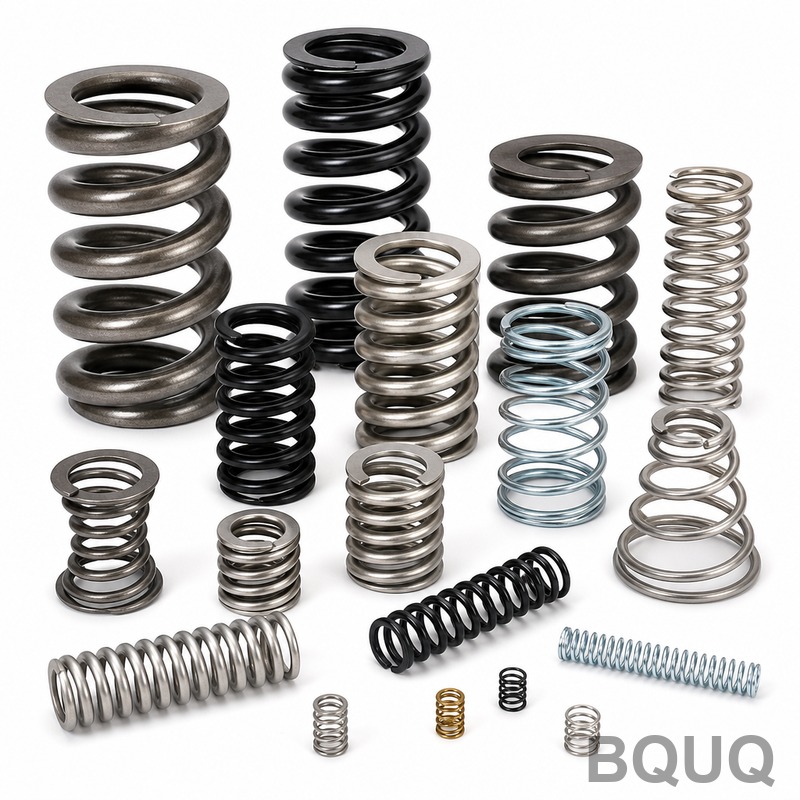
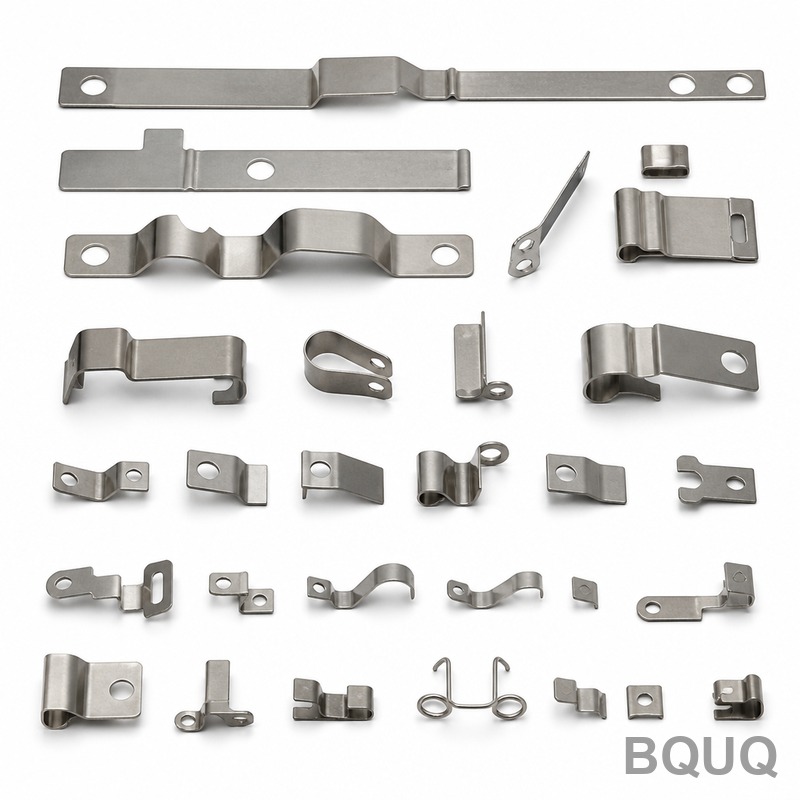
1. **Wave springs** for battery terminal contacts, requiring a flat load-deflection curve over a 3 mm travel range with 5% tolerance. 2. **Conical springs** for motor brush holders, engineered to collapse to solid height without coil clash, maintaining constant force for 10 million cycles. 3. **Wire-formed clips** for busbar connections, manufactured with 0.3 mm thick strip, bent to ±0.05 mm positional accuracy.
The thermal challenge is severe. EV battery enclosures cycle from -40°C to +85°C. Standard spring steel loses 12% of its load capacity at elevated temperatures. BQUQ now uses a proprietary cryogenic treatment (soaking at -196°C for 24 hours) on EV springs, which improves fatigue life by 300% and stabilizes load loss to under 3% across the temperature range.
Surface Treatment and Corrosion Protection Innovations
Surface finishing has evolved from simple zinc plating to multi-layer systems. The industry standard for automotive underhood springs is now: - Zinc-nickel alloy plating (12-15 microns) with a trivalent chromium passivation layer - Topcoat of PTFE or MoS2 for reduced friction coefficient (0.08 versus 0.15 for bare steel) - Salt spray resistance of 720 hours minimum (ASTM B117)
For high-temperature applications, shot peening remains critical. Peening with 0.6 mm ceramic beads at 50-60 psi increases compressive residual stress to 800 MPa at the surface. This improves fatigue strength by 25% compared to unpeened springs. The latest trend is dual-peening: first pass with large media (0.8 mm) for deep stress, second pass with small media (0.3 mm) for surface smoothness, achieving a 0.4-micron Ra surface finish.
Cost Structure and Lead Time Benchmarks in 2024
Understanding pricing transparency is vital for procurement engineers. BQUQ's internal cost model for a typical 5 mm wire diameter compression spring (50 mm free length, 10 active coils) is broken down as follows:
| Cost Component | Percentage of Total Cost | Notes |
| Raw Material (Chrome Silicon) | 38% | Wire cost fluctuates with global nickel prices |
| Tooling Amortization | 12% | CNC cam tooling, $800-$2,500 per spring design |
| Machining/Coiling | 22% | 0.8 minutes per part at $60/hour machine rate |
| Heat Treatment | 8% | Oil quench at 850°C, temper at 400°C, 2-hour cycle |
| Surface Treatment | 10% | Zinc-nickel + PTFE, $0.05 per spring |
| Quality Inspection | 6% | 100% optical check, load testing on 5% sample |
| Packaging and Logistics | 4% | Export-grade anti-rust paper, wooden pallets |
Lead times have contracted. Standard tooled springs ship in 5-7 business days. Custom prototypes with 3D-printed mandrels ship in 72 hours. For high-volume orders (over 100,000 pieces), production lead time is 15-20 days including full PPAP documentation. Same-day quoting is achievable when customers provide a 2D drawing or 3D model with material and load specifications.
Practical Recommendations for Sourcing Engineers
1. **Specify the operating environment first.** If temperature exceeds 150°C, do not use standard chrome silicon. Demand Inconel or Elgiloy. The material upgrade costs 8x more but prevents catastrophic failure. 2. **Define the load at a specific deflection, not just a spring rate.** Manufacturing tolerance of ±5% on rate is standard, but load at height can be held to ±2% with additional grinding and setting operations. 3. **Request the SPC data with your PPAP.** A reliable supplier will provide Cpk values above 1.33 for critical dimensions. If they only offer "in tolerance" certificates, consider it a red flag. 4. **Consider wire diameter optimization.** Reducing wire diameter from 4.0 mm to 3.8 mm lowers material cost by 10% but may require a redesign. Use finite element analysis (FEA) before approving changes. 5. **For prototype testing, order 50 pieces, not 5.** The first 10 pieces prove the coiling setup, the next 40 provide statistically valid fatigue data. This costs $50-$150 extra but saves weeks in validation.
Frequently Asked Questions on Spring Manufacturing Technology
**Q: What is the tightest tolerance achievable on spring outer diameter?** A: With CNC servo-controlled coiling, we hold ±0.02 mm on OD up to 20 mm wire diameter. Below 1 mm wire, tolerance tightens to ±0.005 mm using wire guiding with laser feedback.
**Q: How does spring rate vary with temperature?** A: For music wire, the modulus of elasticity decreases by 10% at 100°C. Chrome silicon retains 95% of its room-temperature rate up to 200°C. Always derate load requirements if operating above 80°C.
**Q: Can springs be manufactured with a coil end ground flat?** A: Yes, closed and ground ends are standard for compression springs over 10 mm free length. Grinding to a squareness of 1 degree per 25 mm length is achievable. Double grinding ensures 0.05 mm flatness on the bearing surface.
**Q: What is the minimum order quantity for custom springs?** A: For CNC coiling, 200 pieces is economical. For wire forming on a four-slide machine, 5,000 pieces is the break-even point. We offer a prototype service at 50 pieces with a 3-day lead time for design validation.
The spring manufacturing landscape is defined by precision, speed, and material intelligence. The transition to EVs and AI-driven quality systems means that suppliers must invest in digital metrology and material science expertise to remain competitive. As a 20-year veteran factory in Dongguan, BQUQ has fully automated its spring lines with 100% inline inspection and maintains in-house metallurgical testing for every incoming wire batch.
For engineers who need a reliable partner for custom springs, heat sinks, or CNC machined components, our engineering team offers free design-for-manufacturability reviews. Submit your drawing or 3D model today and receive a detailed quotation with tolerance analysis and lead time within 12 hours. Email us at sc@bquq.com or contact our technical sales desk on WhatsApp at +86 13713157787. Visit www.bquq.com to browse our material certifications and download our spring design handbook.
Related Articles
- Size control and online intelligent detection technology of precision spring
- Hardware spring fatigue failure analysis and life prediction technology
- In-depth analysis of technology and process in the hardware spring industry in 2026: a full-dimensional interpretation of high stress, functional integration and engineering certification