What Are the Manufacturing Differences Between Bonded Fin and Skived Fin Heat Sinks?
If you are selecting a high-performance heat sink for a power electronics or telecommunications application, the direct answer is that skived fin heat sinks are superior for high fin density and thermal conductivity, while bonded fin heat sinks are more cost-effective for low-to-moderate fin density and simpler geometries. Skiving is a single-piece manufacturing process that achieves fin heights up to 60 mm with fin thicknesses as low as 0.4 mm, whereas bonding involves attaching prefabricated fins to a base plate with thermal epoxy or solder. Your choice depends on thermal budget, volume, and operating environment, with skived units typically costing 30-50 percent more per piece than equivalently sized bonded units.
How Do Bonded Fin and Skived Fin Manufacturing Processes Differ Mechanically?
Bonded fin heat sinks are assembled from separate components: a flat base plate and individual fins that are mechanically interlocked or adhered using thermally conductive epoxy or brazing. The process involves stamping, shearing, or extruding aluminum fins (typically 1.0-2.5 mm thick) and then attaching them to a grooved base plate. The bond line thickness for epoxy is generally 0.05-0.15 mm, and the thermal interface resistance of the joint is approximately 0.1-0.5 °C·cm²/W, depending on the adhesive quality. Skived fin heat sinks, conversely, are produced from a single block of aluminum or copper. A precision cutting tool peels a continuous layer of metal upward, forming fins from the solid parent material without any joints or interfaces. This process yields fin thicknesses of 0.4-1.5 mm and fin pitches down to 1.2 mm, allowing aspect ratios (fin height to gap width) of up to 40:1 for aluminum.
What Are the Achievable Fin Geometries and Tolerances for Each Method?
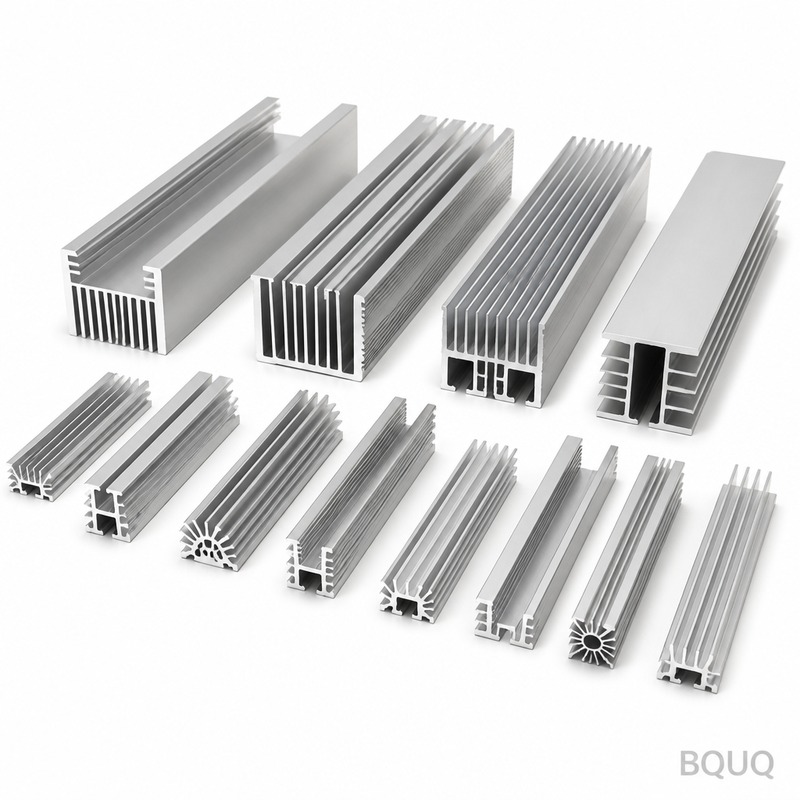
Skiving excels in producing high-density fin arrays with excellent dimensional accuracy, holding fin thickness tolerances of +/-0.05 mm and fin height tolerances of +/-0.15 mm. Bonded fin assemblies have looser tolerances because of the assembly process; fin spacing can vary by +/-0.2 mm and perpendicularity is typically within 0.5 degrees. For bonded fins, maximum fin height is practically limited to 50 mm with a minimum fin thickness of 1.0 mm, while skiving can reach fin heights of 60 mm from aluminum alloy 6063-T5 and 40 mm from copper C1100. The minimum fin gap for skiving is 1.0 mm versus 2.5 mm for bonded fins, meaning skived heat sinks generally provide 20-40 percent more surface area for the same base footprint.
How Much Do Bonded Fin and Skived Fin Heat Sinks Cost per Unit?
For a typical heat sink measuring 150 mm by 100 mm by 50 mm high with a fin pitch of 3.0 mm, bonded fin tooling costs are minimal because the base plate is machined with standard CNC equipment and fins are pre-formed using simple stamping dies. Tooling amortization for a bonded fin design is USD 500-1,500 for low volumes, while skived fin tooling is a custom rotary cutter that costs USD 2,000-4,000 and is specific to the fin pitch and depth. At production volumes of 1,000 pieces, bonded fin units cost USD 8-15 each, whereas skived units cost USD 12-22 each for the same thermal dissipation. The break-even volume is around 5,000 pieces, where the skived unit's higher per-piece price is offset by its lower thermal resistance, which can reduce the total heat sink surface area needed by 15-25 percent.
Which Thermal Performance Values Are Realistic for Bonded vs Skived Fins?
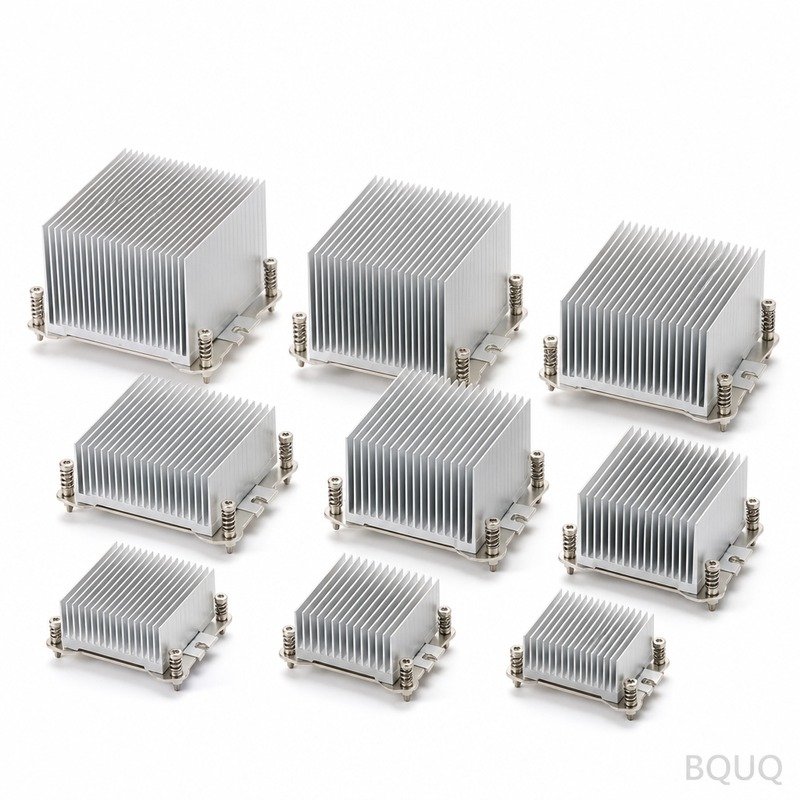
In natural convection at a heat flux of 1 W/cm², a skived aluminum heat sink with 2.0 mm fin pitch and 40 mm fins achieves a thermal resistance of 0.35 °C/W, while a bonded fin equivalent with 4.0 mm pitch achieves 0.55 °C/W. Under forced convection at 2.5 m/s, the skived unit can reach 0.12 °C/W versus 0.20 °C/W for bonded fins. The key temperature limitation for bonded units is the adhesive: standard thermal epoxy is rated to 150 °C continuous and 180 °C peak, while solder-attached fins (using Sn96.5Ag3Cu0.5) handle up to 220 °C. Skived fins have no joint limitation and can operate at temperatures up to 250 °C for aluminum and 300 °C for copper without degradation. Maximum heat dissipation for a skived copper heat sink of 100 mm by 100 mm base is 450 W at a junction temperature of 85 °C, compared to 320 W for a bonded aluminum unit of the same footprint.
Why Does Bond Integrity Affect Long-Term Reliability in Bonded Fin Heat Sinks?
The interface between fin and base plate is the primary failure point in bonded fin heat sinks. Thermal cycling from -40 °C to 125 °C can cause differential expansion between the aluminum base (CTE 23 ppm/°C) and epoxy adhesive (CTE 30-60 ppm/°C), leading to delamination after 500-1,000 cycles. This increases thermal resistance by 30-50 percent over the product life. In contrast, skived fins are monolithic, so there is no interface to degrade; thermal resistance remains stable over 10,000+ thermal cycles. For automotive or aerospace applications requiring 10-year service life, skived fin heat sinks are the recommended choice because they eliminate the risk of adhesive fatigue. Bonded fin units with mechanical interlock (no adhesive) are more reliable than epoxy units but still exhibit 5-10 percent higher initial thermal resistance than skived equivalents due to the micro-gaps at the interface.
When Should a Manufacturer Choose Bonded Fin Instead of Skived Fin?
Choose bonded fin heat sinks when your thermal requirement is below 100 W per 100 mm of base length, when operating temperatures are below 150 °C, and when production volume is less than 2,000 pieces per year. Bonded fin units are also preferred when the heat sink requires a complex base plate shape (e.g., mounting bosses, through-holes for fasteners) because the base can be CNC machined independently before fin attachment. Skived fin heat sinks are the better choice for high-power IGBT modules, laser diodes, or motor controllers where the heat flux exceeds 2 W/cm² and space is constrained. Additionally, skived fins are mandatory for applications with high vibration (above 10 G RMS) because there are no joints that can loosen.
How Do Material Options Compare for Bonded and Skived Heat Sinks?
Bonded fin heat sinks are almost exclusively made from aluminum alloys 6063-T5 or 6061-T6 for both fins and base plates, although copper fins can be attached with silver solder for high-end applications. Skiving is more versatile: it can produce heat sinks from aluminum 6063, aluminum 1100, copper C1100, and even copper-tungsten alloys for matched CTE applications. The thermal conductivity of skived copper (385 W/m·K) is 1.6 times that of aluminum (167-201 W/m·K), but copper skiving costs 40-60 percent more per piece. For bonded fins, the effective thermal resistance includes the adhesive joint, which adds approximately 0.15 °C·cm²/W to the system; this penalty is absent in skived fins.
| Parameter | Bonded Fin (Aluminum 6063) | Skived Fin (Aluminum 6063) | Skived Fin (Copper C1100) |
| Minimum fin thickness | 1.0 mm | 0.4 mm | 0.5 mm |
| Minimum fin gap | 2.5 mm | 1.0 mm | 1.2 mm |
| Maximum fin height | 50 mm | 60 mm | 40 mm |
| Fin height tolerance | +/-0.20 mm | +/-0.10 mm | +/-0.10 mm |
| Thermal resistance (25°C, natural conv., 100x100x40 mm) | 0.55 °C/W | 0.35 °C/W | 0.22 °C/W |
| Maximum continuous operating temperature | 150 °C (epoxy) or 220 °C (solder) | 250 °C | 300 °C |
| Relative cost per piece (1,000 pcs) | USD 8-15 | USD 12-22 | USD 20-35 |
| Tooling cost | USD 500-1,500 | USD 2,000-4,000 | USD 3,000-5,000 |
| Thermal cycle life (-40 to 125 °C) | 500-1,000 cycles | 10,000+ cycles | 10,000+ cycles |
Can Skived Fins Be Combined with Other Manufacturing Processes?
Yes, skived fin heat sinks can be post-processed with CNC machining to add mounting holes, threaded inserts, or fluid channels. The skiving process leaves a continuous base plate of 3-8 mm thickness, which is sufficient for secondary operations. However, note that skiving cannot create fins that are curved or tapered; all fins are straight and parallel to the cutting direction. Bonded fin heat sinks allow for more design freedom in fin orientation, including angled or staggered fins, because each fin is placed individually. If your design requires a liquid-cooled cold plate with integral fins, skiving is the preferred method because the fin structure is machined from the same block as the fluid channel, eliminating any leakage path at fin joints.
What Is the Recommended Selection Procedure for a New Thermal Design?
For a new design, first calculate the required thermal resistance based on your junction temperature limit and power dissipation. If the required thermal resistance is below 0.3 °C/W for a 100 mm by 100 mm base, skived aluminum or copper is necessary. For resistances above 0.5 °C/W, bonded aluminum is sufficient and more economical. Second, verify the operating temperature: if it exceeds 150 °C, bonded fins with epoxy are disqualified. Third, estimate annual volume: below 2,000 pieces, bonded is cheaper; above 5,000 pieces, skiving becomes competitive because the tooling cost is amortized. Fourth, assess vibration and thermal cycling requirements from your environmental specification (e.g., IEC 60068-2-6 for vibration); if cycling exceeds 1,000 cycles, select skived. Finally, request thermal simulation from your manufacturer using computational fluid dynamics to confirm the fin pitch and height before committing to tooling.
FAQ
What Is the Maximum Fin Density Achievable with Skiving?
Skiving achieves a minimum fin pitch of 1.2 mm for aluminum and 1.5 mm for copper, resulting in a fin density of up to 833 fins per meter. This is approximately 2.5 times denser than bonded fin heat sinks, which are limited to 400 fins per meter.
How Long Does Tooling Take for Bonded vs Skived Heat Sinks?
Bonded fin tooling (stamping dies for fins and fixture for assembly) takes 2-3 weeks to manufacture. Skived fin tooling (custom rotary cutter) takes 4-6 weeks because the cutter profile must be ground to match your exact fin pitch and thickness.
Can Bonded Fin Heat Sinks Be Repaired After Delamination?
No, bonded fin heat sinks cannot be reliably repaired because reheating the epoxy or solder damages the aluminum temper and distorts the fins. Replacement is the standard practice, whereas skived fins have no delamination risk and require no repair.
Which Process Is Better for High-Volume Consumer Electronics?
For consumer electronics with thermal loads under 50 W, bonded fin heat sinks are preferred due to lower per-unit cost (USD 5-8) and faster assembly. Skived fins are rarely used in consumer devices because their cost advantage only appears above 100 W dissipation.
What Is the Typical Lead Time for Prototype Skived Fin Heat Sinks?
Prototype skived fin heat sinks (5-10 pieces) require 5-7 business days including CNC finishing, while bonded fin prototypes take 3-5 days because fins can be cut from standard stock and attached with epoxy. For production quantities, lead time is 3-4 weeks for either method.
How Does Surface Finish Affect Thermal Performance of Skived Fins?
Skived fins have a natural surface finish of Ra 1.6-3.2 micrometers, which is adequate for convection heat transfer. Applying a black anodize coating (thickness 15-25 micrometers) increases emissivity from 0.08 to 0.85, improving radiative heat transfer by 15-25 percent in natural convection applications.
Are There Any Restrictions on Heat Sink Size for Skiving?
Skiving is limited by the cutting machine stroke, typically 300 mm in length and 150 mm in width. For heat sinks larger than 300 mm in any dimension, bonded fins or alternative methods like folded fin arrays are required.
After evaluating your thermal requirements, contact BQUQ for a detailed feasibility study and cost quotation. Our engineering team provides 12-hour quoting for custom heat sink designs, including thermal simulation and DFM feedback. Send your CAD files to sc@bquq.com or message us on WhatsApp at +86 13713157787. Visit www.bquq.com to download our heat sink design guide.