What Are the Thermal Effects of Anodizing and Coating on Heat Sinks?
The direct answer is that anodizing improves a heat sink's emissivity (radiative heat transfer) but adds a thin, thermally insulating oxide layer, while organic coatings like paint or powder coating provide a similar emissivity boost with a higher thermal resistance penalty. For most natural convection and low-airflow applications, the radiative benefit of a black anodized coating outweighs the insulating penalty, improving overall thermal performance by 5-20%. However, in high-airflow forced convection systems, the added thermal resistance of thick coatings can degrade performance, making the choice of surface treatment a critical engineering decision.
How Does Anodizing Change the Thermal Performance of an Aluminum Heat Sink?
Anodizing creates a controlled aluminum oxide (Al2O3) layer on the surface, typically 5 to 25 micrometers thick for decorative or protective grades. The oxide layer has a thermal conductivity of roughly 1.0 to 1.5 W/m·K, which is about 150 times lower than the base aluminum alloy (167-220 W/m·K). This adds a thermal resistance of approximately 0.005 to 0.02 °C/W for a typical 100 mm x 100 mm base, which is negligible in most designs. The dominant benefit is the increase in surface emissivity from a polished aluminum value of 0.05-0.10 to a black anodized value of 0.85-0.95, which significantly enhances radiative heat transfer, especially when the heat sink is operating at temperatures 30-80°C above ambient.
What Is the Difference Between Type II and Type III Anodizing for Heat Dissipation?
Type II (sulfuric acid anodizing) produces a porous layer of 5-15 micrometers and is the most common for heat sinks, offering an emissivity of 0.85-0.90 with minimal thermal penalty. Type III (hard anodizing) creates a thicker layer of 25-75 micrometers, which increases wear resistance but raises the thermal resistance by 0.02-0.05 °C/W, making it less ideal for high-heat-flux applications unless wear resistance is mandatory. For most CPU coolers and power electronics, Type II with a black dye is the optimal balance, providing an emissivity of 0.90 while keeping the insulating layer thin enough to add less than 1% to the total thermal resistance.
Why Does a Black Coating Improve Heat Sink Performance in Natural Convection?
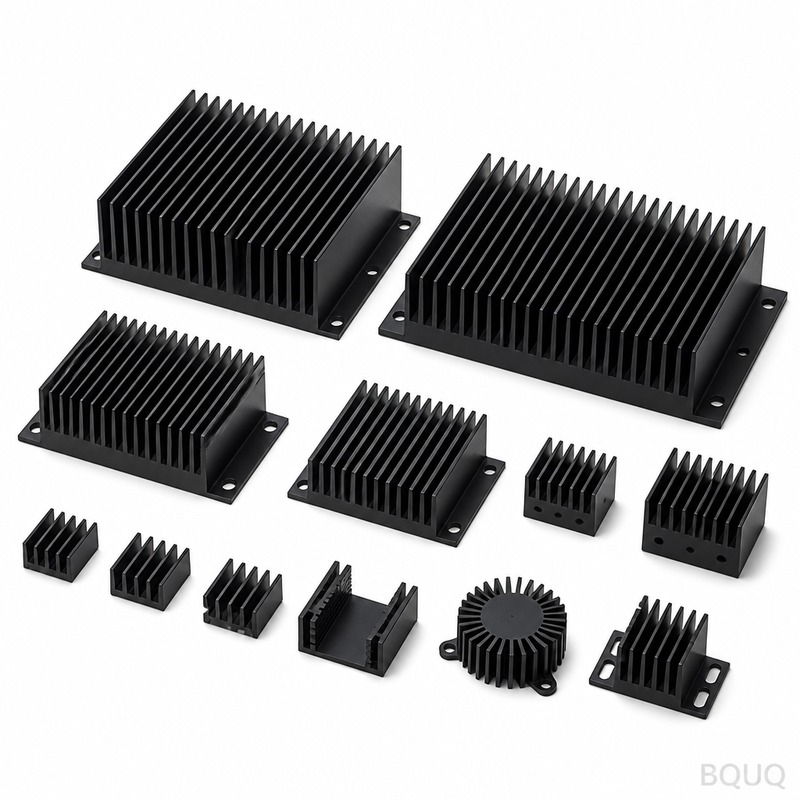
In natural convection (no forced airflow), heat transfer relies on both buoyancy-driven air movement and radiation. At a typical heat sink surface temperature of 70°C in a 25°C ambient, radiation accounts for 25-35% of total heat dissipation for a bare aluminum surface, but this jumps to 45-60% when the surface is black anodized. The high emissivity of anodized aluminum (0.90) allows the heat sink to radiate energy more effectively to surrounding surfaces, reducing the temperature gradient required for the same heat load. A practical example: a 100 W LED heat sink with a black anodized finish will run 5-10°C cooler than the same bare aluminum unit in a sealed enclosure with no airflow.
Which Coating Types Offer the Best Thermal Performance per Unit Cost?
Black anodizing is the gold standard, costing roughly $0.50 to $2.00 per square foot depending on batch size, with a thermal resistance penalty of less than 0.01 °C/W. Electrophoretic coating (e-coating) is a close second, offering an emissivity of 0.90-0.95 with a slightly thicker organic layer (15-30 micrometers) and a thermal penalty of 0.01-0.03 °C/W at a cost of $0.80 to $2.50 per square foot. Powder coating, while durable, is the worst thermal performer due to its thick layer (50-100 micrometers) and low thermal conductivity (0.2-0.5 W/m·K), adding 0.05-0.15 °C/W, which can negate radiative gains in high-power applications. For high-volume production, anodizing remains the most cost-effective and thermally efficient option.
How Much Does Surface Treatment Add to the Overall Heat Sink Cost?
For a typical extruded aluminum heat sink weighing 500 grams, the base extrusion cost is approximately $3.00 to $8.00, while anodizing adds only $0.50 to $1.50 per unit. In contrast, powder coating adds $1.00 to $2.50 per unit due to the thicker material and curing energy, and it also extends lead time by 1-2 days. For a production run of 10,000 units, the cost difference between anodizing and powder coating is roughly $5,000 to $15,000, which is a significant factor for thermal engineers managing tight BOM budgets.
| Surface Treatment | Typical Thickness | Emissivity (0-1) | Thermal Conductivity (W/m·K) | Added Thermal Resistance (°C/W) | Cost per sq ft (USD) |
| Bare Aluminum | 0 micrometers | 0.05-0.10 | 167-220 | 0 | $0.00 |
| Type II Anodizing (Black) | 5-15 micrometers | 0.85-0.90 | 1.0-1.5 | 0.005-0.010 | $0.50-$1.50 |
| Type III Hard Anodizing | 25-75 micrometers | 0.85-0.90 | 1.0-1.5 | 0.020-0.050 | $1.50-$3.00 |
| E-coating (Black) | 15-30 micrometers | 0.90-0.95 | 0.3-0.5 | 0.010-0.030 | $0.80-$2.50 |
| Powder Coating (Black) | 50-100 micrometers | 0.90-0.95 | 0.2-0.5 | 0.050-0.150 | $1.00-$2.50 |
When Should You Avoid Anodizing or Coating on a Heat Sink?
You should skip anodizing when the heat sink is used in high-vacuum environments, where radiation is negligible and any added coating only adds thermal resistance without radiative benefit. You should also avoid coatings in applications with extreme thermal cycling (e.g., -40°C to 150°C) where differential thermal expansion between the coating and aluminum can cause micro-cracking and flaking. For liquid-cooled cold plates where heat transfer is dominated by convection through the coolant, anodizing provides no benefit and can actually reduce the heat transfer coefficient at the interface by up to 5%, so bare aluminum or a thin nickel plating is preferred.
How Should You Specify Surface Treatment for Optimal Thermal and Cost Performance?
Specify Type II anodizing with a black dye (per MIL-A-8625F or ASTM B580) for any heat sink that relies on natural convection or has an airflow velocity below 2 m/s. For forced convection systems with airflow above 3 m/s, request a "thin film" anodizing of 5-8 micrometers or use a bare aluminum with a chromate conversion coating, which provides corrosion resistance with an emissivity of only 0.15-0.30. Always request a thermal test report from your manufacturer comparing bare versus treated units; a reputable shop like BQUQ will provide CFD simulation and empirical data before tooling commitment.
What Are the Failure Modes of Heat Sink Coatings Under Thermal Stress?
The primary failure mode is delamination, typically occurring when the operating temperature exceeds 120°C for organic coatings, causing the polymer matrix to soften and separate from the aluminum substrate. Anodized layers are more stable up to 200°C, but above this temperature, the oxide layer can crack due to the mismatch in thermal expansion coefficients (23.6 x 10^-6 /°C for aluminum versus 5.4 x 10^-6 /°C for alumina). For high-temperature applications exceeding 150°C, consider a ceramic-based coating or leave the aluminum bare and rely on increased fin surface area to compensate for lower emissivity.
Can Surface Treatment Replace Additional Fin Area in a Thermal Design?
Yes, but only within a specific range. A black anodized heat sink with an emissivity of 0.90 can reduce the required fin surface area by 15-25% compared to a bare aluminum design at the same thermal resistance, which can translate to a 10-20% reduction in heat sink weight and volume. However, this trade-off becomes less effective at high power densities (above 50 W/cm²), where conduction through the base and fins dominates and radiation contributes less than 10% of total heat transfer. In those cases, increasing airflow or using heat pipes is a more effective solution than surface treatment.
FAQ
What Is the Maximum Operating Temperature for Anodized Heat Sinks?
Standard Type II anodizing is rated for continuous operation up to 150°C, while Type III hard anodizing can withstand up to 200°C. Above these temperatures, the oxide layer remains intact but the aluminum substrate begins to lose its mechanical strength, so the thermal performance degrades due to structural deformation rather than coating failure.
Does Black Anodizing Improve Heat Sink Performance in Forced Convection?
In forced convection with airflow above 3 m/s, the radiative contribution drops below 10% of total heat transfer, so black anodizing provides minimal benefit. In fact, the added thermal resistance of the oxide layer can reduce overall performance by 2-5% in high-speed airflow, making bare aluminum or a thin conversion coating more suitable.
How Long Does Anodizing Take Compared to Powder Coating?
Anodizing is a batch process that typically takes 45-60 minutes for the full cycle, including cleaning, etching, anodizing, and sealing. Powder coating requires 1-2 hours due to the pre-treatment, powder application, and curing at 180-200°C for 15-20 minutes. For production lead times, anodizing adds 1-2 days to a standard order, while powder coating adds 3-5 days.
Can You Anodize a Heat Sink That Has Already Been Machined?
Yes, CNC-machined heat sinks are commonly anodized after machining, but you must specify that sharp edges and threads be masked or plugged to prevent acid entrapment. The anodizing process removes approximately 2-3 micrometers of material, so critical dimensions should be held to a tolerance of ±0.05 mm to account for this.
What Is the Difference Between Clear Anodizing and Black Anodizing Thermally?
Both clear and black anodizing produce the same oxide layer thickness and thermal conductivity, but clear anodizing has an emissivity of 0.40-0.50, while black dyed anodizing reaches 0.85-0.90. The dye itself is a pigment that increases surface roughness and emissivity without adding significant thickness, so black anodizing is always preferred for radiative heat transfer.
Is Electroless Nickel Plating a Better Option Than Anodizing?
Electroless nickel plating has a thermal conductivity of 4-8 W/m·K, which is better than anodizing, but its emissivity is only 0.20-0.30, making it inferior for radiation. It is recommended for applications requiring solderability, wear resistance, or a hard surface, but for thermal performance alone, anodizing is superior.
How Do You Verify the Emissivity of a Finished Heat Sink?
Emissivity is measured using an infrared thermometer or a Fourier-transform infrared spectrometer in accordance with ASTM E1933 or C1371. A simpler method is to compare the thermal resistance of an anodized sample against a bare sample using a standardized thermal test fixture with a controlled heat source and thermocouples.
For your next heat sink project, BQUQ provides in-house surface treatment lines and thermal testing labs to validate your design. We offer 12-hour quoting on custom CNC-machined and stamped heat sinks, with free emissivity testing for all prototype orders. Contact us at sc@bquq.com or WhatsApp +86 13713157787, or visit www.bquq.com to send your CAD files for immediate review.
Related Articles
- Thermal Management for High Brightness LEDs with Heat Sinks
- New energy vehicle IGBT heat dissipation, heat sink reliability engineering, heat pipe and temperature plate integrated heat sink, surface treatment and heat radiation enhancement: anodic oxidation, black coating and micro-nano structure, graphene/3D printing/intelligent thermal management: 2030 heat sink technology roadmap
- 5G Base Station Outdoor AAU Cooling: The Climate Adaptation Challenge of Fanless Passive Design