What Is a Bonded Heat Sink? High-Performance Fin Assembly Explained
A bonded heat sink is a high-performance thermal management component created by mechanically or adhesively joining individual aluminum or copper fins to a flat machined base plate, achieving fin densities and aspect ratios that are impossible with standard extrusion or skiving processes. This construction method is the preferred engineering solution when thermal budgets require heat dissipation above 50 W/cm² or when the fin height-to-gap ratio exceeds the 10:1 limit of conventional extrusion. Bonded assemblies deliver thermal performance comparable to brazed or skived heat sinks at a lower tooling cost and with faster prototyping lead times, typically 3 to 5 business days for samples.
How Does a Bonded Heat Sink Differ from Extruded or Skived Heat Sinks?
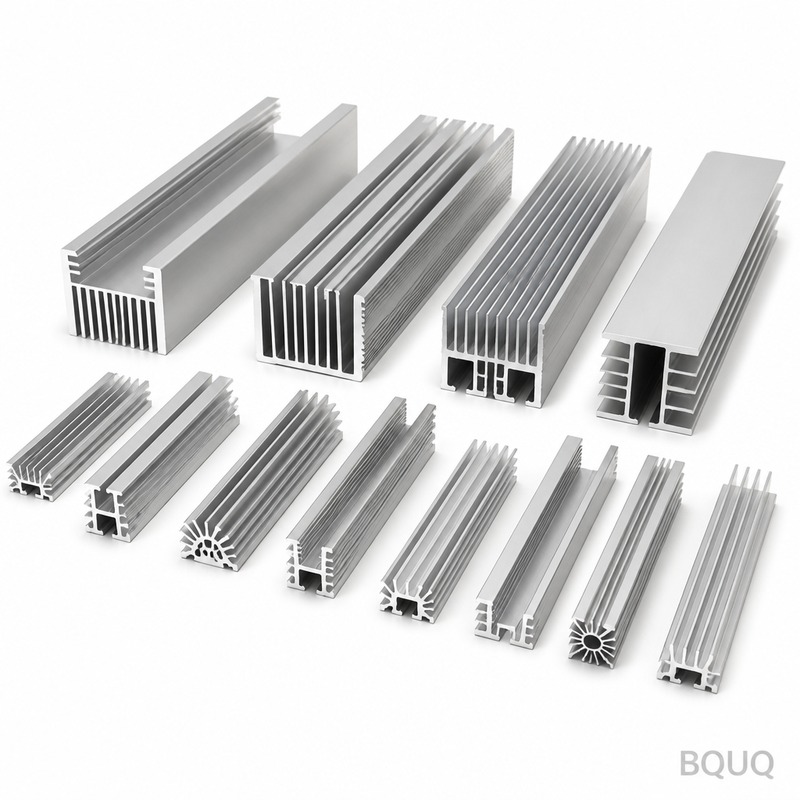
The fundamental difference lies in the manufacturing process and the resulting fin geometry. Extruded heat sinks are formed by forcing heated aluminum billets through a die, which limits fin height-to-gap ratios to approximately 8:1 and minimum fin thickness to around 1.0 mm for 6063-T5 alloy. Skived heat sinks use a cutting tool to shave fins from a solid block, achieving thinner fins (0.3 to 0.8 mm) but with a maximum fin height of about 75 mm and a higher material waste rate of 15% to 20%. In contrast, a bonded heat sink starts with a machined or extruded base plate and individual fins, which are then attached using a high-performance thermal epoxy (thermal conductivity 1.0 to 3.0 W/m·K) or a mechanical interlock method. This allows fin heights up to 200 mm, fin thicknesses down to 0.5 mm, and fin pitch (center-to-center spacing) from 2.5 mm to 6.0 mm, providing up to 40% more surface area than an equivalent-size extrusion.
What Are the Typical Thermal Performance Specifications for Bonded Heat Sinks?
The thermal resistance of a bonded heat sink depends directly on the interface quality between the fins and the base plate. With a properly cured thermal epoxy bond line of 0.05 mm to 0.10 mm, the thermal resistance contribution of the joint is typically 0.05 °C/W to 0.15 °C/W per fin row, depending on the bond area. For a standard bonded heat sink measuring 200 mm by 200 mm with 20 fins of 50 mm height, the overall thermal resistance from case to ambient is approximately 0.12 °C/W to 0.25 °C/W at an airflow of 3 m/s. This performance is within 10% to 15% of a comparable vacuum-brazed unit, while the bonded version costs 20% to 35% less in prototype quantities. The maximum operating temperature is limited by the adhesive, with standard epoxy rated for continuous service at 150 °C and high-temperature grades (such as silicone-based systems) rated up to 250 °C. For applications exceeding 250 °C, mechanical bonding methods, such as expansion-fit or clip-on fins, are required.
Why Choose a Bonded Heat Sink Over a Forged or Die-Cast Solution?
The primary engineering reason is the combination of design flexibility, lead time, and cost efficiency for medium-volume production runs of 500 to 5,000 units per year. Forged heat sinks require expensive tooling (USD 8,000 to USD 25,000) and have geometric constraints that prevent very deep or closely spaced fins. Die-cast aluminum heat sinks have poor thermal conductivity (approximately 80 to 100 W/m·K for ADC12 versus 180 W/m·K for 6063-T5) and are limited to fin thicknesses above 1.5 mm. Bonded heat sinks use standard 6063-T5 or 1100-O aluminum fins and a 6061-T6 or C1100 copper base plate, allowing the thermal designer to optimize each material for its role: the copper base spreads heat quickly with a conductivity of 385 W/m·K, while the aluminum fins provide low-cost surface area. This bi-metallic capability is a significant advantage, as a copper base with aluminum fins can reduce thermal resistance by 25% to 40% compared to an all-aluminum extrusion, at a material cost increase of only 15% to 20%.
Which Materials and Fin Geometries Are Best Suited for Bonded Heat Sinks?
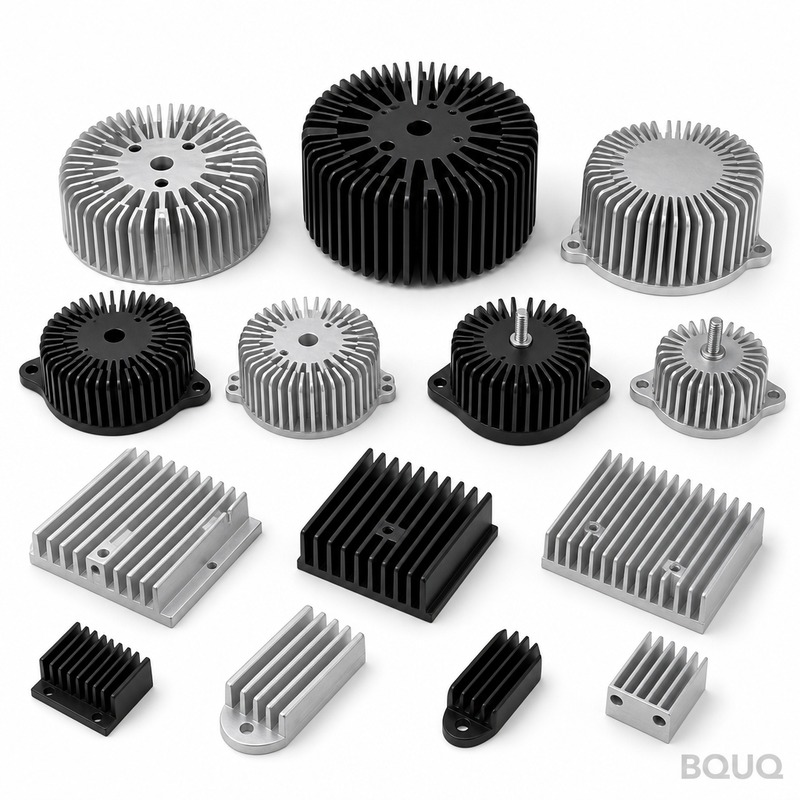
Aluminum alloys 6063-T5 and 6061-T6 are the most common fin materials due to their combination of thermal conductivity (180 to 200 W/m·K), machinability, and corrosion resistance. For copper fins, C1100 electrolytic tough pitch copper is standard, providing 385 W/m·K but increasing weight by a factor of 3.3 and cost by a factor of 4 to 6 compared to aluminum. The optimal fin geometry for bonded assemblies depends on the airflow regime. For natural convection (airflow below 0.5 m/s), a fin pitch of 6.0 to 8.0 mm is recommended to avoid boundary layer interference, with fin heights of 25 to 50 mm. For forced convection (airflow 2 to 5 m/s), a fin pitch of 3.0 to 4.0 mm and fin heights of 50 to 100 mm are typical, as they provide the best balance of surface area and pressure drop. The maximum recommended fin aspect ratio (height divided by gap) is 30:1 for bonded construction, compared to 8:1 for extrusions and 20:1 for skived products.
How Much Does a Bonded Heat Sink Cost and What Is the Lead Time?
The cost structure for bonded heat sinks is highly sensitive to fin count, base plate machining complexity, and bonding method. For a standard aluminum bonded heat sink with a 100 mm by 100 mm base and 10 fins of 30 mm height, the unit price in quantities of 1,000 pieces is typically USD 8 to USD 15. A larger assembly with a 200 mm by 200 mm copper base and 20 aluminum fins of 60 mm height ranges from USD 35 to USD 60 per unit in the same volume. Tooling costs are minimal, usually USD 500 to USD 2,000 for the base plate fixture and fin alignment jig, since standard CNC machining and stamping dies are used. Prototype lead time is 3 to 5 business days for the first article, and production lead time is 10 to 15 business days after design approval, which is 40% faster than brazing or skiving for the same geometry.
| Parameter | Bonded Heat Sink | Extruded Heat Sink | Skived Heat Sink |
| Fin height (max) | 200 mm | 100 mm (typical) | 75 mm |
| Fin thickness (min) | 0.5 mm | 1.0 mm | 0.3 mm |
| Fin pitch (min) | 2.5 mm | 4.0 mm | 1.5 mm |
| Fin height-to-gap ratio | 30:1 | 8:1 | 20:1 |
| Thermal resistance (200x200mm, 20 fins) | 0.12 to 0.25 °C/W | 0.20 to 0.35 °C/W | 0.10 to 0.20 °C/W |
| Tooling cost | USD 500 to 2,000 | USD 1,500 to 5,000 | USD 3,000 to 8,000 |
| Prototype lead time | 3 to 5 days | 10 to 15 days | 7 to 10 days |
| Max operating temperature | 250 °C (high-temp epoxy) | 300 °C | 300 °C |
When Should a Bonded Heat Sink Be Avoided?
Bonded heat sinks are not the correct solution in three specific scenarios. First, for extreme high-vibration environments (above 20 g RMS) or thermal cycling exceeding 10,000 cycles from -40 °C to 125 °C, the adhesive bond line may experience fatigue cracking, and a brazed or folded-fin heat sink is more reliable. Second, for very high power densities above 100 W/cm², the thermal interface resistance of the epoxy becomes the bottleneck; in this case, a vapor chamber or liquid-cooled cold plate is required. Third, for high-volume production above 50,000 units per year, the per-unit labor cost of assembling and curing individual fins makes bonded heat sinks uncompetitive compared to a custom extrusion or a stamped-folded fin assembly. In these cases, the engineering team should evaluate the total cost of ownership, including reliability testing, rather than only the initial unit price.
How Does BQUQ Ensure Quality and Consistency in Bonded Heat Sink Production?
Quality control for bonded heat sinks focuses on three critical parameters: bond line thickness, adhesive coverage, and fin alignment. At BQUQ, we use automated dispensing equipment that applies a consistent 0.08 mm adhesive layer, followed by a vacuum-press curing process at 120 °C for 60 minutes, achieving a void rate below 2% as verified by X-ray inspection. Each production lot is sampled for pull-test strength (minimum 8 MPa adhesive shear strength on 6063-T5 aluminum) and thermal resistance verification using a guarded hot plate method per ASTM D5470. Fin alignment is held to a tolerance of ±0.10 mm across the entire fin array, and base plate flatness is maintained at 0.05 mm over 100 mm, ensuring proper mounting to the heat source. These controls result in a field failure rate of less than 0.1% for bonded heat sinks in industrial power electronics applications.
FAQ
What Is the Maximum Fin Height for a Bonded Heat Sink?
The maximum practical fin height is 200 mm for aluminum fins with a thickness of 1.0 mm and a fin pitch of 5.0 mm, using a 6063-T5 alloy. Beyond 200 mm, the structural stiffness of the fins becomes insufficient to resist vibration and airflow deflection without additional support brackets.
Can a Bonded Heat Sink Use a Copper Base with Aluminum Fins?
Yes, this is one of the most common configurations because it provides the heat-spreading capability of copper (385 W/m·K) with the low cost and light weight of aluminum fins. The thermal resistance penalty of the aluminum-to-copper adhesive joint is approximately 0.10 °C/W, which is acceptable for most applications below 80 W/cm².
What Is the Difference Between Bonded and Brazed Heat Sinks?
Brazed heat sinks use a metallurgical bond formed by melting a filler alloy at high temperature, resulting in zero interface resistance and a maximum operating temperature of 300 °C. Bonded heat sinks use an epoxy or mechanical joint, which is simpler and cheaper to produce but introduces 0.05 to 0.15 °C/W of additional thermal resistance and a lower temperature limit.
How Long Does Thermal Epoxy Last in a Bonded Heat Sink?
With proper curing and operation below the rated temperature, thermal epoxy has a service life of 10 to 15 years in continuous operation. The degradation mechanism is oxidation and thermal cycling, so derating the maximum operating temperature by 20 °C can double the expected lifespan.
Which Industries Use Bonded Heat Sinks Most Frequently?
Bonded heat sinks are widely used in industrial motor drives, LED lighting systems above 100 W, telecommunications base stations, and electric vehicle battery chargers. These applications require the high fin density and bi-metallic design that bonded assemblies provide, typically within a power range of 100 W to 2,000 W per unit.
Is a Bonded Heat Sink Suitable for Outdoor or Corrosive Environments?
Bonded heat sinks are suitable for outdoor use if the aluminum fins are given a protective coating, such as anodizing (Type II or III) or a powder coat, which also improves emissivity for radiation heat transfer. For coastal or chemical environments, a chromate conversion coating or the use of 5052 alloy for fins is recommended to prevent galvanic corrosion at the base-to-fin joint.
What Is the Minimum Order Quantity for Custom Bonded Heat Sinks?
At BQUQ, the minimum order quantity for a fully custom bonded heat sink design is 100 pieces, which allows for cost-effective fixture amortization. For standard geometries using existing tooling, samples can be supplied in quantities as low as 5 pieces within 5 business days.
Conclusion
The bonded heat sink is a versatile and cost-effective solution for engineers who need high fin density, bi-metallic construction, and fast prototyping without the expense of brazing or the geometry limits of extrusion. By selecting the correct fin material, pitch, and bonding method based on airflow and thermal load, you can achieve thermal resistances below 0.25 °C/W with proven reliability. For your next high-performance thermal design, contact our engineering team for a free design review and quotation within 12 hours. Email us at sc@bquq.com, reach us on WhatsApp at +86 13713157787, or visit www.bquq.com for more technical resources and case studies.