What Is a Skived Heat Sink? High-Density Fin Manufacturing Explained
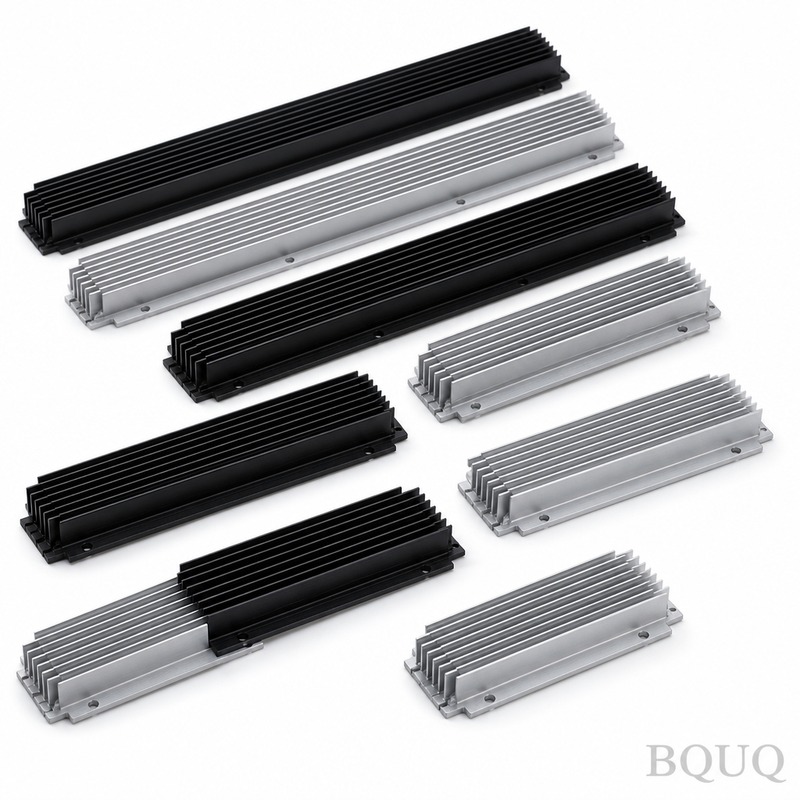
A skived heat sink is a cooling component manufactured by a process called skiving, where a sharp cutting tool peels thin, continuous layers of metal from a solid block to form dense, tall fins in a single piece. Unlike extruded or bonded fin heat sinks, skived fins are integral to the base, offering no thermal interface resistance at the fin-base junction, which allows for fin densities up to 30 fins per inch and fin heights up to 60 mm. This process is ideal for high-power electronics requiring superior thermal performance in constrained airflow environments, typically achieving thermal resistances 15-25% lower than comparable extruded designs.
How Does the Skiving Process Work Step by Step?
The skiving process begins with a solid block of aluminum or copper, typically 30-60 mm thick. A CNC-controlled machine moves a specially designed cutting tool across the block surface; as the tool advances, it lifts and curls a thin layer of metal (0.3-1.2 mm thick) upward, forming a fin without removing any material. The tool then retracts and repeats the cut at a precise pitch, creating a continuous series of fins that remain metallurgically bonded to the base. A single skiving cycle for a 200 mm by 200 mm heat sink takes approximately 8-15 minutes, depending on fin density and material hardness.
What Are the Key Dimensional Tolerances and Fin Specifications?
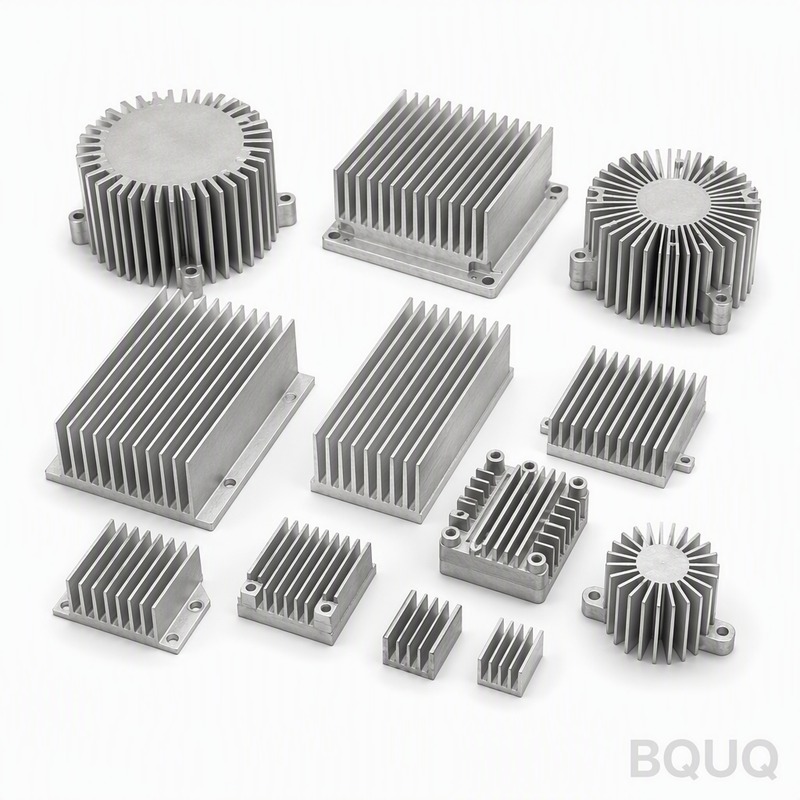
Skived heat sinks achieve tight mechanical tolerances critical for electronics packaging. The base flatness is held to 0.05 mm over 100 mm length, and fin thickness can be controlled within ±0.05 mm. Fin pitch (distance between fin centers) ranges from 1.0 mm to 3.0 mm, enabling fin densities of 8 to 30 fins per inch. The maximum fin height-to-gap ratio is 10:1, meaning for a 1.0 mm gap, fins can be 10 mm tall; typical maximum fin height is 60 mm for aluminum and 40 mm for copper due to tool wear and material ductility.
| Parameter | Aluminum (6063-T5) | Copper (C1100) | Typical Tolerance |
| Base thickness (mm) | 3-15 | 3-12 | ±0.10 mm |
| Fin height (mm) | 5-60 | 5-40 | ±0.15 mm |
| Fin thickness (mm) | 0.3-1.2 | 0.3-1.0 | ±0.05 mm |
| Fin pitch (mm) | 1.0-3.0 | 1.2-3.0 | ±0.08 mm |
| Base flatness (mm/100mm) | 0.05 | 0.05 | - |
| Max fin density (fins/inch) | 30 | 22 | - |
| Surface roughness (Ra, μm) | 1.6-3.2 | 1.6-3.2 | - |
| Max operating temperature (°C) | 250 | 400 | - |
Why Choose Skived Heat Sinks Over Extruded or Bonded Fins?
Skived heat sinks excel where extruded profiles reach their geometric limits. Extrusion is limited to fin height-to-gap ratios of about 6:1 and minimum fin thickness of 1.0 mm, while skiving achieves 10:1 ratios and 0.3 mm fins. Bonded fin heat sinks (using epoxy or solder) introduce a thermal barrier of 0.5-2.0 °C·cm²/W at the joint, whereas skived fins have zero interface resistance because fins are formed from the base metal itself. For a typical 100 W IGBT module, a skived aluminum heat sink can reduce junction temperature by 8-12 °C compared to a bonded fin design of the same volume.
Which Applications Require Skived Heat Sink Technology?
High-density power electronics are the primary users of skived heat sinks. Electric vehicle (EV) inverters, which dissipate 200-500 W per module, benefit from skived copper heat sinks that handle thermal fluxes above 50 W/cm². Telecommunications base station amplifiers, laser diode arrays, and industrial motor drives also use skived heat sinks because they require high fin density in compact footprints (e.g., 150 mm x 150 mm x 80 mm). Additionally, skived heat sinks are specified for aerospace and military radar systems where vibration resistance is critical, since the one-piece construction eliminates joint failure modes found in brazed or epoxied designs.
How Much Does Skiving Tooling Cost Compared to Extrusion?
Skiving tooling is significantly less expensive than extrusion dies, making it economical for medium-volume production. A custom extrusion die costs between $1,500 and $5,000 with a 4-6 week lead time, while skiving requires only a CNC program and a single cutting tool insert costing $200-$400, with no dedicated die. However, skiving machine setup and per-part cycle times are longer, so unit costs are higher at very high volumes. For volumes under 10,000 pieces per year, skiving is typically 10-20% cheaper per unit than extrusion when amortizing tooling; above 50,000 pieces, extrusion becomes more cost-effective unless fin geometry exceeds extrusion limits.
What Are the Thermal Performance Advantages and Limitations?
Skived heat sinks deliver measurable thermal improvements. In natural convection, a skived aluminum sink with 2.0 mm fin pitch achieves a thermal resistance of 0.35 °C/W for a 100 mm x 100 mm footprint, versus 0.48 °C/W for a comparable extruded design. Under forced convection at 3 m/s airflow, skived copper sinks reach 0.12 °C/W, outperforming aluminum by 40%. The main limitation is material cost: skived copper is 3-4 times more expensive than aluminum per unit volume, and maximum fin height of 60 mm restricts use in very tall heat sinks. Additionally, the skiving process cannot create cross-cut or pin-fin patterns, limiting options for omnidirectional airflow.
Can Skived Heat Sinks Be Combined with Other Manufacturing Processes?
Yes, skived heat sinks are frequently post-processed to add functionality. CNC machining can mill mounting holes, channels, and flanges into the base after skiving, with standard tolerances of ±0.05 mm for hole positions. Surface treatments such as black anodizing (per MIL-A-8625, Type II, Class 2) improve emissivity to 0.85 for radiation heat transfer, while nickel plating on copper prevents oxidation and maintains solderability. For liquid cooling, skived fins can be enclosed in a welded or brazed housing to form a cold plate; this hybrid approach achieves thermal resistances of 0.02-0.05 °C/W, suitable for high-performance computing applications.
How Do You Select the Right Skiving Material and Fin Geometry?
Material selection depends on thermal budget and cost. Use aluminum 6063-T5 for applications below 250 °C with thermal resistance targets above 0.3 °C/W; its thermal conductivity is 201 W/m·K. Choose copper C1100 (401 W/m·K) when space is limited or heat flux exceeds 40 W/cm², accepting a 3x material cost increase. For fin geometry, start with a fin height-to-gap ratio of 8:1 for natural convection and 5:1 for forced airflow above 2 m/s, as taller fins provide diminishing returns in high-velocity flow. Always simulate with computational fluid dynamics (CFD) before prototyping, as pressure drop across skived fins can be 20-30% higher than extruded designs at the same airflow.
What Is the Typical Lead Time and Quality Assurance for Skived Heat Sinks?
Prototype skived heat sinks ship in 5-7 business days, while production quantities of 500-5,000 pieces require 2-3 weeks. Quality assurance includes CMM (coordinate measuring machine) inspection for fin pitch and height, X-ray or ultrasonic testing for base integrity on copper parts, and thermal testing using a guarded hot plate method to verify thermal resistance within ±5% of specification. BQUQ performs 100% dimensional inspection on critical features and provides a material certificate per EN 10204 3.1 for aerospace and automotive orders.
How Do Skived Heat Sink Costs Compare to Alternative Technologies?
Per-unit pricing varies with size and material. A 100 mm x 100 mm x 30 mm aluminum skived heat sink with 20 fins costs $8-$15 in quantities of 1,000, versus $6-$10 for an equivalent extrusion. The same size in copper costs $25-$40. At 100-piece prototype volumes, skiving is often cheaper than extrusion because no die fee applies. For high-fin-density designs that cannot be extruded, skiving is the only cost-effective option; bonded fin assemblies cost $12-$20 per unit but underperform thermally. Overall, skived heat sinks offer the best value when thermal performance is critical and volumes are low-to-medium.
FAQ
How Thin Can Skived Heat Sink Fins Be Made?
The minimum fin thickness for aluminum skiving is 0.3 mm, and for copper it is 0.3 mm as well, though copper requires slower cutting speeds to prevent tearing. Thinner fins increase fin density but reduce structural rigidity, so fins below 0.5 mm are typically limited to 25 mm height to avoid vibration damage.
What Is the Maximum Fin Height for a Skived Heat Sink?
Aluminum fins can reach 60 mm, while copper is limited to 40 mm due to material hardness and tool wear. The maximum height is also constrained by the fin pitch; a 60 mm fin requires a minimum pitch of 2.5 mm to maintain a 10:1 height-to-gap ratio.
Are Skived Heat Sinks Suitable for Outdoor Applications?
Yes, with proper surface treatment. Aluminum skived heat sinks should be anodized (at least 18-20 μm thickness) to prevent corrosion in humid or salt-laden environments. Copper skived heat sinks require nickel plating or a conformal coating to prevent oxidation that degrades thermal performance.
Can Skived Heat Sinks Be Recycled at End of Life?
Yes, skived heat sinks are 100% recyclable because they are single-material components without bonded joints or fillers. Aluminum skived heat sinks can be recycled with standard aluminum scrap streams, and copper units are highly valued in scrap markets.
How Does Fin Density Affect Airflow Pressure Drop?
Doubling fin density from 15 to 30 fins per inch increases pressure drop by approximately 300-400% at the same airflow rate. This means skived heat sinks require stronger fans or higher static pressure blowers, which can add system cost and noise.
What Is the Difference Between Skiving and Broaching?
Skiving uses a single-point tool to peel fins from a solid block, while broaching uses a multi-tooth tool to cut channels, which removes material and creates fins as waste. Skiving produces fins with a smooth, work-hardened surface, whereas broaching leaves a rougher finish and is limited to simpler geometries.
How Long Does a Skiving Tool Last Before Replacement?
A carbide skiving tool insert typically cuts 2,000-5,000 linear meters of fin length before requiring resharpening or replacement, depending on material. For a standard 100 mm x 100 mm heat sink with 20 fins, this translates to roughly 1,000-2,500 parts per tool, with tool insert costs of $50-$100 each.
For engineering teams evaluating thermal solutions, skived heat sinks offer a unique combination of high fin density, zero interface resistance, and moderate tooling costs. BQUQ provides rapid prototyping with 5-7 day turnaround and full production support from our Dongguan facility. We offer free design-for-manufacturing reviews and thermal simulations to optimize your fin geometry. Contact us for a quote within 12 hours: Email sc@bquq.com, WhatsApp +86 13713157787, or visit www.bquq.com to upload your CAD files.