What Is Spring Set? Causes, Prevention and Design Implications
Spring set is the permanent plastic deformation that occurs when a spring is compressed or extended beyond its elastic limit, resulting in a loss of free length and a reduction in load-carrying capacity. In practical terms, if a spring is compressed to solid height and released, and it does not return to its original free length, it has taken a set. This failure mode is critical for design engineers because it directly determines the maximum operating stress and temperature limits for any spring application, whether in automotive valves, electrical contacts, or precision medical devices.
What Exactly Happens During Spring Set?
Spring set occurs when the shear stress in the spring material exceeds its elastic limit, causing dislocations in the metal's crystal lattice to move permanently. For music wire (ASTM A228), the elastic limit in torsion is approximately 45-55% of its ultimate tensile strength, which translates to a maximum allowable design stress of around 620-760 MPa for hard-drawn wire. When a spring is compressed to solid, the stress at the inner fiber of the coil can reach 1.2 to 1.5 times the average stress, often pushing the material into the plastic zone. The result is a measurable reduction in free length, typically ranging from 1% to 10% of the original dimension, depending on the stress level and material ductility.
How Does Operating Temperature Accelerate Spring Set?
Temperature is the most aggressive accelerator of spring set because it reduces the material's yield strength and promotes stress relaxation over time. For example, music wire (A228) should not be used above 120°C, as its load loss at this temperature can exceed 15% within 100 hours of continuous operation. Stainless steel 302 (A313) performs better, maintaining stability up to 230°C, while Inconel X-750 can operate at 400°C with minimal set. The general rule is that for every 55°C increase above room temperature, the allowable design stress must be reduced by 20-30% to avoid accelerated set. At elevated temperatures, even stresses below the nominal elastic limit will cause gradual plastic deformation through creep mechanisms.
Which Materials Are Most Resistant to Spring Set?
Material selection is the primary defense against spring set, and the choice depends on the operating stress and temperature envelope. Chrome silicon (A401) offers the best strength-to-cost ratio for high-stress applications, with a maximum operating temperature of 250°C and a tensile strength of 1,900-2,100 MPa. Beryllium copper (ASTM B197) is preferred for electrical applications requiring corrosion resistance and no magnetism, though its maximum temperature is only 200°C. For extreme environments, Elgiloy (a cobalt-chromium-nickel alloy) maintains its elastic properties up to 350°C with virtually no set under normal design stresses. The table below summarizes key material properties for spring set resistance:
| Material (ASTM Spec) | Max Operating Temp (°C) | Tensile Strength (MPa) | Recommended Max Design Stress (% of Tensile) | Relative Cost Index |
| Music Wire (A228) | 120 | 2,200-2,400 | 45 | 1.0 |
| Oil-Tempered (A229) | 150 | 1,700-1,900 | 45 | 1.1 |
| Chrome Silicon (A401) | 250 | 1,900-2,100 | 50 | 1.8 |
| Stainless 302 (A313) | 230 | 1,800-2,000 | 40 | 2.2 |
| Beryllium Copper (B197) | 200 | 1,300-1,500 | 35 | 4.5 |
| Inconel X-750 | 400 | 1,400-1,600 | 35 | 8.0 |
| Elgiloy | 350 | 2,000-2,400 | 45 | 9.5 |
Why Does Shot Peening Prevent Spring Set?
Shot peening induces a compressive residual stress layer of 400-800 MPa on the spring surface, which counteracts the tensile stresses that cause crack initiation and plastic flow. This cold-working process is mandatory for springs that operate at stresses above 60% of the material's tensile strength, as it can improve fatigue life by 200-400% and significantly reduce set. The process involves propelling steel shot (0.3-1.0 mm diameter) at velocities of 40-80 m/s onto the spring surface, creating a dimpled layer that is 0.1-0.3 mm deep. For maximum benefit, the shot peening intensity should be 0.008-0.012A (Almen strip deflection) for wire diameters of 1.0-5.0 mm. However, over-peening can cause surface cracking, so the process must be validated with sample testing.
How Can Design Modifications Reduce Spring Set?
Design geometry has a direct impact on stress distribution and therefore on spring set. The most effective modification is increasing the spring index (D/d, mean coil diameter to wire diameter) from a typical value of 4 to 6-8, which reduces the stress concentration factor at the inner fiber from approximately 1.4 to 1.15. Additionally, reducing the number of active coils while increasing wire diameter for the same spring rate lowers the total deflection per coil, thus reducing peak stress. Setting the spring (also called presetting or scragging) during manufacturing, where the spring is compressed to solid height for 24-48 hours, creates beneficial residual stresses that prevent future set. This presetting operation can increase the load capacity by 10-20% without changing the material or dimensions.
When Should You Consider Presetting or Residual Stress Relief?
Presetting is recommended whenever the design stress exceeds 50% of the material's tensile strength or when the spring will be cycled at high frequencies. The presetting process involves compressing the spring to solid height for a minimum of 24 hours at room temperature, which plastically deforms the inner fibers and creates a compressive residual stress layer. Residual stress relief (heat treatment at 200-350°C for 30-60 minutes) is mandatory after coiling and grinding to remove internal stresses from the forming process. For example, a music wire spring that is not stress-relieved may show 5% set after 10,000 cycles, whereas the same spring after proper stress relief at 260°C for 30 minutes will show less than 1% set. The cost of presetting is approximately 5-8% of the total spring manufacturing cost, which is far less than the cost of premature failure.
What Are the Cost Implications of Designing Against Spring Set?
Designing against spring set typically adds 10-25% to the spring manufacturing cost, but this is negligible compared to the cost of warranty claims or production downtime. Upgrading from music wire to chrome silicon increases material cost by 80%, while adding shot peening adds $0.02-0.05 per spring for high-volume production. For a typical automotive valve spring (wire diameter 3.5 mm, 6 active coils), the total manufacturing cost is $0.80-1.20, of which shot peening accounts for $0.10 and presetting for $0.05. In contrast, failure of that spring in the field can cost $50-200 in warranty labor and parts, making prevention highly cost-effective. The engineering rule is to always specify the maximum operating temperature and required cycle life before quoting, as these parameters determine the material and processing requirements.
How Do You Verify Spring Set in Production?
Verification requires measuring free length, load at specified heights, and solid height before and after a compression cycle. The standard test is to compress the spring to solid height three times, then measure the free length after a 24-hour recovery period; the acceptable set is typically less than 0.5% of the free length for high-quality springs. Load testing at 50% and 75% of the working deflection should show less than 2% deviation from the specified values. For high-reliability applications, 100% inspection with automated load testers is recommended, which adds $0.01-0.03 per spring but ensures consistency. Statistical process control (SPC) with a sample size of 5 springs per hour is generally sufficient for medium-volume production of 10,000-100,000 pieces per month.
What Are Common Misconceptions About Spring Set?
A common misconception is that spring set only occurs at very high loads, when in fact it can occur at moderate stresses if the spring is cycled millions of times or operated at elevated temperatures. Another error is assuming that stainless steel is inherently more resistant to set than music wire; in reality, 302 stainless has a lower elastic limit and requires more conservative design stresses. Finally, some designers believe that presetting eliminates the need for shot peening, but these processes address different failure modes: presetting reduces set, while shot peening primarily improves fatigue life. For optimal performance, both processes should be used when design stresses exceed 55% of the material's tensile strength.
What Is the Maximum Allowable Stress to Avoid Spring Set?
For music wire at room temperature, the maximum allowable design stress is 45% of the ultimate tensile strength, or approximately 620 MPa for a 2.0 mm wire. If the spring will see dynamic loading or temperatures above 80°C, this should be reduced to 35% of tensile strength. Chrome silicon can be designed to 50% of tensile strength but requires shot peening above 45%.
Can Spring Set Be Reversed After It Occurs?
No, spring set is a permanent plastic deformation that cannot be reversed by heat treatment or further mechanical processing. Once the material has yielded, the only corrective action is to replace the spring or redesign it with a higher-grade material or lower operating stress. Attempting to re-set a spring to its original free length will only cause additional plastic deformation and reduce its fatigue life.
How Many Cycles Can a Spring Survive Before Set Occurs?
A properly designed spring with stress below 40% of tensile strength can survive 10 million cycles without measurable set. At 50% of tensile strength, set will typically appear after 100,000-500,000 cycles, and at 60% or above, set may occur within the first 1,000 cycles. The exact number depends on material, surface finish, and operating temperature.
Does Spring Set Affect All Spring Types Equally?
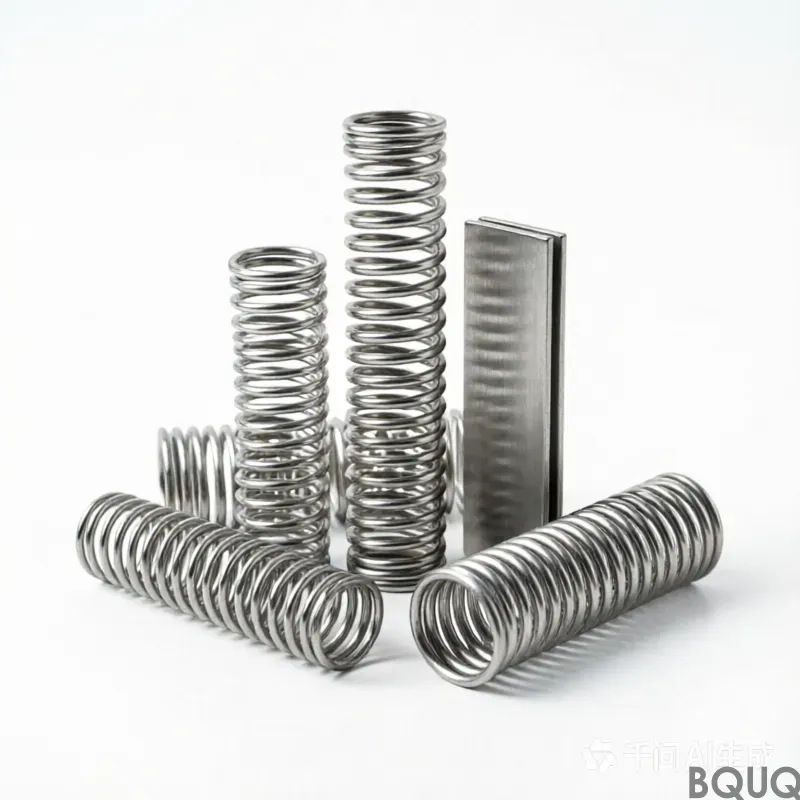
Compression springs are most susceptible to set because they experience the highest stresses at the inner coil fiber. Torsion springs and extension springs also experience set but at a lower rate due to different stress distributions. Flat springs and leaf springs are less prone to set because they are typically designed with lower stress margins.
What Is the Difference Between Spring Set and Stress Relaxation?
Spring set is immediate plastic deformation that occurs when the elastic limit is exceeded, while stress relaxation is a time-dependent loss of load at constant deflection, even at stresses below the elastic limit. Stress relaxation is accelerated by temperature and can cause a 10-20% load loss over time without any change in free length. Both mechanisms require different design strategies: set is avoided by limiting stress, while relaxation is mitigated by material selection and operating temperature limits.
When Should You Specify Preset Springs in Your Design?
Specify preset springs when the design stress exceeds 50% of the material's tensile strength, when the spring operates at high cyclic frequencies (above 100 Hz), or when load consistency is critical within tight tolerances. Presetting is also recommended for springs that will be stored in a compressed state for extended periods, such as safety valves or clutch mechanisms. The additional manufacturing cost of presetting is typically $0.02-0.08 per spring and is always less than the cost of a field failure.
Can Coatings or Plating Affect Spring Set Resistance?
Zinc plating or powder coating adds no structural benefit against spring set and can actually reduce fatigue life by introducing hydrogen embrittlement if not properly baked. For springs operating at high stress, electroless nickel plating at a thickness of 8-12 microns is preferred as it provides corrosion resistance without significant hydrogen pickup. The plating process must include a de-embrittlement bake at 200°C for 2-4 hours to restore ductility.
Designing against spring set requires a clear understanding of the operating stress, temperature, and cycle life, combined with proper material selection and manufacturing processes. By limiting design stress to 45% of tensile strength, specifying presetting and shot peening for high-stress applications, and verifying performance through load testing, you can achieve reliable spring life of over 1 million cycles. If you have an existing spring design that is showing premature set, or if you need assistance with a new application, our engineering team at BQUQ can provide a free design review and quotation within 12 hours. We manufacture springs from 0.1 mm to 10 mm wire diameter with tolerances as tight as ±0.01 mm, using our 20 years of precision manufacturing experience in Dongguan, China. Contact us at sc@bquq.com or WhatsApp +86 13713157787, or visit www.bquq.com to submit your drawings for immediate evaluation.
Related Articles
- Where to Buy Custom Metal Springs Online: Top 7 Suppliers
- Size control and online intelligent detection technology of precision spring
- In-depth analysis of technology and process in the hardware spring industry in 2026: a full-dimensional interpretation of high stress, functional integration and engineering certification