What Is Thermal Grease vs Thermal Pad? Which Should You Use?
For most electronics and power-dense applications, thermal grease (paste) is the better choice for long-term thermal performance, offering a thermal conductivity range of 1.0 to 8.0 W/m·K with a minimum bond line thickness of 0.025 mm, while thermal pads provide easier assembly and reworkability at 1.0 to 6.0 W/m·K but with a higher thermal resistance due to their 0.5 to 5.0 mm thickness. The decision hinges on your production volume, component pressure tolerance, and whether rework or automated dispensing is a priority. If you need maximum heat transfer and can control surface flatness, use grease; if you need vibration dampening, gap filling, or simple hand assembly, use a pad.
What Are the Core Physical Differences Between Thermal Grease and Thermal Pad?
Thermal grease is a viscous, silicone-based or non-silicone compound filled with ceramic, boron nitride, or metal oxide particles. It is applied as a paste and compressed to a very thin layer, typically 0.025 to 0.1 mm, which minimizes thermal resistance. Thermal pads are pre-formed solid sheets of silicone or polyurethane rubber filled with thermally conductive fillers, with standard thicknesses ranging from 0.5 mm to 5.0 mm. The pad’s thickness creates a higher thermal path, but it compensates by conforming to uneven surfaces and filling gaps up to 0.5 mm without pumping-out or drying out.
How Do Thermal Conductivity and Thermal Resistance Compare in Real Numbers?
Thermal conductivity (k-value) is only part of the equation; thermal resistance (R-value) accounts for thickness and contact area. For a typical 1.0 mm pad with 5.0 W/m·K conductivity, the thermal resistance is approximately 0.2 °C·cm²/W. In contrast, a grease with the same 5.0 W/m·K conductivity applied at 0.05 mm thickness yields a thermal resistance of only 0.01 °C·cm²/W, which is 20 times lower. This means that for a 100 W CPU, the grease will produce a 1 °C temperature rise across the interface, while the pad will produce a 20 °C rise, provided the clamping force is adequate. Tests on a 25 mm x 25 mm heatsink at 2.0 N/cm² pressure show that grease outperforms pads consistently at power densities above 10 W/cm².
Which Applications Are Better Suited for Thermal Grease?
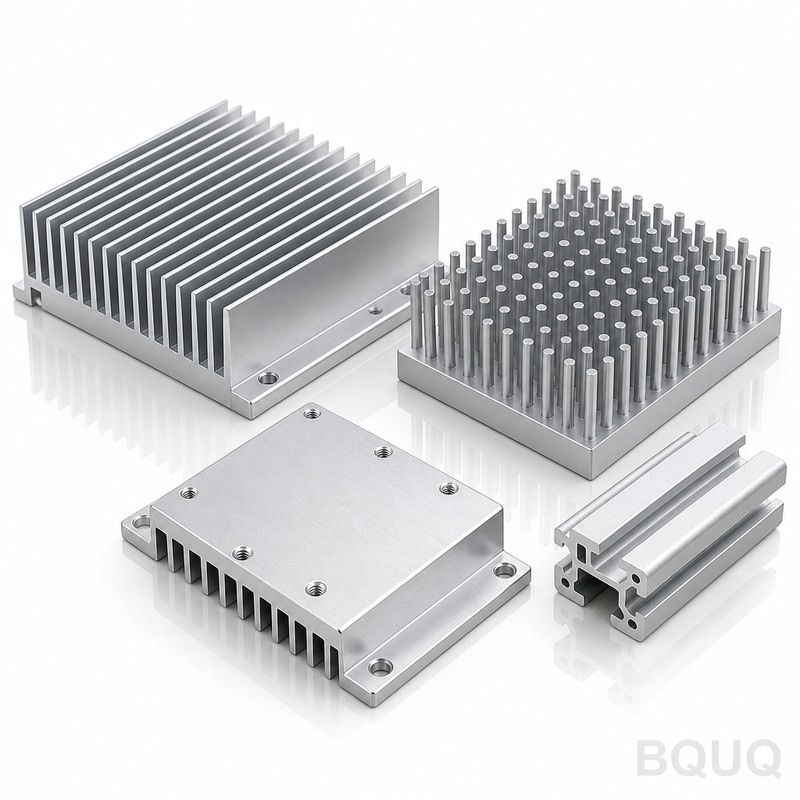
Thermal grease is ideal for applications with rigid, flat surfaces and where the assembly is permanent or infrequently serviced. Typical scenarios include CPU/GPU heatsink mounting, IGBT modules, and power semiconductor packages with flat baseplates. In CNC-machined aluminum heatsinks with a surface flatness of 0.05 mm or better, grease fills only micro-imperfections, maximizing metal-to-metal contact. For high-end consumer electronics, a 2.5 W/m·K silicone grease applied by stencil printing can reduce junction temperature by 15 °C compared to a 3.0 W/m·K pad of 1.0 mm thickness. However, grease is not recommended for applications with large gaps exceeding 0.3 mm, as it cannot fill voids effectively without excessive thickness, which leads to pump-out or dry-out.
Which Applications Are Better Suited for Thermal Pads?
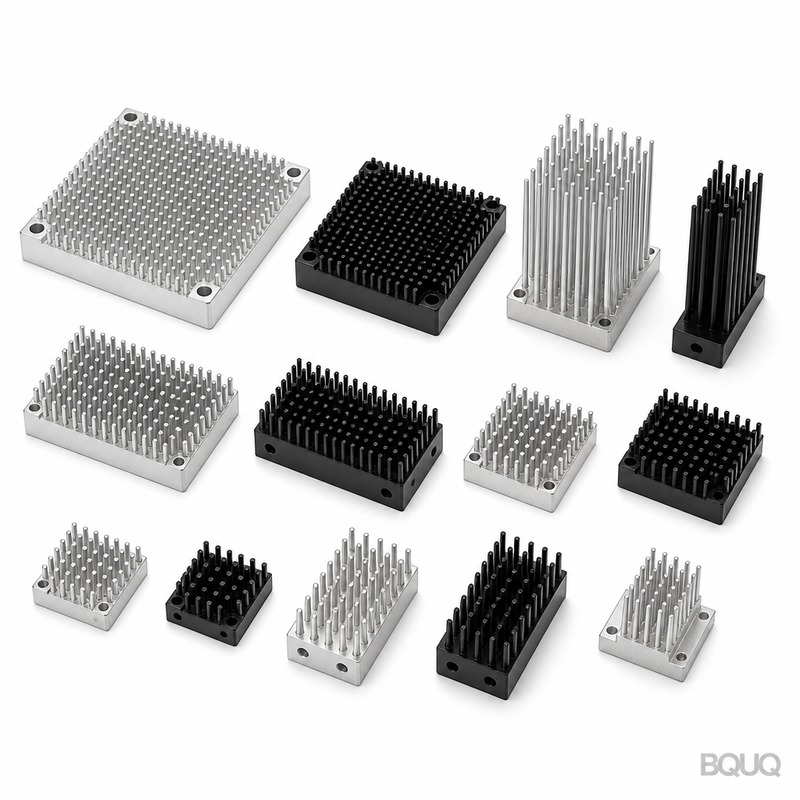
Thermal pads are the preferred solution for stacked printed circuit boards (PCBs), automotive electronics, and LED lighting modules where components have varying heights and require gap filling. A typical pad with 3.0 W/m·K conductivity and 2.0 mm thickness can accommodate a component height mismatch of up to 1.0 mm while maintaining contact pressure. Pads are also essential for applications requiring electrical isolation, as many pads have a dielectric breakdown voltage exceeding 6 kV AC. For BQUQ’s metal stamping and heatsink clients, pads are commonly used between a stamped aluminum heatsink and a PCB where solder joints create uneven topography. The trade-off is that pads must be replaced if disassembled, whereas grease can be reapplied.
How Does Clamping Pressure Affect Performance for Each Material?
Clamping pressure is the single most critical variable for thermal interface materials. Thermal grease requires a minimum pressure of 0.5 to 1.0 N/cm² to achieve optimal wetting, and performance degrades if pressure is too low, leaving air pockets. Thermal pads require a much higher pressure range of 5.0 to 20 N/cm² to compress to 70-80% of their original thickness; at lower pressure, the pad’s thermal resistance increases by up to 40%. For example, a 1.5 mm pad with 5.0 W/m·K conductivity at 5 N/cm² will have a resistance of 0.15 °C·cm²/W, but at 20 N/cm² it drops to 0.08 °C·cm²/W. In spring-loaded assemblies, such as those using BQUQ compression springs, a spring force of 2.0 N per component is sufficient for grease but inadequate for most pads.
Why Is Long-Term Reliability Different Between Grease and Pads?
Thermal grease suffers from pump-out and phase separation over time, especially under thermal cycling. A standard silicone grease can lose 15% of its thermal performance after 1000 cycles from -40 °C to 125 °C due to the movement of the mating surfaces. High-end phase-change materials reduce this to 5%, but they are expensive. Thermal pads, conversely, show excellent long-term stability because they are solid and do not flow or dry out. After 2000 hours of thermal aging at 150 °C, a 2.0 mm pad retains 95% of its initial thermal conductivity. However, pads can suffer from compression set, where they permanently deform and lose recovery force, reducing contact pressure over time. For automotive or aerospace applications with high vibration, pads are more reliable; for static server applications, grease is better.
How Do Cost and Manufacturing Process Affect the Decision?
Cost is a major differentiator. Thermal grease is cheaper per application: a 1.0 g syringe of good quality grease (3.0 W/m·K) costs approximately USD 0.15 to 0.30 per gram, and a single CPU application uses only 0.5 to 0.8 g. Thermal pads cost USD 0.10 to 0.50 per square centimeter for 1.0 mm thickness with 3.0 W/m·K conductivity. For mass production, grease requires automated dispensing equipment (costing USD 5,000 to 20,000 for a stencil printer or dispenser), while pads are cut to shape and hand-placed, requiring no capital investment. However, grease application has a higher defect rate due to air entrapment and contamination, leading to rework costs. Pads are more forgiving in manual assembly lines, which is why many low-volume or prototype runs choose them despite the higher per-unit material cost.
What Are the Standard Thickness and Tolerance Specifications for Both?
When specifying materials, engineers must consider thickness tolerance and manufacturing variability. Thermal grease has no fixed thickness; it is controlled by the clamping force and surface flatness, with a practical minimum of 0.025 mm. Thermal pads come in standard thicknesses of 0.5 mm, 1.0 mm, 1.5 mm, 2.0 mm, 3.0 mm, and 5.0 mm, with a tolerance of ±0.1 mm for pads under 1.5 mm and ±0.2 mm for thicker pads. The surface area of a pad can be die-cut to a tolerance of ±0.3 mm, which is sufficient for most heatsink interface designs. For BQUQ’s stamped heatsinks, we recommend designing the mounting pocket with a depth tolerance of ±0.1 mm to ensure proper pad compression.
| Material Type | Thermal Conductivity (W/m·K) | Typical Thickness (mm) | Thermal Resistance (°C·cm²/W) | Clamping Pressure (N/cm²) | Cost per Application (USD) | Reworkability |
| Thermal Grease | 1.0 to 8.0 | 0.025 to 0.1 | 0.01 to 0.05 | 0.5 to 1.0 | 0.15 to 0.30 | Poor, requires reapplication |
| Thermal Pad (silicone) | 1.0 to 6.0 | 0.5 to 5.0 | 0.10 to 0.40 | 5.0 to 20 | 0.10 to 0.50 per cm² | Excellent, re-positionable |
| Phase Change Material | 3.0 to 8.0 | 0.025 to 0.2 | 0.02 to 0.08 | 1.0 to 5.0 | 0.50 to 1.00 | Good, melts on first heat cycle |
| Graphite Sheet | 5.0 to 15.0 | 0.025 to 0.5 | 0.03 to 0.10 | 1.0 to 10 | 0.20 to 0.80 per cm² | Moderate, fragile |
Which Material Should You Choose for High-Power LED or Power Electronics?
For high-power LEDs (greater than 5 W per chip) and IGBT modules, thermal grease is the only sensible choice when the heatsink base is machined flat. A typical COB LED with a 20 W output generates 20 W of heat; using a 3.0 W/m·K pad of 1.0 mm thickness results in a 20 °C temperature rise, while grease of the same conductivity gives only 1 °C rise. This directly affects LED lifespan, as every 10 °C reduction in junction temperature doubles the LED’s lifetime. For power electronics with direct bonded copper (DBC) substrates, grease is mandatory. However, if the mounting surface has a step or recessed components, a pad is necessary to bridge the gap, and you should select a high-performance pad with 5.0 W/m·K and a thickness matching the gap exactly.
How Do You Validate Thermal Performance Before Mass Production?
Before committing to a material, run a thermal impedance test using a standardized fixture (ASTM D5470). Measure the thermal resistance at your actual clamping pressure and expected bond line thickness. For grease, test at three different dispensing volumes to find the optimum. For pads, test at three different compression ratios (70%, 80%, 90%) to determine the resistance curve. Also conduct a thermal cycling test (500 cycles from -40 °C to 125 °C) to check for pump-out or compression set. At BQUQ, we recommend sending your actual stamped heatsink and component to the material supplier for a thermal simulation; this costs around USD 200 to 500 and takes 2 weeks, but it prevents costly field failures.
Can Thermal Grease Be Used on Flexible or Curved Surfaces?
No, thermal grease cannot bridge gaps or adhere to curved surfaces without forming thick, uneven layers that increase thermal resistance. For flexible printed circuits or curved LED strips, use a thermal pad with a conformable core that can bend and fill irregular gaps. A 2.0 mm pad with a shore hardness of 10-20 (very soft) is recommended for curved surfaces.
How Long Does Thermal Grease Last vs Thermal Pad?
Thermal grease lasts 3 to 5 years in typical consumer electronics but can degrade faster in high-temperature environments above 125 °C. Thermal pads last 5 to 10 years under the same conditions because they are chemically stable and do not migrate. For industrial equipment with a 10-year service life, pads are the safer choice.
Is Thermal Pad Reusable After Disassembly?
No, thermal pads are single-use components. Once compressed, they do not fully recover their original thickness, so reusing them creates air gaps and reduces thermal performance by up to 50%. Thermal grease also loses its viscosity and should be cleaned off and reapplied during any rework.
What Is the Maximum Operating Temperature for These Materials?
Standard silicone-based thermal grease operates up to 150 °C continuously, while high-temperature versions (ceramic-filled) can reach 200 °C. Silicone thermal pads have a maximum continuous rating of 150 °C, but some polyurethane-based pads can handle 180 °C. Beyond these limits, the binder degrades and thermal conductivity drops rapidly.
How Do You Remove Thermal Grease or Pad Residue?
For grease, use isopropyl alcohol (99% purity) with lint-free wipes; for cured silicone grease, use a specialized solvent like heptane. For pads, peel off the pad and clean the residual adhesive with a citrus-based cleaner or isopropyl alcohol. Never use metal scrapers on CNC-machined aluminum surfaces, as they can scratch the finish and affect flatness.
Which Material Is Better for Automated High-Volume Production?
Thermal grease is better for fully automated lines where a dispenser or stencil printer can apply a precise dot or pattern in under 2 seconds per unit. Thermal pads require manual or robotic pick-and-place, which is slower (5-10 seconds per unit) and requires die-cut carrier tapes. For volumes above 10,000 units per month, grease with automated dispensing is the most cost-effective.
Can You Combine Thermal Grease and Thermal Pad Together?
It is not recommended to stack grease and pad, as the pad’s thickness dominates the thermal path and the grease only adds a thin, ineffective layer. If you have a large gap, use a thicker pad alone. If you have a flat surface, use grease alone. Combining them increases cost and introduces an extra interface with no measurable benefit.
Conclusion
Selecting between thermal grease and thermal pad is a decision based on mechanical constraints, not just thermal conductivity. For flat, rigid interfaces with high heat flux, thermal grease delivers superior performance with lower cost. For uneven surfaces, gap filling, and easy rework, thermal pads provide manufacturing simplicity and long-term stability. Always quantify your actual clamping pressure and thermal resistance requirements before choosing. At BQUQ, we manufacture precision CNC-machined heatsinks and metal stampings with surface flatness controlled to 0.02 mm, making them ideal for grease applications. If you need assistance with your thermal interface design, our engineers can provide a free review of your assembly drawings and recommend the optimal material and thickness.
For a quick quote or engineering consultation, contact us at sc@bquq.com or WhatsApp at +86 13713157787. We respond to all inquiries within 12 hours. Visit our website at www.bquq.com to download our thermal management design guide and material selection datasheets.