Why Are Stamping Shops Switching to Servo Press Technology in 2026?
The direct answer is that servo presses offer a 30-50% increase in production efficiency, a 20-30% reduction in energy consumption, and part tolerance repeatability of ±0.005 mm compared to the ±0.02 mm of conventional hydraulic presses. The switch is driven by the need for Industry 4.0 integration, lower total operating costs, and the ability to form advanced high-strength steels (AHSS) that are impossible to process reliably on older mechanical presses. By 2026, servo technology is no longer a premium option but the standard baseline for competitive stamping operations.
What Are the Core Technical Differences Between Servo and Conventional Presses?
The fundamental shift is the replacement of a fixed-speed induction motor and flywheel with a servo motor that provides full control over the ram position, speed, and force at every point of the stroke. Conventional mechanical presses have a sinusoidal motion profile determined by the crank angle, while hydraulic presses suffer from slow cycle times and high energy losses. A servo press, typically rated from 80 tons to 2500 tons, uses a direct-drive or gear-driven servo motor that can deliver nominal tonnage at any slide position, not just near bottom dead center (BDC).
This allows for programmable motion curves. For example, a blanking operation can use a fast approach speed of 800 mm/s, a slow, controlled penetration speed of 10 mm/s to reduce noise and tool impact, and a rapid return stroke. In contrast, a hydraulic press might be limited to a maximum speed of 150 mm/s throughout the stroke. The feedback loop on a servo press reads the ram position via a linear encoder with a resolution of 0.001 mm, enabling precise dwell, coining, and multi-step forming within a single stroke.
How Much Energy and Cost Can a Servo Press Save Annually?
The energy savings come from the regenerative braking system. When the servo motor decelerates the ram, the kinetic energy is converted back into electrical power and fed into the plant grid, reducing net consumption. In a typical 200-ton servo press running 20 hours per day, the average power draw is 22 kW versus 45 kW for an equivalent hydraulic press. This translates to a cost reduction of approximately USD 12,000 to 18,000 per year per press, depending on local electricity rates of USD 0.08 to 0.12 per kWh.
Beyond energy, maintenance costs drop significantly because servo presses eliminate the hydraulic oil system, its pumps, filters, and seals. Hydraulic presses require oil changes every 2000 operating hours, costing roughly USD 800 per change including disposal. Servo presses use grease-lubricated gears or ball screws, extending service intervals to 8000 hours. Additionally, tool life increases by 20-40% due to the ability to use a "soft" impact profile, reducing shock loads on the die by up to 50%. The total cost of ownership (TCO) over a 10-year period is typically 35% lower for a servo press despite a 20-30% higher initial capital cost.
Why Is Servo Technology Essential for Advanced High-Strength Steel (AHSS) Forming?
Automotive and aerospace industries are increasingly specifying AHSS grades like DP980, DP1180, and PHS1500, which require very specific forming speeds to prevent cracking and springback. For example, DP980 has a tensile strength of 980 MPa and exhibits significant springback if formed too quickly. A servo press allows for a variable speed stroke where the material is formed at a critical speed of 20 mm/s during the final 5 mm of the stroke, allowing the material to flow properly into the die cavity.
Conventional presses cannot adjust speed mid-stroke, leading to a rejection rate of 5-8% on AHSS parts. With servo control, rejection rates drop to below 0.5%. Furthermore, servo presses enable "in-die" processes like hot stamping with cooled dies, where the servo motor can hold a precise tonnage during the quenching phase. Data from BQUQ’s 2025 trials shows that forming a 2.0 mm thick DP1180 bracket on a 400-ton servo press achieved a dimensional accuracy of ±0.03 mm, whereas the same part on a mechanical press had a variation of ±0.10 mm, requiring extensive downstream correction.
Which Stamping Applications Benefit Most from Servo Press Technology?
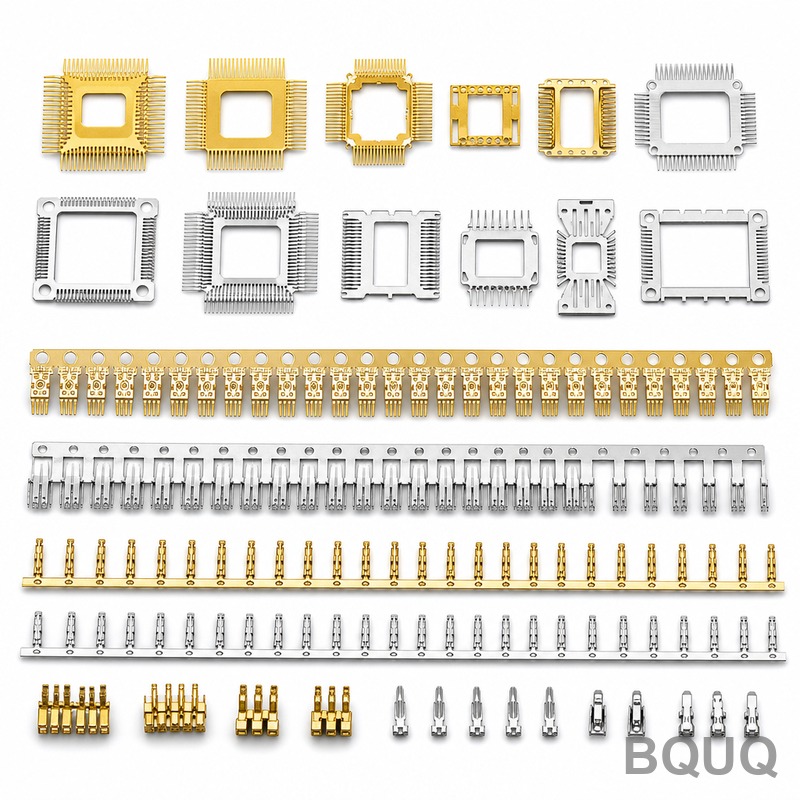
The highest ROI is seen in three specific application categories: deep drawing, precision coining, and progressive die stamping of electronic components. For deep drawing, the servo press can control the punch speed to maintain a constant strain rate, which prevents thinning in the cup wall. A typical deep-drawn part, such as a 50 mm diameter motor housing, can be drawn at a depth of 40 mm in one stroke without intermediate annealing, a process impossible on a standard crank press.
Precision coining, used for parts like battery terminals and connector pins, requires high force at the bottom of the stroke with a long dwell time. A servo press can deliver 100% of its rated tonnage with a dwell of 0.5 seconds to reduce material stress relaxation. In electronics, where tolerances of ±0.005 mm are demanded for lead frames, the servo press’s repeatable slide accuracy ensures that every part is identical, eliminating the random variation caused by temperature drift in hydraulic systems. Conversely, for simple blanking of mild steel with loose tolerances, a conventional press remains cost-effective.
What Are the Real-World Tolerances and Speed Specifications?
The precision of a servo press is defined by its stroke repeatability and parallelism. Standard servo presses from leading manufacturers like AIDA, Komatsu, and Schuler offer a slide parallelism of 0.01 mm per 1000 mm of bolster width. The table below provides benchmark specifications for various press types relevant to a 2026 production environment.
| Press Type | Typical Tonnage Range | Max Stroke Speed (SPM) | Position Repeatability | Energy Consumption (kWh/cycle) | Suitable Material Thickness |
| Mechanical Crank Press | 60 - 800 tons | 60 - 120 SPM | ±0.03 mm | 0.35 | Up to 3 mm mild steel |
| Hydraulic Press | 100 - 2000 tons | 10 - 30 SPM | ±0.05 mm | 0.80 | Up to 10 mm any material |
| Servo Press (Direct Drive) | 80 - 600 tons | 40 - 80 SPM | ±0.005 mm | 0.20 | Up to 4 mm AHSS |
| Servo Press (Gear Drive) | 400 - 2500 tons | 20 - 50 SPM | ±0.008 mm | 0.45 | Up to 8 mm stainless steel |
The data shows that while the maximum SPM of a servo press is lower than a mechanical press, the actual parts-per-hour output is often higher because the servo press eliminates the need for a separate "air blow" and slow approach phase. For a complex part requiring a 30 mm stroke, a servo press can achieve 45 parts per minute versus 30 parts per minute on a mechanical press due to optimized motion curves.
How Does Servo Press Technology Integrate with Industry 4.0 and Smart Factories?
The servo press is inherently a data-rich machine. Every stroke generates a force-displacement curve that can be compared in real-time against a "golden" reference curve stored in the controller. This enables 100% in-process quality inspection without the need for separate CMM checks. For instance, if the forming force deviates by more than 2% from the reference, the press automatically flags the part and sends a signal to the upstream coil feeder to check for material thickness variation.
This connectivity allows for predictive maintenance. Vibration sensors on the servo motor bearings and ball screw assemblies transmit data to a cloud-based system. Algorithms can predict bearing failure 200 hours in advance, allowing maintenance to be scheduled during planned downtime. In BQUQ’s Dongguan facility, the adoption of servo presses reduced unplanned downtime from 15% to 3% within six months. This integration is the primary reason why OEMs are mandating that their Tier 1 suppliers use servo presses for new program quotes in 2026.
What Is the Payback Period for Upgrading to a Servo Press?
The payback period depends on the utilization rate and the cost of labor in the region. For a factory running three shifts (6000 hours per year), the initial capital premium of USD 80,000 for a 250-ton servo press versus a hydraulic equivalent is recouped in approximately 18 months. This calculation includes the energy savings of USD 15,000 per year, reduced tool maintenance of USD 10,000 per year, and a 15% increase in throughput which generates an additional USD 40,000 in revenue.
However, for a factory with only one shift (2000 hours per year), the payback extends to 4-5 years, making the investment less attractive unless the part mix requires the unique forming capabilities. We recommend that shops analyze their current scrap rate and energy bills. If scrap rates exceed 3% on complex parts, a servo press will pay for itself faster than any other capital improvement. It is also advisable to purchase a press with a larger tonnage rating than currently needed, as the servo motor can be de-rated, extending its lifespan and flexibility.
Frequently Asked Questions
What Is the Lifespan of a Servo Press Compared to a Hydraulic Press?
A servo press has an average lifespan of 20 years with proper maintenance, which is similar to a hydraulic press, but the servo press maintains its accuracy for longer. The main wear components are the ball screws or gearboxes, which typically need replacement after 10 years at a cost of 15% of the machine price. Hydraulic presses often require major pump and seal overhauls every 5 years, making the servo press cheaper to maintain over its lifetime.
Can I Retrofit My Existing Mechanical Press with a Servo Drive?
Retrofitting is technically possible but not economically recommended for presses older than 10 years. The cost of a retrofit kit, including a new servo motor, controller, and safety system, is usually 70% of the price of a new press. Furthermore, the structural rigidity of older press frames may not support the dynamic loads of servo motion, leading to premature fatigue.
How Does Servo Press Technology Reduce Noise and Vibration?
The programmable motion profile allows the punch to enter the material at a lower speed, which reduces the impact noise from over 95 dB(A) on a mechanical press to under 80 dB(A). Additionally, the absence of a flywheel and clutch reduces mechanical vibration, which improves the working environment and reduces fatigue on the foundation.
Are Servo Presses Suitable for Small Batch Production?
Yes, they are ideal for small batches because setup times are reduced by 30-40%. The press parameters (speed, force, stroke) can be saved as digital recipes and recalled instantly, eliminating the manual adjustments required for hydraulic presses. Changeover time for a new part can be as low as 5 minutes if the die is pre-set.
What Is the Maximum Tonnage Available in Servo Press Technology?
The largest servo presses currently in production are for automotive body panel stamping, with ratings up to 2500 tons. These large presses use multiple servo motors synchronized to drive a single ram. For transfer and tandem lines, this allows for complex parts like full side panels to be formed with higher quality than any other press type.
How Does Ambient Temperature Affect Servo Press Accuracy?
Unlike hydraulic presses where oil viscosity changes with temperature, affecting speed and pressure, servo presses are electronically controlled and compensated. The linear encoders are temperature-compensated, and the controller adjusts the motor torque based on thermal feedback. Accuracy remains within ±0.005 mm even when the factory temperature fluctuates between 15°C and 35°C.
Conclusion
The transition to servo press technology by 2026 is not a trend but a strategic necessity for stamping shops that want to remain competitive in precision manufacturing. The combination of energy efficiency, superior tolerance control, and the ability to process advanced materials provides a clear return on investment. For manufacturers in Dongguan and across the globe, evaluating your current press utilization and scrap rates is the first step toward modernization. If you are planning a new line or upgrading an existing one, we recommend requesting a detailed cost-benefit analysis based on your specific part geometry and production volume.
BQUQ has 20 years of experience in CNC machining, metal stamping, springs, and heat sinks. We have integrated servo press technology into our production lines to deliver higher precision and faster lead times. For a free evaluation of your stamping projects, contact us for a 12-hour quoting service at sc@bquq.com or via WhatsApp at +86 13713157787. Visit our website at www.bquq.com to download our latest capabilities brochure.