BQUQ explains stamping springback: why parts snap back, typical angles by material, and five die-side compensation methods that hold the print.
Springback in Stamping: Predicting and Compensating the Snap-Back
Short answer: springback is the elastic recovery that happens when the punch withdraws — the part springs open by roughly 1–3° on a 90° mild steel bend at a radius-to-thickness ratio of one, but 4–8° or more on high-strength steel, hard stainless and high-temper aluminum. You compensate by overbending the die, by bottoming or coining the bend zone, or by restriking, and you predict the amount with the r/t ratio, material yield strength and simulation before you cut steel. Expect one to three die tryout iterations on any new bend geometry — springback is never zero, it is just managed.
Every stamping buyer has met springback the hard way: the drawing says 90°, the part measures 93°, and the die maker shrugs. Springback is not a defect in the usual sense — the die did exactly what physics asked. Metal bent past its yield point still carries elastic strain, and when the tool releases, that strain relaxes and the part snaps back toward its original shape. The engineering question is never "will it spring back?" but "how much, and how do we aim the tool so the part lands on the print?"
What Springback Is: Elastic Recovery After Plastic Bending
Bending a sheet works because the outer fibers stretch past their yield strength while the inner fibers compress. That plastic deformation is what holds the new shape — but only part of the strain is plastic. The rest is elastic, stored in the material like a bent spring, and it releases the moment the punch lifts. The result is a decrease in bend angle (the part opens up) and a small increase in bend radius. The ratio of what the part keeps to what the tool imposed is the springback factor, and it is a material property conversation more than a tooling conversation.
Three material facts drive the amount. First, higher yield strength means more elastic strain at the same bend, so high-strength steels and spring-tempered alloys snap back more than dead-soft steel. Second, a larger radius relative to thickness — a high r/t ratio — leaves a bigger share of the section elastic, so gentle bends spring back more than sharp ones. Third, thinner material at the same r/t bends a smaller absolute amount but the relative angle error is similar. This is exactly why a hard-tempered contact spring design and a structural bracket need completely different die math, and why the same material in different tempers can behave like two different metals at the press.
How Much Will Your Part Spring Back: Real Numbers by Material
The table below shows typical springback per 90° of air-bent angle at an r/t ratio of about 1, measured on a V-die or wipe-bend. These are indicative starting points for die design — actual values shift with temper, grain direction (bend perpendicular to the rolling direction springs back less), and tool geometry. Treat them as the number to start the tryout with, not the number to engrave on the die.
| Material (typical temper) | Yield strength, indicative | Springback per 90° air bend, r/t ≈ 1 |
|---|---|---|
| Low-carbon steel (SPCC/DC01) | 200–280 MPa | 1–3° |
| Stainless steel 304 (annealed) | 300–350 MPa | 3–5° |
| Stainless steel 301 (hard) | 900–1,200 MPa | 6–10° |
| Aluminum 5052-H32 | 190–230 MPa | 2–4° |
| Aluminum 6061-T6 | 240–280 MPa | 4–6° |
| High-strength steel (DP780/DP980) | 550–700 MPa | 5–10° |
| Spring steel / hardened strip | 1,200+ MPa | 8–12° |
Read the pattern, not the rows: springback tracks yield strength almost linearly, which is why substituting a stronger material into an existing die without retrying the tool is a reliable way to make a bad part. It also explains why stamping tolerances on bent features are looser than on flat features — a die shop can hold a flat blank dimension tightly, but a bend angle sits on top of material scatter, temper scatter and press variation.
Predicting Springback Before You Cut Steel
Prediction has three layers, and serious die work uses all of them. Layer one is geometry: the bend allowance calculation for flat-pattern length uses a k-factor (neutral axis position) typically between 0.3 and 0.5 of thickness, and the r/t ratio tells you whether you are in a mild or severe springback regime. Layer two is experience tables like the one above, which give the die designer the overbend starting point — if a part must land at 90° and the material is expected to snap back 4°, the die is cut to 86° (or the punch angle is adjusted) so the relaxed part reads 90°. Layer three is finite element simulation, which models the stress state through the bend and predicts both angle and twist — particularly valuable on long, open sections where springback is not uniform along the length.
Even with simulation, plan for tryout. Springback prediction is good enough to get you close and accurate enough to tell you which features will fight you, but real dies are still finished on the tryout press against real material from the real coil. A competent die shop budgets one to three iterations of adjustment on bend geometry — typically by machining the punch or adjusting the die insert angle, not by rebuilding the tool. If a supplier promises zero springback risk on a first-shot production die, they are selling you confidence, not engineering. What they should promise is a die design that anticipates the compensation and a tryout process that dials it in.
Five Ways to Compensate Springback in the Die
| Method | How it works | Typical result | Trade-offs |
|---|---|---|---|
| Overbend (angle compensation) | Die angle cut past the target by the predicted springback | Correct angle at one material condition | Sensitive to temper and thickness scatter |
| Bottoming (ironing at stroke end) | Punch forces material into the die bottom, stressing it past yield at the inner surface | Near-zero springback, tight angle control | Needs ~3× air-bend tonnage; marks the outer surface |
| Coining | Thin the bend zone by squeezing, plastically setting the radius | Very stable angles, sharp inner radius | High tonnage, thins material at the bend, tool wear |
| Stretch bending / tensioning | Apply tension while bending to push the whole section past yield | Excellent on long extrusions and open profiles | Complex tooling; mainly sheet-metal forming, not die stamping |
| Restrike (secondary station) | Second, calibrated hit in the progressive die after the rough form | Good consistency across temper scatter | Extra station and tool cost; slight work-hardening |
For progressive die work the practical hierarchy is: overbend first because it costs nothing, add a bottoming or restrike station where the angle is functional, and reserve coining for features that must hold a sharp, stable inner radius — the same reasoning a press brake operator uses when they switch from air bending to bottoming to kill springback on a job. Note that bottoming and coining raise the tonnage requirement, which is one of the reasons press selection and springback compensation are discussed together when a progressive die is quoted. A die that needs a coin station on a 200-ton press will not run on the 110-ton press in the corner.
When Springback Is the Design — Not the Defect
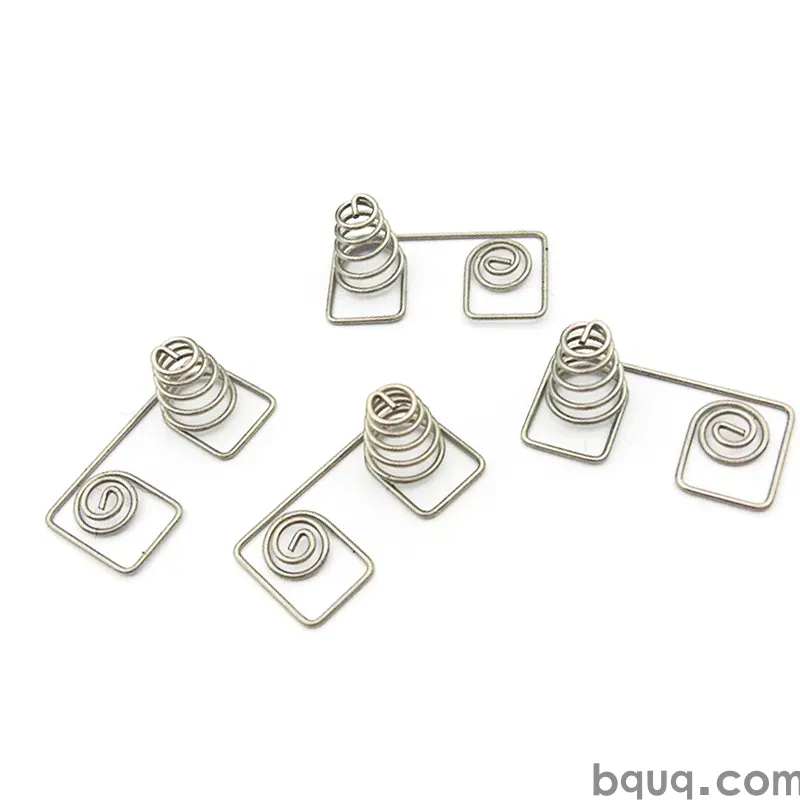
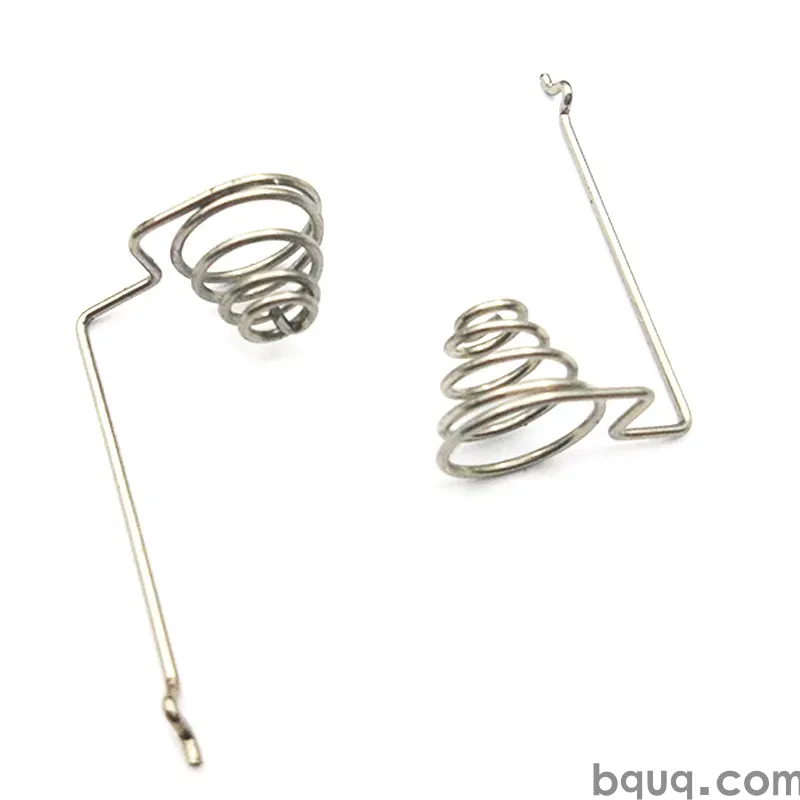
One class of stamped parts has the opposite requirement: parts that must spring back. Contact springs, shrapnel, EMI fingers, battery clips and every stamped spring contact is a springback machine by design — the die forms a shape whose elastic deflection under load creates the contact force. In those parts the die maker controls the free-state geometry precisely because the springback under deflection is the function, and the material is chosen for its elastic range and fatigue behavior rather than its formability. The design logic, materials and plating choices for that family are covered in our electronic contact springs guide; the manufacturing logic is the same one this article describes, pointed in the opposite direction.
The practical takeaway for buyers is to separate the two questions when you source a formed part. First, what does the print actually require at the functional points — angle at a mating surface, radius at a stress point, flatness across a seating area? Second, what material and temper will the factory run, because that decides the springback number the die must absorb? Send both the drawing and the material spec together; a die quoted for "stainless steel" and run on 301 hard is a die that misses angle on day one. Drawings, material grade, quantity — that is the RFQ package a die shop can price honestly, and a 12-hour quote is only honest if it is quoting the material you will actually run.
Frequently Asked Questions
Q: How much does a stamped part spring back after bending?
A: Indicatively 1–3° per 90° bend for mild steel at a radius-to-thickness ratio of one, 3–5° for annealed stainless, and up to 8–12° for hardened spring steels. Higher yield strength, larger r/t ratio and thinner sections all increase springback.
Q: Can springback be eliminated completely in stamping?
A: No, it cannot be removed — elastic recovery is a material property. It can be made negligible by bottoming or coining the bend zone, which stresses the material past yield and sets the angle, at the cost of higher tonnage and some surface marking.
Q: Do I need stamping simulation to get accurate bends?
A: Not for simple V and wipe bends — overbend tables plus a tryout iteration handle most geometry. Simulation earns its cost on long open sections, twist-sensitive channels and high-strength materials where springback varies along the part.
Q: Why did my parts change angle when the factory changed material?
A: Springback tracks yield strength. Substituting a higher-strength or harder-temper material into a die that was compensated for the original grade shifts the bend angle, sometimes by several degrees. Any material change on a formed part should trigger a die review and tryout.
Q: Who owns the springback risk on a new stamped part?
A: The die maker owns hitting the print at the agreed material and press conditions, and normally budgets one to three tryout iterations. The buyer owns specifying material grade, temper and functional angle requirements accurately — a die can only compensate for the material it is told to run.
Related Resources
- Metal stamping tolerances guide: what angle and flatness tolerances a stamping house can actually hold.
- Stamping die types guide: progressive, compound and transfer dies and where each is used.
- Stamped terminals and contacts: formed contacts where controlled springback is the function.
- About BQUQ: ISO9001-certified source factory in Dongguan for stamping, CNC, springs and heat sinks.
- Contact us: send your drawing and material spec for a quote within 12 working hours.
Authored by the BQUQ Engineering Team. BQUQ is an ISO9001-certified source factory in Dongguan, China, running CNC machining, metal stamping, custom springs, heat sink and collet lines under one roof. Send drawings to sc@bquq.com or WhatsApp +86 13713157787 for a quote within 12 working hours. www.bquq.com