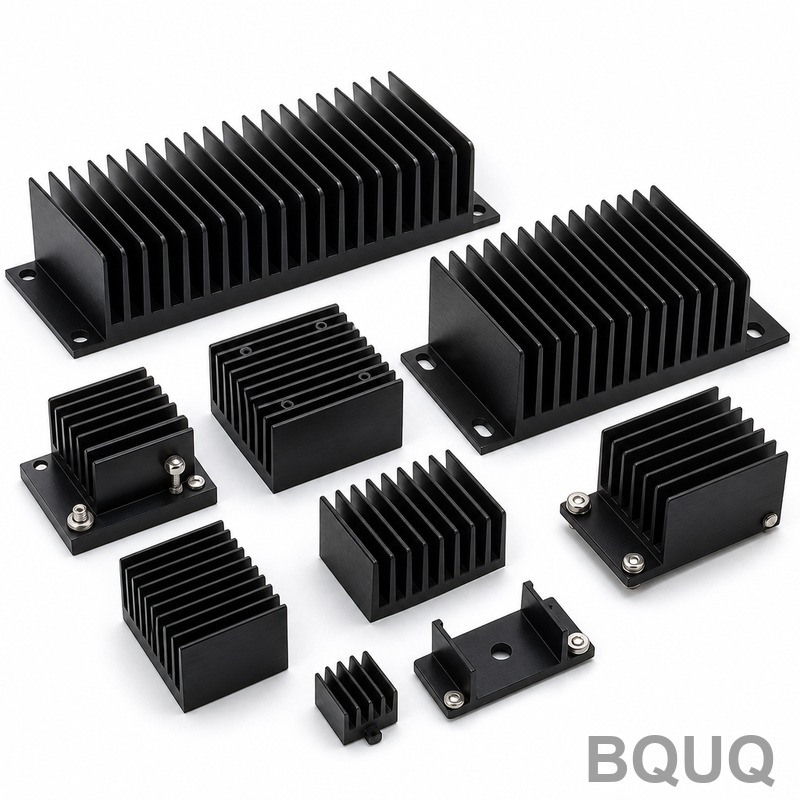
5G RRU Heat Sink: 300mm Extruded Profile, CNC-Machined, Black Anodized
A 5G remote radio unit packs its power amplifiers into a housing the size of a shoebox and then hangs it on a pole in the sun. The heat sink is the whole enclosure's thermal path, and it has to work passively - no fan, no pump - at 300mm long, with a machined interface to the RF board and mounting features that survive wind and vibration. Long profiles like this are where extrusion straightness, machining accuracy and anodize quality all run into each other.
Project Background & Challenge
A telecom infrastructure vendor supplying 5G RRU hardware brought us a 300mm extruded heat sink that doubles as part of the radio housing. Volumes were 10,000 pieces per month. The profile is 6063-T5 with a dense fin field on the outside and a flat internal face where the RF power board mounts. It looks like a simple extrusion until you read the machining and finish notes.
The die had to be right the first time, because a fin field with uneven wall sections extrudes badly at volume. The vendor had already lived through that on an earlier revision, where thin fins cooled at different rates than the thick base and came off the press slightly wavy, and the housing did not close cleanly against its gasket.
The thermal brief was equally specific. With no active cooling allowed, the fin field had to reject the full amplifier load into still air, and the board's thermal pad only holds contact when the machined interface stays flat to it. That put mounting-face flatness and fin geometry on the same short list of features this part lives or dies by.
Three things make this part hard. First, length: past 300mm, extrusion straightness and twist get worse, and a bowed profile will not seat against the housing gasket. Second, the mounting face and a set of threaded bosses have to be machined after extrusion, and they must sit in the correct place relative to the fin field, not relative to a bowed blank. Third, black anodize: on a 300mm part, uneven or thin coating shows up immediately, and a masked ground pad has to stay perfectly clean so the board still grounds to the housing.
The vendor had been buying the profile from one supplier and sending it out for machining and anodizing to two more. Every hand-off added days to the schedule, and every supplier pointed at the others whenever a batch drifted out of tolerance. They wanted one partner who owned the whole sequence from extrusion to packed finished part.
BQUQ Process Solution
We extrude the profile, stabilize it, then machine only the surfaces that must be exact - so the fin field stays as-extruded and the interface stays controlled end to end.
Profile Extrusion and Straightness Control
6063-T5 extrusion with the fin field on the outer face, followed by stretch-straightening to bring the 300mm length back within 0.5mm straightness so it closes cleanly against the housing gasket. Blanks are then cut to length and stress-stabilized before machining, so the part does not creep after the mounting features are cut and the length stays stable through anodizing. Fin wall thickness is controlled across the profile so the long fins do not pull the base out of line, and extrusion pull speed and cooling are held steady so the fin tips track true along the length rather than drifting as the profile exits the die.
CNC Milling of the Mounting Interface
The internal mounting face and the threaded boss pattern are milled in one setup, holding the face flat within 0.05mm and locating boss positions to 0.01mm relative to the interface datums. The finned side is left untouched, so the thermal surface formed by the die is not disturbed by cutters or chips. Milled edges are deburred in-process, because a burr left on the mounting face would hold the board off its thermal pad and quietly cost the board its contact.
Black Anodizing and Masked Pads
Parts go through black anodizing for corrosion resistance and a uniform appearance. The ground pad and the board interface are masked so coating never sits where conductivity is needed, and coating thickness is controlled so it does not bridge fin gaps or round the fin edges. A masking re-check before packing confirms no anodize has crept onto the mounting pads, which is the kind of defect that only shows up when the unit fails its ground test. Coating on the fin field is also kept thin enough that it does not measurably raise the surface temperature the fins are there to reject.
Key Specifications
| Item | Specification |
|---|---|
| Material | 6063-T5 extruded aluminum |
| Profile length | 300mm |
| Mounting face flatness | 0.05mm |
| Boss / hole position | ±0.01mm |
| Straightness | ≤0.5mm over the full length |
| Fin thickness | 1.0mm (0.3mm minimum capability) |
| Surface finish | Black anodized, masked ground pad and board interface |
| Volume | 10,000 pcs/month |
| Inspection | CMM layout + air gauging on the interface, CPK≥1.33 |
| Delivery | Samples in 6 days, first 10,000-pc batch in 18 days |
Quality Control & Delivery
First-article inspection is a full CMM layout: flatness mapped across the mounting face, boss positions verified against the board drawing, straightness checked over the full 300mm, and anodize thickness plus masking confirmed before the lot is released. Critical interface features carry a CPK target of 1.33 or better, and the data ships with every batch under an ISO9001:2015 quality system. Inspection records are kept per lot so a field question can be traced back to the extrusion run and the finishing line that produced it.
Result: samples were approved in 6 days, the first 10,000-piece batch shipped in 18 days, and the part now runs on a rolling monthly schedule. Because extrusion, machining, anodizing and inspection sit in one sequence, the vendor dropped two outside suppliers and all the shipping and re-qualification that came with them. Flatness on the mounting face and boss positions held inside tolerance across the qualification run, and the black anodized finish came out uniform from end to end of every 300mm part.
Related Products & Resources
Browse the Custom Extruded Aluminum Heat Sink collection for the wider range of profiles, or the Black Anodized Aluminum Heat Sink collection for finished parts like this one. Common questions on tolerances, finishes and lead times are answered in our FAQ Center. Send a drawing and get a quotation within 12 hours.
FAQ
What flatness and straightness can you hold on a 300mm extruded heat sink?
We machine the mounting face flat within 0.05mm and hold the profile straight within 0.5mm over the full 300mm. Straightness is checked against the housing gasket datum, and flatness is mapped with a CMM rather than checked at a single point, with CPK held at ≥1.33.
Does black anodizing hurt the thermal performance?
Not in a way that matters here. Anodize is a thin conversion layer, and a black surface actually radiates heat slightly better than bare aluminum. What matters is masking the ground pad and controlling coating thickness so fin gaps are not bridged, which we verify before the lot is packed.
Can you mask specific pads during anodizing?
Yes. The ground pad and the board interface are masked so the coating never sits where conductivity is needed. Thickness on the masked area is checked after anodizing, and a final re-check confirms no coating has crept onto the mounting pads before shipment.
What volume can you run for a 5G RRU heat sink?
From 1,000 to 100,000 pieces per month. This part runs at 10,000 pieces monthly, with a first batch of 10,000 shipped in 18 days after sample approval. Samples themselves are ready in 6 days from drawing sign-off.