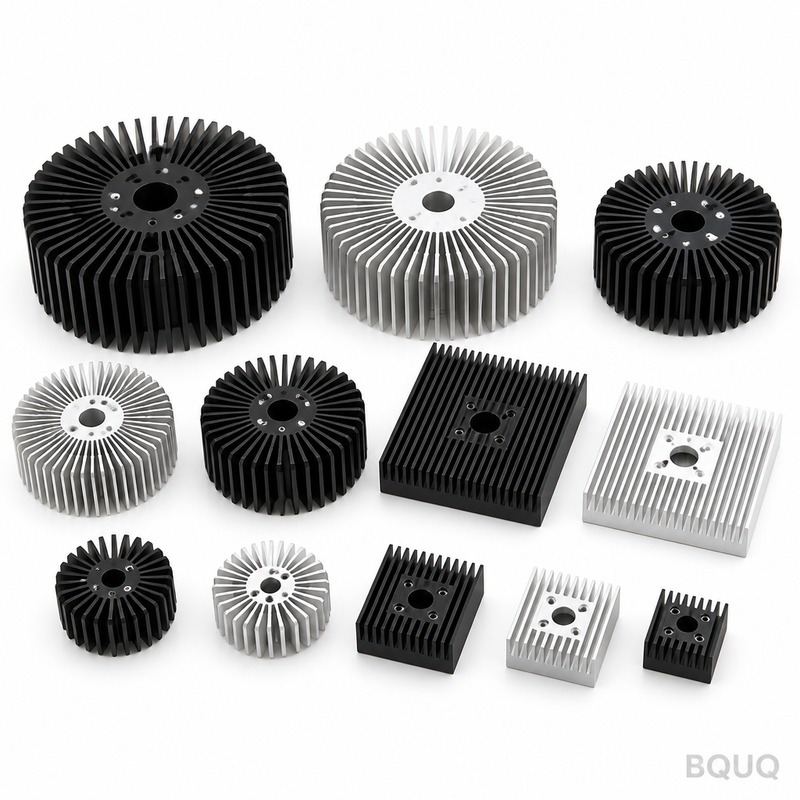
LED High Bay Heatsink: 6063-T5 Extrusion, φ150mm, Black Anodized, 5K-20K/mo
An extruded heatsink for LED high bay luminaires looks like a commodity until it is pushed into real service: hot ceiling air on a Gulf warehouse summer afternoon, an LED board that must never exceed its junction temperature limit, and a brand reputation riding on every unit shipped. The part has to combine stable extrusion geometry, a precision-machined mounting face, and a durable black anodized finish - and it has to do all three at 5,000 to 20,000 pieces a month without batch-to-batch drift.
Project Background & Challenge
Our client is an LED luminaire brand selling high bay and low bay fixtures into the Middle East and Europe. Their 150W-200W high bay platform uses a cylindrical heatsink above the LED module: outer diameter φ150mm, length 180mm, with extruded fins running the full circumference. Fixtures in this market burn 12-16 hours a day, and in summer the ambient air near the warehouse ceiling can exceed 50 °C. At those temperatures a meaningful share of the heat must leave by radiation as well as convection, which is why the drawing called for a black anodized surface with infrared emissivity ≥0.85 rather than bare aluminum.
Three problems had pushed the client to re-source the part. First, the previous supplier delivered raw extrusion with a sawn mounting face; flatness varied between roughly 0.15mm and 0.3mm from lot to lot, forcing over-application of thermal grease and still leaving hotspots on the LED PCB. Second, the black anodize color drifted visibly between production batches - easy to notice when fixtures hang side by side in the same hall. Third, capacity: when retail and logistics fit-out seasons peaked, the supplier could not flex from 5,000 to 20,000 pieces a month without missed shipments.
The technical requirements were therefore written into the drawing without room for interpretation: 6063-T5 extrusion, fin thickness 0.8mm with uniform spacing around the profile, mounting face machined to 0.05mm flatness, black anodized finish with emissivity ≥0.85, and a monthly volume of 5,000-20,000 pieces with short-notice peaks.
BQUQ Process Solution
BQUQ treated this as one thermal component rather than three disconnected operations, locking the extrusion profile, CNC facing and anodizing into a single controlled flow under one quality system.
Extrusion Die and Profile Control
The φ150mm profile with 0.8mm fins is extruded from 6063 billets, quenched on-press and aged to T5 - the standard aluminum alloy for LED thermal components because of its balance of extrudability and thermal conductivity. A dedicated die is maintained for this customer, with the die bearing inspected and re-polished on a fixed schedule so fin geometry stays constant across the year. Fin tips are monitored on every production run; thickness is kept from 0.8mm downward only within the agreed tolerance band, so the airflow passages between fins never narrow enough to hurt convection. Extruded lengths are stress-managed and straightened before cutting to keep the long 180mm body true, which is what makes the later single-pass facing possible. Cutting is scheduled so that every anodizing batch draws from one extrusion lot, keeping the alloy condition uniform and giving the anodize a consistent substrate to form on.
CNC Facing of the Mounting Base
Every blank is held in soft jaws and the mounting face is faced in a single continuous pass on CNC turning centers. Single-pass facing is deliberate: it removes the flatness error that saw-cut or multi-step machining introduces, and it leaves a consistent fine finish that spreads thermal grease evenly under the LED module. The 0.05mm flatness requirement is verified by CMM sampling on first articles and on a fixed in-process cadence. Mounting holes for the LED assembly are drilled in the same setup, so hole-to-face position never accumulates a second clamping error. This is where the client's original pain point - wavy mounting faces and hotspots - is eliminated at the source.
Black Anodizing with Batch Color Control
The heatsinks are black anodized to a thickness chosen to raise infrared emissivity to ≥0.85 while keeping the coating's own thermal resistance negligible. Dye bath parameters are locked per production lot, and every batch is compared against retained master samples in a standard light booth before packing - this is how the visible color drift between lots was removed. Anodize thickness is checked with an eddy-current gauge on each lot and recorded in the shipment paperwork, so the client's incoming inspection can verify the radiative-performance specification without re-testing.
Packing is engineered rather than an afterthought: heatsinks are interleaved in dividers with the fin tips protected, because a bent fin tip on a φ150mm profile is both a cosmetic claim and a convection loss. Cartons are qualified by drop test before the shipping lane is approved.Mounting geometry is held as tightly as the thermal shape: the bolt circle and the LED-board seating face are CNC machined after extrusion and aging, with hole positions at ±0.1 mm and the seating face machined to 0.05 mm flatness so thermal paste gaps stay thin across the whole board. This machining step is what turns an extruded profile into a drop-in heatsink for the luminaire assembly line.
Key Specifications
| Item | Specification |
|---|---|
| Material | 6063-T5 aluminum extrusion |
| Overall dimensions | Outer diameter φ150mm, length 180mm |
| Fin thickness | 0.8mm extruded fins, uniform spacing |
| Mounting face flatness | 0.05mm, single-pass CNC facing |
| Surface finish | Black anodized, infrared emissivity ≥0.85 |
| Volume | 5,000-20,000 pcs/month with peak flexibility |
| Inspection | CMM flatness sampling, eddy-current anodize gauge, color match vs. master samples, CPK≥1.33 on critical dimensions |
| Delivery | Samples in 3-7 days, first batch in 12-20 days |
Quality Control & Delivery
Production runs under an ISO9001:2015 quality system. First-article inspection covers full CMM layout of the profile, mounting-face flatness and hole positions; anodize thickness and emissivity-critical surface condition are measured on every lot. In-process sampling tracks fin geometry and mounting-face flatness at a fixed frequency, and CPK on critical dimensions is kept at ≥1.33 across rolling monthly batches. Each shipment includes an inspection report so the client's quality team can release the goods at their dock without re-measuring.
Result: first samples approved within 7 days, first production batch of 10,000 pieces delivered inside the agreed window, and the supply schedule has since flexed smoothly between 5,000 and 20,000 pieces a month through two peak seasons - with zero color-deviation claims and a measurable drop in LED hotspot failures at the client's burn-in test.
Related Products & Resources
To see more of this product family and how BQUQ scales it, browse the black anodized and extruded heatsink collections:
For production capacity, equipment and quality-system details, visit Factory Strength.
FAQ
Can you make fins thinner than 0.8mm on an extruded heatsink?
For extrusion, around 0.8mm is a practical floor for a φ150mm profile; pushing much thinner risks die deformation and inconsistent fins. If a design needs 0.3mm fins, the right process is a stamped-fin assembly: fins stamped from 0.3mm aluminum sheet and assembled into a CNC-machined base, which BQUQ also produces.
How do you guarantee 0.05mm flatness on the mounting face?
The face is machined in one continuous CNC pass rather than sawn or stepped, which removes the main source of waviness. Flatness is then verified by CMM on first articles and at a fixed in-process sampling frequency, with CPK≥1.33 tracked on the dimension across monthly batches.
Why is black anodizing specified instead of bare aluminum?
Bare aluminum reflects infrared; black anodized surfaces have emissivity of ≥0.85, so they radiate heat far more effectively. In an enclosed high bay housing running above 45 °C ambient, that radiative share measurably lowers LED junction temperature and extends lumen maintenance life.
What are the sample and batch lead times?
Samples take 3-7 days after drawing approval, and a first production batch ships in 12-20 days depending on anodizing queue and volume. After the first batch, rolling monthly schedules from 1K to 100K pieces are standard, so peak-season flex from 5,000 to 20,000 pieces a month does not require re-qualification.