Server CPU heat sinks: extruded base plus stamped-fin assembly, fins down to 0.3mm, ramp from sample to 50K pcs/month in two months, thermal test reports included. BQUQ heat sinks.
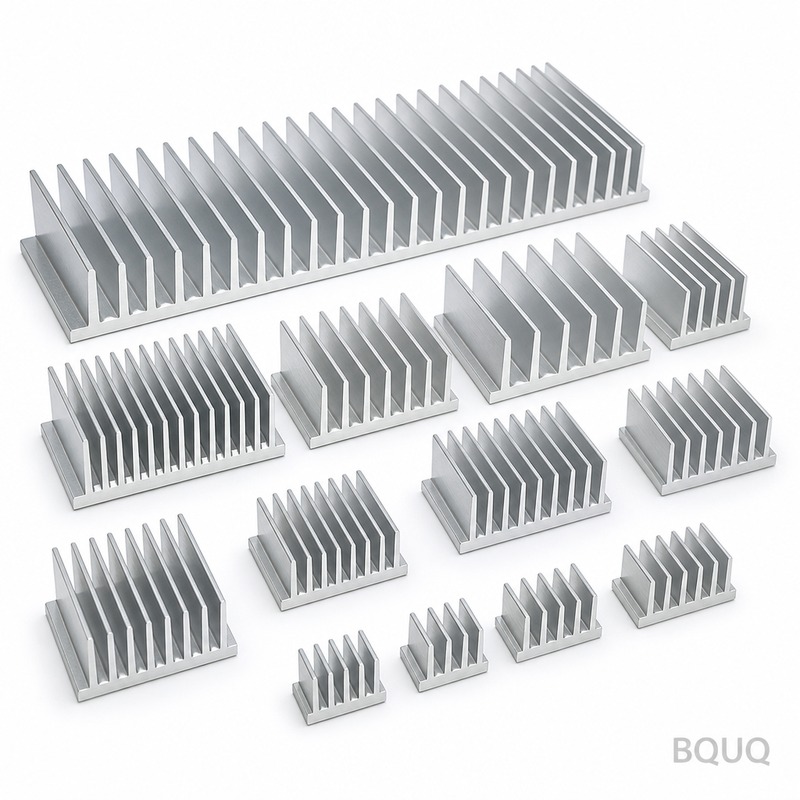
Server Heat Sink Extrusion + Stamped Fin Assembly: Bonded-Fin Design, 0.3mm Fin, 60-Day Volume Ramp
As server CPU power climbs, conventional extruded heat sinks have hit their limit: make fins denser and the die cannot push the profile; make them thinner and they lack strength. The composite answer: an extruded base for flatness and heat path, with thin stamped fins assembled onto it - fins can be much thinner and denser, and surface area multiplies.
Project Background & Challenge
A server maker was developing a heat sink for its next CPU: 6063-T5 extruded base with 0.3mm stamped aluminum fins assembled onto it, 60mm total height, thermal resistance 15% better than the previous generation, and only two months from design freeze to volume.
The challenges: 0.3mm fins distort easily during stamping and assembly; the fin-to-base joint decides thermal transfer - a poor joint is as bad as no fins at all; and a two-month ramp leaves no room for trial and error, so tooling and process must be right the first time.
BQUQ Process Solution
Base and Fins Split
The base is extruded with CNC-finished underside for CPU contact (flatness ≤0.05mm). Fins are stamped on a progressive die - 0.3mm aluminum with locating features built in, so dimensional consistency comes from the tool. Assembly uses a mechanical interlock plus thermally conductive adhesive as a double guarantee of strength and heat transfer.
Fast Ramp Path
Tools develop in parallel: extrusion die in 20 days, fin progressive die in 25 days. First assembled units go through thermal resistance testing and drop testing; once verified, volume ramps to 50,000 pieces a month within two months.
Key Specifications
| Item | Specification |
|---|---|
| Base | 6063-T5 extruded, underside flatness ≤0.05mm |
| Fins | 0.3mm stamped aluminum, interlock + thermal adhesive |
| Total height | ≤60mm |
| Thermal resistance | Measured reports included, 15% better than previous gen |
| Surface | Anodizing (natural or black) |
| Volume | Ramp to 50K pcs/month within two months |
| Inspection | Thermal test + flatness + joint pull + drop test |
Quality Control & Delivery
First articles per batch go through thermal resistance and joint pull verification. Weak joints are prevented by controlled process parameters plus pull sampling; anodizing thickness is measured per batch. Samples in 4 weeks, ramp complete in two months, quarterly rolling orders after.
Related Products & Resources
To see more parts in this category and how we scale them, browse the Extruded Heat Sinks category page, or these related products:
Related Q&A: What Performance Limits Do Microchannel Cold Plates Push in Liquid Cooling? More Q&A is in our FAQ Center.
For our capabilities, equipment and quality system, visit About BQUQ and Factory Strength.
FAQ
Won't 0.3mm fins distort in stamping?
A progressive die forms them in one pass with an in-die sizing station that corrects warpage, and locating features guide assembly so fins never take uneven loads. Distortion is controlled by tooling, not hand straightening.
How do you join fins to the base without weak spots?
A mechanical interlock carries the load and thermally conductive adhesive fills contact gaps for heat transfer. Joint pull and thermal resistance are verified per batch with data included.
Is a two-month ramp realistic?
Yes. The extrusion die and fin die run in parallel - samples in 4 weeks, ramp in 4 more, planned down to the week. Send the drawing and thermal targets and we respond with a process plan and schedule within 12 hours.