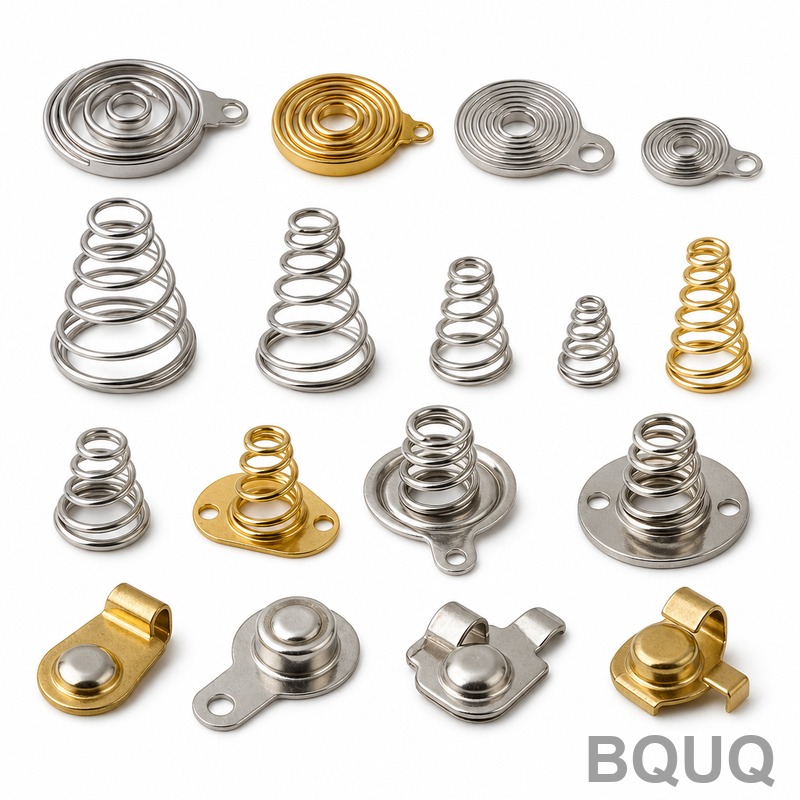
TWS Battery Contact Spring: 304 Stainless Steel, 0.3mm Wire, ±3% Force
A battery contact spring inside a true wireless earbud charging case looks like the simplest line item in the bill of materials - a few coils of 0.3mm stainless wire. In practice it is one of the most punishing parts to build. The contact force must hold within a few percent across millions of pieces a month, the plating must survive sweat, humidity and repeated docking, and any drift shows up in the field as charging failures and warranty returns.
Project Background & Challenge
The customer is an Asian ODM that develops and manufactures TWS earbuds and wearable devices for international brands. Inside each charging case, a small battery contact spring presses against the battery terminal to maintain a stable connection through thermal expansion, vibration and thousands of open-close cycles. The previous supplier could coil the part at volume, but the delivered force varied noticeably from batch to batch, and plating wear after a few thousand insertion cycles led to elevated contact resistance and intermittent charging complaints from end users.
The engineering requirements were tight in three directions. First, the spring is coiled from 0.3mm wire - near the fine end of practical coiling - so every process parameter, from wire tension to pitch, influences the final force. Second, the contact force tolerance was set at ±3%, considerably tighter than the ±10% commonly quoted for commodity springs. Third, the contact must survive 100,000 insertion and press cycles with the nickel plating intact, because each time a user docks the earbuds the plated surface sees sliding contact against the terminal.
Volume made everything harder. The program ramped from 1 million to 3 million pieces per month within two quarters. At that rate, even a 1% escape rate means tens of thousands of defective charging cases. The customer needed a supplier who could hold statistical control at volume, not just pass a first article.
There was also a practical constraint that commoditized springs rarely discuss: the parts ship in bulk to two assembly plants in different countries, and loose coiled springs at 0.3mm wire tangle badly. Tangled springs arrive with deformed leads, so packaging, moisture protection and per-box quantity control all became part of the technical agreement rather than an afterthought.
BQUQ Process Solution
BQUQ treated this as a force-control problem first and a coiling job second, and built the process around keeping the force distribution centered and narrow at monthly volumes of 1-3 million pieces.
Material & Wire Selection
All springs are coiled from 304 stainless steel wire, chosen by the customer for corrosion resistance in humid environments. Wire from audited mills is inspected on arrival for diameter and tensile consistency, because a 0.3mm wire with even slight diameter variation shifts the spring rate measurably. The 0.3mm size sits comfortably within the 0.2-3mm spring wire range that BQUQ works with, and incoming inspection records diameter uniformity so any mill lot change is caught before it reaches the coiling floor. Switching between approved mills is only permitted after a confirmation run shows the force distribution unchanged.
Coiling & Force-Window Setup
Coiling is scheduled on CNC spring coiling equipment with in-line monitoring of outer diameter. Rather than targeting a single nominal force, the process is set up around a force window: sample springs from each setup are tested on a spring force tester, and the load-deflection curve is compared against the ±3% band. Pitch, diameter and free length are adjusted until the distribution sits centered in the window, then locked. Stress relieving after coiling stabilizes residual stress so the measured force does not drift during storage and transport.
Nickel Plating & Cycle Validation
Before plating, every spring passes through deburring to remove the sharp cutoff tail and any wire-drawing residue that could scratch the battery terminal. Nickel plating is then applied with thickness controlled for both corrosion protection and low, stable contact resistance. To verify durability, sample springs are run through 100,000 insertion and press cycles on a fixture that replicates the earbud docking motion, with contact resistance measured at set intervals. The plating showed no breakthrough and resistance drift stayed within the customer's limit.
Coil geometry is set first on the coiling station, then every parameter that influences contact feel is locked before volume runs: wire diameter 0.3 mm, coil diameter, pitch and leg length are measured on the first article, and contact force is verified across the ±3% window with a force gauge sampling five points per batch. Because the spring works against a 0.3 mm battery tab, burr height and leg alignment matter as much as force; a misaligned leg can ride on the tab edge and scratch the plating, so legs are checked against a go/no-go fixture at every changeover.
Key Specifications
| Item | Specification |
|---|---|
| Material | 304 stainless steel spring wire |
| Wire diameter | 0.3mm |
| Force tolerance | ±3% on contact force |
| Surface finish | Deburred, nickel plated |
| Cycle life | 100,000 insertion/press cycles validated |
| Volume | 1M-3M pcs/month on rolling schedules |
| Inspection | Spring force curve sampling, CPK≥1.33 on force, ISO9001:2015 system |
| Delivery | Samples 3-7 days; first batch 12-20 days |
Quality Control & Delivery
Each new setup starts with a first-article approval: full dimensional check on the optical projector, force testing across a statistically meaningful sample, and plating thickness measurement. After approval, production runs under SPC with contact force as the key characteristic; every batch ships with an inspection report, and capability data is tracked so that CPK on force stays at or above 1.33. The entire flow operates under an ISO9001:2015 quality system.
Result: the customer qualified the part after two sample rounds, and BQUQ now ships on rolling monthly schedules that have scaled from 1 million to 3 million pieces per month. Field charging complaints attributable to the contact spring dropped to effectively zero over the first year of volume production. Alongside the force improvement, the bulk packaging format was refined with the customer to prevent wire tangling during shipment, closing out the last of the assembly-plant complaints.
Traceability was built into the flow as well: each production lot is linked to the wire mill lot and the plating lot, so if either upstream input ever shows an anomaly, the affected range of boxes can be identified and contained within hours instead of weeks. That discipline mattered more than once when the customer's own supplier audits required evidence of material provenance at 3-million-piece scale.
Related Products & Resources
To see more parts in this category, browse the Battery Contact Spring Collection and Custom Coil Springs.
Questions about spring tolerances, plating or cycle testing are answered in the BQUQ FAQ Center.
FAQ
How tight a force tolerance can you hold on battery contact springs?
Force and torque tolerances of ±3-5% are standard capability for coiled springs at BQUQ. This project required ±3%, which is held by setting up around a force window on the coiler and confirming CPK≥1.33 on contact force before any batch ships.
What wire diameters and materials can you work with?
Spring wire from 0.2mm to 3mm, in 302 and 304 stainless steel, 65Mn, music wire and phosphor bronze. The 0.3mm wire on this project is a routine size; on finer diameters we pay extra attention to incoming wire diameter uniformity, since small variation shifts the spring rate.
How is cycle life validated?
BQUQ's fatigue and cycle validation capability covers 5 million to 10 million cycles. The customer requirement here was 100,000 insertion/press cycles, so a fixture replicating the docking motion was built and contact resistance was measured at intervals; plating integrity was confirmed at the end of the test.
What are typical lead times at this volume?
Samples take 3-7 days and a first batch 12-20 days after drawing approval. For running volumes of 1M-3M pcs/month, deliveries run on rolling monthly schedules with agreed safety stock, so assembly line supply is not affected by individual shipment timing.