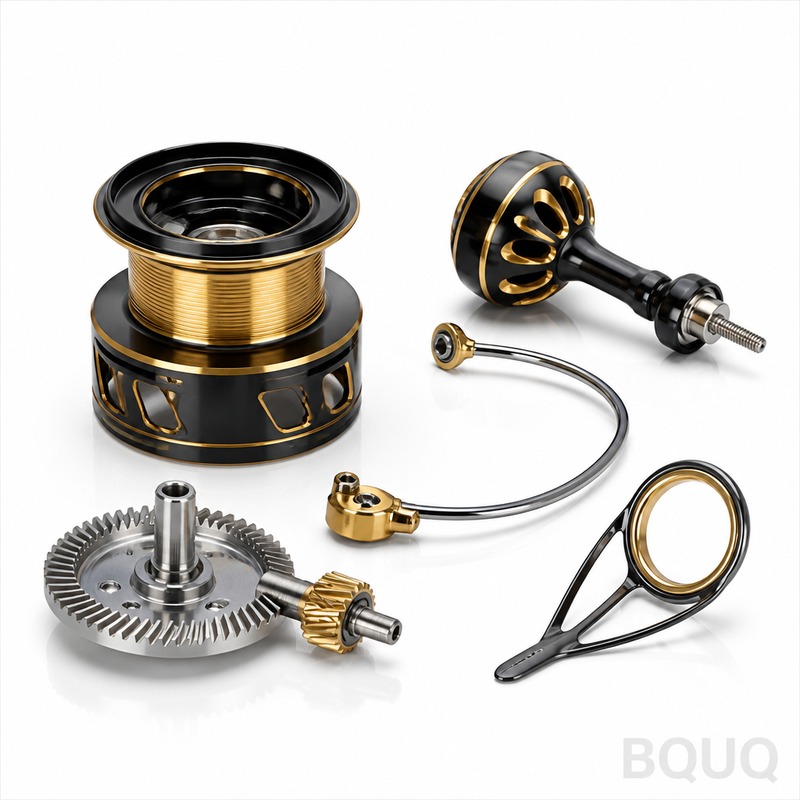
Why Your Scroll Set Needs 5-Micron Control, Not Just Tight Tolerances This is a Cnc Machined Compressor Scroll Parts set — the fixed scroll and orbiting scroll that form the compre
Cnc Machined Compressor Scroll Parts | Precision Scrolls by BQUQ
Why Your Scroll Set Needs 5-Micron Control, Not Just Tight Tolerances This is a Cnc Machined Compressor Scroll Parts set — the fixed scroll and orbiting scroll that form the compression chamber in you
Get a Fast Quote for This Part
Send us your drawing / quantity / material — reply within 24h.
Why Your Scroll Set Needs 5-Micron Control, Not Just Tight Tolerances
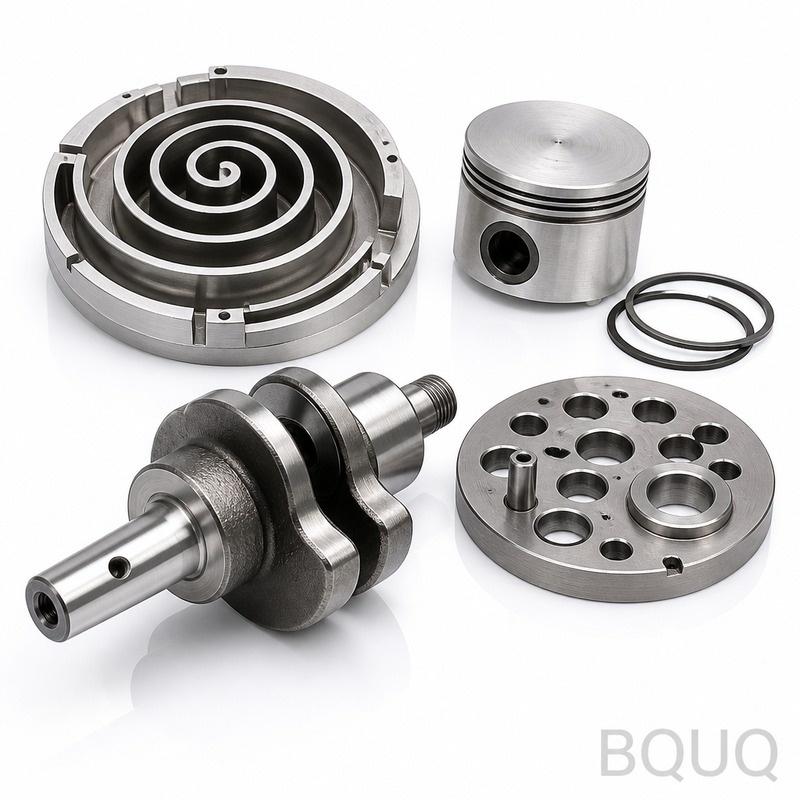
This is a Cnc Machined Compressor Scroll Parts set — the fixed scroll and orbiting scroll that form the compression chamber in your scroll compressor. The concrete benefit is repeatable tip clearance: we hold profile tolerance to ±0.005 mm and total runout under 0.008 mm. That means less internal leakage, higher volumetric efficiency, and a quieter run at high discharge pressure. Lead time is 10 working days for prototypes, 15 days for production runs.
Profile Machining: How We Cut the Involute Curve Without Chatter
The scroll wrap is an involute spiral, not a simple circle. We machine it on 5-axis CNC mills with high-pressure coolant through the spindle. Tool path is generated from the actual CAD profile, not a simplified spline. We use a single-point diamond-coated end mill for the finishing pass at 12,000 RPM. This gives us a flank surface finish of Ra 0.4 µm — smooth enough that the two scrolls slide against each other with minimal friction. We also check the wrap thickness at 20 points along the spiral; deviation stays under 0.01 mm.
Materials and Heat Treatment We Use for Wear Resistance
For cast iron scrolls, we use QT500-7 ductile iron — good damping, low thermal expansion. For aluminum scrolls (lightweight compressors), we use 6061-T6 or 7075-T6. But the critical part is the hardening step. For steel scrolls, we apply gas nitriding to 48–52 HRC case hardness, depth 0.3–0.5 mm. That gives you a wear-resistant surface without the distortion of through-hardening. We measure hardness on every batch with a Rockwell tester and record it in the inspection report. If you need stainless steel (for medical or food-grade compressors), we use 17-4PH H1025, which reaches 35–38 HRC without additional coating.
Runout and Balancing: Why Your Orbiting Scroll Won't Vibrate
An unbalanced orbiting scroll causes bearing wear and noise. We balance each orbiting scroll dynamically on a hard-bearing balancing machine. Residual unbalance is held to G2.5 grade per ISO 1940. That means for a typical 150 mm diameter scroll, the residual unbalance is under 1.5 g·mm. We also control the bore-to-wrap concentricity: the center bore runout relative to the spiral datum is 0.008 mm TIR. This is measured on a CMM with a rotary table and a touch-trigger probe. We don't rely on the machine axis — we measure the actual part.
Inspection Before Every Shipment: CMM Report and Surface Roughness Trace
Every single scroll part, not just a sample, gets a dimensional check. We use a Zeiss CMM with 0.5 µm resolution. The report includes: wrap profile deviation, tip height, bore diameter, pin hole position, and flatness of the base plate. For surface finish, we use a portable profilometer with a 2 µm stylus, measuring Ra at three locations on the flank. We send you the PDF report with the parts — no extra charge. If you need a full PPAP Level 3, we can do that too; it adds 2 days to the lead time.
Balancing Act: Aluminum vs. Cast Iron for Your Scroll Set
If you are building a variable-speed inverter compressor for a heat pump, aluminum scrolls are your choice — lower inertia means faster RPM changes. But if you are running a high-pressure refrigeration compressor (R410A, R32), cast iron is better because it resists galling when the oil film breaks down. We machine both, but the tooling is different. For aluminum, we use a 3-flute carbide end mill with a TiB2 coating. For cast iron, we use a 5-flute with AlTiN. The cutting parameters change too: aluminum runs at 8,000 RPM with 2 mm depth of cut, cast iron at 4,500 RPM with 1.5 mm depth. We can recommend the right material for your operating pressure and speed. Just send us your duty cycle and refrigerant type.
What is the minimum order quantity for Cnc Machined Compressor Scroll Parts?
No MOQ — we accept a single piece for prototype testing, and the per-unit price drops at 50, 200, and 500 pieces.
Can you customize the scroll geometry for my existing compressor?
Yes — send your 3D model (STEP or IGES) or a 2D drawing with the base circle radius, involute angle, and wrap height; we will generate the exact tool path and verification report.
How do you control quality across a production batch of 500 scrolls?
We use SPC on the CMM data: every 5th part is fully measured, and the control chart is sent to you weekly; if a trend appears, we stop the machine and recut the fixture.
What is the lead time for a rush order of 20 pieces?
We can ship 20 pieces in 7 working days if you approve the material specification by email within 24 hours of drawing review.
Tooling Strategy: Beating the 'Chatter Zone' on Thin Scroll Walls
Thin scroll wraps (under 3 mm) are the hardest to machine because they deflect during cutting. We solve this with a two-step strategy. First, we rough cut leaving 0.5 mm stock. Second, we finish cut both sides of the wrap in a single climb-milling pass with a 6 mm stub-length end mill. The tool overhang is kept under 25 mm, and we use a hydraulic chuck — not a collet — to reduce runout at the tool tip. This is a critical choice: a standard ER collet can add 0.01 mm runout, which ruins the wrap profile. If you want to understand the tool selection logic in more depth, read our CNC cutting tool selection guide. For the math behind our ±0.005 mm tolerance, see the CNC machining tolerances guide.
Shipping and Packaging for Scroll Parts: No Rust, No Dents
We pack each scroll individually in a VCI (vapor corrosion inhibitor) bag, then place it in a foam-lined box. For aluminum scrolls, we use anti-static foam to prevent galvanic reaction. For cast iron, we add a desiccant pack. Standard export plywood case for orders over 50 kg. We ship by DHL or FedEx for prototypes (3–5 days to USA/Europe), and by sea freight for production orders (20–25 days to Los Angeles or Rotterdam). We mark the packing list with the batch number and CMM report number for traceability.
Get a Firm Quote Within 12 Hours — Send Your Drawing Today
Send your 2D drawing (PDF) or 3D model (STEP) to sc@bquq.com with your target quantity and material preference. We will reply within 12 working hours with a firm unit price, tooling cost (if any), and delivery date. For urgent projects, message us on WhatsApp at +86 13713157787. We are a precision manufacturing factory in Dongguan, China, with 20 years of experience in CNC machining, stamping, springs, and heat sinks. No MOQ, no hidden costs — just the exact part you drew.