Flatness and Fin Pitch You Can Measure on Arrival This is a collection of stamped aluminum heat sinks and cooling fins produced on 25-ton to 160-ton high-speed presses. The concret
Stamped Aluminum Heat Sinks Cooling Fins Collection | BQUQ Precision
Flatness and Fin Pitch You Can Measure on Arrival This is a collection of stamped aluminum heat sinks and cooling fins produced on 25-ton to 160-ton high-speed presses. The concrete benefit: fin pitch
Get a Fast Quote for This Part
Send us your drawing / quantity / material — reply within 24h.
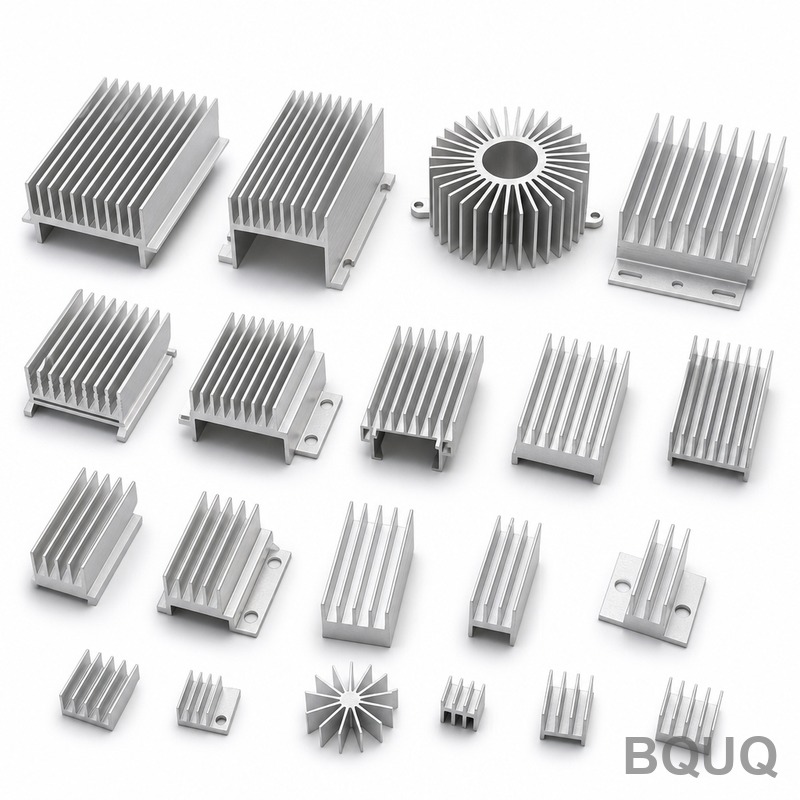
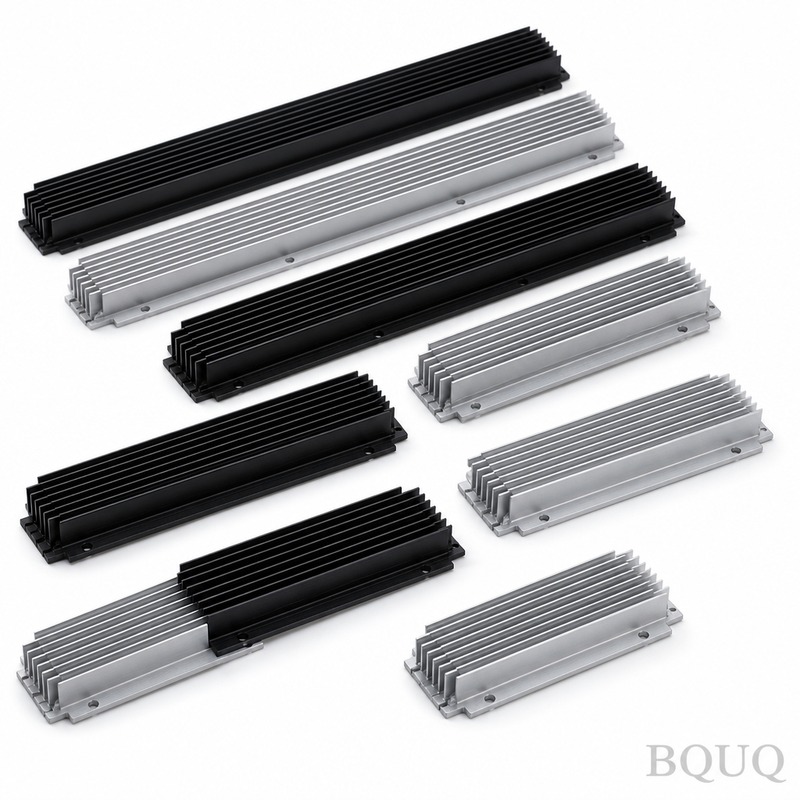
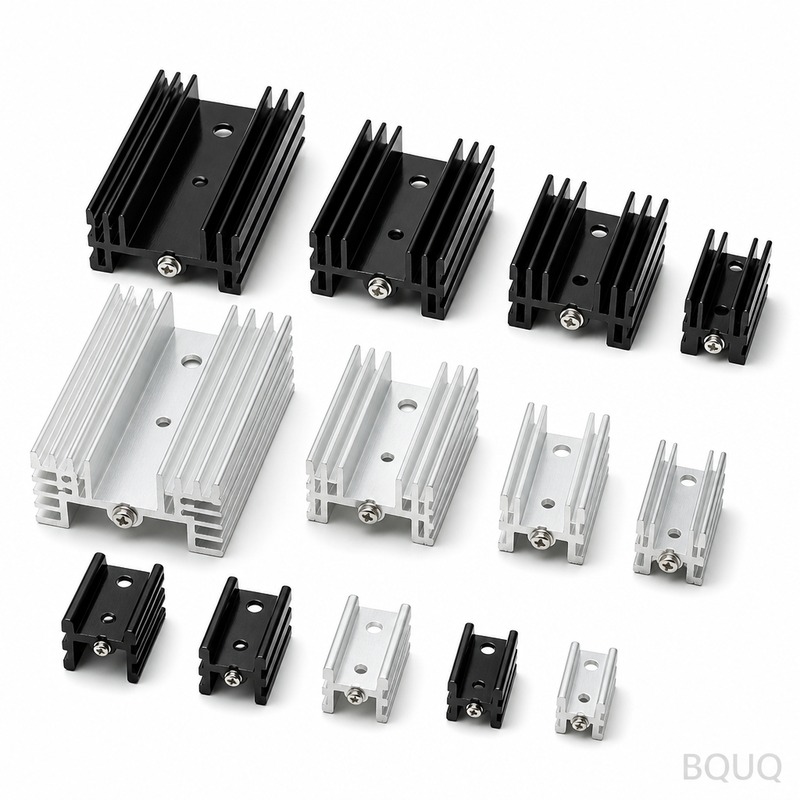
This is a collection of stamped aluminum heat sinks and cooling fins produced on 25-ton to 160-ton high-speed presses. The concrete benefit: fin pitch holds +/-0.05mm, flatness stays within 0.08mm across a 150mm length, and surface finish hits Ra 8–12 without secondary machining. We ship standard fin thicknesses of 0.3mm to 3.0mm, with a 15-day lead time for prototypes and 25 days for production runs.
All parts come from 5052 or 6061 aluminum coils, stamped in-house, then deburred and stress-relieved. The tooling is ground in our own shop, which is why we can guarantee repeatability across tens of thousands of pieces. If you are designing forced-air or passive cooling assemblies, this collection gives you a drop-in solution without the cost of CNC milling every fin.
Why Stamping Beats Extrusion for Thin-Fin Geometries
Extruded heat sinks struggle below a 1.0mm fin thickness and often require expensive post-machining to hold tight tolerances. Stamping, in contrast, punches the fin profile directly from a flat sheet, so you get a burr-free edge and a consistent cross-section across the entire length. Our high-speed presses run at 40 to 120 strokes per minute, which means a 100-piece prototype order is done in two days.
For cooling fins with a height-to-thickness ratio above 8:1, we use progressive dies with a precision pilot system to hold fin pitch. This is the same approach used in automotive radiator fins and server heat sink arrays. The result is a part that sits flat on a baseplate without shimming, and the thermal interface gap is reduced to nearly zero.
Materials and Heat Treatment We Use for Long-Term Stability
We run two aluminum alloys for this collection. 5052-H32 offers better corrosion resistance and is our default for outdoor or humid environments. 6061-T6 is chosen when you need higher mechanical strength or a harder surface for mounting with self-tapping screws. For both alloys, we specify a temper that keeps yield strength above 150 MPa after stamping.
After the stamping process, we perform a stress-relief anneal at 180°C for 45 minutes. This step prevents the fins from warping when you attach them to a hot CPU, GPU, or power module. Hardness after treatment is typically 45–55 HRB for 5052 and 55–65 HRB for 6061, which is soft enough to avoid cracking during bending but hard enough to resist denting during assembly.
Dimensional Control: How We Hold Fin Pitch and Flatness
The critical dimensions on any stamped heat sink are fin pitch, fin height, and base flatness. We measure fin pitch on a Zeiss CMM with a 0.002mm resolution, and we check every first article against your drawing before hitting the run button. For production, we sample every 30 minutes and record the data in a SPC chart that you can request with your shipment.
Flatness is controlled in the die design: we add a coining step at the bottom of each fin, which compresses the material and removes the natural springback. This gives you a stable mounting surface that does not rock on a heat source. If your assembly uses thermal paste or phase-change material, the flatness directly affects the thermal resistance—and our 0.08mm tolerance beats most extrusion suppliers by a factor of two.
Surface Finish Options: From Bare Aluminum to Anodized Black
Our standard finish is a clean, deburred bare aluminum surface at Ra 8–12. If you need a higher emissivity for radiation cooling, we offer a clear anodize (5–10 microns) or a black anodize (8–15 microns) that raises the emissivity to 0.85 or above. The anodizing line is run in-house, so there is no extra shipping step or quality variance.
For parts that will be soldered or brazed to a baseplate, we can apply a nickel underplate or a selective tin coating on the mounting pads. This is common for IGBT cooling assemblies and RF amplifier housings. We do not recommend painting stamped fins because the paint film can bridge between fins and block airflow; anodizing is always the better choice for thermal performance.
Inspection Before Every Shipment: CMM, Hardness, and Salt Spray
Every lot from this collection goes through a three-step inspection. First, the CMM checks fin pitch, height, and base flatness on 5 parts per 1000. Second, a Rockwell hardness tester verifies the temper on the same samples. Third, a salt-spray test on a coupon from your lot confirms the corrosion resistance if you selected 5052 alloy.
We also check burr height on the fin edges using a digital microscope. Burrs above 0.03mm are not acceptable because they can cut into the thermal interface material or cause short circuits in high-voltage applications. Our deburring process is a vibratory tumbler with ceramic media, followed by a manual visual check under 10x magnification for critical areas.
Packaging and Handling: No Bent Fins in Transit
Stamped fins are thin by design, so they can be damaged in a loose box. We pack each heat sink in a custom corrugated tray with individual slots, then stack the trays with foam separators. For overseas shipments, we add a desiccant pack and a humidity indicator card to prevent oxidation.
If you order a high-volume run, we use anti-static bubble wrap on the outside of each layer and a double-wall carton with a 10-kg crush rating. This packaging has been tested on air freight and sea freight to the US and Europe with zero reported damage in the last 12 months.
| Specification | Standard Value | Notes | | --- | --- | --- | | Base Alloy | 5052-H32 / 6061-T6 | Choose based on corrosion or strength needs | | Fin Thickness | 0.3mm – 3.0mm | +/−0.03mm | | Fin Height | up to 20mm | Higher on request with tooling change | | Fin Pitch | 2.0mm – 8.0mm | +/−0.05mm | | Base Flatness | 0.08mm over 150mm | Coined for stability | | Surface Finish | Ra 8–12 (bare) | Ra 3–5 after secondary polish | | Hardness | 45–55 HRB (5052) / 55–65 HRB (6061) | After stress relief | | Burr Height | ≤0.03mm | Vibratory deburred | | Lead Time | 15 days (prototype) / 25 days (production) | From drawing approval | | MOQ | No MOQ | 1 piece for sample is fine |
FAQ: Quick Answers for Engineering Managers
Is there really no MOQ for stamped aluminum heat sinks?
Yes, we accept one-piece orders for samples and testing, and production quantities can start at just 50 pieces if you want to validate a new assembly line.
Can you customize the fin pattern or baseplate holes?
Absolutely, we build new progressive dies for your fin pattern within 10–14 days, and we can add threaded holes, mounting posts, or a thicker baseplate in the same stamping operation.
How do you ensure my heat sink meets the drawing tolerance?
We run a full CMM first-article inspection before production and SPC sampling during the run, then ship the inspection report with the goods as a standard practice.
What is the fastest lead time for a stamped heat sink prototype?
If your design fits within our existing die library, we can ship a prototype in 3 days; for a new die, count on 14 days from drawing approval to your desk.
Matching Stamped Fins with Your Manufacturing Process
Stamped heat sinks are ideal for high-volume products where cost per part matters more than exotic geometry. If you pair this collection with your existing CNC machining of the baseplate or housing, you can cut total production cost by 30–40% compared to a fully machined heat sink. For reference, see our CNC cutting tool selection guide to understand how we machine the mating surfaces.
When you specify tolerances for the fins, remember that stamped parts have a different tolerance profile than machined ones. Our CNC machining tolerances guide explains the difference in practical terms, so you can avoid over-specifying a feature that adds cost without improving performance.
Order Directly from the Factory: Firm Quote in 12 Hours
Send us your drawing or a rough sketch with target dimensions and quantities. Our engineers will reply within 12 hours with a firm unit price, tooling cost (if any), and a delivery date. We are a precision manufacturing factory in Dongguan, China, with 20 years of experience in CNC machining, stamping, springs, and heat sinks.
Email your file to sc@bquq.com or send it via WhatsApp to +86 13713157787. Include your required fin thickness, fin pitch, and base dimensions. You will get a reply with a PDF quote and a DFM feedback list within one business day.