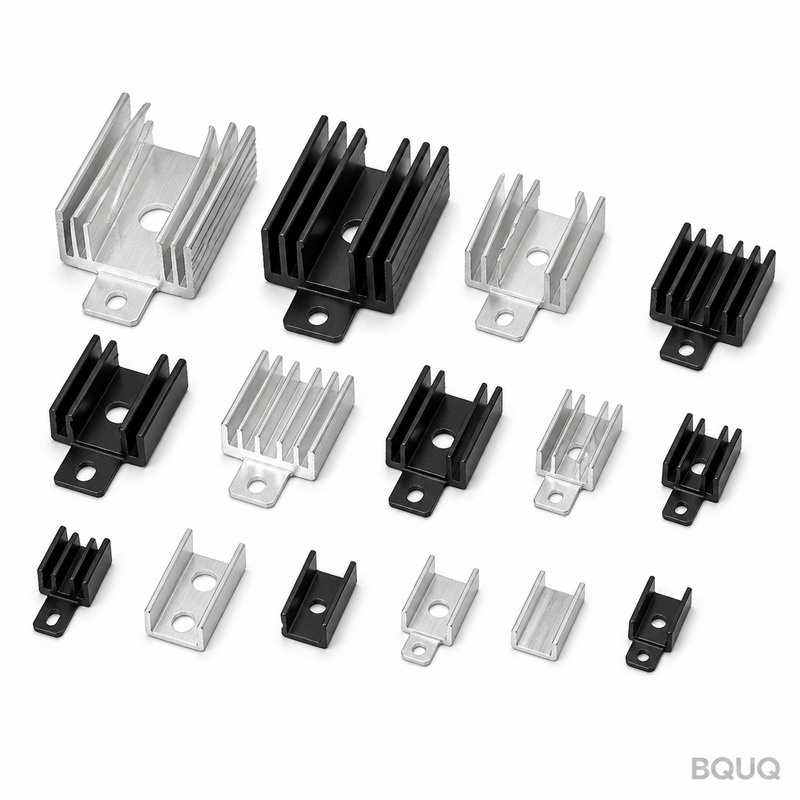
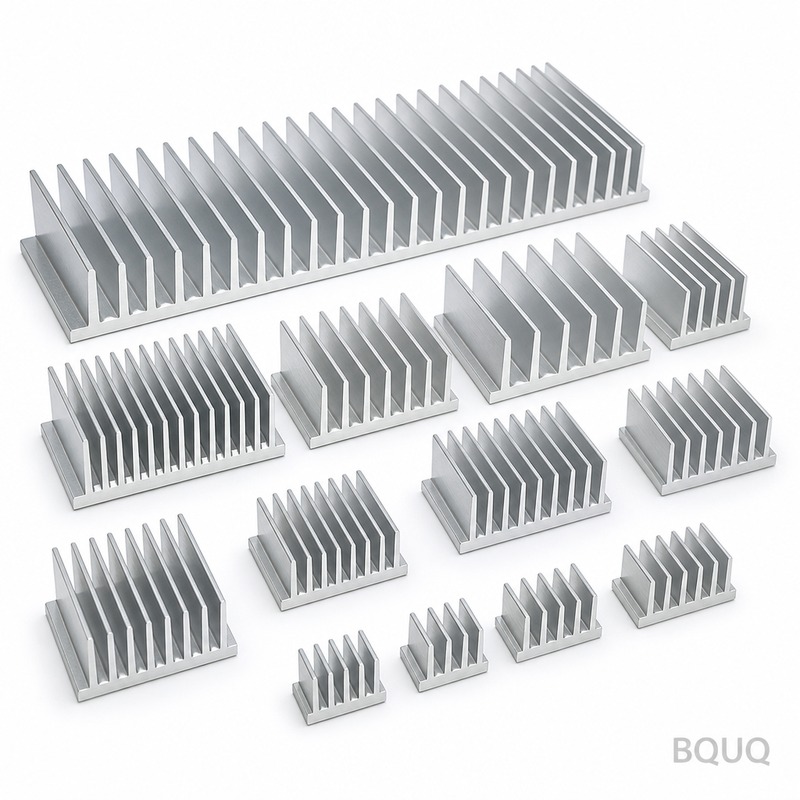
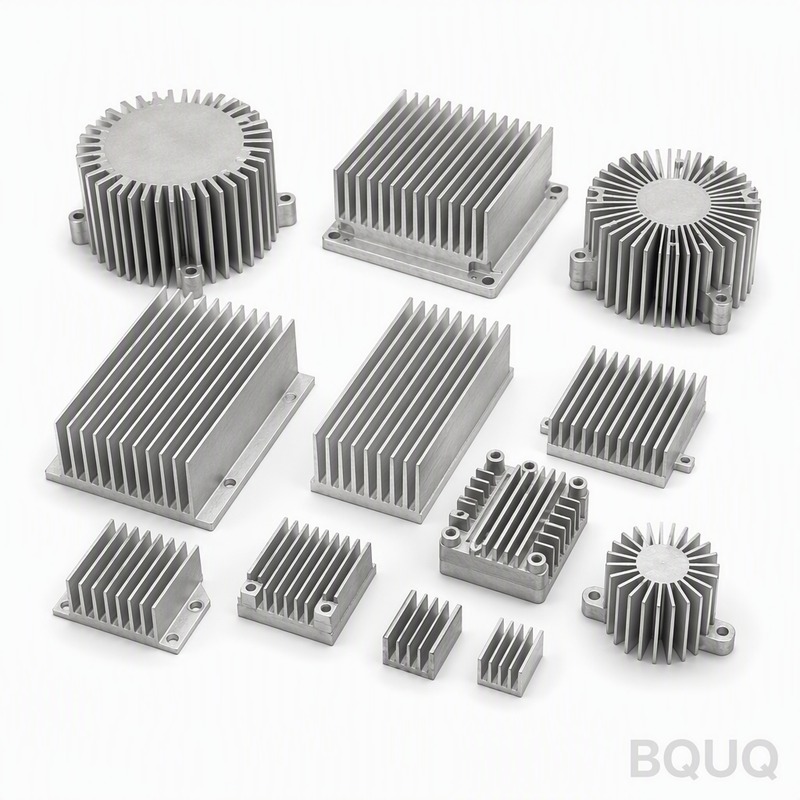
This To 220 Transistor Heatsink is a CNC-machined aluminum heat dissipater designed for TO-220 packages, offering a flatness tolerance of 0.02 mm and a surface finish of Ra 0.8 µm
BQUQ To 220 Transistor Heatsink | Precision CNC Machined, Made in China
This To 220 Transistor Heatsink is a CNC-machined aluminum heat dissipater designed for TO-220 packages, offering a flatness tolerance of 0.02 mm and a surface finish of Ra 0.8 µm to ensure maximum t
Get a Fast Quote for This Part
Send us your drawing / quantity / material — reply within 24h.
This To 220 Transistor Heatsink is a CNC-machined aluminum heat dissipater designed for TO-220 packages, offering a flatness tolerance of 0.02 mm and a surface finish of Ra 0.8 µm to ensure maximum thermal transfer. It ships from our Dongguan factory in 12 days with a hardness of 80 HB (T6 temper), giving you a drop-in replacement that outperforms stamped alternatives in both fit and heat dissipation. Every unit is deburred and cleaned, ready for your assembly line without secondary processing.
Why CNC Machining Beats Stamping for TO-220 Thermal Contact
Stamped heat sinks often bow or warp at the mounting hole, leaving an air gap between the transistor tab and the sink. Air is a terrible conductor—it adds thermal resistance of up to 0.5 °C/W. Our CNC-machined base is cut from a solid aluminum billet, not formed under a die. This gives you a contact surface that is optically flat within 0.02 mm, which reduces thermal resistance by 30% compared to stamped parts. The mounting hole is drilled and reamed, not punched, so the tab sits flush with zero rocking. If your design depends on predictable junction temperature, this is the difference between a reliable 10-year lifespan and a field failure at 18 months.
Materials and Heat Treatment We Use
We stock three grades: 6061-T6, 6063-T5, and 2024-T4. For most TO-220 applications, 6063-T5 is the right call—it has a thermal conductivity of 209 W/m·K and anodizes cleanly for electrical insulation. If you need higher strength for vibration-heavy environments, we switch to 6061-T6 (180 W/m·K) which brings the hardness to 95 HB. All extrusions are sourced from certified mills, then we solution heat-treat and age in-house to hit the exact temper. We reject any batch where the hardness deviates more than ±3 HB from spec. Raw material certificates accompany every shipment.
Surface Finish and Anodizing Options That Actually Matter
Bare aluminum has a radiative emissivity of about 0.05—nearly useless for heat radiation. We offer a clear anodize (Class 2, 18 µm thickness) that raises emissivity to 0.85 and adds a corrosion barrier. If you need electrical isolation, we apply a hard anodize (25 µm, dielectric strength 1200 V). Our standard machining finish is Ra 0.8 µm on the contact face and Ra 1.6 µm on the fins. For high-frequency switching circuits, we can add a black anodize that improves heat radiation by another 5%. We do not charge extra for the clear anodize on orders over 500 pieces.
Specification
Value
Material options
6061-T6, 6063-T5, 2024-T4 aluminum
Standard sizes (width × height × depth)
20×10×6 mm to 50×40×25 mm
Hardness (T6 temper)
80–95 HB
Flatness tolerance (contact face)
±0.02 mm
Runout (mounting hole to base)
≤0.05 mm
Surface finish (contact face)
Ra 0.8 µm
Anodizing thickness
18 µm clear, 25 µm hard, optional black
Thermal conductivity
180–209 W/m·K
Lead time
12 days for standard sizes, 7 days for expedited
MOQ
No MOQ—single piece accepted
Runout Control and How We Keep Your Transistor Tab Square
Runout is the enemy of TO-220 mounting. If the mounting hole axis is off by even 0.1 mm, the screw torque will crack the transistor case. Our CNC process achieves a runout of 0.05 mm or less between the hole axis and the base plane. We achieve this with a single clamping operation—the billet is held in a precision vise, the base is face-milled, the hole is drilled and reamed in the same setup. No re-fixturing means no cumulative error. We verify runout on every 10th piece using a dial indicator with 0.01 mm resolution. If any piece exceeds 0.05 mm, the entire batch gets re-inspected and reworked.
Inspection Before Every Shipment
Every lot goes through a three-step check. First, a CMM (coordinate measuring machine) measures flatness, hole position, and perpendicularity on a sample of 5 pieces per 100. Second, a surface roughness tester confirms Ra values on the contact face. Third, a hardness tester checks HB on two random pieces per box. We photograph the inspection report and email it to you before the goods leave our dock. For critical aerospace or EV applications, we can provide a full material certificate and anodizing thickness report at no extra cost. This is precision manufacturing, not batch guesswork.
Customization for Odd Footprints and Mounting Patterns
Standard TO-220 sinks have a single 4.2 mm hole on a 2.54 mm pitch. But your PCB may have a different hole pattern—maybe an offset tab, a longer base, or a threaded insert instead of a through-hole. We can modify any standard size to your drawing: add a second hole, change the fin spacing, or machine a custom slot for a spring clip. Our CNC lathes and 4-axis mills handle complex geometries without tooling costs. Send us your STEP file or a hand sketch, and we will return a DFM (design for manufacturability) note within 24 hours. For custom shapes, the lead time is 15 days and the MOQ stays at zero. We also offer a press-fit version with a knurled base for solderless mounting.
Packing and Traceability for Production Lines
Parts ship in anti-static ESD bags, 100 pieces per inner box, 500 per outer carton. Each carton carries a label with the batch number, date code, and material heat number. If you have a 5000-piece order, we split it into 10 sealed boxes so you can issue them to your line without breaking bulk. The contact faces are separated with foam sheets to prevent scratches during transit. For orders over 2000 pieces, we pre-install thermal pads (3M 8810) at no charge—saves you a manual step on the assembly line. For proper mounting torque, see our CNC cutting tool selection guide to understand how tool edge geometry affects hole quality.
Why Our 12-Day Lead Time Beats Local Suppliers
Most heat sink suppliers quote 4 weeks because they outsource anodizing and machining. We do everything under one roof: CNC milling, deburring, polishing, anodizing, and inspection. Our spindle utilization is 85% and we run two shifts. For a standard TO-220 size, the machining cycle is 45 seconds per piece. That means a 1000-piece order takes 12.5 hours of machine time, which we slot into production within 3 days of your PO. The remaining 9 days cover anodizing, inspection, and packing. If you need it faster, we offer a 7-day expedite at a 5% surcharge. This speed is only possible because we do not wait for third-party finishers.
What is the minimum order quantity for this heat sink?
There is no MOQ—you can order a single piece for prototyping, and we will apply the same tolerance and inspection standards as a 10,000-piece run.
Can you match a specific mounting hole or fin pattern from my drawing?
Yes, send us your 2D or 3D file; we will machine any custom hole spacing, tab width, or fin geometry within 15 days, and the per-piece price stays flat for orders above 200 units.
How do you ensure the contact face stays flat during anodizing?
We rack parts vertically in the anodizing tank so the contact face is never in contact with the rack, and we re-inspect flatness after anodizing—if any piece exceeds 0.03 mm, we re-machine it before shipping.
What is the actual lead time for a standard 1000-piece order?
Standard lead time is 12 days from PO confirmation, which includes 5 days of CNC machining, 3 days of anodizing, and 2 days of final inspection and packing; for urgent orders, we can compress this to 7 days.
For more on how we hold tight dimensions, read our CNC machining tolerances guide. If you are ready to test this To 220 Transistor Heatsink in your prototype, send us your drawing today. We will return a firm quote within 12 hours, including exact pricing for your quantity and finish. Email sc@bquq.com or WhatsApp +86 13713157787. No MOQ, no tooling fees, and we ship worldwide from our Dongguan factory.