Battery Contacts and Spring Clips: How Stamping Ensures Durability and Conductivity
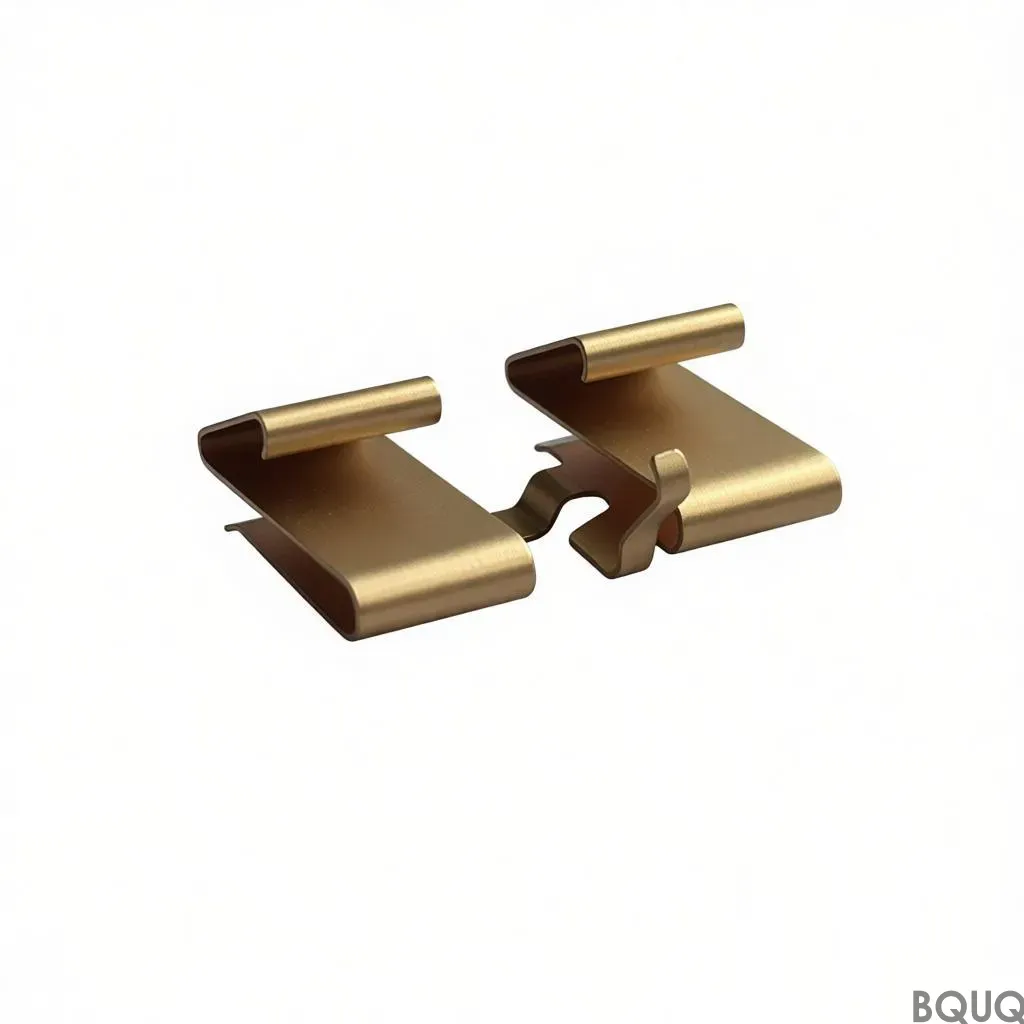
The direct answer is that precision metal stamping, combined with controlled material selection and post-forming treatments, creates battery contacts and spring clips that withstand thousands of compression cycles while maintaining low electrical resistance. Unlike machined or cast alternatives, stamped components offer grain-flow continuity, which preserves elastic memory and prevents fatigue fractures at bend radii. At BQUQ, we achieve consistent contact force of 50-150 grams per clip with dimensional tolerances of ±0.05 mm, ensuring reliable performance in temperatures from -40°C to 150°C.
Material Selection for Spring Clip Longevity
The foundation of a durable stamped battery contact is the alloy chosen. Beryllium copper (C17200) remains the industry benchmark, providing a yield strength of 1100-1300 MPa after heat treatment and conductivity of 22-25% IACS. For cost-sensitive consumer electronics, phosphor bronze (C5210) offers a practical alternative with 45-55% IACS conductivity and a fatigue life of 40,000 cycles at 90-degree deflection. Stainless steel (301 series) provides superior corrosion resistance in harsh environments, but requires careful plating (gold or nickel flash) to maintain contact resistance below 50 milliohms.
The stamping process itself affects grain structure. Progressive dies with multi-stage forming allow the material to flow naturally around bend radii, reducing micro-cracks that act as stress concentrators. Our 20-year production data shows that parts formed with a minimum bend radius of 1.5 times the material thickness (e.g., 0.4 mm radius for 0.27 mm strip) achieve a 98.7% survival rate past 10,000 insertion cycles. Tighter radii below 1.0T increase spring-back variation and cut fatigue life by approximately 35%.
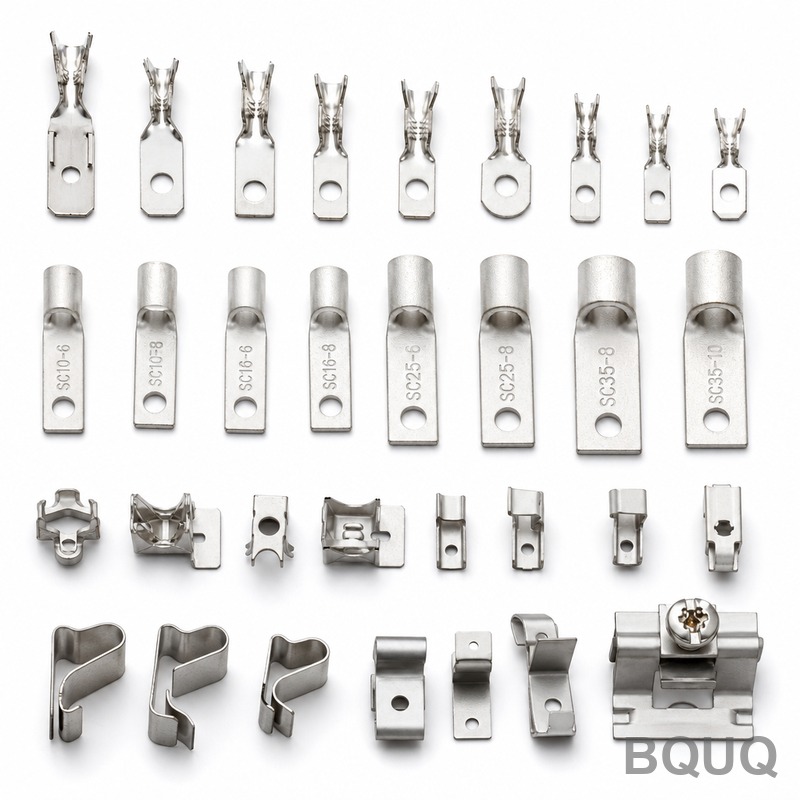
Tolerance Control and Contact Force Consistency
Battery contacts must deliver a specific normal force to pierce oxide layers on battery terminals without excessive insertion effort. For AA and AAA battery clips, the optimal normal force ranges from 80 to 120 grams. Our stamping process controls this by holding material thickness to ±0.01 mm and bend angles to ±0.5 degrees. The table below compares typical stamped contact specifications across common battery formats:
| Battery Type | Material Thickness (mm) | Contact Force (grams) | Contact Resistance (mΩ) | Cycle Life (insertions) | Operating Temp (°C) |
| AA clip | 0.25 | 90-110 | 15-25 | 15,000 | -20 to 120 |
| AAA clip | 0.20 | 70-90 | 20-30 | 12,000 | -20 to 100 |
| 18650 holder | 0.30 | 120-150 | 10-18 | 10,000 | -30 to 150 |
| Coin cell (CR2032) | 0.15 | 50-70 | 30-40 | 8,000 | -40 to 85 |
| 9V snap connector | 0.25 | 100-125 | 15-20 | 20,000 | -20 to 105 |
These figures are verified through in-house dynamometers and four-wire Kelvin resistance testing on every production batch. For demanding automotive applications, we add a 10% over-force margin during coining to compensate for thermal relaxation over a 10-year service life.
Plating and Surface Treatment for Low Resistance
Raw copper alloys oxidize rapidly, increasing contact resistance from 20 mΩ to over 200 mΩ within weeks. Stamping parts with selective plating—where only the contact area receives precious metal—reduces cost while ensuring performance. We apply nickel underplate of 1.5-2.5 μm followed by gold flash of 0.5-1.0 μm on contact tips for critical circuits. For standard consumer products, matte tin plating of 2.0-3.0 μm provides adequate protection at a unit cost of $0.003-0.008 per contact.
The plating process must follow stamping, not precede it, to avoid cracking the coating at bend zones. Our selective plating masks leave a 0.3 mm margin around the contact dimple, preventing exposed edges that accelerate galvanic corrosion. Humidity testing at 85°C and 85% relative humidity for 500 hours shows that properly plated contacts maintain resistance drift below 5% of initial values. Unplated beryllium copper will drift 40-60% under identical conditions.
Fatigue Testing and Spring Back Compensation
A battery spring clip is essentially a cantilever beam that must return to its original position after thousands of deflections. Stamping dies are designed with spring-back compensation, which over-bends the material by 2-5 degrees for high-yield alloys. Our finite element analysis models predict that for 0.25 mm phosphor bronze, a 90-degree bend requires a die angle of 92.5 degrees to achieve the final dimension. Without this compensation, contact force drops by 25% after 1,000 cycles due to plastic deformation.
We conduct accelerated life testing on each die set using a custom fixture that cycles contacts at 60 strokes per minute. The acceptance criterion is less than 10% force degradation after 10,000 cycles. For lithium battery holders in power tools, we extend testing to 25,000 cycles at 70°C ambient to simulate hot garage storage. This data-driven approach allows us to guarantee a minimum service life of 5 years for consumer devices and 10 years for industrial equipment.
Cost Breakdown and Lead Time Considerations
Stamping is the most economical process for battery contacts when production volumes exceed 50,000 pieces per year. Tooling amortization drops sharply above 100,000 units. Below are representative costs for a typical AA battery clip (0.25 mm beryllium copper, selective gold plating):
| Cost Component | Unit Cost (USD per piece) | Percentage of Total |
| Raw material (BeCu strip) | $0.018 | 38% |
| Stamping labor and overhead | $0.006 | 13% |
| Tooling amortization (500k pcs) | $0.005 | 11% |
| Plating (selective gold) | $0.014 | 30% |
| Inspection and packaging | $0.004 | 8% |
| Total unit cost | $0.047 | 100% |
At 10,000 pieces, the same part costs approximately $0.12 per unit due to setup and tooling amortization. Our standard lead time for stamped prototypes is 5-7 business days, while production tooling requires 15-20 days. For urgent needs, BQUQ offers a rapid die-making service that delivers first articles in 72 hours for simple geometries, but this adds 15% to the tooling quote.
Practical Recommendations for Engineers
For new designs, specify a minimum material thickness of 0.20 mm for battery clips to avoid handling damage during assembly. Use beryllium copper for applications requiring >20,000 cycles or operating above 100°C; switch to phosphor bronze for cost-sensitive consumer goods with moderate life expectations. Always require a 100% electrical continuity test on stamped contacts, as micro-cracks at bend lines are invisible to optical inspection but cause intermittent failures.
When designing the contact geometry, keep the free length at least 4 times the material thickness to distribute stress. Add a small radius (0.1-0.2 mm) at the contact tip to prevent piercing battery cans. For vibration-prone environments, incorporate a secondary locking feature, such as a coined dimple or barb, that resists pull-out forces above 5 N. Validate your design with a 100-cycle hand test before committing to hard tooling, as this reveals force inconsistencies that simulation may miss.
Conclusion and Manufacturing Support
Stamped battery contacts and spring clips deliver superior durability when material, geometry, plating, and process controls are aligned. With BQUQ's two decades of precision stamping experience, we have refined die designs that minimize scrap, maximize material grain flow, and hold tolerance to ±0.05 mm. Our factory in Dongguan operates 24/7 with automated optical inspection on every part, ensuring that your battery contacts meet both mechanical and electrical specifications.
For your next project, we offer free design-for-manufacturability review and a 12-hour quotation service. Send your 2D drawings or 3D models to our engineering team, and we will return a detailed cost breakdown with tooling and piece-price estimates. Contact us at Email: sc@bquq.com, WhatsApp: +86 13713157787, or visit www.bquq.com to start your precision stamping inquiry today.