CNC Spring Machine Guide: Precision Coiling Technology and Process Control
CNC spring coilers achieve repeatable tolerances of ±0.01 mm on wire diameter up to 12 mm, with production speeds of 120 parts per minute for compression springs. Modern CNC machines control feed length, pitch angle, and tool position via servo motors with 0.001 mm resolution, enabling complex geometries that manual cam-driven coilers cannot produce. This guide details the technology parameters, cost factors, and process control methods that determine spring quality in precision manufacturing.
Machine Types and Capabilities
The selection of a spring coiling machine depends on wire diameter, spring geometry, and production volume. There are three primary categories in current use.
CNC 2-axis machines handle wire from 0.1 mm to 8.0 mm. They control feed and coiling point position, suitable for compression and extension springs without complex end forms. A typical 2-axis machine costs USD 45,000 to 120,000 and achieves cycle times of 0.5 to 2.0 seconds per part.
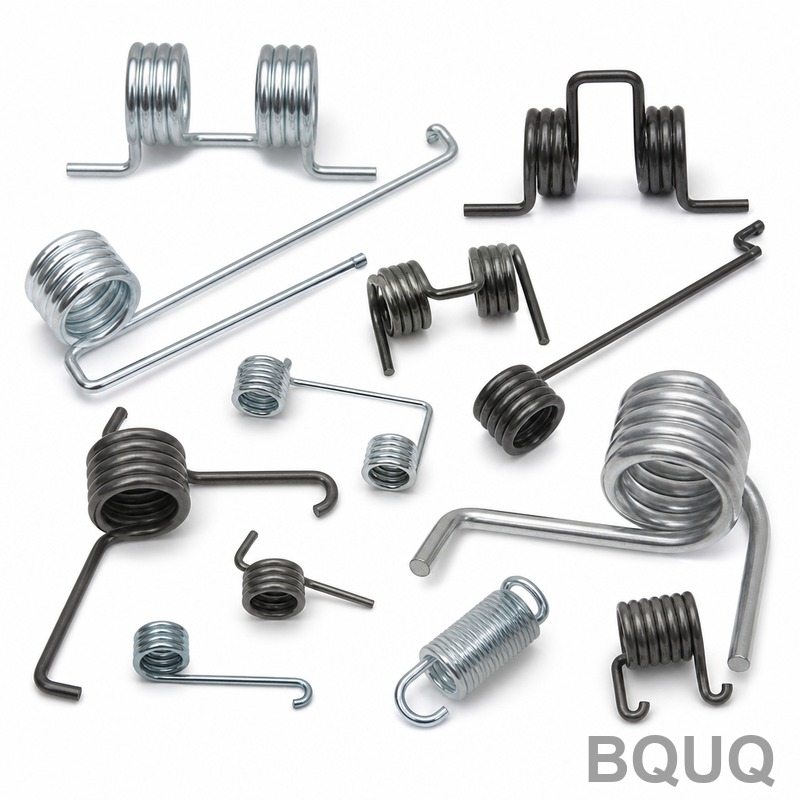
CNC 4-axis machines add pitch tool and cut-off tool control. These machines produce torsion springs, double torsion springs, and springs with precise pitch variation. Wire capacity ranges from 0.3 mm to 12.0 mm. Pricing is USD 80,000 to 250,000, with tolerances of ±0.02 mm on coil diameter.
CNC 8-axis machines incorporate wire straightening, feed, pitch, coiling point, cut-off, and two forming slides. They handle wire up to 16 mm and produce complex shapes such as conical, barrel, and hourglass springs. High-end models exceed USD 400,000 but reduce secondary operations by 60% compared to 2-axis machines.
Wire straighteners are mandatory for wire above 2 mm diameter. A poor straightener induces residual curvature, causing pitch variation and diameter drift. Most 8-axis machines integrate straightening with feedback sensors that adjust roller pressure in real time.
Material Selection and Spring Properties
Spring wire material determines maximum operating temperature, fatigue life, and corrosion resistance. The following materials are common in precision manufacturing.
Oil-tempered chrome silicon steel (ASTM A401) offers tensile strength of 1,800 to 2,100 MPa and operates up to 230°C. It is the standard choice for automotive suspension springs and industrial valves.
Stainless steel 302 (ASTM A313) provides corrosion resistance with tensile strength of 1,200 to 1,500 MPa. It works up to 290°C but costs 2.5 times more than chrome silicon. Use for medical devices and food processing equipment.
Music wire (ASTM A228) has the highest tensile strength at 2,300 to 2,600 MPa for diameters under 3 mm. It is brittle and unsuitable for dynamic loading above 120°C. Use for precision instrument springs.
Inconel X-750 handles 650°C continuous operation with tensile strength of 1,100 MPa. It is required for jet engine and exhaust system springs. Cost is 8 to 10 times that of chrome silicon.
| Material | Tensile Strength (MPa) | Max Temp (°C) | Relative Cost | Typical Wire Dia (mm) | Fatigue Life (cycles) |
| Chrome Silicon | 1800-2100 | 230 | 1.0x | 1.0-12.0 | 10^6 |
| Stainless 302 | 1200-1500 | 290 | 2.5x | 0.1-8.0 | 10^5 |
| Music Wire | 2300-2600 | 120 | 0.8x | 0.1-3.0 | 10^5 |
| Inconel X-750 | 1100 | 650 | 9.0x | 0.5-6.0 | 10^4 |
| Phosphor Bronze | 700-900 | 100 | 3.0x | 0.1-4.0 | 10^4 |
For hot-coiled springs above 12 mm wire diameter, the process requires preheating to 850-950°C before coiling. This introduces scale formation and requires shot blasting after heat treatment.
Tolerance Standards and Measurement Methods
Spring tolerances follow DIN 2095 for cold-coiled compression springs and DIN 2096 for hot-coiled springs. The critical dimensions are coil outer diameter, free length, and pitch.
Coil diameter tolerance for wire under 3 mm is ±0.05 mm. For wire from 3 to 6 mm, it is ±0.10 mm. Above 6 mm, tolerance is ±0.20 mm. These values apply to a CNC machine with thermal compensation, operating in a 20±2°C environment.
Free length tolerance depends on the number of active coils. For springs with 3 to 10 active coils, free length tolerance is ±1.5% or ±0.3 mm, whichever is greater. For over 10 coils, it is ±2.0%.
Pitch tolerance is the most difficult to control. It directly affects the spring rate. A CNC machine with servo-driven pitch tool maintains pitch within ±2% of nominal value. Manual machines achieve only ±5%.
Measurement methods include optical comparators for wire diameter, coordinate measuring machines for free length and pitch, and spring testers for load at specified deflection. Load testing at 80% of maximum deflection is mandatory for safety-critical springs.
Cost Breakdown and Lead Times
The cost of CNC spring production includes tooling, machine time, material, and finishing operations. Tooling for a standard compression spring costs USD 500 to 2,000, depending on the number of forming pins and cams.
Machine time cost is USD 40 to 80 per hour for a 4-axis CNC coiler. A simple compression spring with 10 coils and 2 mm wire takes 1.2 seconds to coil. Finishing operations include stress relieving, grinding, and shot peening.
| Operation | Cost per Unit (USD) | Lead Time (days) | Notes |
| CNC coiling only | 0.05-0.30 | 1-3 | Includes setup for 1000 pcs |
| Stress relieving | 0.02-0.08 | 1-2 | 250-350°C for 20-30 min |
| Grinding ends | 0.10-0.25 | 2-4 | Flatness within 0.05 mm |
| Shot peening | 0.15-0.40 | 2-3 | Increases fatigue life 30% |
| Zinc plating | 0.05-0.15 | 3-5 | 8-12 micron thickness |
For a typical order of 5,000 compression springs with 2 mm chrome silicon wire, the unit price ranges from USD 0.35 to 0.60. The price drops to USD 0.25 at 50,000 pieces due to amortized setup and tooling costs.
Lead time for a prototype is 3 to 5 working days. Production runs of 10,000 pieces take 7 to 10 working days from approved drawings. Complex torsion springs with multiple bends require an additional 2 to 3 days for programming and first article inspection.
Process Control and Quality Assurance
Temperature control is critical in spring coiling. Wire temperature rises during coiling due to friction. For wire above 4 mm, the coiling point temperature can reach 80°C. This changes the yield strength and causes diameter variation. CNC machines with coolant systems maintain wire temperature below 40°C.
Stress relieving after coiling is mandatory for all cold-coiled springs. The process heats springs to 250-350°C for 20 to 30 minutes. This removes residual stress from coiling and prevents stress corrosion cracking. The holding temperature affects the spring rate. A 10°C increase in stress-relieving temperature reduces spring rate by approximately 1.5%.
Shot peening is applied to springs under dynamic loading. The process bombards the surface with steel shot at 50-70 m/s, creating compressive residual stress of 400 to 800 MPa. This increases fatigue life by 30 to 50% but adds 0.15 to 0.40 USD per unit.
First article inspection requires measuring 5 parameters on 5 samples: wire diameter, outer diameter, free length, total coils, and load at specified height. The inspection report must include the actual values and the acceptance criteria. For automotive and aerospace parts, a full PPAP submission with capability studies is required.
Common Defects and Troubleshooting
Coil diameter variation across a batch typically indicates wire straightener misalignment or incorrect feed roller pressure. Check the straightener rollers for wear and adjust the pressure to achieve zero residual curvature.
Pitch variation at spring ends occurs when the pitch tool retracts too early or late. Adjust the cam timing by 0.1 to 0.3 degrees. The pitch tool should maintain contact with the wire for at least 180 degrees of the coiling point rotation.
Surface marks on the wire come from worn coiling point or feed rollers. Replace these components when marks appear. The recommended replacement interval is every 500,000 cycles for coiling points and every 200,000 cycles for feed rollers.
Spring rate deviation beyond ±5% indicates incorrect wire feed length. Measure the actual feed length per coil using the machine encoder. Recalibrate the feed system if the error exceeds 0.1%.
FAQ-Style Tips for Spring Coiling Engineers
How do I choose between 2-axis and 4-axis CNC coiler? Use a 2-axis machine for simple compression and extension springs where the ends do not require special forms. Use a 4-axis machine when you need torsion springs, pigtails, or precision pitch control. The 4-axis machine costs 70% more but reduces secondary forming operations.
What is the minimum wire diameter for CNC coiling? The practical minimum is 0.1 mm for 2-axis machines. Below this diameter, wire feed becomes unstable and manual coiling is more economical. For wire below 0.3 mm, use a machine with wire diameter sensors and automatic tension control.
How do I reduce spring set during compression? Spring set occurs when stress exceeds the elastic limit. Reduce the stress by increasing the number of active coils or using a material with higher tensile strength. Shot peening also reduces set by introducing compressive residual stress.
Can CNC coiling produce springs with variable pitch? Yes, with a 4-axis or 8-axis machine. The pitch tool is servo-controlled and can change pitch every 0.1 mm of coil travel. This is used for progressive rate springs where the spring rate increases with deflection.
Conclusion and Recommendation
CNC spring coiling technology provides the repeatability and precision required for modern manufacturing. The choice of machine axis count, wire material, and finishing processes directly determines the final spring performance and cost. For production volumes above 1,000 pieces, CNC coiling is almost always cheaper than manual methods due to reduced labor and scrap.
For your next spring project, define the operating temperature, fatigue life requirement, and dimensional tolerances before selecting the machine and material. Provide the maximum and minimum wire diameter, and the required compression load at specified height. This allows the manufacturer to recommend the optimal process and provide an accurate quote.
BQUQ has operated CNC spring coiling machines for over 20 years in Dongguan, China, serving automotive, electronics, and medical device industries. We provide free design review for spring manufacturability and offer 12-hour quoting on drawings. Send your 2D or 3D files to sc@bquq.com or contact us on WhatsApp at +86 13713157787. Visit www.bquq.com for more information on our spring manufacturing capabilities.
Related Articles
- Where to Buy Custom Metal Springs Online: Top 7 Suppliers
- Size control and online intelligent detection technology of precision spring
- From "standard parts" to "functional parts": 2026 hardware spring industry technology trends and functional innovation engineering direction
Frequently Asked Questions
What tolerances can your CNC spring coilers achieve?
Our CNC spring coilers achieve repeatable tolerances of ±0.01 mm on wire diameter up to 12 mm. For coil diameter, 4-axis machines hold ±0.02 mm. Servo motors with 0.001 mm resolution control feed length, pitch angle, and tool position, ensuring high precision.
What wire diameters and materials can you handle for custom springs?
We handle wire from 0.1 mm to 16 mm depending on machine type. Materials include oil-tempered chrome silicon steel (1,800-2,100 MPa, up to 230°C), stainless steel 302 (1,200-1,500 MPa, up to 290°C), music wire (2,300-2,600 MPa under 3 mm), and Inconel X-750 (up to 650°C).
What is the production speed for compression springs?
Production speeds reach 120 parts per minute for compression springs on CNC machines. Typical cycle times range from 0.5 to 2.0 seconds per part on 2-axis machines. Higher-axis machines reduce secondary operations by up to 60% compared to 2-axis models.
How do you ensure quality for complex spring geometries?
We use CNC 8-axis machines with integrated wire straightening and feedback sensors that adjust roller pressure in real time. This controls feed, pitch, coiling point, and forming slides, enabling conical, barrel, and hourglass shapes. Wire straighteners are mandatory for wire above 2 mm to prevent pitch variation and diameter drift.