Compression Spring vs Extension Spring: Which Type Do You Need?
Choose a compression spring when you need to push components apart or absorb shock, and choose an extension spring when you need to pull components together or store energy under tension. Compression springs operate in a compressive load mode with coils that touch or nearly touch in their free state, while extension springs operate in a tensile load mode with coils that are tightly wound together. The decision hinges on your required force direction, available space, and whether you need fail-safe behavior in the event of a broken spring.
What Is the Fundamental Difference Between Compression and Extension Springs?
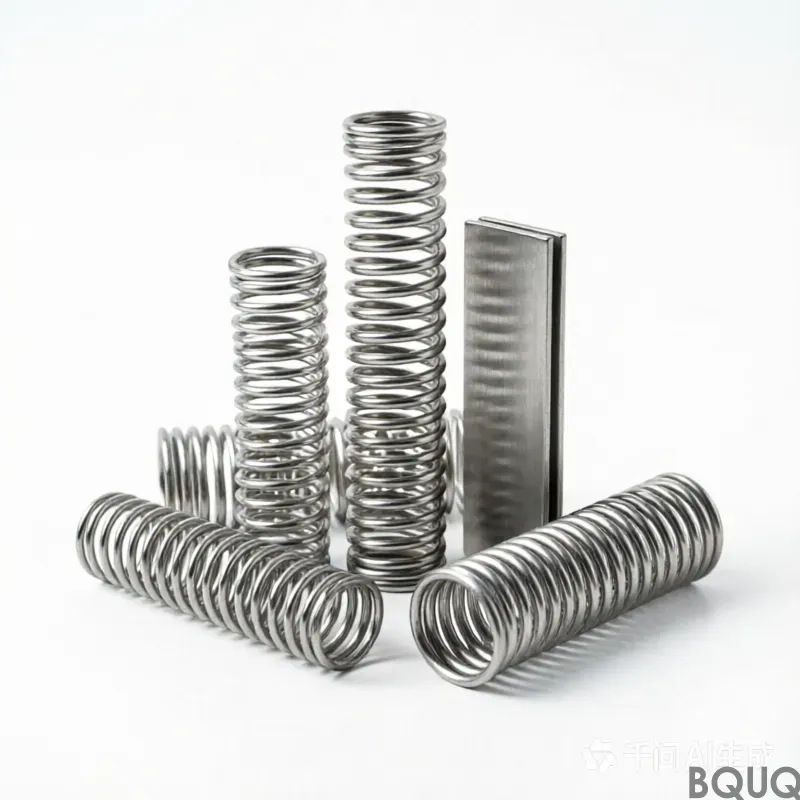
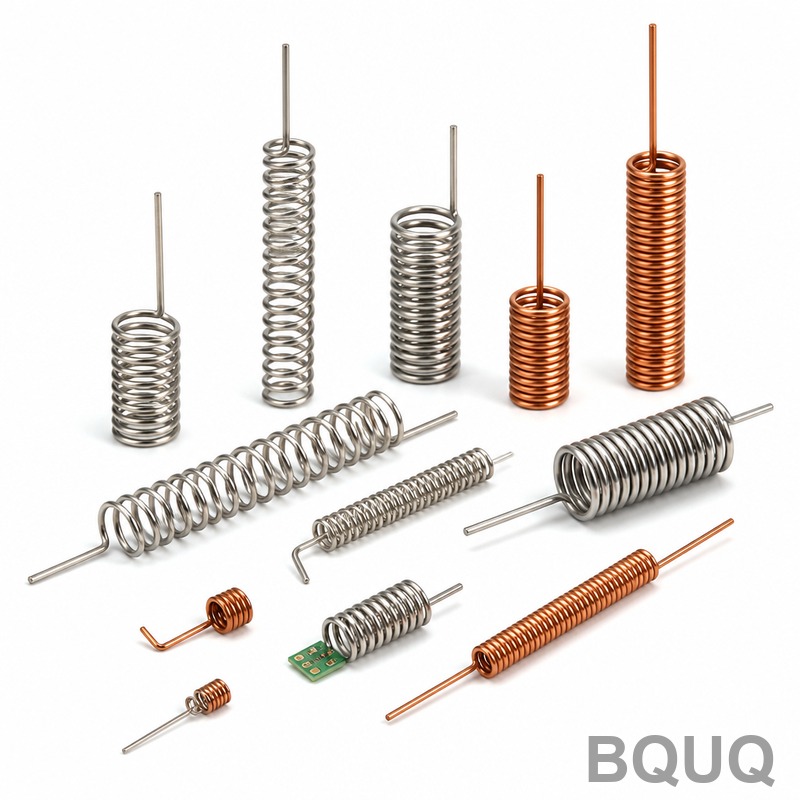
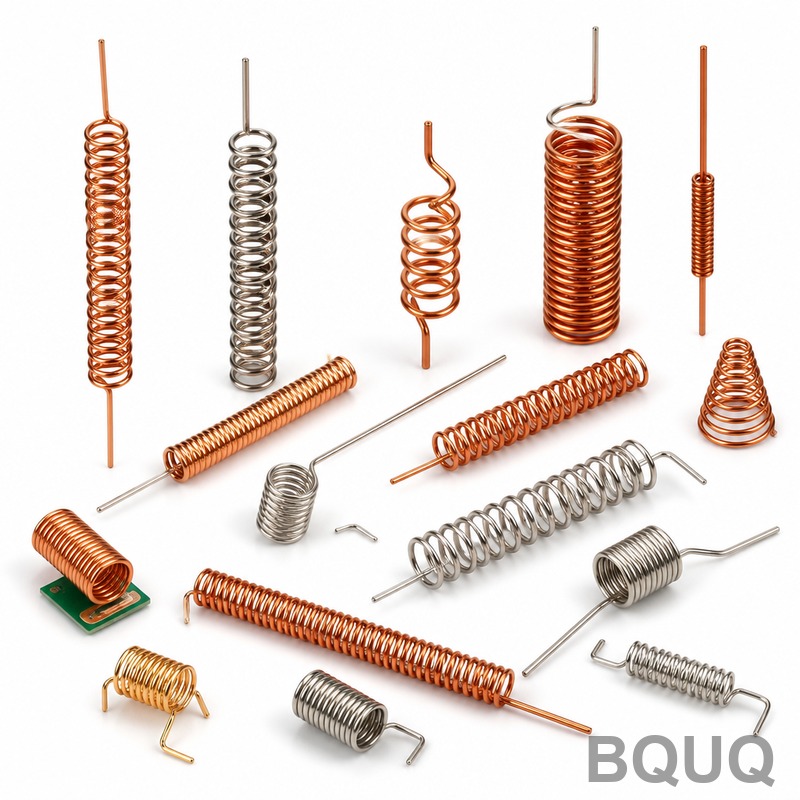
A compression spring shortens under an applied load, resisting the force that pushes its ends together. It typically has an open pitch, meaning the coils are spaced apart, and it is designed to be loaded along its axis with no attachment hardware required at the ends. An extension spring lengthens under an applied load, resisting the force that pulls its ends apart. It is usually wound with close pitch (coils touching) and requires hooks, loops, or end fittings to transmit the tensile load. The primary engineering distinction is load direction: compression springs accept axial compressive force, while extension springs accept axial tensile force.
How Do Load and Deflection Characteristics Compare?
Compression springs exhibit a linear force-deflection relationship according to Hooke's Law, with spring rate (k) expressed in Newtons per millimeter (N/mm) or pounds per inch (lb/in). A typical compression spring with a wire diameter of 2.0 mm, mean coil diameter of 12 mm, and 8 active coils has a spring rate of approximately 8.5 N/mm. Extension springs also follow Hooke's Law, but they have an initial tension (preload) that must be overcome before deflection begins. This initial tension typically ranges from 5 to 15 percent of the maximum load capacity, depending on the winding process. For example, an extension spring with the same dimensions but an initial tension of 4 N will require 4 N of force before any measurable elongation occurs, whereas a compression spring will deflect immediately at zero load.
Which Spring Type Offers Better Fatigue Life Under Cyclic Loading?
Compression springs generally provide superior fatigue life because they do not suffer from stress concentrations at hooks or loops, which are common failure points in extension springs. For music wire (ASTM A228), a compression spring operating at 40 percent of its maximum tensile stress can achieve over 1 million cycles without failure. In contrast, an extension spring with standard machine hooks experiences stress concentrations at the hook bends that can reduce fatigue life by 30 to 50 percent compared to a compression spring of identical wire and coil dimensions. If your application involves frequent cycling, such as in an automotive valve train or a mechanical seal, a compression spring is the safer choice. For extension springs, specify reduced hook radius (at least 1.5 times wire diameter) and shot peening to improve fatigue performance.
What Are the Typical Tolerance and Dimensional Specifications?
Compression springs can be manufactured to tighter tolerances because they have simpler end conditions, typically closed and ground ends. For wire diameters from 0.5 to 3.0 mm, standard manufacturing tolerances are plus or minus 0.05 mm on wire diameter and plus or minus 1 percent on free length. Extension spring tolerances are looser, especially on overall length including hooks, where a tolerance of plus or minus 2 percent is common due to the variability in hook forming. The following table summarizes typical specifications for both spring types based on BQUQ production data for medium-volume orders (100 to 10,000 pieces).
| Parameter | Compression Spring | Extension Spring |
| Free Length Tolerance | plus/minus 1% (min 0.3 mm) | plus/minus 2% (min 0.5 mm) |
| Wire Diameter Tolerance | plus/minus 0.03 mm (for wire under 3 mm) | plus/minus 0.05 mm (for wire under 3 mm) |
| Spring Rate Tolerance | plus/minus 5% | plus/minus 7% |
| Maximum Operating Temperature (music wire) | 120 degrees Celsius | 100 degrees Celsius |
| Initial Tension Range | Not applicable | 5 to 15% of max load |
| Typical Lead Time (prototype) | 3 to 5 days | 5 to 7 days |
| Tooling Cost (setup) | USD 50 to 150 | USD 80 to 200 |
How Do End Configurations Affect Performance and Cost?
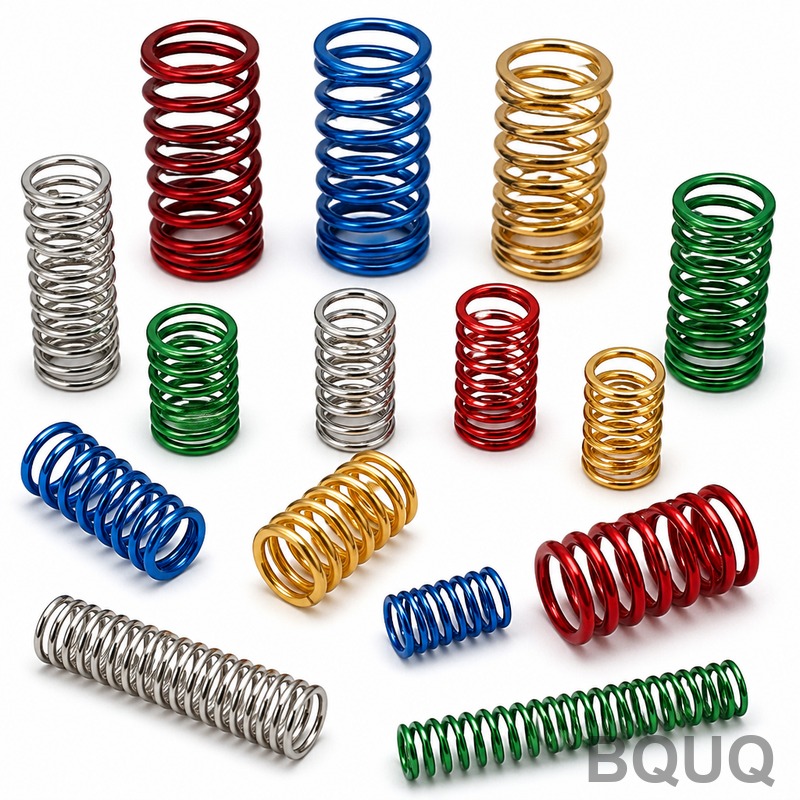
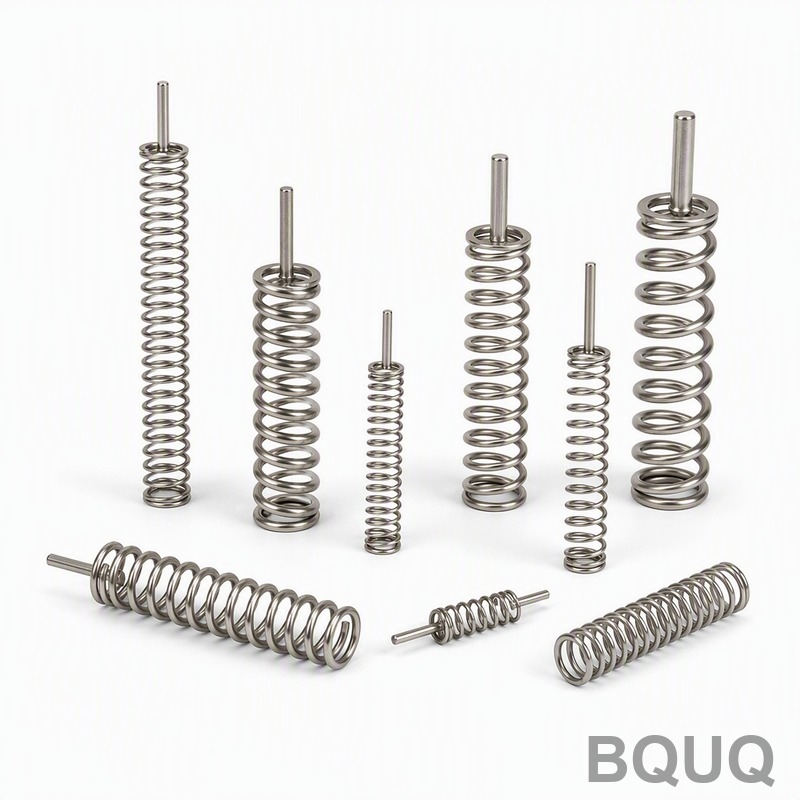
Compression springs can have four end types: plain ends, plain and ground ends, closed ends, and closed and ground ends. Closed and ground ends are the most expensive but provide the best load alignment and are required when spring height must be square within 2 degrees. Plain ends are the cheapest but may buckle under load if the free length exceeds 4 times the mean coil diameter. Extension springs require hooks or loops, with standard machine hooks being the most economical, followed by cross-over hooks and side hooks which add 10 to 20 percent to unit cost. For critical applications, specify reduced-radius hooks to minimize stress concentration, but expect a 15 percent price increase. Each end hook adds approximately 0.5 to 1.0 mm to the overall length, so account for this in your space calculation.
Which Spring Type Is More Cost-Effective for Your Production Volume?
For low to medium volumes (under 10,000 pieces), compression springs are generally 10 to 20 percent cheaper than extension springs of equivalent material and load capacity because they require no secondary hook-forming operations. A typical compression spring of 2 mm wire, 15 mm free length, costs USD 0.05 to 0.15 per piece at 5,000 pieces, while an extension spring with the same wire and free length costs USD 0.08 to 0.20 per piece. However, at high volumes (over 100,000 pieces), the cost difference narrows to under 5 percent because automated coiling machines can form hooks at the same rate as cutting compression springs. For stamping or CNC machining of spring retainers or end fittings, compression springs are easier to integrate because they do not require mating hook geometry. If your assembly has a threaded rod or a clevis, an extension spring with machine hooks may reduce total assembly cost by eliminating separate fasteners.
Can Compression Springs Be Used in Place of Extension Springs or Vice Versa?
In limited cases, you can substitute a compression spring for an extension spring by adding mechanical guides such as rods or tubes, but this increases assembly complexity and cost. For example, a compression spring can be mounted over a rod to create a pushing action, but it cannot pull unless you add a mechanical linkage, which introduces friction and wear. Conversely, an extension spring cannot push without rigid end plates, which is rarely practical. The load direction is fundamentally reversed, so substitution requires a complete redesign of your mechanism. A safer approach is to use a torsion spring if you need rotational force, or a constant force spring if you need uniform load over a long deflection. Always verify the operating temperature and corrosion resistance: use stainless steel (AISI 302 or 316) for temperatures above 120 degrees Celsius or in humid environments, but expect a 30 percent cost increase over music wire.
What Are the Common Failure Modes and How Do You Prevent Them?
Compression springs fail by buckling, stress relaxation, or fracture at the ends. Buckling occurs when the free length exceeds 4 times the mean diameter; prevent this by using a guide rod or a longer spring with a smaller coil diameter. Stress relaxation happens at temperatures above 80 degrees Celsius for music wire, resulting in a loss of free length of up to 5 percent over 1,000 hours. Extension springs fail primarily at the hook bends due to high localized stress, especially when the hook radius is less than the wire diameter. To prevent hook failure, specify a hook radius of at least 2 times the wire diameter and apply shot peening to the hook area. Both spring types can suffer from corrosion pitting, which reduces fatigue life by up to 50 percent; use passivated stainless steel or apply an epoxy coating for outdoor or chemical exposure.
FAQ
How Do I Calculate the Spring Rate for My Application?
Calculate the spring rate by dividing the required load by the deflection: k = F / x, where F is the force in Newtons and x is the deflection in millimeters. For a compression spring, use the formula k = (G * d^4) / (8 * D^3 * N), where G is the shear modulus (79.3 GPa for music wire), d is wire diameter, D is mean coil diameter, and N is the number of active coils.
What Is the Maximum Temperature for Each Spring Material?
Music wire (ASTM A228) operates up to 120 degrees Celsius for compression springs and 100 degrees Celsius for extension springs due to hook stress. Stainless steel 302 operates up to 250 degrees Celsius, and Inconel X-750 can handle up to 600 degrees Celsius, but these materials cost 2 to 5 times more than music wire.
How Long Does It Take to Get a Prototype Spring?
At BQUQ, compression spring prototypes are typically ready in 3 to 5 working days, while extension spring prototypes take 5 to 7 working days due to hook forming and inspection. For urgent needs, we offer 24-hour express prototyping for standard wire diameters at a 30 percent surcharge.
Can I Order Springs with Custom End Configurations?
Yes, we manufacture compression springs with plain, ground, closed, and closed-ground ends, and extension springs with machine hooks, cross-over hooks, and side hooks. Custom end configurations such as threaded inserts or ball ends are available, but they add 3 to 5 days to lead time and increase unit cost by 20 to 40 percent.
What Is the Minimum Order Quantity for Custom Springs?
Our minimum order quantity is 100 pieces for standard sizes and 500 pieces for custom wire diameters or exotic materials. For production runs above 10,000 pieces, we offer volume discounts of 10 to 15 percent, with automated coiling machines running at speeds up to 200 springs per minute.
How Do I Specify Spring Tolerance in My Drawing?
Specify tolerances according to DIN 2095 for compression springs and DIN 2097 for extension springs, which define standard grade 1 and grade 2 tolerance classes. For precision applications, use grade 1 tolerances which are half the grade 2 values, but expect a 15 to 20 percent cost increase.
Which Spring Type Is Better for High-Speed Cycling Above 100 Hz?
Compression springs are better for high-speed cycling because they have lower mass and no hook inertia, allowing natural frequencies above 200 Hz for typical sizes. Extension springs with hooks have a natural frequency 20 to 30 percent lower, which can cause resonance and premature failure; use a compression spring with a guide rod instead.
Conclusion
Selecting between a compression spring and an extension spring is a straightforward decision based on load direction: use compression for pushing and extension for pulling. For most engineering applications, compression springs offer better fatigue life, tighter tolerances, and lower cost, while extension springs are necessary when space constraints require a tensile load with minimal assembly hardware. Always verify operating temperature, corrosion environment, and required cycle life before finalizing your material choice. If you provide your load, deflection, space envelope, and cycle requirements, our engineers can recommend the optimal spring type and produce a prototype within 3 to 7 days. Contact BQUQ for a free design review and quotation within 12 hours at sc@bquq.com or WhatsApp +86 13713157787, or visit www.bquq.com for our full spring manufacturing capabilities.