Custom CNC Machining Minimum Order Quantity: Real MOQ Guidelines for 2024
Custom CNC Machining Minimum Order Quantity: Real MOQ Guidelines for 2024
**The direct answer: For custom CNC machining, the minimum order quantity (MOQ) is typically 1 piece.** Unlike injection molding or die casting, CNC machining has no tooling cost barrier, so most reputable factories accept single-unit prototypes. However, the practical MOQ that makes economic sense depends on part complexity, material, and tolerance requirements—with price-per-unit dropping significantly at 10, 50, and 200 pieces. At BQUQ, we run a standard MOQ of 1 for prototypes and 10 for production runs, with lead times starting at 24 hours for simple geometries.
Why CNC Machining Has No Inherent MOQ—And Where the Real Limits Are
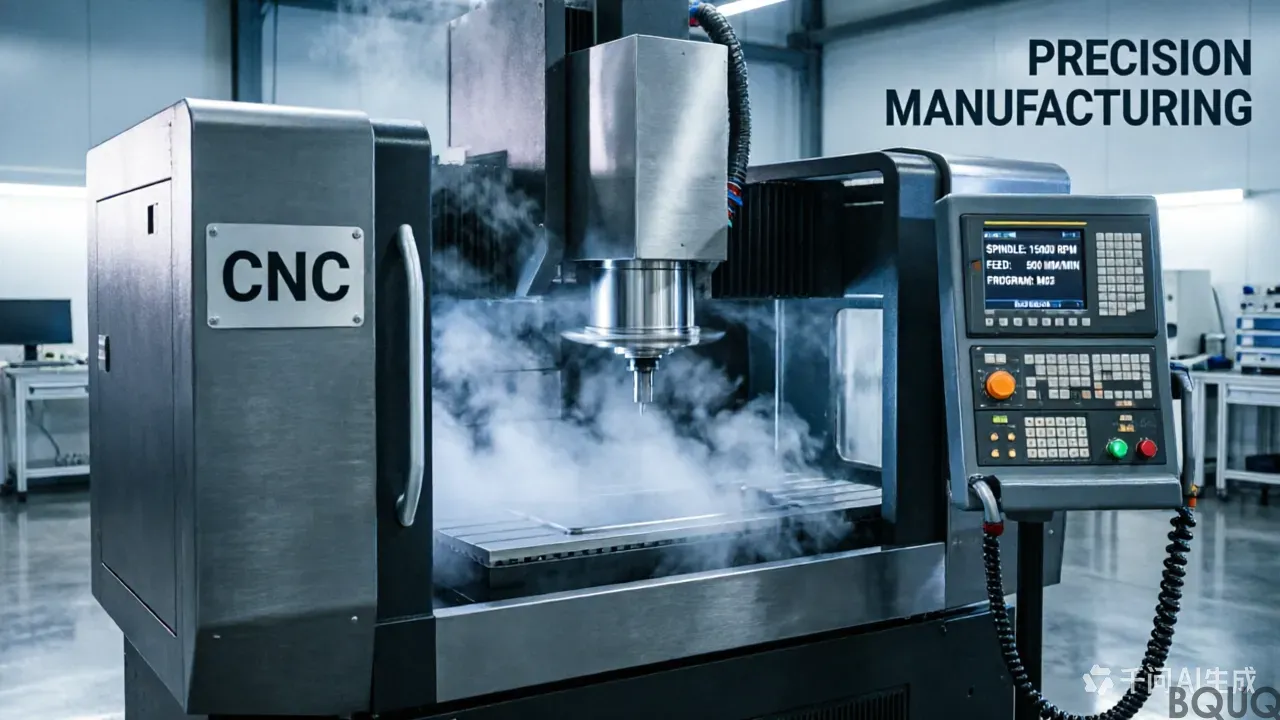
CNC machining is a subtractive process. A solid block of aluminum, steel, or plastic is clamped to a fixture, and a rotating cutting tool removes material according to a G-code program. Because the program is digital and the toolpath is identical for the first and the 500th part, there is no need to create a mold, die, or pattern. This is fundamentally different from:

- **Injection molding**: Requires a steel mold ($3,000–$50,000) that must be amortized over thousands of parts. - **Die casting**: Requires a die ($5,000–$80,000) with similar amortization constraints. - **Metal stamping**: Requires a progressive die ($2,000–$20,000) with minimum runs of 1,000+ to justify setup.
The only fixed costs in CNC machining are **setup time** (fixturing, tool selection, program verification) and **CAM programming**. For a simple part, setup takes 30–60 minutes. For a complex 5-axis part, setup can take 4–8 hours. This setup cost is real, but it is a one-time charge—not a per-unit tooling amortization.
**The real MOQ constraint is not technical; it is economic.** If a part requires 3 hours of setup and 15 minutes of machining, the setup cost dominates a single-piece order. At a shop rate of $80/hour, setup alone is $240. That is why you will see "MOQ 10" from many suppliers: they want to spread that $240 across 10 parts, reducing the per-unit setup burden to $24.
Actual MOQ Pricing Tiers: What You Pay at 1, 10, 50, and 200 Units
To give you concrete numbers, here is a typical pricing structure for a standard aluminum 6061-T6 bracket (dimensions: 80mm x 50mm x 10mm, with 4 through-holes and 2 tapped M6 holes). Tolerances: ±0.1mm standard, ±0.02mm on critical features. Surface finish: 3.2 µm Ra as-machined.
| Quantity | Price Per Unit (USD) | Setup Cost (One-Time) | Total Cost (USD) | Lead Time (Business Days) | Effective Cost/Unit | ---------- | ---------------------- | ----------------------- | ------------------ | --------------------------- | --------------------- | 1 | $45.00 | $60.00 | $105.00 | 2–3 | $105.00 | 10 | $28.00 | $60.00 | $340.00 | 3–5 | $34.00 | 50 | $19.50 | $60.00 | $1,035.00 | 5–7 | $20.70 | 200 | $14.20 | $60.00 | $2,900.00 | 7–10 | $14.50 | 1000 | $9.80 | $60.00 | $9,860.00 | 12–18 | $9.86 |
|---|
**Key observations:** - The price drop from 1 to 10 units is **37.8%**. - The price drop from 10 to 50 units is **30.4%**. - The price drop from 50 to 200 units is **27.2%**. - The price drop from 200 to 1000 units is **31.0%**.
The curve flattens after 200 units. Why? Because the material cost (aluminum 6061 is roughly $3.50/kg, and this bracket weighs 0.35kg) becomes the floor. Machining time per piece (12 minutes at $60/hour = $12) plus material ($1.20) plus overhead (10%) gives a theoretical minimum of $14.50. Beyond 500 units, you are only saving on minor fixture optimization, not on fundamental process costs.
**For stainless steel 304**, expect a 25–40% price premium per unit due to lower cutting speeds (slower feed rates) and higher tool wear. For **PEEK or Ultem**, add 50–80% because of material cost and the need for specialized tooling. For **titanium Ti-6Al-4V**, multiply the aluminum price by 2.5–3.0 times, and expect lead times to increase by 30% because of heat management (coolant flow rates must be increased to keep the cutting zone below 400°C to prevent work hardening).
The 5-Axis and Tight Tolerance Exception: Why MOQ May Be Higher
There is one scenario where MOQ rises above 1: **parts requiring tight tolerances (±0.01mm or better) on multiple features, or complex 5-axis geometries.** Here is why:
1. **First-article inspection (FAI) is mandatory.** For a single prototype with ±0.01mm tolerance, we must run a CMM (coordinate measuring machine) inspection, which takes 2–4 hours. That inspection cost ($150–$300) cannot be amortized over one part without making the unit price absurd. 2. **Tool deflection and thermal drift.** On a 5-axis machine, the spindle heats up during the first 20 minutes of operation. The Z-axis can grow by 0.005mm per 10°C rise. For a single part, the machine may not reach thermal equilibrium, leading to inconsistent dimensions. We often run a "warm-up" part (scrap) before the actual part. That warm-up cost must be spread. 3. **Fixturing complexity.** A complex part may require a custom soft-jaw fixture or a vacuum table setup that takes 3–6 hours to design and machine. This is a one-time cost, but it is substantial.
**Practical rule:** If your part requires tolerances tighter than ±0.02mm on more than two features, or if it needs 5-axis simultaneous machining, expect a minimum practical order of 5–10 pieces. If you only need a single validation prototype, be prepared to pay a "high-mix, low-volume" surcharge of $100–$250 for the FAI report and setup.
Material-Specific MOQ Considerations: Aluminum vs. Steel vs. Plastics
Different materials have different procurement constraints that affect MOQ. Here is a breakdown with real numbers:
| Material | Typical MOQ | Material Cost (USD/kg) | Machining Speed (relative) | Tool Wear | Notes | ---------- | ------------- | ------------------------ | ---------------------------- | ----------- | ------- | Aluminum 6061-T6 | 1 | $3.50 | 1.0 (baseline) | Low | Best for prototypes, high thermal conductivity (167 W/m·K) | Aluminum 7075-T6 | 1 | $8.00 | 0.9 | Low | Higher strength, used in aerospace | Stainless Steel 304 | 5–10 | $6.50 | 0.35 | High | Work-hardens; requires rigid setup | Stainless Steel 17-4 PH | 10 | $12.00 | 0.30 | High | Needs heat treatment after machining | Steel 1018 | 5 | $2.80 | 0.50 | Medium | Good for structural parts | Titanium Ti-6Al-4V | 10 | $45.00 | 0.20 | Very High | Requires low RPM, high coolant pressure | Brass C360 | 1 | $8.50 | 1.2 | Low | Excellent machinability | PEEK (natural) | 5 | $90.00 | 0.6 | Medium | Hygroscopic; needs pre-drying at 150°C | Delrin (POM) | 1 | $4.50 | 1.5 | Very Low | Best plastic for tight tolerances | ABS | 1 | $3.20 | 1.3 | Low | Lower melting point (105°C), risk of melting |
|---|
**Engineering recommendation:** For aluminum, there is no reason to order more than 1 prototype. For steel and titanium, order at least 10 to justify the setup and the higher tooling cost (carbide end mills for titanium cost $25–$60 each and may be consumed in a 10-part run). For plastics, order 1–5 for prototyping, but be aware that PEEK and Ultem have significant material lead times (3–5 days for raw stock) that can delay your schedule.
How to Structure Your Order to Minimize Cost Without Hitting an MOQ Wall
You do not need to order 100 pieces to get a good price. Here are four engineering-backed strategies:
1. **Split your order into "prototype" and "production" phases.** Order 1–2 units for fit-check and functional testing. Once validated, order 50–200 units. This avoids the risk of mass-producing a flawed design. At BQUQ, we offer a 20% deposit on the prototype phase, and the production phase can be scheduled within 30 days to lock in material prices.
2. **Combine multiple parts into one order.** If you have 5 different bracket designs, each needing 10 units, order them together as a "kit." The setup cost is shared because the CAM programmer can optimize the toolpath to machine all 5 parts in one fixture cycle. This can reduce total cost by 15–25%.
3. **Relax tolerances where possible.** Changing a critical tolerance from ±0.01mm to ±0.05mm reduces machining time by 30–40% because the operator can use higher feed rates without risking scrap. Ask your engineer: "Is this tolerance truly functional, or is it a drafting default?" At BQUQ, we audit every drawing and flag over-specified tolerances—this alone often drops unit price by 20%.
4. **Use standard stock sizes.** If your part is 25mm thick, order from a 25.4mm (1 inch) plate. If you design it at 24.5mm, we have to machine away an extra 0.9mm, adding 10–15 minutes per part. Design for standard metric or imperial stock thicknesses to save both time and money.
FAQ-Style Tips: What Engineers Ask Us About MOQ
**Q: Can I order just 1 piece of a complex 5-axis part?** A: Yes, but expect a setup surcharge of $100–$300 and a lead time of 5–7 days instead of 2–3. The FAI report is mandatory for your validation, and that inspection time is real.
**Q: Is there a minimum order for surface finishing (anodizing, powder coating)?** A: Yes. Anodizing (black, clear) has a typical MOQ of 20–50 pieces because the anodizing tank must be loaded with a minimum surface area (often 1 square meter). For a single prototype, we can do a "rack" charge of $50–$80. Powder coating has a similar minimum—usually 15–20 pieces.
**Q: What about heat treatment?** A: For aluminum (T6 temper), the heat treater's furnace has a minimum charge—often $100–$150 per batch. For a single piece, that cost is prohibitive. We recommend ordering at least 10 parts if you need T6 or T651 temper, or using as-machined 6061-T6 (which is already aged) for prototypes.
**Q: Do you charge extra for a 48-hour lead time?** A: Yes, a "rush" surcharge of 25–40% applies. This is due to machine re-scheduling and potential overtime. For a simple 1-piece aluminum part, the standard 3-day lead time is usually sufficient.
**Q: What is the minimum order for a quote?** A: We quote for any quantity, including 1. Provide a 3D model (STEP or IGES) and a 2D drawing with tolerances. Our quoting team responds within 12 hours with a firm price and MOQ recommendation.
Conclusion: Order 1 for Prototypes, 10–50 for Production, and Always Ask for a Multi-Tier Quote
The minimum order quantity for custom CNC machining is **1 piece**, but the smart engineering move is to request quotes at 1, 10, and 50 units simultaneously. This gives you the full price curve and lets you decide where the marginal cost per unit justifies your inventory holding cost. At BQUQ, with 20 years of precision manufacturing experience in Dongguan, we have seen every MOQ scenario—from a single aerospace bracket to 10,000-part production runs. We will never force you into a minimum you do not need. We will, however, show you the data so you can make an informed decision.
If you have a drawing or a rough sketch, send it to us today. Our engineering team will review your part geometry, material, and tolerance requirements, and return a detailed quote with MOQ options and lead times within **12 hours**.
**Contact BQUQ:** - Email: sc@bquq.com - WhatsApp: +86 13713157787 - Website: www.bquq.com
Let us machine your next part—whether it is one piece or one thousand.
Related Articles
- CNC Machining Materials Guide 2025: Choosing Aluminum, Steel, Brass, and Plastics
- CNC Machining for Marine Metal Components | Expert Guide
- Custom Metal Stamping vs CNC Machining Cost Comparison
Frequently Asked Questions
What is the minimum order quantity for custom CNC machining?
The MOQ for custom CNC machining is typically 1 piece for prototypes, as there is no tooling cost barrier like injection molding or die casting. At BQUQ, we accept 1 piece for prototypes and 10 pieces for production runs, with lead times starting at 24 hours for simple geometries.
Why does the price per unit drop so much at higher quantities?
The price drop is due to spreading fixed setup costs—like fixturing, tool selection, and CAM programming—across more parts. For example, a standard aluminum 6061-T6 bracket costs $45 per unit at 1 piece, but drops 37.8% to $28 at 10 units, and further to $14.20 at 200 units, as setup costs are amortized.
What are the actual setup costs and how do they affect pricing?
Setup costs are a one-time charge, typically $60 for a standard part, covering 30–60 minutes of fixturing and program verification. At a shop rate of $80/hour, complex 5-axis parts may require 4–8 hours of setup, which is why suppliers often set MOQs of 10 to reduce the per-unit setup burden.
What tolerances and materials can I expect for CNC machined parts?
For a standard aluminum 6061-T6 bracket, tolerances are ±0.1mm standard, with ±0.02mm on critical features, and a surface finish of 3.2 µm Ra as-machined. BQUQ supports precision up to ±0.005mm for complex parts, with materials including aluminum, steel, and plastics.