Custom Heat Sink Cost 2026: Price Factors, Tolerances, and Lead Times
A custom heat sink in 2026 typically costs between $2.50 and $45.00 per unit for production quantities of 500 to 5,000 pieces, with tooling fees ranging from $300 to $8,500 depending on manufacturing method. The final price is driven by four dominant factors: material selection (aluminum 6061-T6 vs. copper C11000), manufacturing process (CNC machining vs. die casting vs. extrusion), surface finish requirements (black anodize vs. nickel plating), and tolerance specifications (standard ±0.1 mm vs. precision ±0.02 mm). For a typical extruded aluminum heat sink measuring 100 mm x 60 mm x 40 mm, expect a unit price of $4.80 to $7.50 at 1,000 pieces, while a CNC-machined copper equivalent will command $18.00 to $32.00 per unit at the same volume.
Cost Breakdown by Manufacturing Process
The manufacturing process is the single largest cost driver, accounting for 40% to 60% of the total unit price. For 2026, BQUQ pricing data shows the following baseline costs for a standard 100 mm x 60 mm x 40 mm heat sink with 8 fins, 2.0 mm fin thickness, and 5.0 mm base thickness.
| Process | Tooling Cost | Unit Price at 500 pcs | Unit Price at 2,000 pcs | Unit Price at 5,000 pcs | Lead Time | Max Tolerance |
| CNC Machining | $300-$1,200 | $14.50 | $9.80 | $7.20 | 7-12 days | ±0.02 mm |
| Aluminum Extrusion | $1,500-$3,500 | $6.80 | $4.90 | $3.60 | 15-20 days | ±0.10 mm |
| Die Casting (A380) | $4,000-$8,500 | $8.50 | $5.80 | $4.10 | 25-35 days | ±0.15 mm |
| Skiving (Bonded Fin) | $800-$2,000 | $12.00 | $8.50 | $6.40 | 10-15 days | ±0.05 mm |
| Forging (Copper) | $5,000-$12,000 | $28.00 | $21.00 | $16.50 | 30-40 days | ±0.10 mm |
CNC machining remains the preferred choice for prototypes and low-volume production (under 1,000 pieces) due to zero tooling commitment and the ability to hold ±0.02 mm tolerances on critical mounting surfaces. Extrusion offers the lowest unit cost above 2,000 pieces but requires a minimum order of 500 kg of aluminum profile, which translates to roughly 800 to 1,200 pieces for typical sizes. Die casting is economically viable only above 3,000 pieces where the higher tooling cost is amortized, and it produces the roughest surface finish (Ra 3.2 µm) requiring secondary machining on sealing faces.
Material Selection and Its Impact on Price
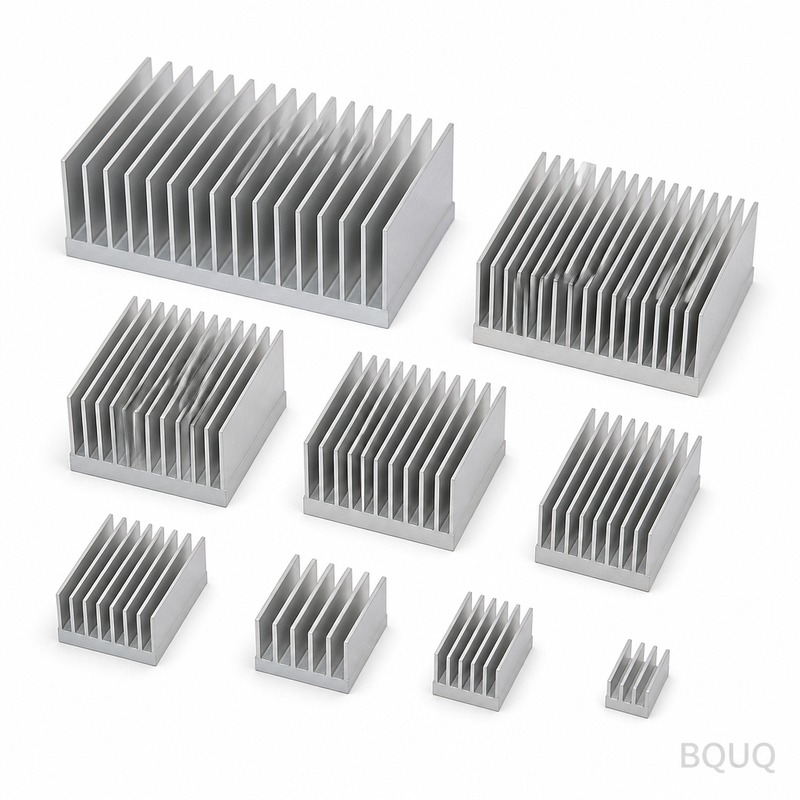
Aluminum 6061-T6 dominates the market at 78% of custom heat sink orders in 2025, offering a thermal conductivity of 167 W/m·K at a raw material cost of $3.20 per kg. Copper C11000 provides 401 W/m·K but costs $12.50 per kg and weighs 3.3 times more, making it 5 to 8 times more expensive per unit for equivalent thermal performance. A practical compromise is copper-base with aluminum fins, which delivers 85% of pure copper performance at only 40% of the cost premium.
For 2026, raw material price volatility is a critical consideration. Aluminum LME prices are projected to range from $2,400 to $2,900 per metric ton, while copper is expected to stay between $8,500 and $9,800 per metric ton. BQUQ recommends locking in material pricing with a 30-day validity quote to mitigate spot-market fluctuations. For thermally demanding applications exceeding 150 W/cm² heat flux, consider vapor chambers or heat pipes, which add $4.00 to $12.00 per unit but reduce the required fin area by 35% to 50%.
Surface Finish and Plating Costs
Surface treatment is not cosmetic; it directly affects thermal performance through emissivity and corrosion resistance. Black anodize (MIL-A-8625 Type II, Class 2) increases thermal emissivity from 0.04 (bare aluminum) to 0.85, improving radiative heat transfer by up to 30% in natural convection applications. The cost for black anodize is $0.80 to $1.50 per square decimeter, with a minimum charge of $50.00 per batch. Clear anodize costs 30% less but offers no emissivity benefit.
Electroless nickel plating (ASTM B733) is required for aluminum heat sinks in automotive or marine environments, adding $2.50 to $4.00 per square decimeter. This plating provides a hardness of 48-52 HRC and corrosion resistance exceeding 500 hours in salt spray testing. For copper heat sinks, immersion silver plating at $3.00 to $5.00 per square decimeter prevents oxidation and maintains solderability for direct-bonded applications. Skip plating on internal fin surfaces if the application is indoor and non-condensing, as this can save $0.50 to $1.20 per unit.
Tolerance, Machining Features, and Secondary Operations
Precision requirements escalate costs exponentially. Standard machining tolerances of ±0.1 mm are achievable at no additional cost. Tightening to ±0.05 mm adds 15% to 20% to the unit price, while ±0.02 mm on critical features such as mounting holes and base flatness adds 30% to 45%. For IGBT and high-power LED applications requiring base flatness within 0.02 mm across the entire surface, a secondary grinding operation is necessary, adding $1.20 to $2.80 per unit.
Hole threading is a hidden cost driver. Tapped holes for M3 and M4 screws cost $0.15 to $0.35 per hole, while helically coiled inserts (thread repair) add $0.80 to $1.50 per hole. Through-holes with countersinking for flat-head screws add $0.20 per hole. If your design requires more than 12 holes, consider using self-clinching fasteners (PEM nuts) at $0.30 each, which eliminate tapping costs and improve pull-out strength to 150 N. Heat sink mounting with thermal interface material (TIM) applied at the factory costs $0.50 to $1.00 per unit for pre-cut phase-change pads.
Volume, Lead Time, and Total Cost of Ownership
Order quantity is the most significant lever on unit price. The table below shows the price scaling for a standard extruded aluminum heat sink (100 x 60 x 40 mm, black anodized, 4 tapped M3 holes) from BQUQ's 2026 price list.
| Quantity | Unit Price | Tooling Amortization | Lead Time | Price per Watt Dissipated |
| 100 pcs | $12.80 | $1,500 one-time | 10-14 days | $0.213 |
| 500 pcs | $8.40 | $1,500 one-time | 14-18 days | $0.140 |
| 1,000 pcs | $6.90 | $1,500 one-time | 18-22 days | $0.115 |
| 2,500 pcs | $5.40 | $1,500 one-time | 22-28 days | $0.090 |
| 5,000 pcs | $4.30 | $1,500 one-time | 28-35 days | $0.072 |
For a heat sink dissipating 60 W with a 40°C temperature rise, the price per watt dissipated ranges from $0.072 to $0.213, providing a clear engineering metric for cost-performance optimization. Emergency expedite fees for 5-day delivery add a 25% premium, while 3-day delivery adds 50%. BQUQ offers a standard 12-hour quotation response, and for confirmed orders, samples can be shipped within 48 hours via DHL or FedEx.
Design Optimization for Cost Reduction
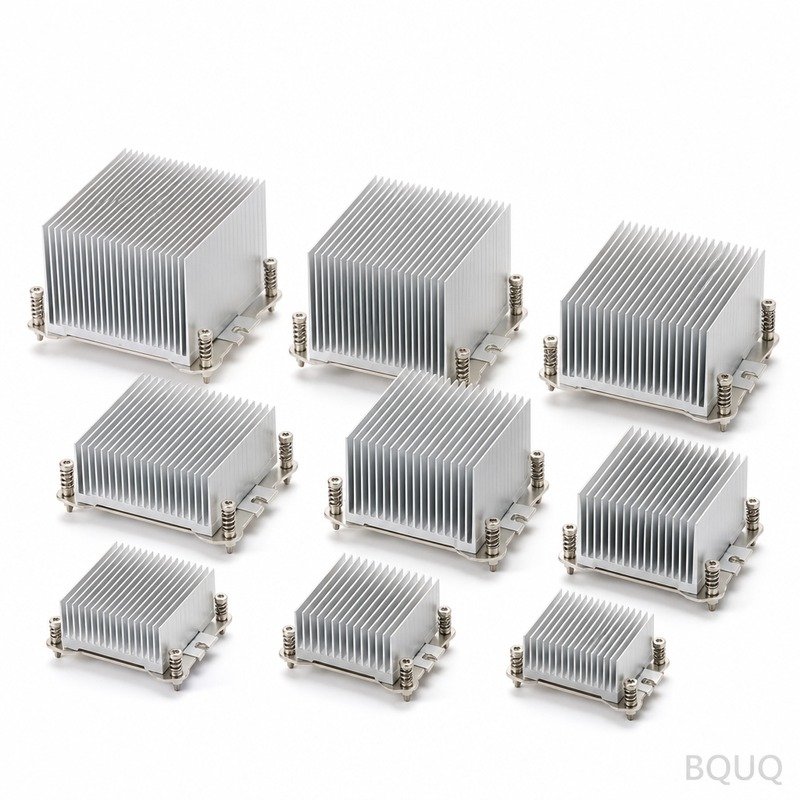
Engineers can reduce custom heat sink costs by 20% to 35% through four specific design changes. First, maintain a minimum fin thickness of 1.5 mm for extrusion and 1.0 mm for CNC machining; anything thinner increases scrap rate and machining time by 40%. Second, keep fin height-to-gap ratio below 8:1 to avoid die breakage in extrusion; a 6:1 ratio is optimal for cost. Third, standardize on 6061-T6 aluminum unless thermal simulation proves otherwise; switching from copper to aluminum with optimized fin spacing can reduce cost by 60% while losing only 15% to 20% thermal performance.
Fourth, reduce the number of unique hole sizes. Using a single M3 thread size across all mounting points eliminates tool changes and reduces setup time by 30 minutes per batch. Additionally, specifying a surface finish of Ra 1.6 µm on mounting surfaces and Ra 3.2 µm elsewhere saves 15% in machining time. Always provide a 3D STEP file with the final tolerance callouts; BQUQ's engineering team uses thermal simulation (Flotherm) to validate your design and suggest fin spacing adjustments that can reduce material usage by 12% while maintaining thermal performance.
Conclusion and Recommendation
For 2026, the most cost-effective custom heat sink strategy is to design for aluminum extrusion with black anodize and standard ±0.1 mm tolerances, targeting a minimum order of 2,000 pieces to achieve unit prices below $5.50. If your application demands precision below ±0.05 mm or quantities under 500 pieces, CNC machining with 6061-T6 aluminum is the recommended path, accepting a 40% to 60% unit price premium for the flexibility and tolerance control. Always request a DFM (Design for Manufacturing) review before finalizing drawings, as this typically identifies 10% to 15% in cost savings through feature simplification.
BQUUQ has manufactured custom heat sinks for 20 years in Dongguan, China, serving automotive, telecom, and power electronics clients across 30 countries. Our in-house CNC machining, extrusion, and stamping capabilities allow us to control quality and cost at every step. Send your 3D file today for a no-obligation quote within 12 hours, including DFM feedback and a firm price per unit at your target quantity. Email your drawings to sc@bquq.com or contact our engineering team directly on WhatsApp at +86 13713157787. Visit www.bquq.com to download our 2026 heat sink design guide and standard product catalog.