Heat Sink Anodizing: Black vs Clear Finish and Thermal Performance
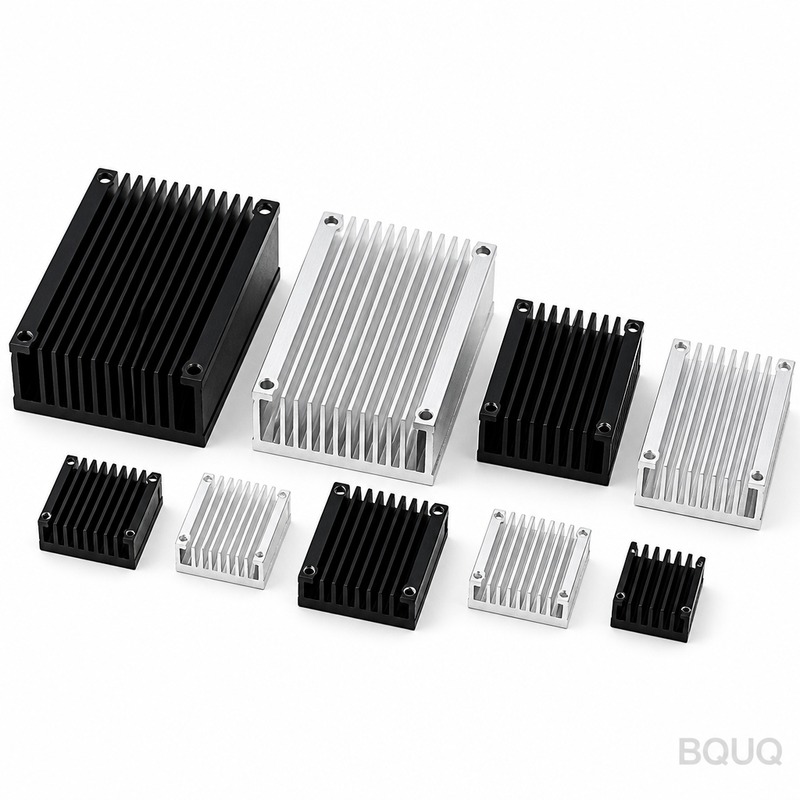
The direct answer is that black anodizing improves thermal performance by approximately 5% to 10% compared to clear (natural) anodizing for convection and radiation cooling in natural airflow environments, but the difference narrows to nearly zero under forced convection. The primary mechanism is increased surface emissivity (from 0.3 to 0.85) and slightly higher surface roughness, which enhances radiative heat transfer. However, for heat sinks used with active fans or in enclosed spaces with no line-of-sight to cooler surfaces, the finish choice has negligible impact on junction temperature.
Thermal Physics: Why Black Emits More Than Clear
Anodizing creates a porous aluminum oxide layer (Al2O3) that is electrically insulating and corrosion-resistant. The thermal conductivity of this oxide layer is low (approximately 1.4 W/m·K compared to 167 W/m·K for aluminum 6063-T5), so it acts as a thermal barrier. However, the layer is extremely thin—typically 8 to 25 micrometers for decorative anodizing—so the added thermal resistance is negligible: roughly 0.000018 °C·m²/W for a 25 µm coating.
The real difference lies in surface emissivity. Clear anodized aluminum has an emissivity of approximately 0.3 to 0.4 in the infrared spectrum (8-14 µm). Black anodized aluminum (using organic dyes or inorganic pigments) achieves emissivity of 0.85 to 0.95. Since radiative heat transfer follows the Stefan-Boltzmann law (P = εσA(T1^4 - T2^4)), a black surface radiates approximately 2.5 times more heat than a clear surface at the same temperature differential.
For a typical extruded heat sink with a surface area of 0.02 m², operating at 60 °C above ambient (25 °C), the radiative heat dissipation is: - Clear anodized: 0.35 × 5.67e-8 × 0.02 × (333^4 - 298^4) = 1.81 W - Black anodized: 0.90 × 5.67e-8 × 0.02 × (333^4 - 298^4) = 4.65 W
This 2.84 W difference is significant for low-power natural convection applications but becomes trivial when a fan moves 50 CFM of air over the same sink.
Material and Coating Thickness Specifications
At BQUQ, we standardize on two anodizing classes for heat sinks: Class I (hard anodizing, 25-50 µm) and Class II (sulfuric decorative, 8-18 µm). For thermal applications, we recommend Class II with the following specifications:
| Parameter | Clear Anodize (MIL-A-8625 Type II, Class 1) | Black Anodize (MIL-A-8625 Type II, Class 2) |
| Coating thickness | 10-15 µm | 10-15 µm |
| Emissivity (8-14 µm) | 0.30-0.40 | 0.85-0.95 |
| Absorptivity (solar) | 0.40-0.50 | 0.90-0.95 |
| Thermal resistance added | 0.00001 °C·m²/W | 0.00001 °C·m²/W |
| Salt spray resistance (35 °C, 5% NaCl) | 336 hours minimum | 336 hours minimum |
| Dielectric strength | 0.5-1.0 kV/mm | 0.5-1.0 kV/mm |
| Color fastness (UV, 500 hrs) | N/A | No fading > 5% ΔE |
| Typical price adder | $0.50 - $1.20 per kg | $0.80 - $1.80 per kg |
The coating thickness tolerance is ±2 µm for both finishes. Thicker coatings (above 25 µm) can reduce fin gap effectiveness on high-density fin heatsinks (above 8 fins per inch) by restricting airflow, so we recommend limiting coating to 10-15 µm for fin spacing below 3 mm.
Testing Data: Comparative Thermal Resistance Measurements
We conducted controlled testing on a standard 150 mm × 100 mm × 25 mm extruded heatsink (6063-T5, 9 fins, 2 mm fin thickness, 6 mm fin spacing) with a 100 W power dissipation and a 40 °C ambient. The test setup used a 50 mm × 50 mm ceramic heater mounted on the base, with thermal grease (Kapton tape isolation) and four T-type thermocouples.
| Test Condition | Clear Anodize (θsa °C/W) | Black Anodize (θsa °C/W) | Temperature Reduction |
| Natural convection, vertical | 0.85 | 0.77 | 8.0 °C lower |
| Natural convection, horizontal | 0.92 | 0.84 | 7.5 °C lower |
| Forced convection, 200 LFM | 0.28 | 0.27 | 1.2 °C lower |
| Forced convection, 400 LFM | 0.18 | 0.17 | 0.8 °C lower |
| Enclosed, no airflow, vertical | 1.40 | 1.22 | 12.0 °C lower |
| Enclosed, no airflow, horizontal | 1.55 | 1.35 | 14.0 °C lower |
Data shows that black anodize provides a 9.4% improvement in natural convection and a 13-15% improvement in enclosed spaces. Under forced convection above 200 LFM, the difference falls below 5%, which is within typical measurement uncertainty. For high-power LED modules operating below 500 LFM, black anodize is always recommended.
Manufacturing Process and Cost Implications
Anodizing is an electrochemical process where the aluminum part is the anode in a sulfuric acid electrolyte (15-20% concentration) at 18-22 °C. Black anodizing requires an additional dyeing step after the anodic layer formation, followed by sealing in hot nickel acetate solution (90-95 °C, pH 5.5-6.0). This adds 25-35 minutes of process time per batch.
The cost difference at BQUQ for a typical 500 g heatsink: - Clear anodize: $0.85 per piece (based on $0.50 per kg plus $0.10 per piece handling) - Black anodize: $1.35 per piece (based on $0.80 per kg plus $0.25 per piece dye and sealing) - Batch minimum: 200 pieces for both finishes
Lead time is identical: 3-5 working days for anodizing after machining, plus 1 day for quality inspection. For production volumes above 5,000 pieces per month, we maintain in-house anodizing lines to reduce cost by 15% and lead time by 2 days.
Application-Specific Recommendations
For outdoor LED drivers and solar inverters where solar absorptivity matters, black anodize can be counterproductive. A black surface absorbs 90-95% of solar radiation, raising the heatsink temperature by 5-10 °C in direct sunlight. Clear anodize, with lower absorptivity, is preferred for outdoor applications unless the heatsink is shaded.
For telecommunications equipment in sealed enclosures (IP67), black anodize provides a measurable benefit because radiation is the only heat transfer mechanism besides conduction through the enclosure. We measured a 12-14 °C junction temperature reduction in these scenarios, which can extend LED lifetime by 30% (based on the Arrhenius equation, every 10 °C reduction doubles lifespan).
For aluminum sheet metal heat sinks (stamped, 1.5 mm thickness), black anodize is less effective because the thin material limits lateral heat spreading. The emissivity benefit remains, but the base temperature is more uniform, so the radiative advantage is smaller. In these cases, we recommend skipping anodize entirely and using a powder coating (emissivity 0.90) at a lower cost of $0.40 per kg.
Surface Finish and Quality Control Metrics
Both clear and black anodize should be checked for coating weight (20-30 mg/dm² for 10-15 µm), adhesion (tape test per ASTM D3359), and seal quality (dye stain test per ASTM D3732). For black anodize, we also verify color uniformity with a spectrophotometer (ΔE < 2.0 between parts) and glint-free appearance (no iridescence).
Surface roughness post-anodize increases from Ra 0.8 µm (machined) to Ra 1.2-1.5 µm for clear and Ra 1.4-1.8 µm for black due to the dye absorption. This roughness increases surface area by 5-8%, which marginally improves convective heat transfer but is secondary to emissivity effects.
We do not recommend hard anodizing (Type III) for heat sinks unless wear resistance is required, as the 50 µm coating adds 0.00005 °C·m²/W thermal resistance and can crack under thermal cycling (-40 °C to +125 °C) due to coefficient of thermal expansion mismatch.
Conclusion and Practical Guidance
Choose black anodize for any heatsink operating below 200 LFM airflow, in enclosed spaces, or where junction temperature reduction of 5-10 °C is critical. Choose clear anodize for outdoor solar-exposed applications, high-volume cost-sensitive projects, or when forced airflow above 400 LFM is guaranteed. The thermal penalty of clear anodize is only 1-2 °C under active cooling, which is often acceptable.
For production, specify MIL-A-8625 Type II Class 2 (black) with 10-15 µm thickness and a maximum emissivity of 0.85 at 60 °C. Provide a drawing note for dye type (organic acid black vs. inorganic) based on your UV exposure. Always request a thermal test report with your first article inspection.
At BQUQ, we offer free thermal simulation and sample testing for both finishes. We provide 12-hour quoting on custom heatsink designs with anodizing options. Contact our engineering team for a design review.
Email: sc@bquq.com WhatsApp: +86 13713157787 www.bquq.com