How Does Precision Stamping Ensure Reliable Electrical Contacts and Terminals?
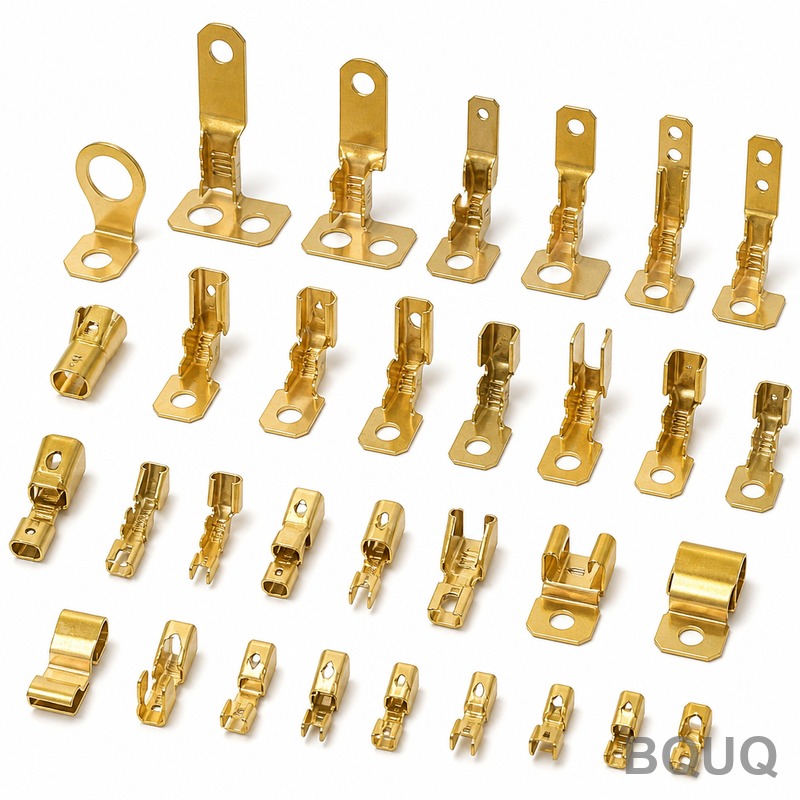
Precision stamping ensures reliable electrical contacts and terminals by producing millions of identical components with tolerances as tight as ±0.01 mm, using high-conductivity materials like C11000 copper and C17200 beryllium copper, and applying controlled surface finishes that maintain consistent contact resistance below 10 milliohms. This manufacturing process combines high-speed progressive dies (up to 1,200 strokes per minute) with real-time dimensional monitoring to achieve repeatable geometry, spring force, and plating integrity across massive production volumes. The result is a contact that performs consistently over 100,000 mating cycles in automotive, aerospace, and industrial applications.
What Tolerances Can Precision Stamping Achieve for Electrical Contacts?
Precision stamping of electrical contacts achieves dimensional tolerances of ±0.01 mm for critical features such as contact beam width, terminal height, and mating interface angles, with some high-end applications reaching ±0.005 mm. For example, a typical automotive terminal for a 2.8 mm connector has a contact beam thickness tolerance of ±0.02 mm and a mating force variation of ±15% around a nominal 5.0 N. In practice, BQUQ uses in-die optical sensors that measure 100% of parts at speeds up to 800 strokes per minute, rejecting any part outside the specification limit (USL/LSL). The stamping die itself is ground using wire EDM with a positioning accuracy of ±0.002 mm, and die wear is compensated by using carbide inserts with a hardness of 88-92 HRA, which maintain tolerance over 10 million strokes before requiring re-grinding.
How Does Material Selection Affect Contact Reliability?
The material choice directly determines current-carrying capacity, contact resistance, and corrosion resistance. C11000 electrolytic tough pitch copper offers 101% IACS conductivity but has low yield strength (69 MPa), making it suitable only for non-spring terminals. C17200 beryllium copper (aged to temper TH04) provides 220-260 MPa yield strength with 22-25% IACS conductivity, ideal for spring contacts requiring 100,000 cycles. For high-temperature environments exceeding 150°C, C19400 copper-iron alloy (conductivity 60% IACS, tensile 380 MPa) is preferred. The table below compares common materials used in precision-stamped electrical contacts:
| Material | IACS Conductivity (%) | Yield Strength (MPa) | Max Operating Temp (°C) | Typical Application |
| C11000 Copper | 101 | 69 | 100 | Power terminals, busbars |
| C17200 BeCu TH04 | 22-25 | 220-260 | 175 | Relay springs, connector pins |
| C19400 CuFe | 60 | 300-380 | 200 | Automotive connectors |
| C52100 Phosphor Bronze | 15 | 380-450 | 150 | Socket contacts, clips |
| C70250 CuNiSi | 45-55 | 500-600 | 200 | High-force spring terminals |
For plating, selective gold plating (0.76 µm minimum) on the contact interface and nickel underplate (1.27-2.54 µm) reduces contact resistance to below 5 milliohms, while tin plating (2-5 µm) is used for lower-cost applications but limits cycles to 25-50 at 85°C.
Why Is Spring Force Consistency Critical for Terminal Reliability?
Spring force consistency determines the contact normal force, which must remain above a minimum threshold to prevent fretting corrosion and intermittent signals. A typical stamped terminal for a 1.5 mm pin requires a normal force of 1.5-2.5 N, and precision stamping holds this within ±10% by controlling the beam thickness, bend radius, and material grain direction. For example, a 0.25 mm thick C17200 beryllium copper beam with a 0.5 mm bend radius yields a spring rate of 0.8 N/mm; a thickness variation of just 0.01 mm changes the force by 12%. Precision stamping uses a four-slide or progressive die with coining stations that calibrate the bend angle to ±0.3 degrees, ensuring that after 50,000 insertion cycles, the force drops by less than 8%. This consistency prevents micro-arcs, which generate temperatures above 1,000°C locally and cause premature failure.
How Does the Stamping Process Prevent Burrs and Edge Defects?
Burrs and edge micro-cracks are the primary cause of premature fatigue failure in stamped contacts, as they create stress concentrations. Precision stamping controls burr height to less than 5% of material thickness (e.g., 0.012 mm for 0.25 mm material) by maintaining a die clearance of 4-6% of material thickness per side. For example, stamping 0.30 mm thick C19400 with a clearance of 0.015 mm per side produces a shear zone of 70-80% and a fracture zone of 20-30%, yielding a clean edge with no secondary shear. In high-reliability applications, BQUQ adds a secondary coining operation on the cut edge, which compresses the material to a radius of 0.05 mm, eliminating micro-cracks. Additionally, a vibratory deburring step (using ceramic media, 30 minutes at 30 Hz) removes any remaining microscopic protrusions, ensuring the contact passes a 10x magnification inspection per IPC-A-600 standards.
Which Stamping Techniques Are Best for Different Contact Geometries?
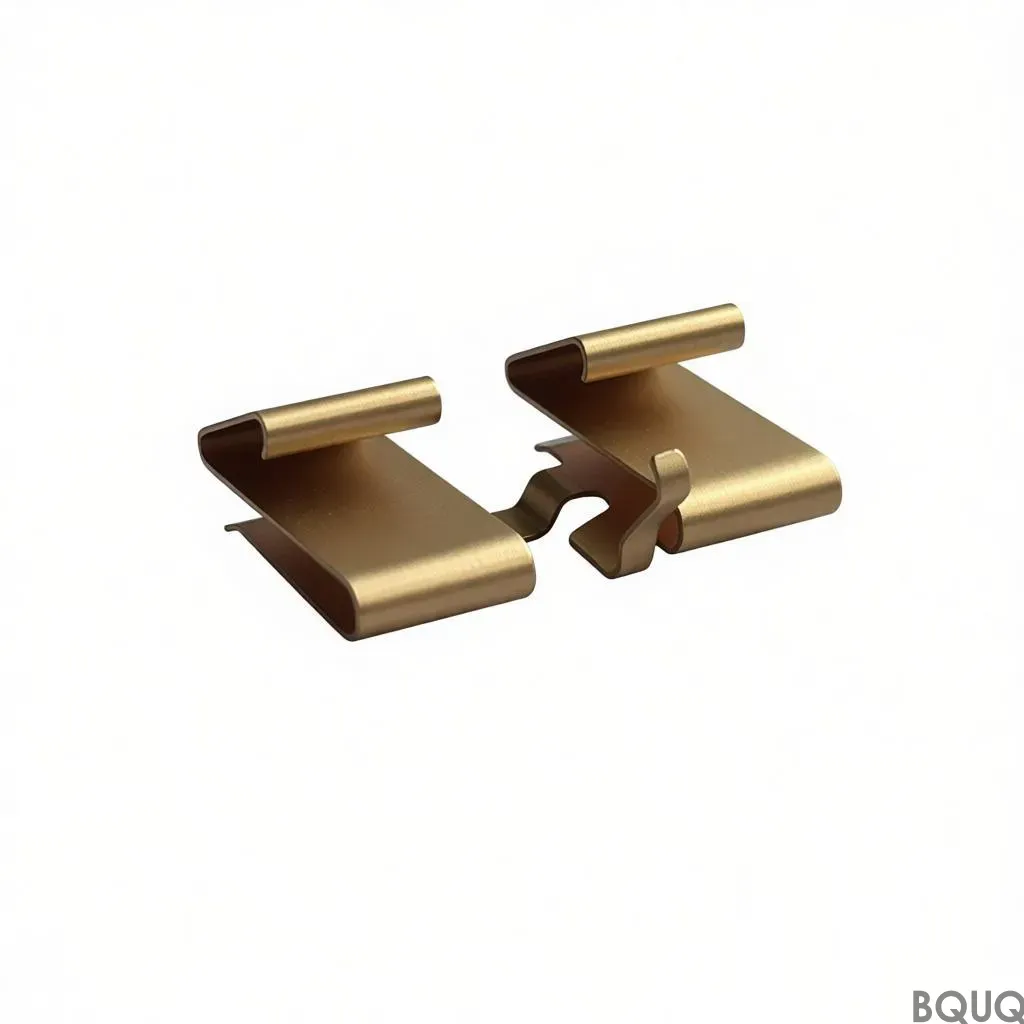
Progressive die stamping is best for high-volume (over 1 million parts per year) contacts with complex geometry, such as multi-beam terminals, because it combines blanking, forming, coining, and plating in one pass at speeds of 300-800 strokes per minute. Four-slide stamping (multi-slide) is preferred for wire-formed contacts and clips with bends in multiple planes, operating at 100-400 parts per minute, and offers better control of bend springback for tight radii below 0.3 mm. Deep drawing is used for cylindrical terminal bodies (e.g., battery contacts) where the depth-to-diameter ratio exceeds 1:1, achieving wall thickness tolerances of ±0.03 mm. For micro-contacts below 0.5 mm width, a high-speed press with a precision die made of powdered high-speed steel (PM-HSS) is required, achieving tolerances of ±0.005 mm but at a tooling cost of $40,000-$80,000 versus $15,000-$30,000 for a standard progressive die.
How Much Does Precision Stamping Tooling Cost and What Is the Lead Time?
Tooling cost for a precision stamping die for electrical contacts ranges from $12,000 for a simple two-station die to $85,000 for a complex 24-station progressive die with in-die sensing and carbide inserts. Lead times are 4-6 weeks for standard tooling, 8-10 weeks for high-complexity dies with wire EDM-cut cavities. For example, a 16-station progressive die for a USB-C type 24-pin terminal costs approximately $48,000, includes water-cooled stations to control thermal expansion, and has a die life of 30-50 million strokes. The per-part cost at 5 million annual volume is $0.018-$0.035 for material and stamping, excluding plating, which adds $0.01-$0.05 per part depending on gold thickness. Prototype stamping (soft tooling) is available in 2-3 weeks at $3,000-$8,000, using aluminum-bronze dies for up to 5,000 parts, allowing functional testing before full production tooling.
What Testing Validates the Reliability of Stamped Contacts?
Reliability validation follows USCAR-20 and EIA-364 standards, which include contact resistance testing (initial below 10 milliohms at 10 mV, 100 mA), insertion/withdrawal force testing (e.g., 5-20 N insertion for a 2.8 mm terminal), and thermal aging at 125°C for 1,000 hours with a maximum resistance change of 20%. Mechanical endurance testing cycles the contact 100,000 times at a rate of 10 cycles per minute, verifying that the normal force drops by less than 20%. Corrosion testing (salt spray per ASTM B117 for 96 hours) ensures the plating has no pitting that exposes the base metal. Vibration testing per ISO 16750-3 (random vibration, 10-1000 Hz, 5 g RMS) confirms no intermittent disconnection of more than 1 microsecond. At BQUQ, every production lot undergoes a first-article inspection (FAI) using a coordinate measuring machine (CMM) with a resolution of 0.5 µm, and a sample of 32 parts per hour is tested for contact resistance using a four-wire Kelvin method.
Can Precision Stamping Handle High-Mix Low-Volume Production?
Yes, precision stamping can handle high-mix low-volume (HMLV) production using quick-change tooling systems that swap dies in under 15 minutes, allowing batch sizes as low as 5,000 parts economically. For example, BQUQ runs a family of 12 different terminal designs on one press, changing dies and feeders between batches while maintaining the same ±0.01 mm tolerance. The cost penalty for a 5,000-part batch versus a 1,000,000-part batch is approximately 2.5x on a per-part basis ($0.09 vs $0.035 for a standard terminal), which still beats CNC machining (which would cost $1.50-$3.00 per part). This capability is enabled by digital die presetting (setting shut height and pilot position offline) and servo-driven presses that store 20 different stroke profiles, allowing rapid adjustment of speed (200-800 SPM) and force (30-200 kN) without manual setup.
FAQ
What Is the Minimum Thickness for Precision-Stamped Contacts?
The minimum thickness for precision-stamped contacts is 0.05 mm for high-conductivity copper alloys, but practical production limits are 0.10 mm to maintain flatness and avoid tearing. For beryllium copper, the minimum is 0.08 mm due to its higher strength and springback behavior. Below these values, etching or laser cutting is recommended.
How Do I Choose Between Gold and Tin Plating for Contacts?
Choose gold plating (0.76 µm) for applications requiring under 5 milliohms contact resistance and over 10,000 mating cycles, such as automotive airbag connectors. Choose tin plating for cost-sensitive applications under 50 cycles and operating temperatures below 100°C. Gold is also required in corrosive environments with sulfur or salt exposure.
What Is the Maximum Current a Stamped Terminal Can Carry?
A stamped terminal with a 2.8 mm pin and a cross-section of 2.5 mm² can carry 15-20 A continuous at a 30°C temperature rise above ambient. Larger terminals, such as a 6.3 mm blade, with a 6 mm² cross-section, handle 40-50 A. The limit is set by resistive heating, where I²R losses must not melt the plating or soften the base material.
How Long Does a Stamping Die Last Before Needing Replacement?
A carbide progressive die for electrical contacts lasts 30-50 million strokes before needing re-grinding of the cutting edges, which restores the die for another 20-30 million strokes. Full die replacement is typically required after 80-100 million strokes, which takes 4-6 weeks and costs 70-80% of the initial tooling price.
Can Stamping Achieve a Mirror Finish on Contact Surfaces?
Yes, a mirror finish down to Ra 0.2 µm is achievable using a final coining or burnishing station in the progressive die. This finish reduces contact resistance by 10-15% compared to a standard stamped surface (Ra 0.8 µm). However, for high-frequency applications, a controlled roughness of Ra 0.4-0.6 µm is preferred to prevent cold welding.
What Is the Typical Lead Time for Stamped Contact Samples?
Standard samples from soft tooling are available in 5-7 business days for simple flat terminals and 10-14 days for formed spring contacts. Production samples from hard tooling require the full tool build of 4-8 weeks. BQUQ offers expedited sample service at 3 days for an additional 30% engineering fee.
How Does Stamping Compare to CNC Machining for Contacts?
Stamping is 10-50 times cheaper per part for volumes above 100,000 parts, with tolerances of ±0.01 mm versus ±0.02 mm for CNC. However, CNC offers no tooling cost (just programming) and is better for prototypes under 1,000 parts or geometries requiring undercuts. For any production volume, stamping is the only economically viable method.
Conclusion
Precision stamping delivers electrical contacts and terminals that meet the demanding reliability requirements of modern electronics, with achievable tolerances of ±0.01 mm, consistent spring forces within ±10%, and plating that ensures stable contact resistance over 100,000 cycles. The combination of advanced die materials, high-speed servo presses, and in-process inspection makes it the optimal choice for volumes from 5,000 to 50 million parts. For your next connector or terminal project, request a design-for-manufacturing review to optimize material selection and tooling cost.
For a detailed feasibility analysis and firm quote within 12 hours, contact BQUQ at sc@bquq.com or WhatsApp +86 13713157787. Visit www.bquq.com to download our stamping design guidelines and tolerance charts.