How to Choose a Heat Sink Supplier: Thermal Resistance, Fin Design and Lead Time Guide
Selecting a heat sink supplier requires evaluating three quantifiable parameters: thermal resistance (Rth) in °C/W, fin geometry efficiency, and manufacturing lead time. A supplier who cannot guarantee a thermal resistance below 0.5 °C/W for a 100W application, hold fin pitch tolerances of ±0.1 mm, and ship within 15 days is not viable for production-grade electronics. This guide provides the specific numerical benchmarks and engineering criteria you need to qualify a partner for CNC-machined or stamped aluminum heat sinks.
Thermal Resistance: The Primary Performance Metric
Thermal resistance is the single most important specification because it defines the temperature rise (ΔT) between the heat sink base and the ambient air. The formula is ΔT = Rth × P, where P is the dissipated power. For a 120W IGBT module operating at a maximum junction temperature of 125°C with an ambient of 40°C, you have a 85°C budget. If the thermal interface material (TIM) adds 0.1 °C/W, the heat sink alone must be below 0.6 °C/W.
Do not accept a supplier's Rth value without verifying the test conditions. A reputable supplier will provide data measured at a specific airflow rate (e.g., 2 m/s or natural convection at 0.5 m/s) and a specific heat input. For natural convection, a typical extruded aluminum heat sink (200mm x 100mm x 40mm) with a flat base offers 0.8 to 1.2 °C/W. The same size with a 10mm thick base and 25 fins offers 0.5 to 0.7 °C/W. For forced convection at 3 m/s, the same heat sink drops to 0.2 to 0.3 °C/W. Always request the Rth curve, not just a single datapoint.
Fin Design: Density, Pitch, and Aspect Ratio
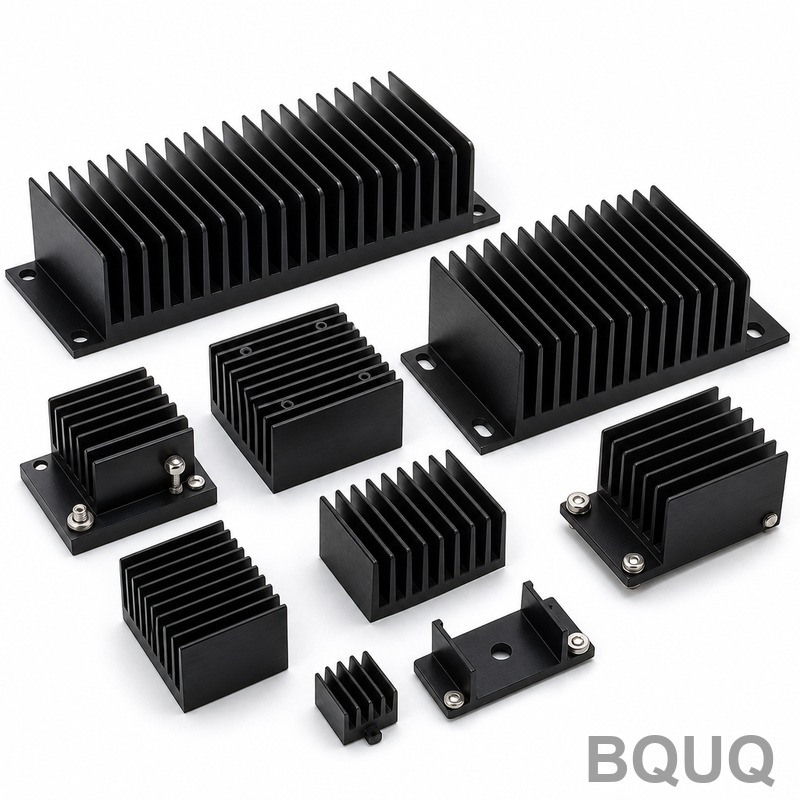
Fin geometry determines the surface area available for convective heat transfer. The critical parameters are fin pitch (distance between fins), fin thickness, and fin height. For stamped aluminum heat sinks, a common pitch is 4.0 mm with a fin thickness of 0.8 mm. For CNC machined heat sinks, you can achieve a pitch of 2.5 mm with a thickness of 1.0 mm, which increases surface area by approximately 30% compared to stamped versions.
The aspect ratio (fin height divided by gap) matters for airflow. If the gap is too narrow (below 2.0 mm), natural convection is severely restricted, and dust accumulation becomes a failure risk. For natural convection, keep the gap above 3.5 mm. For forced convection with a 5 m/s fan, you can safely use a 2.0 mm gap. A fin height of 25 mm with a gap of 4 mm (aspect ratio 6.25) is a balanced design for both natural and low-speed forced airflow. Deeper fins (40mm) increase surface area but require higher static pressure fans to push air through.
Manufacturing Processes: CNC vs. Stamping vs. Extrusion
Your choice of process directly impacts cost, tolerance, and lead time. CNC machining offers the highest precision (±0.05 mm on fin pitch) and allows complex base profiles with embedded heat pipes. However, the cost is high, typically $8 to $15 per piece for a 150mm x 100mm x 40mm heat sink in quantities of 500. Lead time is 7 to 10 days for the first article.
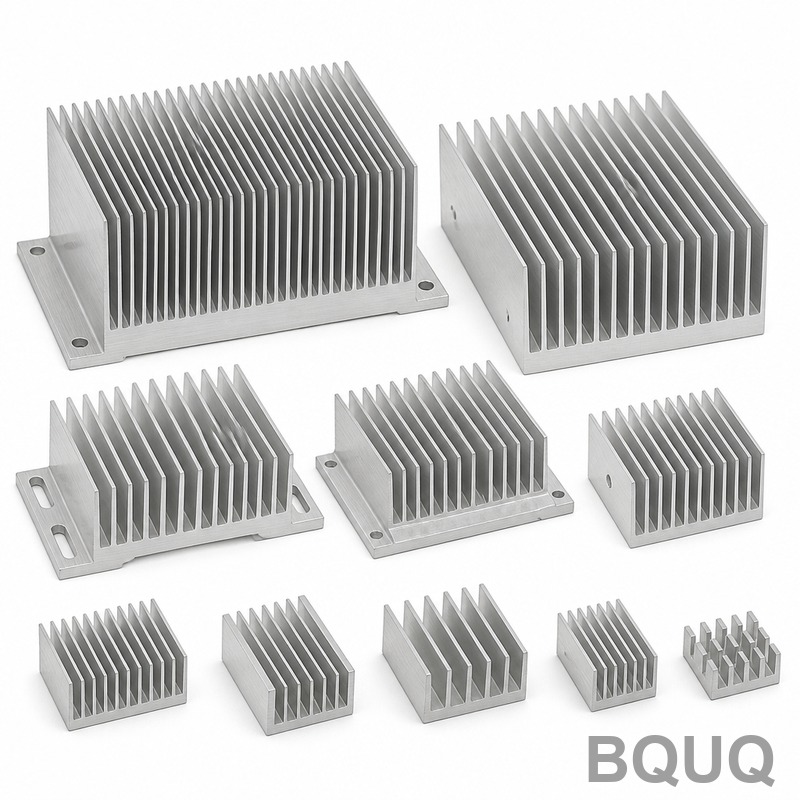
Metal stamping is the fastest and cheapest for high volume. A stamped heat sink with 0.8mm aluminum fins can cost $1.5 to $3.0 per piece at 10,000 units. The tolerance on fin pitch is ±0.15 mm, and the minimum fin thickness is 0.5 mm. Lead time for stamping dies is 15 to 20 days, plus 3 to 5 days for production. Extrusion is the middle ground: tooling costs $800 to $1,500, and the per-unit cost at 2,000 pieces is $4 to $6. Extrusion tolerances on fin pitch are ±0.1 mm, and the maximum fin aspect ratio is 10:1.
Lead Time and Supply Chain Reliability
Lead time is not just the manufacturing time; it includes material sourcing, surface treatment (anodizing), and quality inspection. A standard anodizing process (clear, 8-12 microns) adds 2 to 3 days. Black anodizing (for better emissivity) adds 3 to 4 days. A supplier with in-house CNC and stamping presses can compress total lead time to 10 days for prototypes and 15 days for production runs of 1,000 pieces.
Beware of suppliers who quote 5-day lead times for custom CNC heat sinks with tight tolerances. This usually means they are skipping first-article inspection or using substandard aluminum (6063-T5 instead of 6061-T6). For production, you require a 20% buffer in the schedule. If you need 1,000 units in 20 days, the supplier must commit to a 16-day internal deadline. Insist on a written lead time commitment in the purchase order, with penalty clauses for late delivery.
Cost Breakdown and Total Cost of Ownership
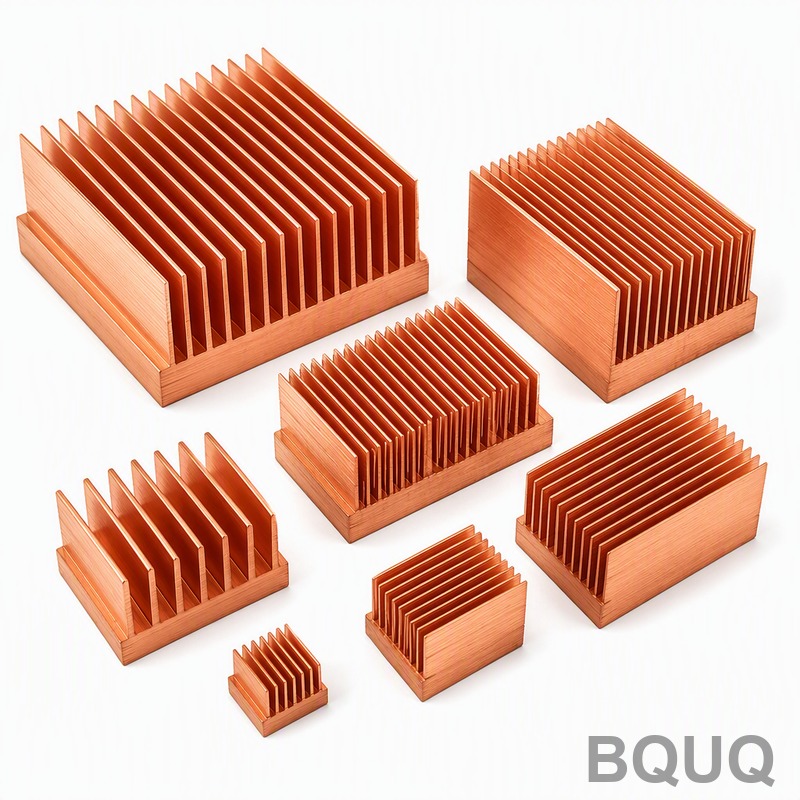
The cheapest quote is rarely the lowest total cost. A heat sink with a higher Rth value will force you to increase airflow, requiring a larger fan and a bigger enclosure. For a 200W power supply, a 10% improvement in heat sink Rth (from 0.4 to 0.36 °C/W) reduces the required fan speed by 15%, saving $0.50 per unit in fan cost and reducing acoustic noise by 3 dB. The price premium for the better heat sink is usually $0.80 to $1.20, making the total system cost lower.
| Parameter | CNC Machined | Extruded | Stamped |
| Minimum Fin Pitch (mm) | 2.5 | 3.0 | 4.0 |
| Fin Thickness Tolerance (mm) | ±0.05 | ±0.10 | ±0.15 |
| Typical Rth (°C/W) 100W, 2m/s | 0.25 | 0.35 | 0.55 |
| Tooling Cost (USD) | $500-$1,000 | $800-$1,500 | $2,000-$4,000 |
| Unit Cost (USD, 1,000 pcs) | $8-$12 | $4-$6 | $2-$4 |
| Lead Time (days, first article) | 7-10 | 10-14 | 15-20 |
| Best For | High density, complex base | Medium volume, good Rth | High volume, cost-sensitive |
Quality Inspection and Testing Protocols
You must verify the supplier's quality control process. At a minimum, they should perform a CMM (Coordinate Measuring Machine) check on the base flatness (must be below 0.05 mm for proper TIM contact) and a visual inspection for die marks. Ask for a thermal test report using a thermocouple attached to the base and a calibrated power resistor. The test should be performed at 25°C ambient with a 2 m/s airflow using a small wind tunnel. A reliable supplier will provide a test report with a thermal image showing the temperature gradient across the base. The maximum base temperature variation should not exceed 5°C for a 100W load.
Practical Recommendations for Sourcing
For prototype runs (under 50 pieces), choose CNC machining because the tooling cost is zero and you can iterate on fin design. For production runs of 500 to 2,000 pieces, extrusion is the most economical if your fin aspect ratio is below 10:1. For volumes above 5,000 pieces, stamping is the only way to achieve a unit cost below $3.00. Always request a thermal simulation report (CFD) from the supplier before committing to tooling. The simulation should match your actual airflow conditions, not an idealized lab setup.
Verify the supplier's material certificate. Use 6063-T5 alloy for extrusion (thermal conductivity 201 W/mK) and 6061-T6 for CNC machining (thermal conductivity 167 W/mK). If your application involves high vibration, require a vibration test per IEC 60068-2-6 to ensure the fin-to-base joints (for stamped or bonded types) do not crack. For anodized surfaces, specify a thickness of 10 microns minimum; thicker anodizing (above 25 microns) acts as an insulator and increases Rth by 5-10%.
Conclusion and Next Steps
Choosing a heat sink supplier is a data-driven decision. You need a supplier who can provide a certified Rth curve, hold fin pitch tolerances of ±0.1 mm or better, and commit to a 15-day production lead time. The trade-off between CNC, extrusion, and stamping is clear: precision costs more per unit but saves system-level costs through lower fan requirements. At BQUQ, we operate CNC machining centers and stamping presses in-house, with 20 years of experience in thermal management for power electronics. Our standard lead time for CNC heat sink prototypes is 7 days, and for stamped production runs of 5,000 pieces, we quote 12 days. We provide full thermal simulation reports and CMM inspection data with every shipment.
To get a precise quotation for your specific thermal load, send us your power dissipation, airflow rate, and maximum allowable base temperature. We will respond with a detailed Rth calculation and a 3D model within 12 hours. Contact our engineering team at Email: sc@bquq.com, WhatsApp: +86 13713157787, or visit www.bquq.com.
Related Articles
- Heat Sinks for Battery Packs: Prevent Thermal Runaway
- Thermal Management for High Brightness LEDs with Heat Sinks
- Stamped Metal vs Die Cast Heat Sinks: Cost & Quality Comparison
Frequently Asked Questions
What is the maximum thermal resistance I should accept for a 120W IGBT module?
For a 120W IGBT module with a 85°C temperature budget (125°C junction minus 40°C ambient), the heat sink alone must be below 0.6 °C/W if the thermal interface material adds 0.1 °C/W. Always verify the Rth value with test conditions like airflow rate.
What fin pitch tolerances can I expect from CNC machining versus stamping?
CNC machining achieves a fin pitch of 2.5 mm with a thickness of 1.0 mm, increasing surface area by about 30% compared to stamped versions. Stamped heat sinks typically use a 4.0 mm pitch with 0.8 mm thickness. CNC offers higher precision at ±0.05 mm on fin pitch.
How does airflow affect the thermal resistance of a typical extruded aluminum heat sink?
A 200mm x 100mm x 40mm extruded aluminum heat sink with a flat base offers 0.8 to 1.2 °C/W under natural convection. With a 10mm thick base and 25 fins, it drops to 0.5 to 0.7 °C/W. Under forced convection at 3 m/s, the same sink achieves 0.2 to 0.3 °C/W.
What is the typical lead time and cost for CNC-machined heat sinks?
CNC-machined heat sinks have a lead time of 7 to 15 days. The cost ranges from $8 to $15 per piece for a 150mm x 100mm x 40mm heat sink in quantities of 500. This process offers the highest precision and allows complex base profiles with embedded heat pipes.