How to Choose Spring Wire Diameter for Your Application?
The wire diameter of a spring is the single most critical dimension that determines its load capacity, rate, stress levels, and physical envelope. To choose the correct wire diameter, you must first define the required spring rate (N/mm) and maximum working load, then calculate the stress using the Wahl factor to select a wire size that keeps the maximum torsional stress below 50% of the material's tensile strength. For most industrial applications, starting with a wire diameter that is 10-15% larger than your initial hand calculation accounts for manufacturing tolerances and fatigue life, but the exact value depends on your space constraints and material selection.
What Are the Core Engineering Formulas for Wire Diameter Selection?
The foundation of wire diameter selection rests on two primary equations: the spring rate equation and the torsional stress equation. The spring rate (k) is calculated as k = (G × d⁴) / (8 × D³ × N), where G is the shear modulus of the material (79.3 GPa for music wire), d is the wire diameter in mm, D is the mean coil diameter, and N is the number of active coils. The torsional stress (τ) is calculated as τ = (8 × F × D × K) / (π × d³), where F is the applied force and K is the Wahl correction factor.
The Wahl factor (K) is critical for accuracy and is calculated as K = (4C - 1)/(4C - 4) + 0.615/C, where C is the spring index (D/d). For a spring index of 8, the Wahl factor is 1.184, which increases the calculated stress by 18.4% compared to the simple formula. Ignoring this factor leads to undersized wire and premature fatigue failure, particularly in high-cycle applications exceeding 100,000 load cycles.
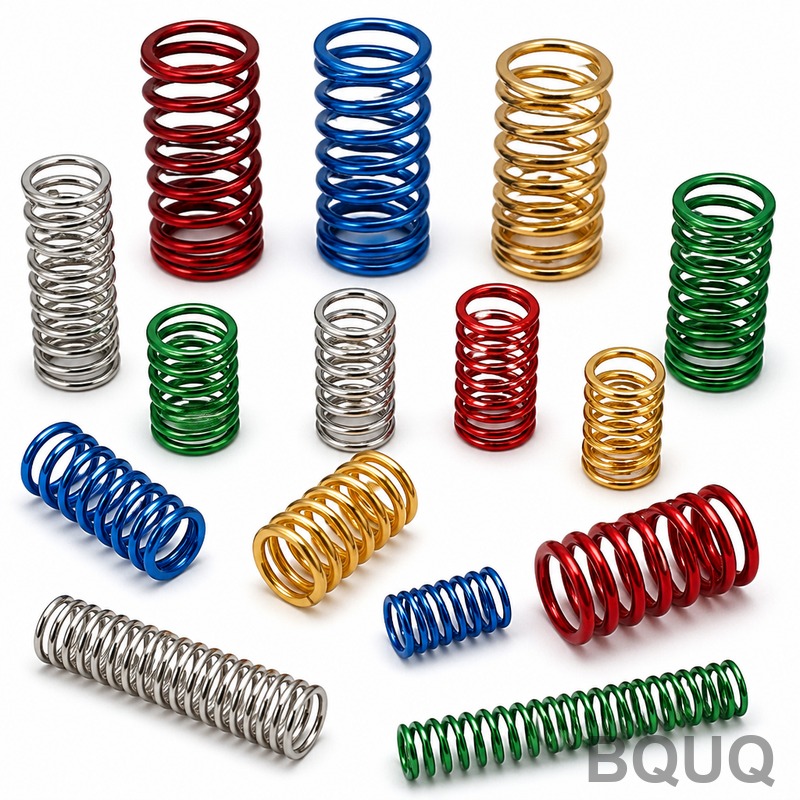
How Does Wire Diameter Affect Spring Rate and Load Capacity?
Wire diameter has a fourth-power relationship with spring rate, meaning a 10% increase in wire diameter results in a 46.4% increase in spring rate (1.1⁴ = 1.4641). This sensitivity means that a standard manufacturing tolerance of ±0.02 mm on a 2.00 mm wire produces a spring rate variation of approximately ±4%, which is acceptable for most general-purpose springs but must be tightened to ±0.01 mm for precision applications.
Load capacity scales with the cube of wire diameter. For example, a spring with a 1.5 mm wire diameter and a mean coil diameter of 12 mm has a maximum load of approximately 250 N at a stress of 800 MPa. Increasing the wire to 1.8 mm (a 20% increase) raises the maximum load to approximately 432 N, a 72.8% increase, while maintaining the same stress level. However, this also increases the solid height and reduces the available deflection range, so the design must be checked against the required travel.
Which Spring Materials Offer the Best Strength-to-Diameter Ratios?
The material choice directly determines how much stress a given wire diameter can safely handle. Music wire (ASTM A228) offers the highest tensile strength, ranging from 2,300 MPa for 0.5 mm wire to 1,650 MPa for 6.0 mm wire, making it ideal for compact, high-force springs. Oil-tempered wire (ASTM A229) provides slightly lower strength (1,400-1,800 MPa) but better fatigue resistance for dynamic applications.
For corrosive environments, stainless steel 302 (ASTM A313) offers a tensile strength of 1,200-1,700 MPa but has a lower maximum operating temperature of 290°C compared to 120°C for music wire. Chrome-silicon alloy steel (ASTM A401) provides the best strength-to-cost ratio for high-stress static applications, with tensile strengths up to 2,000 MPa and an operating temperature range up to 230°C. Inconel X-750 is specified for temperatures above 300°C, but its tensile strength drops to approximately 1,000 MPa, requiring a larger wire diameter for the same load.
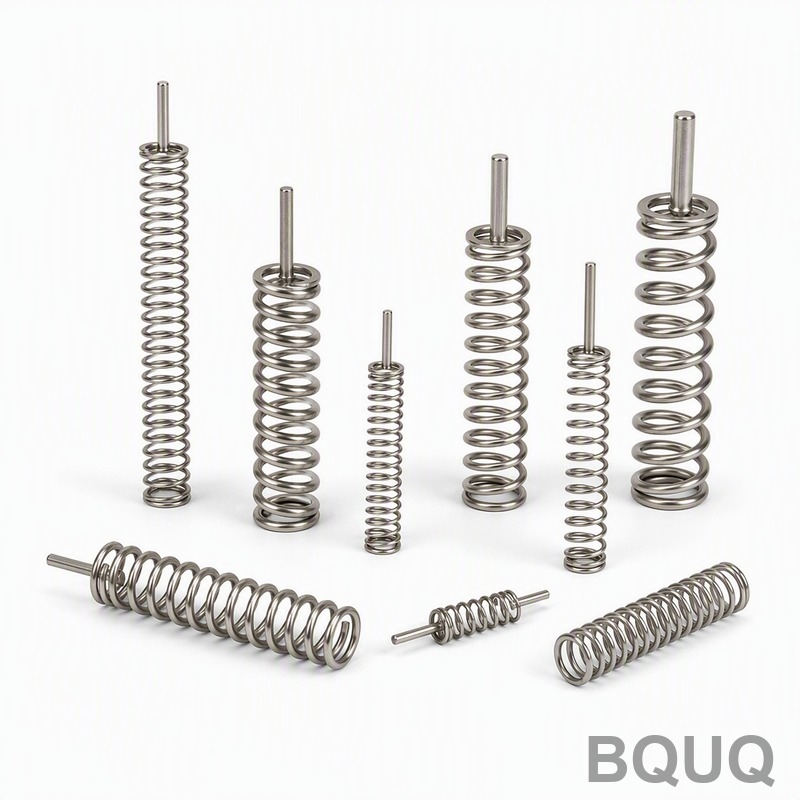
What Is the Proper Spring Index Range for Wire Diameter Selection?
The spring index (C = D/d) must be maintained between 4 and 16 for manufacturable and reliable springs. A spring index below 4 causes excessive stress concentration on the inner surface of the coil and makes the spring difficult to coil without cracking. A spring index above 16 results in a spring that is too flexible laterally and prone to buckling.
For a given load and space envelope, the spring index dictates the practical wire diameter range. If you have a 25 mm outer diameter constraint and require a spring index of 8, the wire diameter must be 2.78 mm, calculated from d = OD/(C+1). Reducing the spring index to 6 allows a wire diameter of 3.57 mm, which increases the load capacity by 112% but increases stress concentration. The recommended starting point for most applications is a spring index of 6-10, which balances stress distribution, manufacturability, and space efficiency.
How Much Space and Deflection Do You Need to Define Wire Diameter?
The available space envelope (outer diameter, free length, and solid height) and required deflection directly constrain the wire diameter selection. The solid height of a spring with squared and ground ends is calculated as (N+2) × d, meaning a spring with 8 active coils and a 3.0 mm wire has a solid height of 30.0 mm. The maximum deflection is the difference between free length and solid height, which determines the maximum available travel.
For example, if your application requires 40 mm of deflection and the solid height must not exceed 45 mm, the free length is limited to 85 mm. With a mean coil diameter of 20 mm and 6 active coils, the wire diameter must satisfy the equation k = (79,300 × d⁴) / (8 × 20³ × 6). For a required spring rate of 5 N/mm, solving for d gives approximately 2.4 mm. This calculation must be iterated because the solid height changes with wire diameter, and the design must leave a 10-15% deflection margin to prevent coil binding.
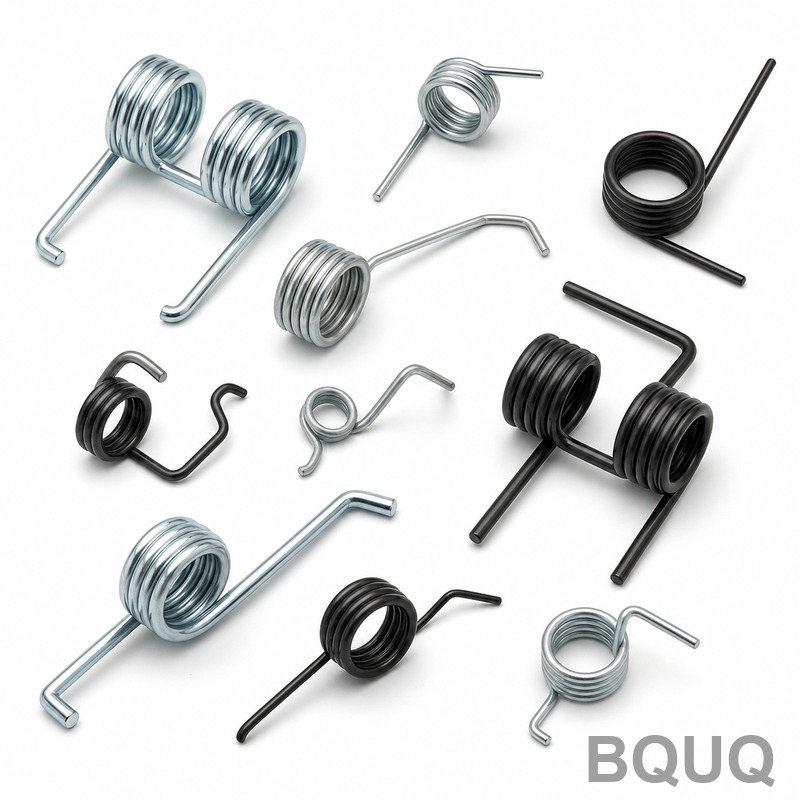
When Should You Increase Wire Diameter for Fatigue or Impact Loading?
For applications with cyclic loading exceeding 10,000 cycles, the wire diameter must be increased to keep the alternating stress below the endurance limit of the material. The endurance limit for music wire is approximately 45% of tensile strength, but this drops to 35% when the spring is shot-peened. For infinite life (over 10⁷ cycles), the maximum allowable shear stress should not exceed 400 MPa for music wire, regardless of wire diameter.
Impact loading, such as in valve springs operating at 6,000 RPM, requires a 20-30% increase in wire diameter compared to static load calculations. This is because the dynamic load can reach 2-3 times the static load due to surge waves. Adding 0.5 mm to the wire diameter in a 3.0 mm wire spring (a 16.7% increase) reduces the maximum stress by approximately 37% due to the cubic relationship between diameter and stress, providing a substantial fatigue life improvement.
How Do Manufacturing Tolerances Affect Wire Diameter Selection?
Wire diameter tolerances follow the EN 10270-1 standard for cold-drawn spring wire, with tolerance classes ranging from Grade A (±0.03 mm for 2.0 mm wire) to Grade C (±0.01 mm for 2.0 mm wire). Grade C wire costs 15-20% more but is required for precision springs with tight load tolerances. For a spring with a 2.0 mm nominal wire diameter, a Grade A tolerance of ±0.03 mm produces a spring rate variation of ±6%, while Grade C reduces this to ±2%.
The selection of wire diameter must account for these tolerances in the stress calculation. Design for the minimum wire diameter (nominal minus tolerance) to ensure the maximum stress stays within limits, and design for the maximum wire diameter to ensure the spring rate does not exceed requirements. This worst-case analysis ensures that all production parts meet the specification, avoiding costly rework and field failures. For high-volume production (over 100,000 pieces), BQUQ recommends using Grade B wire (±0.02 mm) as the default to balance cost and performance.
| Wire Diameter (mm) | Spring Rate (N/mm) at D=10mm, N=5 | Max Load (N) at 800 MPa | Solid Height (mm) for 5 Active Coils | Relative Cost per Meter |
| 1.0 | 0.99 | 39 | 7.0 | 1.0 |
| 1.5 | 5.02 | 132 | 10.5 | 1.8 |
| 2.0 | 15.86 | 314 | 14.0 | 2.9 |
| 2.5 | 38.72 | 613 | 17.5 | 4.2 |
| 3.0 | 80.28 | 1060 | 21.0 | 5.8 |
| 4.0 | 253.80 | 2513 | 28.0 | 9.5 |
What Are the Most Common Wire Diameter Selection Mistakes?
The most common error is selecting a wire diameter based on the required spring rate without checking the resulting stress against the material's endurance limit. This leads to springs that pass static testing but fail after 50,000 cycles in service. Another frequent mistake is ignoring the manufacturer's wire tolerance, which can cause the actual spring rate to deviate by up to 6% from the design value. Finally, many engineers forget to account for the spring's operating temperature, which reduces the material's tensile strength by approximately 10% at 100°C for music wire, necessitating a larger diameter.
How Can BQUQ Help You Validate Your Wire Diameter Selection?
BQUQ's engineering team can run a free FEA simulation on your spring design within 24 hours, validating stress distribution, fatigue life, and spring rate against your application requirements. We provide a detailed report with recommended wire diameters, material grades, and manufacturing tolerances, along with a firm quote for prototype and production quantities. Our 20 years of manufacturing experience in CNC machining and spring production ensures that your design is optimized for both performance and manufacturability.
What Is the Minimum Wire Diameter for a Given Load?
The minimum wire diameter can be calculated by rearranging the stress formula to d = ∛((8 × F × D × K) / (π × τ_allowable)). For a load of 500 N, a mean coil diameter of 20 mm, a spring index of 8, and an allowable stress of 800 MPa, the minimum diameter is approximately 3.3 mm. Always add a 10% safety margin to account for material variations and dynamic effects.
Can I Use a Thinner Wire for a Higher Spring Rate?
No, a thinner wire produces a lower spring rate because the spring rate is proportional to the fourth power of the wire diameter. To achieve a higher spring rate, you must either increase the wire diameter, reduce the mean coil diameter, or reduce the number of active coils. These changes must be evaluated together to avoid exceeding stress limits.
When Do I Need to Use Shot-Peened Wire?
Shot peening is required for springs subjected to cyclic loads above 100,000 cycles or when the calculated stress exceeds 60% of the material's tensile strength. Shot peening introduces compressive residual stresses on the surface, increasing fatigue life by up to 200%. It adds approximately 10-15% to the spring cost but is essential for engine valve springs and suspension springs.
Which Wire Diameter Tolerance Class Should I Specify?
Specify Grade C tolerance (±0.01 mm for 2.0 mm wire) for precision applications such as medical devices, aerospace actuators, and fuel injectors where load consistency is critical. Use Grade B (±0.02 mm) for general industrial springs, and Grade A (±0.03 mm) for non-critical applications like simple compression springs in consumer products. The cost difference between Grade A and Grade C is typically 15-20%.
How Does Operating Temperature Change My Wire Diameter Choice?
Operating temperature reduces the material's tensile strength and shear modulus. For music wire, the maximum safe operating temperature is 120°C, above which the stress relaxation becomes significant. If your application runs at 150°C, switch to chrome-silicon alloy steel or stainless steel 302, and increase the wire diameter by 5-8% to compensate for the reduced strength.
What Is the Maximum Spring Index for a Stable Spring Design?
The maximum spring index is 16, but for stability, the free length should not exceed 2.6 times the mean coil diameter for a spring with both ends supported. Exceeding this ratio causes buckling under load. If your design requires a high spring index above 12, consider adding a guide rod or housing to prevent lateral buckling.
Can I Use the Same Wire Diameter for Different Spring Lengths?
Yes, the same wire diameter can be used for different spring lengths, but the spring rate remains the same if the mean coil diameter and number of active coils are unchanged. Changing the free length without changing the wire diameter or coil count only changes the preload and available deflection, not the spring rate. This allows standardization of wire stock while varying spring dimensions for different applications.
To get your spring design evaluated with a detailed engineering report and a same-day quote, contact BQUQ today. Our team responds within 12 hours with actionable recommendations and production pricing. Email your drawings or specifications to sc@bquq.com, call or WhatsApp us at +86 13713157787, or visit www.bquq.com to start your project.