How to Design a Torsion Spring: Calculations and Design Guidelines
The design of a torsion spring requires a precise balance between applied torque, angular deflection, and stress management, with the core calculation being the spring rate (k) expressed in N·mm/degree. To design a functional torsion spring, you must first determine the required torque and deflection angle, then select a wire diameter and mean coil diameter that keep the bending stress below the material's tensile strength divided by a safety factor of 1.5 to 2.0. The fundamental formula is k = (E × d⁴) / (3667 × D × Nₐ), where E is the Young's modulus of the material (typically 206,000 MPa for spring steel), d is the wire diameter in mm, D is the mean coil diameter in mm, and Nₐ is the number of active coils.
What Is the Basic Formula for Torsion Spring Rate and Torque?
The torsion spring rate (k) defines the moment required to rotate the spring by one degree, calculated using the formula k = (E × d⁴) / (3667 × D × Nₐ) for metric units. The applied torque (M) is then calculated as M = k × θ, where θ is the deflection angle in degrees. For example, a spring with a rate of 2.5 N·mm/degree deflected 90 degrees will generate a torque of 225 N·mm. The bending stress (σ) in the wire is calculated using σ = (32 × M × Kᵢ) / (π × d³), where Kᵢ is a stress correction factor that accounts for the curvature of the wire, typically ranging from 1.05 to 1.30 depending on the spring index.
How Do You Determine the Number of Active Coils and Body Length?
The number of active coils (Nₐ) is the total number of coils minus the end legs, and it directly influences the spring rate. For a torsion spring with ends positioned at a 90-degree angle, the active coils are calculated as Nₐ = Nₜ - 1, where Nₜ is the total number of coils. The body length (L) under no load is calculated as L = (Nₜ + 1) × d, and this dimension must be checked against the available space in your assembly. For example, if you have a wire diameter of 2.0 mm and a total of 8 coils, the body length is 18 mm. The minimum recommended spring index (D/d) is 4, and the maximum is 16, with values below 4 causing excessive stress concentration and values above 16 leading to coil buckling.
What Are the Critical Stress Limits and Material Selection Criteria?
The maximum allowable bending stress for a torsion spring is typically 60 to 70 percent of the material's ultimate tensile strength, depending on the application's cycle life requirement. For static applications (fewer than 10,000 cycles), you can use up to 70 percent of tensile strength, while for dynamic applications exceeding 1 million cycles, the limit drops to 45 percent. Music wire (ASTM A228) is the most common material, with tensile strengths ranging from 2,300 MPa for 0.5 mm wire to 1,700 MPa for 6.0 mm wire. Stainless steel 302 (ASTM A313) offers corrosion resistance with a tensile strength of 1,900 MPa at 1.0 mm diameter, but it has a lower maximum operating temperature of 290°C compared to 120°C for music wire.
How Do You Calculate the Free Position and Deflection Angle Limits?
The free position of a torsion spring is the angular position of the legs when no load is applied, typically specified as a nominal angle with a tolerance of ±5 degrees. The maximum deflection angle is limited by the stress in the wire and the physical clearance between coils; as the spring deflects, the coils wind up and reduce the inner diameter. The reduction in inner diameter at maximum deflection can be calculated as ΔID = (θ × D) / (360 × Nₐ), and you must ensure this value does not cause the spring to bind against the mandrel. For example, a spring with a mean diameter of 12 mm, 5 active coils, and a deflection of 90 degrees will experience an inner diameter reduction of 0.6 mm.
What Are the Effects of End Leg Configuration and Direction of Winding?
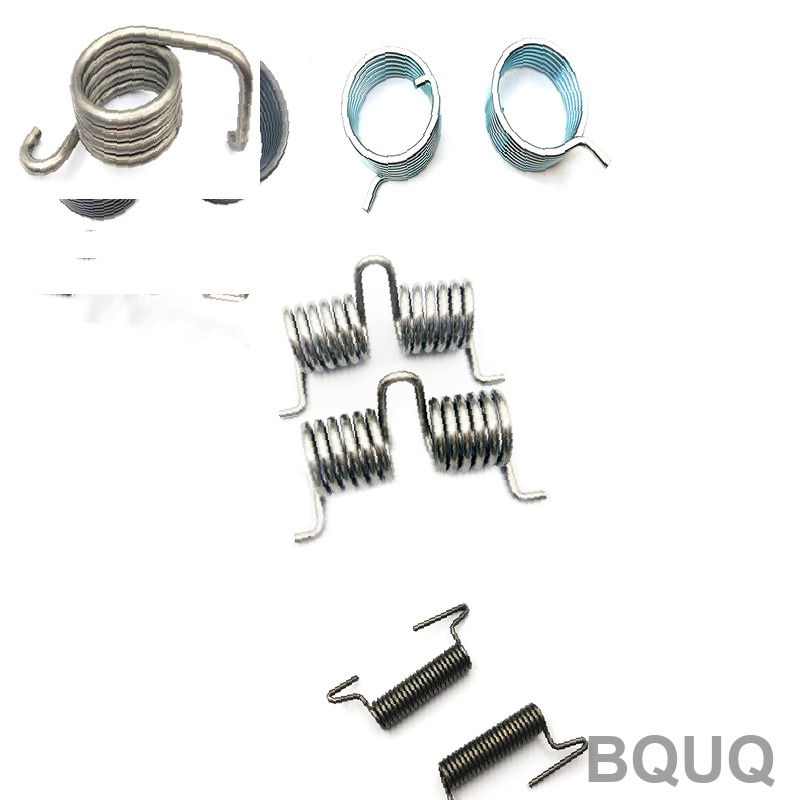
The end leg configuration determines how the spring transmits torque, with common designs being straight torsion ends, hinged ends, and short hook ends. The leg length and bend radius affect the stress distribution, and the leg should be designed with a minimum bend radius of 1.5 times the wire diameter to avoid cracking. The direction of winding (right-hand or left-hand) must be specified based on the direction of applied torque; a right-hand spring should be wound in the direction that tightens the coils when torque is applied. If the spring is wound in the wrong direction, it will unwind and fail prematurely, so this specification is critical on the drawing.
How Much Does Prototype Tooling Cost and What Are the Lead Times?
Prototype torsion springs can be manufactured using CNC coiling machines without dedicated tooling, with costs ranging from $150 to $500 for a batch of 50 pieces, depending on wire diameter and complexity. Production tooling for high-volume runs (over 10,000 pieces) costs between $800 and $2,500 for a standard torsion spring die set, with lead times of 2 to 3 weeks. The following table provides typical specifications for common torsion spring designs:
| Wire Diameter (mm) | Mean Coil Diameter (mm) | Spring Rate (N·mm/deg) | Max Deflection (deg) | Material Cost per kg (USD) | Lead Time (days) |
| 0.5 | 4.0 | 0.08 | 120 | $18 | 5 |
| 1.0 | 8.0 | 0.45 | 180 | $15 | 7 |
| 1.5 | 12.0 | 1.20 | 150 | $14 | 10 |
| 2.0 | 16.0 | 2.80 | 100 | $13 | 12 |
| 3.0 | 24.0 | 8.50 | 90 | $12 | 15 |
How Do You Validate the Design with FEA and Physical Testing?
Finite element analysis (FEA) should be used to verify stress concentrations at the bend points of the end legs, as these are the most common failure locations. The FEA model should use a solid mesh with at least 10 elements across the wire cross-section to accurately capture the bending stress distribution. Physical testing should include a torque-deflection curve measurement using a torsion spring tester, with the actual spring rate verified to be within ±5 percent of the calculated value. For high-cycle applications, a fatigue test should be run at the maximum deflection for at least 100,000 cycles to confirm no premature fracture, and the test temperature should not exceed the material's maximum operating limit.
What Are the Common Failure Modes and How Do You Prevent Them?
The most common failure mode is fatigue fracture at the inner surface of the coil, caused by stress concentrations from surface defects or incorrect shot peening. Surface treatment with shot peening can increase fatigue life by up to 30 percent by introducing compressive residual stresses on the wire surface. Another failure mode is stress relaxation, where the spring loses torque over time when held at a constant deflection; this is mitigated by using a higher strength material or by pre-setting the spring to its solid height during manufacturing. Corrosion failure occurs in humid environments, and this is prevented by specifying stainless steel or applying a zinc or epoxy coating with a minimum thickness of 8 micrometers.
How Do You Specify Tolerances on the Engineering Drawing?
Tolerances for torsion springs follow the DIN 2095 standard for cylindrical helical torsion springs, with grade 1 for precision applications and grade 2 for general use. The wire diameter tolerance is typically ±0.01 mm for wires under 1.0 mm and ±0.02 mm for larger wires. The spring rate tolerance is ±5 percent for grade 1 and ±10 percent for grade 2, while the free angle tolerance is ±3 degrees for grade 1 and ±5 degrees for grade 2. The total length tolerance is ±0.5 mm for body lengths under 20 mm, and the leg position tolerance is ±2 degrees. Include these specifications on your drawing to ensure consistent manufacturing quality.
What Are the Cost Optimization Strategies for High-Volume Production?
For production volumes exceeding 50,000 pieces, the material cost dominates, typically accounting for 60 to 70 percent of the total part cost. Specifying a standard wire diameter that is readily available from suppliers reduces material waste and shortens lead times; common diameters are 0.5, 0.8, 1.0, 1.2, 1.5, 2.0, 2.5, and 3.0 mm. Combining multiple torsion springs into a single coiling operation with a mandrel can reduce cycle time from 15 seconds to 8 seconds per part. Additionally, reducing the number of active coils by 10 percent can increase the spring rate by 11 percent, potentially allowing a thinner wire and lower material cost.
What Is the Recommended Safety Factor for Different Application Types?
The safety factor for torsion spring design varies by application: consumer products such as clips and latches use a safety factor of 1.5, automotive applications such as door hinges use 2.0, and aerospace or medical devices require 2.5 to 3.0. The safety factor is applied to the maximum bending stress, meaning the allowable stress is the material's tensile strength divided by the safety factor. For example, a music wire spring with a tensile strength of 2,000 MPa and a safety factor of 2.0 has an allowable stress of 1,000 MPa. Always verify the calculated stress at maximum deflection against this allowable limit before finalizing the design.
What Is the Difference Between a Torsion Spring and a Helical Compression Spring?
A torsion spring applies torque around its axis and deflects by twisting, while a compression spring absorbs axial force and shortens in length. Torsion springs have end legs to transmit the rotational force, whereas compression springs have flat or closed ends. The stress in a torsion spring is primarily bending stress, while a compression spring experiences torsional shear stress.
How Do You Measure the Torque of a Torsion Spring?
Torque is measured using a torsion spring tester that applies a known angular deflection and records the resulting moment. The tester typically uses a load cell and an angular encoder to plot the torque-deflection curve. The measured spring rate is the slope of this curve, which should match the calculated value within 5 percent.
Which Material Is Best for High-Temperature Torsion Spring Applications?
For operating temperatures above 200°C, music wire and stainless steel are not suitable, and you should specify Inconel X-750 or 17-7 PH stainless steel. Inconel X-750 maintains its tensile strength up to 600°C but costs approximately $80 per kg. For temperatures up to 250°C, chrome vanadium steel (ASTM A232) is a cost-effective alternative with a tensile strength of 1,900 MPa.
When Should You Use a Double Torsion Spring Instead of a Single Spring?
Use a double torsion spring when the torque requirement exceeds the stress limit of a single spring with a practical wire diameter. A double torsion spring consists of two coils wound in opposite directions and connected in the middle, providing higher torque with a more compact axial length. This design also eliminates the side thrust forces that occur in single torsion springs.
Can You Adjust the Spring Rate Without Changing the Wire Diameter?
Yes, the spring rate can be adjusted by changing the mean coil diameter or the number of active coils. Increasing the mean coil diameter by 10 percent reduces the spring rate by approximately 30 percent, while decreasing the number of active coils by 20 percent increases the rate by 25 percent. These adjustments allow fine-tuning of the rate within the constraints of the available space.
How Does Shot Peening Affect the Fatigue Life of a Torsion Spring?
Shot peening introduces compressive residual stress on the wire surface, which prevents crack initiation and propagation. The fatigue life of a shot-peened torsion spring can be increased by 20 to 30 percent compared to an unpeened spring. The shot peening intensity should be specified as 0.2 to 0.4 mm A, and the coverage should be 100 percent.
What Is the Maximum Deflection Angle for a Standard Torsion Spring?
The maximum deflection angle is typically limited to 120 degrees for a spring with a spring index of 8 and a safety factor of 2.0. Exceeding this angle can cause the coils to bind and the stress to exceed the allowable limit. For deflections above 180 degrees, consider a multi-coil design or a spring with a larger spring index.
For a torsion spring design that meets your exact torque, deflection, and life requirements, the engineering team at BQUQ can provide a detailed calculation and a free prototype quote within 12 hours. With 20 years of experience in CNC machining, metal stamping, springs, and heat sinks, we ensure your design is manufacturable and cost-effective. Send your drawings or specifications to sc@bquq.com or contact us on WhatsApp at +86 13713157787, and visit www.bquq.com for more information.
Related Articles
- Hardware spring fatigue failure analysis and life prediction technology
- In-depth analysis of technology and process in the hardware spring industry in 2026: a full-dimensional interpretation of high stress, functional integration and engineering certification
- From "standard parts" to "functional parts": 2026 hardware spring industry technology trends and functional innovation engineering direction