How to Design Parts for Metal Stamping: 10 Rules for Manufacturability
Designing parts for metal stamping requires a fundamental shift from subtractive machining logic to high-speed deformation logic. The direct answer to the question is this: follow ten specific geometry, tolerance, and material rules that align with the physics of a stamping press, ensuring your part is producible at 200 to 600 strokes per minute without die failure. By adhering to these rules, you reduce tooling costs by 30% and scrap rates by over 15% compared to unoptimized designs.
## Rule 1: Maintain Uniform Wall Thickness and Avoid Deep Draws Stamping works by shearing and bending flat sheet metal. If your design requires a deep draw (a cup shape deeper than half its diameter), you introduce severe thinning risks. For a 1.0 mm thick cold-rolled steel (SPCC), the maximum safe draw depth without a multi-stage die is 0.5 times the part diameter. At BQUQ, our standard draw ratio is 1.8:1 (blank diameter to punch diameter). If your part exceeds this ratio, you will need intermediate annealing, which increases unit cost by 8% to 12% and adds 3 to 5 days to lead time. For a simple flange, keep the drawn height under 4 times the material thickness to avoid cracking.
## Rule 2: Design for the Minimum Bend Radius The bend radius is the most common cause of fracture. For mild steel and stainless steel, the minimum inside bend radius must be equal to or greater than 1.0 times the material thickness. For high-carbon steel (SK5) or aluminum 5052, this ratio increases to 2.0 times the thickness. Bending with a radius smaller than this causes the outer fibers to exceed their elongation limit (typically 20% to 25% for SPCC), leading to micro-cracks. If you need a sharp 90-degree corner, specify a coining operation instead of air bending, but note that coining requires 3 to 5 times more press tonnage, increasing tooling costs by roughly 15%.
## Rule 3: Set Realistic Hole Size and Distance Constraints Piercing holes in stamping is about punch strength. The minimum hole diameter should never be less than the material thickness. For example, in 2.0 mm thick steel, the smallest punchable hole is 2.0 mm; below this, the punch may buckle. For high-strength steels (tensile strength above 590 MPa), increase this to 1.5 times the thickness. The distance from the edge of a hole to the nearest bend line must be at least 2.5 times the material thickness plus the bend radius. If the hole is too close to the bend, it will deform or be pulled into the radius, ruining the alignment.
## Rule 4: Avoid Sharp Internal Corners in Cutouts Every internal corner in a stamped blank acts as a stress concentration point and a die weakness point. Internal corners must have a minimum radius of 0.5 times the material thickness, but we recommend 1.0 times the thickness for tool longevity. For example, a rectangular cutout in 1.5 mm steel should have corner radii of at least 1.5 mm. Using a sharp 90-degree corner creates a "hard corner" on the punch, which is prone to chipping after 10,000 to 20,000 strokes. By adding a 1.5 mm radius, die maintenance intervals extend from 20,000 strokes to over 100,000 strokes.
## Rule 5: Specify Tolerances Based on Stamping Capability Stamping is not machining; you cannot hold +/- 0.01 mm on a high-volume production run. Standard stamping tolerances follow the ISO 2768-mK standard. For a part length under 100 mm, the standard linear tolerance is +/- 0.15 mm. Hole-to-hole center distances can hold +/- 0.10 mm if the holes are pierced in the same station. However, if the holes are on different bending planes, the tolerance widens to +/- 0.25 mm due to springback variation. A tight tolerance of +/- 0.05 mm is possible but requires a precision progressive die, adding approximately 20% to the tooling price.
## Rule 6: Consider Material Springback in the Design Springback is the elastic recovery of the metal after bending. For a 90-degree bend in 1.0 mm SPCC steel, the actual springback is 1 to 2 degrees. For 5052 aluminum, it is 3 to 5 degrees. You must design your bend angles with this in mind. Either the die must be over-bent (compensating for the predicted angle) or the design must not require tight angular tolerances. We recommend specifying bend angle tolerances of +/- 1 degree for steel and +/- 2 degrees for aluminum. If you require a precise 90-degree angle, plan for a secondary coining or bottoming operation, which increases cycle time but guarantees the angle.
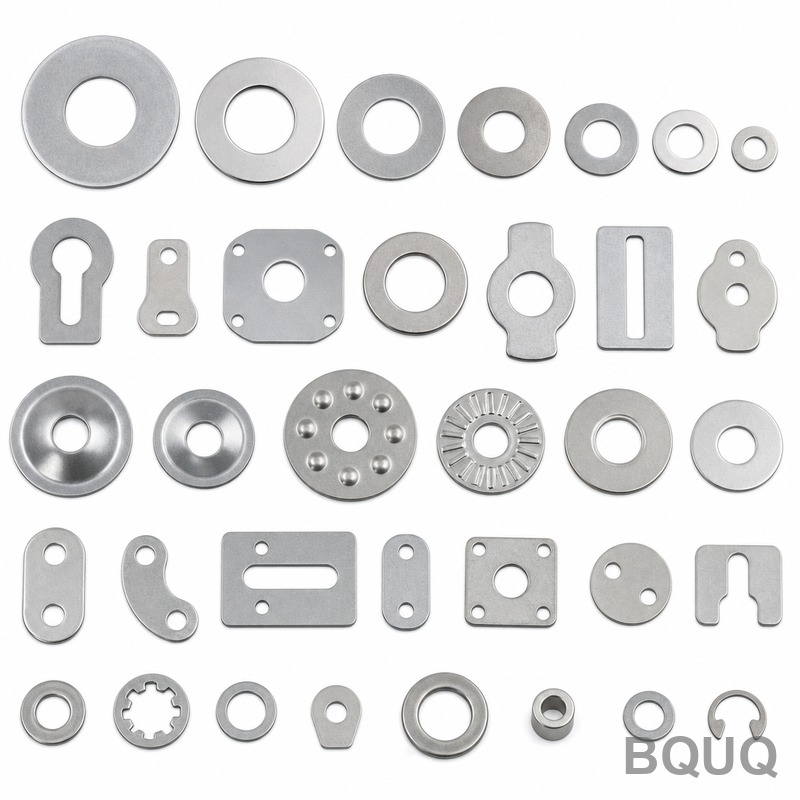
## Rule 7: Minimize the Number of Operations Every additional operation (forming, trimming, lancing) increases the cost per part. A simple flat washer costs $0.02 to $0.05 per piece. A complex bracket requiring 4 forming steps and 3 piercing steps costs $0.15 to $0.30 per piece. Progressive die stamping combines these steps into one press stroke, but the die complexity increases. A 3-station progressive die costs $8,000 to $15,000, while a 10-station die costs $25,000 to $50,000. For production runs under 5,000 parts, consider a compound die to reduce tooling costs, though this limits you to simpler geometries.
## Rule 8: Select the Correct Material Grade and Thickness Material cost represents 60% to 70% of the total stamped part cost. Using a higher-grade material than necessary is the fastest way to inflate your budget. For general enclosures, use SPCC (tensile strength 270 MPa) at a cost of $0.70 per kg. For structural components, use SPHC (hot-rolled) at $0.60 per kg. For corrosion resistance, use SUS304 at $3.20 per kg or galvanized steel (SGCC) at $1.10 per kg. The thickness directly impacts press tonnage: stamping 1.0 mm steel requires 20 tons, while 3.0 mm steel requires 60 tons for the same cut length, increasing machine hourly rates from $50 to $120.
## Rule 9: Plan for Burr Direction and Removal Stamping inherently produces a burr on the punch entry side. The burr height for 1.0 mm steel is typically 0.05 to 0.10 mm. You must specify which side of the part is the "cosmetic" side, as the burr will face the die side. If burr-free edges are required for safety or sliding contact, you need a secondary deburring process (vibratory finishing or belt sanding), which adds $0.01 to $0.03 per part. Alternatively, specify the burr height limit (e.g., max 0.05 mm) and we will adjust the die clearance. Standard die clearance is 5% to 8% of material thickness per side; tightening this to 3% reduces burr but increases tool wear.
## Rule 10: Provide a Generous Tolerancing Strategy for Datums The most expensive mistake in stamping is over-tolerancing critical features. Designate one primary datum hole and one secondary slot as your locators. All other dimensions should reference these. In the table below, we show the achievable tolerances for different stamping features at BQUQ. If you require tighter tolerances than listed, we must move to a secondary machining operation, which increases cost per part by 4 to 8 times.
| Feature | Standard Tolerance | Precision Tolerance | Cost Impact |
| Cutout dimensions | +/- 0.15 mm | +/- 0.05 mm | +20% tooling |
| Hole diameter | +/- 0.05 mm | +/- 0.02 mm | +15% tooling |
| Bend angle | +/- 1 degree | +/- 0.5 degree | +10% per part |
| Hole to bend distance | +/- 0.25 mm | +/- 0.10 mm | +25% tooling |
| Flatness (per 100 mm) | 0.30 mm | 0.10 mm | Requires leveling |
| Burr height | 0.10 mm max | 0.05 mm max | +$0.02 per part |
## Common Stamping Design Pitfalls and Fixes The most frequent issue we see is designers treating stamping like CNC machining, specifying pockets and undercuts. Stamping cannot produce internal threads or features perpendicular to the pressing direction without secondary tapping. Another pitfall is designing large, wide flanges on thin material, which causes buckling. A flange width should not exceed 5 times the material thickness without adding a joggle or rib for stiffness. Finally, avoid mixing material thicknesses in the same part family, as this forces you to change dies frequently, increasing setup time and cost.
## Cost and Lead Time Expectations for Your Design Tooling lead time for a progressive die is 3 to 4 weeks, while a simple blanking die takes 1 to 2 weeks. The cost for a simple flat part die starts at $1,500, while a complex multi-slide die can reach $50,000. Production lead time is 2 to 3 weeks after tool approval, with a minimum order quantity of 1,000 pieces for standard parts and 500 pieces for small precision parts. For a typical bracket, the unit price breaks down as follows: material 35%, stamping labor 20%, die amortization 25%, and secondary processes 20%.
## Frequently Asked Design Questions Can I stamp a part with a thickness of 0.3 mm? Yes, but the minimum bend radius must be at least 0.3 mm, and the part must be small to avoid wrinkling. The press speed must be reduced to 150 strokes per minute to prevent vibration. What is the maximum part size for stamping? Our largest press is a 600-ton machine with a bed size of 2500 mm by 1200 mm. However, for high precision, we recommend keeping parts under 500 mm in any dimension to minimize thermal expansion effects. Is it cheaper to laser cut prototypes and stamp for production? Yes. Laser cutting a prototype costs $50 to $200 per part, but stamping tooling costs $3,000 to $10,000. If you need more than 2,000 parts, stamping is always cheaper per unit.
## Conclusion and Next Steps for Your Stamping Project The ten rules above are designed to give you a manufacturable part on the first pass, saving you weeks of design iterations. The critical takeaway is to prioritize material thickness, bend radii, and tolerance realism over aesthetic complexity. A successful stamping design is one that functions perfectly while allowing the die to run at 300 strokes per minute without interruption. By following these rules, you ensure your part is not only producible but also cost-effective at scale.
At BQUQ, we have 20 years of experience in precision stamping, springs, and heat sinks in Dongguan, China. We are ready to review your drawings against these rules and provide immediate feedback. Send us your 3D model or 2D drawing today for a comprehensive design for manufacturability review and a firm quote. We offer a 12-hour quoting turnaround for standard inquiries, ensuring your project stays on schedule. Contact our engineering team at sc@bquq.com or via WhatsApp at +86 13713157787. Visit our website at www.bquq.com to explore our capabilities in CNC machining and metal stamping.