How to Estimate Metal Stamping Prices: Tooling, Part Cost and MOQ Explained
Estimating metal stamping prices requires separating three distinct cost drivers: tooling (one-time die construction), piece price (per-unit material and labor), and MOQ (minimum order quantity, which amortizes tooling and setup). As a rule of thumb, progressive die tooling for a simple part ranges from $3,000 to $15,000, while a single-piece price for a medium-complexity bracket (0.5 mm steel) lands between $0.15 and $0.80, with MOQs typically starting at 1,000 to 5,000 pieces. This article breaks down the calculation method, using real 2025 pricing data from our Dongguan factory, so you can budget accurately before sending a request for quote (RFQ).
What Are the Main Cost Components in a Metal Stamping Quote?
A metal stamping quote is built from four components: tooling cost, material cost, processing cost (press time and labor), and secondary operations (tapping, deburring, plating). Tooling is a fixed, one-time fee that covers die design, steel cutting, heat treatment, and tryout. Material cost is calculated by multiplying the blank size (including scrap allowance) by material density and market price per kilogram. Processing cost is driven by press tonnage and strokes per minute (SPM); a 25-ton press runs at $35 to $55 per hour, while a 110-ton press runs at $60 to $90 per hour. Secondary operations add $0.02 to $0.50 per part depending on complexity. Ignoring any of these four leads to a quote that is either too high (lost business) or too low (zero margin).
How Is Tooling Cost Calculated for a Progressive Die?
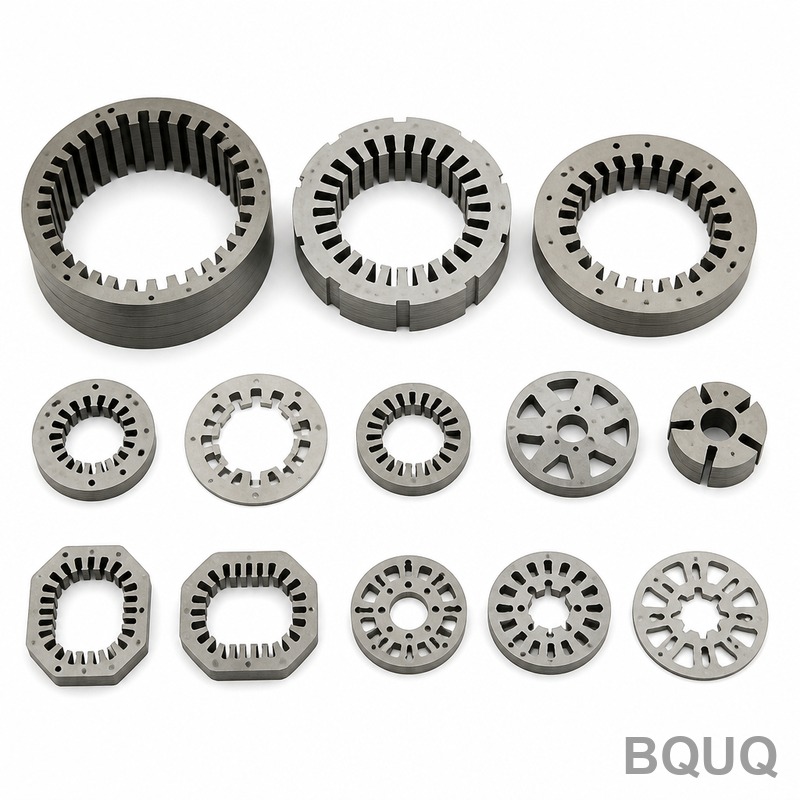
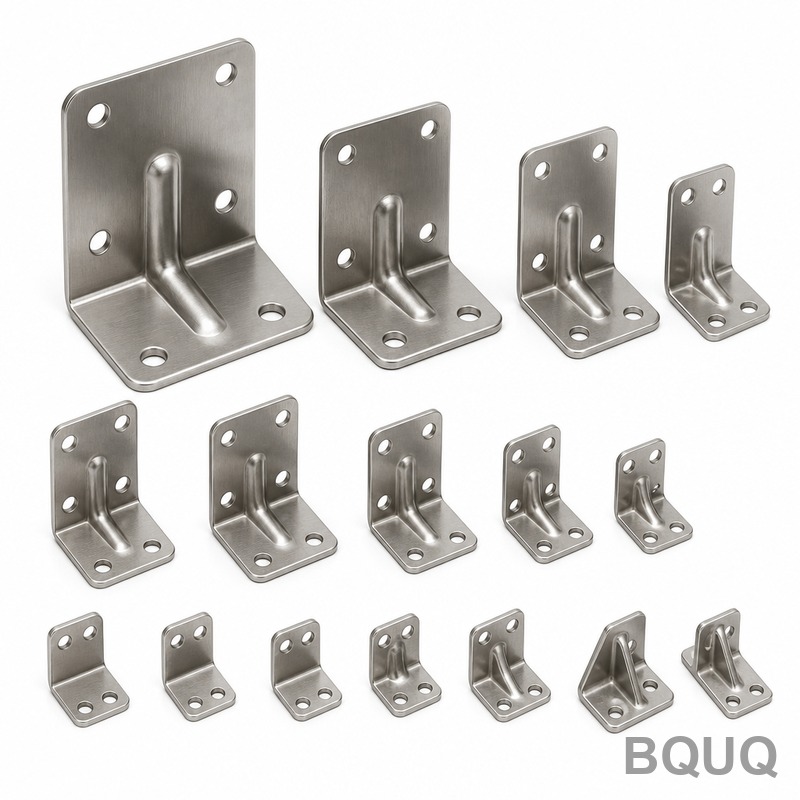
Tooling cost is estimated based on die size, number of stations, and required steel grade. A simple blanking die (1-2 stations) costs $2,500 to $6,000; a progressive die with 5-8 stations (piercing, forming, bending) costs $8,000 to $25,000; a high-speed progressive die for connectors (10+ stations) ranges from $30,000 to $80,000. The steel grade matters: D2 tool steel is standard ($18-$25 per kg), while powder metallurgy steel (ASP23) costs $45-$60 per kg and is used for runs over 1,000,000 strokes. We also add 15-20% for tryout press time and minor revisions. For a typical 0.8 mm thick steel bracket with four bends, expect tooling at $9,500 to $14,000 with a 4-week lead time.
How Do You Calculate the Per-Part Price (Piece Price)?
The piece price is the sum of material, stamping, and secondary costs, divided by yield rate. For example, a 50 mm x 30 mm bracket in SPCC 0.8 mm steel: blank area is 1,500 mm², but with a 10% strip scrap, actual material used is 1,650 mm². Weight per piece is 0.0104 kg (density 7.85 g/cm³). At SPCC price of $0.72/kg, material cost is $0.0075. Stamping cost: press rate $45/hr, running at 60 SPM with a 95% efficiency, yields 3,420 parts per hour, so processing cost is $0.0132 per part. Secondary (deburr and pack) adds $0.01. Total piece price before margin is $0.0307; with 25% margin, the quote is $0.038 per piece. For a full table of reference values, see the cost breakdown below.
Which Factors Most Strongly Influence the Final Stamping Price?
Three factors move the price the most: material thickness and grade, tolerance requirement, and annual volume. Thicker material (2.0 mm vs 0.5 mm) increases tooling cost by 30-50% because heavier presses (63-ton vs 25-ton) and stronger die steels are required. Tight tolerances (e.g., ±0.05 mm instead of ±0.15 mm) force slower press speeds (reducing SPM from 60 to 35) and add 100% inspection, which can double processing cost. Annual volume matters because tooling amortization is the dominant factor at low quantities: at 5,000 pieces/year, tooling adds $2.00 per part; at 500,000 pieces/year, tooling adds only $0.02 per part. We always recommend customers consider 3-year total cost, not just piece price.
What Is the Role of MOQ (Minimum Order Quantity) in Pricing?
MOQ is not a profit tool; it is the minimum quantity that recovers setup cost, material minimums, and tooling trial. For a standard progressive die, setup takes 1.5 to 3 hours, costing $70 to $160 in machine time. Material minimums from steel mills are typically 500 kg per coil, which for a 0.8 mm thick part is roughly 25,000 pieces. Our standard MOQ is 5,000 pieces for simple parts and 2,000 pieces for complex parts where tooling is already paid. If you order below MOQ, we add a "small lot surcharge" of $50 to $150 per order to cover the setup and material waste. For prototyping, we recommend single-hit dies (not progressive) with an MOQ of 100 pieces, at a tooling cost of $1,500 to $3,000.
How Do Secondary Operations (Plating, Tapping, Heat Treatment) Affect Price?
Secondary operations can add 20% to 80% to the bare stamping cost. Zinc plating (blue or yellow) costs $0.06 to $0.15 per kg of parts, but the minimum batch charge is $50. Tapping a hole (M3 or M4) adds $0.02 to $0.05 per hole, but if you require a thread depth tolerance of ±0.1 mm, it increases to $0.08. Heat treatment (hardening to HRC 40-50) is priced per kg, typically $1.20 to $2.50 per kg, but it causes slight distortion, so a straightening operation adds another $0.03 per part. The key engineering advice is to combine operations: a progressive die can tap holes in-station, which eliminates a separate secondary process and reduces cost by 40% compared to post-stamping tapping.
How Can You Reduce Metal Stamping Costs Without Sacrificing Quality?
The most effective cost reduction is to design for stamping (DFS): avoid tight tolerances unless functionally required, use standard material thicknesses (0.5, 0.8, 1.0, 1.2, 1.5 mm) to avoid coil surcharges, and minimize bend radii to at least 0.5x material thickness. Consolidating parts into a single stamping (e.g., using a carrier strip to make two parts per stroke) can cut piece price by 30%. Increasing annual volume from 10,000 to 100,000 pieces reduces the amortized tooling cost per part from $1.20 to $0.12. Finally, accept "burr side" as a standard spec (burr height under 0.1 mm) rather than requiring deburring on all edges, which eliminates a $0.01-$0.03 per part operation.
Data Table: Reference Metal Stamping Cost Estimates (2025, Dongguan, China)
| Part Complexity | Typical Tooling Cost (USD) | Tooling Lead Time (weeks) | Piece Price (USD, 0.8mm steel) | Standard MOQ (pieces) | Press Tonnage Used |
| Simple flat blank (50x30mm) | $2,500 – $4,500 | 2-3 | $0.012 – $0.025 | 5,000 | 25 ton |
| Bracket with 2-3 bends | $6,000 – $12,000 | 3-4 | $0.035 – $0.080 | 3,000 | 45 ton |
| Progressive die, 5+ stations (electrical contact) | $15,000 – $30,000 | 4-6 | $0.080 – $0.200 | 2,000 | 63 ton |
| High-precision connector (0.2mm thick) | $35,000 – $60,000 | 6-8 | $0.150 – $0.400 | 1,000 | 25 ton high-speed |
FAQ
How Long Does It Take to Get a Metal Stamping Quote?
We provide a preliminary budget quote within 12 hours of receiving your 2D drawing (PDF or DXF) and material spec. A final quote with full tooling breakdown and MOQ terms is issued within 48 hours after our engineers review tolerances and secondary operations.
Can You Stamp Stainless Steel or Aluminum?
Yes, we stamp stainless steel (301, 304, 316), aluminum (5052, 6061), brass, and copper. Stainless steel 304 costs 2.5 to 3 times more than SPCC steel per kg and requires 20-30% higher press tonnage. Aluminum is easier to stamp but requires coated tools to prevent galling; we add a $500 to $1,000 tooling surcharge for aluminum.
What Is the Maximum Part Size for Stamping?
Our largest press is 250 tons with a bed size of 2,500 mm x 1,200 mm, so the maximum part size is approximately 2,000 mm x 800 mm with a material thickness up to 6.0 mm. For parts larger than this, we recommend CNC machining or fabrication instead of stamping.
Do You Provide Free Samples Before Mass Production?
Yes, we offer free samples from the trial run of your tooling. The sample is shipped within 5-7 days after tooling completion. However, the cost of courier (DHL/FedEx) is paid by the customer, typically $30 to $80 for a 0.5 kg package.
Is Tooling Cost Refundable After Mass Production?
Tooling cost is non-refundable, but we do not charge a separate tooling maintenance fee for the first 500,000 strokes. For long-term programs, we offer a tooling depreciation credit: if your cumulative orders exceed $100,000 within 2 years, we rebate 10% of the original tooling cost.
What Tolerances Can You Hold?
Standard stamping tolerance is ±0.15 mm for dimensions up to 50 mm and ±0.25 mm for larger dimensions. With precision dies and slower press speeds, we can achieve ±0.05 mm on pierced holes and bend angles of ±0.5 degrees. Tighter tolerances require secondary processes like coining or grinding, which increase cost.
How Do I Send a Request for Quote?
Send your drawing (STEP, DXF, or PDF) with material grade, required quantity per year, and target price to sc@bquq.com. Our engineering team reviews manufacturability and replies with a cost breakdown, including tooling, piece price, and MOQ options, within 12 hours.
Conclusion
Estimating metal stamping prices is a systematic process: calculate tooling as a one-time investment, piece price as material plus press time plus secondary operations, and always evaluate MOQ against your annual demand. The real cost driver is design complexity—each additional bend, tight tolerance, or secondary operation adds both tooling and per-piece cost. At BQUQ, we have 20 years of experience in CNC machining, metal stamping, springs, and heat sinks in Dongguan, and we routinely help customers reduce their total stamping cost by 15-30% through design-for-manufacturing feedback. For a precise quotation on your part, send your drawing to sc@bquq.com or contact us on WhatsApp at +86 13713157787. We provide detailed quotes within 12 hours and free design review for manufacturability. Visit www.bquq.com for more technical guides and case studies.