How to Estimate Metal Stamping Prices: Tooling, Part Cost and MOQ Explained
Estimating metal stamping prices requires separating three distinct cost drivers: tooling (one-time die construction), piece price (per-unit material and processing), and minimum order quantity (MOQ) amortization. As a rule, tooling for a simple blanking die starts at USD 800, while a progressive die for complex parts runs USD 8,000 to USD 50,000; piece prices typically range from USD 0.05 to USD 2.00 depending on material thickness and tolerance. This article breaks down the exact formulas, industry benchmarks, and negotiation levers so you can build a realistic budget before receiving a formal quotation.
What Are the Three Core Components of a Metal Stamping Quote?
A complete metal stamping quotation from BQUQ or any reputable factory contains three line items with different accounting logic. Tooling cost is a fixed, one-time charge that covers die design, CNC machining of tool steel, heat treatment, and tryout runs. Piece price is the variable cost per stamped part, including raw material, press time, labor, and quality checks. MOQ is the minimum quantity per production run that the factory requires to justify setup time and material purchasing; it usually ranges from 500 pieces for simple parts to 10,000 pieces for high-speed progressive stamping. Understanding which of these three dominates your total cost is the first step in estimation.
How Is Tooling Cost Calculated for Different Die Types?
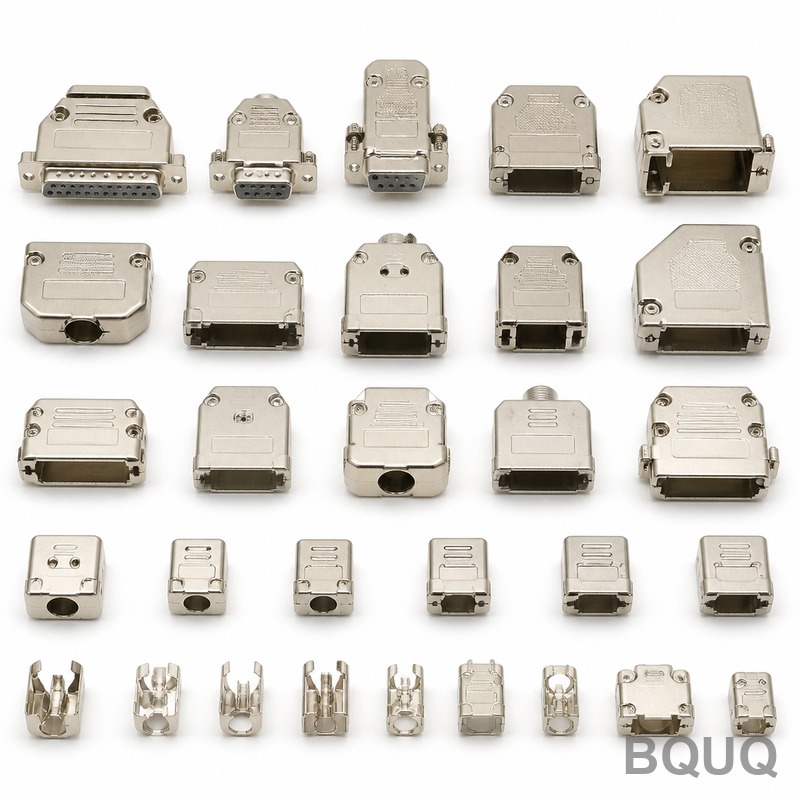
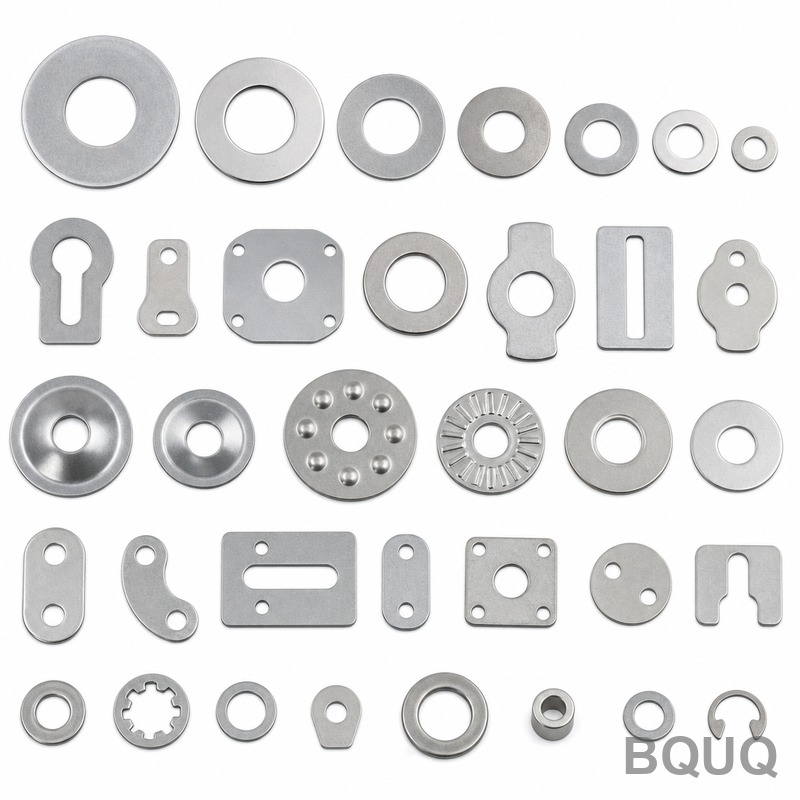
Tooling cost scales with die complexity, number of stations, and required precision. A single-station blanking die for a flat washer (diameter under 50 mm) costs USD 800 to USD 2,500. A compound die that performs blanking and piercing in one stroke costs USD 2,500 to USD 6,000. A progressive die with 5 to 15 stations (bending, forming, tapping, and cutoff) costs USD 8,000 to USD 25,000 for steel up to 2 mm thick. For high-tolerance automotive parts (tolerance below ±0.05 mm), tooling can exceed USD 50,000 because the die requires D2 or M2 tool steel, wire EDM finishing, and laser inspection. The die lifespan is also a price factor: carbide inserts for high-volume runs cost 30% more than standard tool steel but last 3 to 5 times longer.
What Is the Formula for Estimating Piece Price per Stamped Part?
The piece price follows this formula: (Material Weight x Material Cost per kg) + (Press Hours x Hourly Rate) + (Secondary Operations) + (Quality and Packaging). For example, a 0.8 mm thick stainless steel 304 bracket weighing 45 grams uses material costing USD 3.20 per kg, giving USD 0.144 in material. A 60-ton press runs at USD 45 per hour and produces 1,200 parts per hour, adding USD 0.038 per part for press time. Secondary operations like deburring or tapping add USD 0.01 to USD 0.10 each. Total piece price: USD 0.19 to USD 0.28 before MOQ amortization. For high-volume runs above 100,000 pieces, piece price can drop 20% due to reduced setup frequency and bulk material discounts.
How Does Minimum Order Quantity (MOQ) Affect Your Total Cost?
MOQ is not a penalty; it is the volume at which the factory recovers setup and material ordering costs. For a simple blanking die, MOQ of 1,000 pieces means setup time (2 hours at USD 30 per hour) adds USD 0.06 per part. For a progressive die with MOQ of 5,000 pieces, setup time of 6 hours adds USD 0.036 per part. If you order below MOQ, factories typically charge a "small quantity surcharge" of 15% to 30% on piece price to cover die changes and material waste. The optimal economic order quantity is usually 3 to 6 months of your projected consumption, balancing inventory holding cost against the per-unit amortization of tooling.
Which Factors Cause Metal Stamping Prices to Vary by More Than 50%?
Five variables create wide price swings between quotations: material grade, tolerance specification, press tonnage, surface finish, and annual volume. Material is the largest variable: cold-rolled steel (SPCC) costs USD 0.80 per kg, while phosphor bronze (C5210) costs USD 9.50 per kg, an 11x difference. Tolerance below ±0.05 mm requires slower press speeds (reducing output by 40%) and 100% inspection, adding USD 0.10 to USD 0.20 per part. Press tonnage matters because a 250-ton press costs USD 80 per hour versus USD 30 per hour for a 45-ton press; thicker or larger parts need more tonnage. Secondary finishes like nickel plating (USD 0.05 per dm²) or passivation for springs (USD 0.02 per piece) also add fixed costs.
Why Is the Total Cost Different for Springs and Heat Sinks Compared to Simple Brackets?
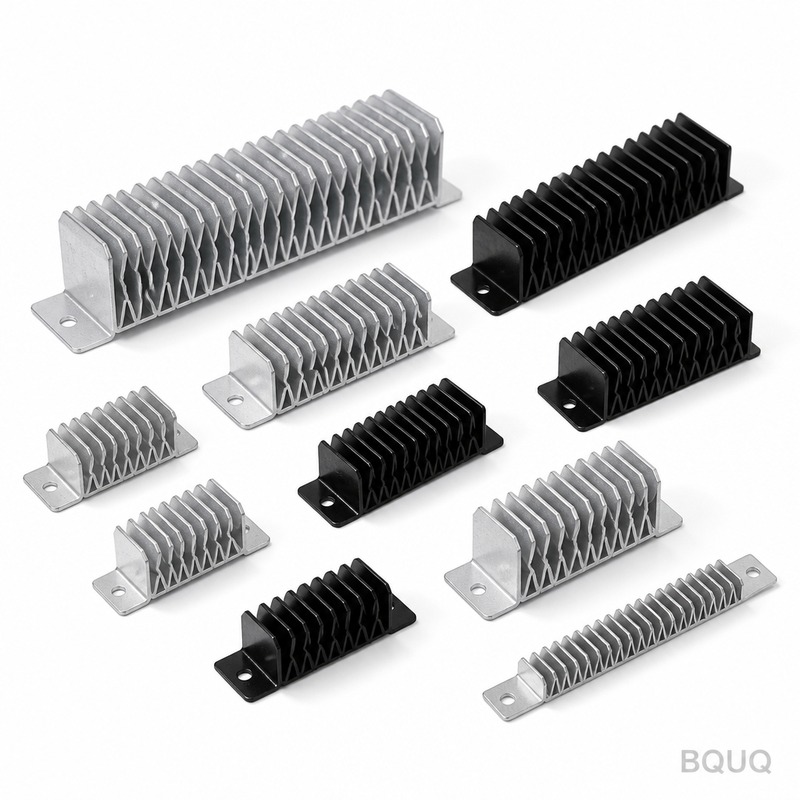
Springs and heat sinks require specialized stamping processes that change the pricing model. Compression springs made from music wire (SWP-B) are often stamped or coiled, with piece prices starting at USD 0.08 for a 10 mm spring but rising to USD 1.50 for a 50 mm spring with tight load tolerance (±5%). Heat sink stamping involves thicker aluminum (1.5 to 3.0 mm) and often requires a 200-ton press plus a separate degreasing and anodizing line, adding USD 0.30 to USD 0.80 per piece. In contrast, a simple steel bracket (0.5 mm SPCC) may cost only USD 0.05 per piece. Always request a separate quote for secondary operations like heat treatment (USD 0.15 per kg) or vibratory finishing (USD 0.01 per piece) because these are rarely included in the base stamping price.
How Can You Reduce Metal Stamping Costs Without Sacrificing Quality?
Engineering changes can cut total cost by 20% to 40% before you send a single RFQ. First, relax tolerances where functionally possible: changing from ±0.05 mm to ±0.1 mm allows a 15% faster press speed and eliminates 100% inspection. Second, specify standard material thickness (e.g., 0.8 mm, 1.2 mm, 2.0 mm) to avoid custom rolling fees. Third, design for progressive die compatibility: avoid sharp corners (use radius ≥ 0.3x material thickness) and keep hole sizes above 1.5x material thickness. Fourth, combine multiple parts into one strip layout to reduce material scrap from 40% to 15%. Finally, commit to an annual volume forecast; factories like BQUQ offer a 5% to 8% price reduction for a 12-month blanket order with fixed monthly releases.
What Is a Typical Price Breakdown Table for a Metal Stamping Project?
The table below shows a representative cost breakdown for a mid-complexity part (50 mm x 30 mm bracket, 1.2 mm SPCC steel) at different annual volumes. This illustrates how tooling amortization shifts the average unit cost.
| Cost Component | Volume 2,000 pcs | Volume 10,000 pcs | Volume 50,000 pcs |
| Tooling (one-time) | USD 3,200 | USD 3,200 | USD 3,200 |
| Tooling amortization per part | USD 1.60 | USD 0.32 | USD 0.064 |
| Material per part | USD 0.08 | USD 0.08 | USD 0.07 |
| Press and labor per part | USD 0.12 | USD 0.09 | USD 0.06 |
| Secondary operations per part | USD 0.05 | USD 0.04 | USD 0.03 |
| Total unit cost (first year) | USD 1.85 | USD 0.53 | USD 0.224 |
| MOQ requirement | 2,000 pcs | 5,000 pcs | 10,000 pcs |
FAQ: Metal Stamping Pricing Questions Answered
What Is the Minimum Order Quantity for Metal Stamping?
The MOQ depends on die type and part size, ranging from 500 pieces for a simple flat blank to 10,000 pieces for complex progressive die parts. BQUQ typically quotes MOQ of 2,000 for parts under 100 mm and 5,000 for larger or multi-operation parts. If your requirement is lower, we can supply at a 15% to 25% surcharge to cover setup and material minimums.
How Long Does It Take to Manufacture Metal Stamping Tooling?
Simple blanking dies take 2 to 3 weeks, compound dies take 3 to 4 weeks, and progressive dies take 5 to 8 weeks including design, machining, and tryout. Expedited tooling is available at a 20% cost premium if you need first articles in under 2 weeks. Tooling trials consume 1 to 2 days and are included in the tooling price.
Can Metal Stamping Achieve Tight Tolerances Like CNC Machining?
Yes, but with limits: standard stamping holds ±0.1 mm, while precision stamping with carbide dies and high-speed presses achieves ±0.03 mm. This is comparable to CNC machining for thin parts, but stamping cannot hold tight tolerances on features deeper than 3x material thickness. For tolerances below ±0.03 mm, we recommend a hybrid approach: stamp the blank then machine critical features.
Why Do Some Metal Stamping Quotes Include a Material Surcharge?
Metal prices fluctuate daily, especially for copper, nickel, and stainless steel. Factories add a surcharge clause that adjusts the material line item monthly based on the London Metal Exchange (LME) index. This protects both parties; for example, if LME copper rises 5% in a month, your piece price adjusts by approximately 2% to 3% depending on material content. Always ask for the surcharge formula in writing.
Which Surface Finishes Are Available After Metal Stamping?
Common finishes include zinc plating (USD 0.03 per dm²), nickel plating (USD 0.05 per dm²), powder coating (USD 0.10 per dm²), and anodizing for aluminum (USD 0.08 per dm²). Passivation for stainless steel springs costs USD 0.02 per piece. These finishes add corrosion resistance but also add 2 to 3 days to lead time.
How Do I Get an Accurate Quote Without a Full Drawing?
Send a sketch, sample part, or STEP/IGES file; our engineers will reverse-engineer dimensions and suggest material grades. For a rough estimate, provide the outer dimensions, thickness, material, and annual volume. A preliminary quote can be issued within 24 hours, but a firm price requires a formal drawing with tolerances and surface finish callouts.
Can Small Quantities Be Stamped Economically?
For quantities below 1,000 pieces, metal stamping is rarely economical compared to laser cutting or CNC machining. The breakeven point is typically 500 to 1,000 pieces per year, where stamping tooling amortization becomes cheaper than per-part laser cutting costs. If your volume is below this threshold, we recommend laser cutting with a secondary bending operation.
Conclusion: Getting a Reliable Metal Stamping Price Estimate
The most accurate estimate combines the three factors outlined above: tooling (USD 800 to USD 50,000), piece price (USD 0.05 to USD 2.00), and MOQ (500 to 10,000 pieces). Use the formula and table in this article to create a preliminary budget, then engage a factory with engineering support to review your design for cost reduction. At BQUQ, we provide detailed breakdowns of tooling, material, and processing costs so you can see exactly where your money goes, with no hidden charges. For a precise quotation within 12 hours, send your drawing to our engineering team.
Email: sc@bquq.com
WhatsApp: +86 13713157787
www.bquq.com