How to Estimate Spring Cost: Wire, Tooling and Quantity Factors
Estimating spring cost accurately requires breaking the price into three core components: raw wire material, amortized tooling or setup fees, and per-piece processing costs that scale with quantity. As a rule of thumb, wire accounts for 20-40% of the total unit price, tooling is a fixed upfront cost from $300 to $5,000 depending on complexity, and quantity drives the per-piece price down through economies of scale. For a precise estimate, you must calculate wire volume, select the correct material grade, and apply a quantity-based pricing tier that reflects setup amortization.
What Are the Primary Cost Drivers in a Spring Price Quote?
The three dominant cost drivers are wire material cost, tooling or setup cost, and production quantity. Wire material is calculated by weight: spring steel wire averages $2.50 to $8.00 per kilogram for common grades like music wire (ASTM A228) or chrome silicon (ASTM A401), while stainless steel 302 costs $6.00 to $12.00 per kilogram. Tooling for a compression spring includes a coiling mandrel, feed rollers, and cutoff dies, typically ranging from $350 for simple compression springs to $4,800 for complex torsion springs with multiple bends. Quantity directly influences unit price because setup time (usually 30-90 minutes per run) is amortized across the batch; a 100-piece order may carry a $1.50 per-piece setup burden, while a 50,000-piece order reduces that to $0.03 per piece.
How Does Wire Diameter and Material Grade Affect the Unit Price?
Wire diameter determines the cross-sectional area and thus the material volume per spring, which scales linearly with weight and cost. For example, a 0.5 mm music wire spring weighing 0.2 grams costs approximately $0.0015 in raw material, while a 5.0 mm chrome silicon spring weighing 80 grams costs $0.48 in raw material. Material grade also sets the base price per kilogram: hard-drawn steel (ASTM A227) is cheapest at $2.50/kg, oil-tempered (ASTM A229) is $3.20/kg, music wire is $4.50/kg, and stainless steel 316 is $9.80/kg. Higher-grade materials like Inconel X-750 for high-temperature applications (up to 650°C) can reach $85.00/kg, which can dominate the total cost for specialty springs.
How Is Wire Length and Weight Calculated for a Spring Blank?
The wire length is the product of the mean coil diameter, the total number of active coils plus dead coils, and pi (π), then adjusted for end configurations. For a compression spring with mean diameter D (in mm), active coils Na, and two dead coils, the blank length L = π × D × (Na + 2). The weight is then L × (wire cross-sectional area) × (material density). For example, a compression spring with a 10 mm mean diameter, 8 active coils, and 1.0 mm wire: L = 3.1416 × 10 × 10 = 314.16 mm, cross-section = 0.785 mm², volume = 246.6 mm³, and steel density of 7.85 g/cm³ gives 1.94 grams. At $4.50/kg for music wire, the material cost is $0.0087 per spring before any processing.
How Much Does Tooling Cost for Different Spring Types?
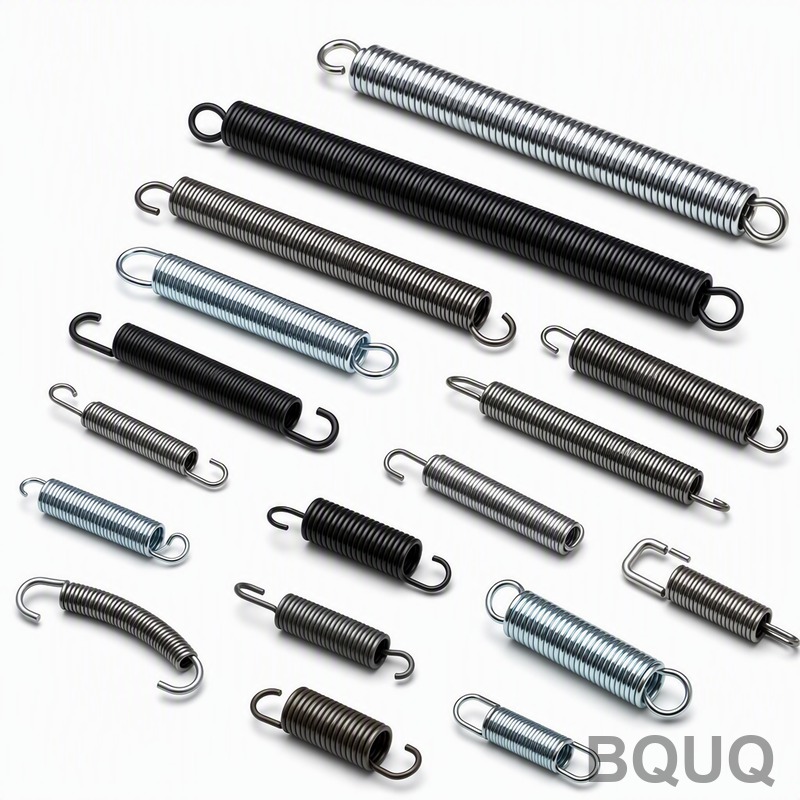
Tooling cost varies significantly by spring geometry and production method. CNC coiling machines use a single set of programmable guides, so tooling for a new compression spring typically costs $350 to $800, covering a mandrel and feed system. Torsion springs with legs or hooks require additional bending fixtures, raising tooling to $1,200 to $2,800. Custom extension springs with loops or reduced ends need secondary forming tooling, costing $800 to $2,500. For high-volume production using cam-driven coiling machines, hard tooling costs $2,500 to $5,000 but yields a lower per-piece rate above 100,000 units. Precision springs requiring grinding of flat ends add a grinding fixture cost of $400 to $900, which is a one-time charge.
Which Quantity Breaks Even on Tooling Amortization?
The break-even quantity is where the amortized tooling cost per piece equals the savings from reduced per-piece processing. If tooling costs $1,500 and the per-piece processing difference between a small batch and a large batch is $0.15, the break-even is 10,000 pieces. For a typical compression spring, a 1,000-piece order has a tooling burden of $1.50 per piece, while a 50,000-piece order has a burden of $0.03 per piece. The table below shows representative pricing tiers for a standard compression spring (10 mm OD, 1.0 mm music wire, 20 mm free length):
| Quantity | Tooling Amortization per Piece | Wire Cost per Piece | Processing per Piece | Total Unit Price |
| 500 | $3.00 | $0.009 | $0.80 | $3.81 |
| 1,000 | $1.50 | $0.009 | $0.45 | $1.96 |
| 5,000 | $0.30 | $0.009 | $0.28 | $0.59 |
| 10,000 | $0.15 | $0.009 | $0.22 | $0.38 |
| 50,000 | $0.03 | $0.009 | $0.18 | $0.22 |
How Does Heat Treatment and Surface Finishing Add to Cost?
Heat treatment is mandatory for hardened wire grades after coiling to relieve internal stress and set the spring rate. For oil-tempered and chrome silicon springs, a tempering cycle at 300-450°C for 20-40 minutes costs $0.02 to $0.10 per piece in a batch furnace. Surface finishing options include zinc plating ($0.05-$0.15 per kg of springs), powder coating ($0.20-$0.50 per piece), and shot peening ($0.10-$0.30 per piece) which improves fatigue life by 20-50%. For springs requiring passivation (stainless steel), the cost adds $0.03-$0.08 per piece. These secondary processes can add 10-35% to the base unit price, so include them in the estimate before finalizing the quote.
Why Do Minimum Order Quantities (MOQs) Influence Per-Unit Cost?
MOQs exist because setup time, inspection, and first-article validation cost roughly $150-$250 per run regardless of order size. A low MOQ of 200 pieces forces the supplier to spread this fixed cost over fewer units, resulting in a unit price that is 5-10 times higher than a 10,000-piece order. For example, a simple compression spring with a $200 setup cost yields a $1.00 per-piece setup charge at 200 units but only $0.02 at 10,000 units. Additionally, small batches often require manual feed on CNC machines, increasing cycle time from 2 seconds per piece to 15 seconds per piece, further raising processing costs. For the lowest unit price, consolidate your annual demand into one or two larger releases rather than multiple small orders.
What Is the Most Accurate Method for a Quick Cost Estimate?
The most accurate quick method is a four-step calculation: first, compute wire weight using the formula Weight = π × D × (Na + 2) × (d² × π / 4) × density; second, multiply weight by the material price per kilogram; third, add processing cost based on spring complexity (simple compression: $0.15-$0.50 per piece, torsion: $0.40-$1.20 per piece); fourth, add tooling amortization by dividing the tooling quote by the expected quantity. Then apply a 10-20% margin for secondary operations like grinding or plating. This method provides an estimate within ±15% of a formal quote, which is sufficient for budgeting or comparing supplier bids.
FAQ
How Accurate Is a Wire-Based Cost Estimate Compared to a Formal Quote?
A wire-based estimate is typically within 10-20% of a formal quote when you include tooling amortization and secondary processing. The variance comes from machine cycle time differences, scrap rates (usually 2-5%), and inspection requirements. For engineering budgeting, use the wire cost multiplied by a factor of 4 to 6 for simple springs and 8 to 12 for complex torsion springs.
Can I Reduce Spring Cost by Changing the Material Grade?
Yes, switching from stainless steel 302 to music wire can reduce material cost by 40-60%, but only if the application does not require corrosion resistance. Music wire has a tensile strength of 2,300-2,600 MPa and operates up to 120°C, whereas stainless 302 is suitable for corrosive environments but costs nearly double. Always verify the operating temperature and environmental exposure before downgrading material.
What Is the Typical Lead Time for Custom Spring Tooling?
Simple compression spring tooling takes 3-5 business days, while torsion or extension spring tooling with custom forms takes 7-12 business days. CNC tooling is faster because it uses programmable guides rather than hard dies. If you are in a rush, many suppliers can produce first articles using existing tooling with minor adjustments within 48 hours.
How Much Does Spring Prototyping Cost Without Full Tooling?
Prototyping on a CNC coiling machine without dedicated tooling costs $80 to $250 per prototype, including setup and material. This is viable for quantities under 50 pieces, as the machine can be programmed directly from your dimensions. For production quantities, the prototype cost is typically credited toward the final tooling charge.
Do Spring Price Quotes Include Heat Treatment and Plating?
Most quotes include standard heat treatment for hardened wire but exclude plating or coating unless specified. Zinc plating adds $0.05-$0.15 per piece, and powder coating adds $0.20-$0.50 per piece. Always request a split quote showing base material, processing, and finishing costs separately to compare suppliers fairly.
When Does the Per-Unit Price Stop Decreasing with Quantity?
The per-unit price typically reaches its floor at 50,000 to 100,000 pieces for compression springs, where processing cost approaches the raw wire cost plus a fixed machine rate of $0.10-$0.15 per piece. Beyond 100,000 pieces, savings are minimal because tooling amortization is already near zero and material cost is fixed. At that point, negotiate on payment terms or lead time instead of further price reduction.
How Do I Get an Accurate Spring Cost Estimate for My Specific Design?
Send your spring drawing or specifications (wire diameter, outer diameter, free length, active coils, material, and quantity) to a manufacturer with CNC coiling capability. A qualified supplier will provide a detailed breakdown of wire cost, tooling, processing, and finishing within 24-48 hours. Include the operating temperature and load requirements to ensure the correct material grade is selected.
For a reliable spring cost estimate, always calculate wire weight first, then add tooling amortization and quantity-based processing fees. BQUQ provides detailed cost breakdowns for custom springs, metal stampings, and CNC machined parts with a 12-hour quoting service. Contact us at sc@bquq.com, WhatsApp +86 13713157787, or visit www.bquq.com for a precise quote on your spring design.