How to Order Custom Springs: The 7 Critical Specifications You Must Provide
Ordering custom springs without complete specifications is the fastest way to incur rework costs, missed deadlines, and functional failures. To get an accurate quote and a spring that meets your exact load and fatigue requirements, you must provide material, wire diameter, outer diameter, free length, number of active coils, spring rate, and end finish type. At a minimum, you also need to state your operating environment, maximum deflection, and required tolerance grade, as these dictate manufacturing feasibility and pricing.
Material Selection and Its Impact on Cost and Performance
The material you choose determines the spring's maximum operating temperature, corrosion resistance, and fatigue life. For standard compression springs, music wire (ASTM A228) is the default choice, offering tensile strength up to 2,300 MPa and a maximum working temperature of 120°C. For higher temperatures or corrosive environments, you must specify stainless steel (302/316) or Inconel X-750, which handles up to 650°C but costs 4 to 6 times more per kilogram.
When you order, provide the material grade and any required certifications (e.g., EN 10270-1, ASTM A313). If you skip this, BQUQ will default to oil-tempered chrome silicon wire, which offers good fatigue resistance but may not suit chemical exposure. The price difference is significant: music wire costs approximately 8 to 12 USD per kilogram, while Inconel X-750 costs 55 to 75 USD per kilogram. For a 10,000-piece order of 2 mm wire springs, this material choice alone changes your unit cost from 0.15 USD to 0.68 USD.
Critical Dimensions: Wire Diameter, Outer Diameter, and Free Length
Precision springs require three fundamental dimensions: wire diameter (d), outer diameter (OD), and free length (L0). You must provide these in millimeters with explicit tolerances. Standard manufacturing tolerances for wire diameter are ±0.01 mm for wire under 3 mm, and ±0.02 mm for wire from 3 to 6 mm. Outer diameter tolerance typically runs ±0.15 mm for springs under 20 mm OD, but tightens to ±0.05 mm if you specify a precision grade.
Free length tolerance is more complex, as it depends on the number of coils. For springs with 3 to 10 active coils, free length tolerance is ±1.0% or ±0.3 mm, whichever is greater. If you need tighter control, you can request a load-tolerance specification instead of a free-length specification. BQUQ uses CNC coiling machines that hold wire diameter consistency within ±0.005 mm across a production run, but your tolerance callout directly affects the reject rate and price.
| Specification Parameter | Standard Tolerance | Precision Tolerance | Impact on Unit Price |
| Wire Diameter (d) | ±0.01 mm | ±0.005 mm | +8% to 15% |
| Outer Diameter (OD) | ±0.15 mm | ±0.05 mm | +10% to 20% |
| Free Length (L0) | ±1.0% or ±0.3 mm | ±0.5% or ±0.1 mm | +15% to 25% |
| Spring Rate (k) | ±5% | ±2% | +20% to 30% |
| Total Coils (Nt) | ±1/4 coil | ±1/8 coil | +5% to 10% |
Spring Rate and Load Requirements
Spring rate (k) is the force required to compress the spring by one millimeter, expressed in N/mm. You must specify either the spring rate or the load at a specific height, but providing both is ideal for verification. For example, if you need 50 N at 20 mm compressed height and 100 N at 30 mm, that defines a rate of 5 N/mm. BQUQ can manufacture springs with rates from 0.1 N/mm (fine wire, large diameter) up to 500 N/mm (heavy wire, small diameter).
When providing load requirements, state the operating height (L1, L2) and the corresponding force (F1, F2). The manufacturing tolerance for spring rate is typically ±5% for commercial grade and ±2% for precision grade. If you request a load tolerance at a specific height, we test each spring on a digital force tester with accuracy of ±0.5% of reading. Remember that the maximum allowable deflection should not exceed 85% of the spring's solid height, or you risk coil binding and premature failure.
End Finish Type and Number of Active Coils
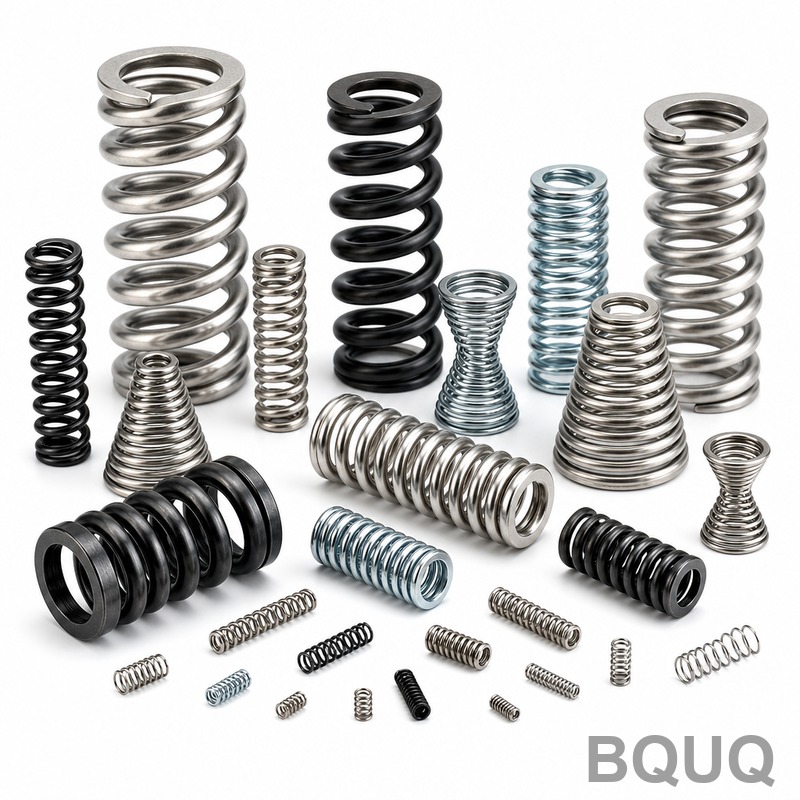
The end configuration significantly affects the spring's effective length and stability. You must choose from four standard end finishes: closed and ground, closed not ground, open, or open and ground. For compression springs, closed and ground ends are the most common because they provide a flat seating surface and reduce buckling. This finish requires grinding both end coils, which adds a secondary operation and increases unit cost by 10% to 15% compared to closed not ground.
Number of active coils (Na) determines the spring rate, and total coils (Nt) includes the inactive end coils. For closed and ground ends, total coils equals active coils plus 2. If you provide only total coils and wire diameter, BQUQ will calculate active coils, but this introduces potential error. Always specify active coils directly if you have a calculated spring rate. The solid height (Ls) equals Nt multiplied by wire diameter; for a spring with 8 total coils and 2 mm wire, solid height is 16 mm. Ensure your application allows for this compressed dimension.
Operating Environment and Fatigue Life Requirements
Your spring's service life depends on operating temperature, cyclic loading frequency, and exposure to chemicals. Provide the maximum operating temperature, minimum temperature, and any contact with oils, fuels, or acids. For temperatures above 150°C, music wire loses its tensile strength rapidly; use chrome silicon (up to 250°C) or stainless steel 302 (up to 300°C). For cyclic applications exceeding 10 million cycles, specify a shot-peened finish and a reduced design stress of 30% of the material's tensile strength.
Fatigue life is directly tied to stress range. If you expect infinite life, the stress amplitude must stay below the endurance limit, typically 350 MPa for music wire. BQUQ recommends providing the maximum and minimum operating loads so our engineers can calculate the stress ratio and recommend the appropriate material and surface treatment. For high-cycle applications, we apply a residual compressive stress via shot peening, which increases fatigue life by 30% to 50% at a cost increase of 5% to 8% per piece.
Dimensional Tolerances and Quality Inspection Standards
You must specify the inspection standard, as this determines the QC process and cost. BQUQ follows ISO 9001 and can comply with IATF 16949 for automotive parts. For precision springs, we perform 100% dimensional inspection of OD, free length, and load at specified heights. Standard sampling per AQL 2.5 applies to commercial grades, but you can request 100% inspection for critical safety applications, which increases price by 15% to 20%.
Define your acceptance criteria for surface defects: cracks, seams, and scratches. For springs with wire diameter below 1 mm, surface defects deeper than 1% of wire diameter are rejectable per ASTM A125. Also specify whether you require a certificate of conformance, material test reports, or full dimensional data per batch. A typical lead time for custom springs at BQUQ is 7 to 12 days for prototypes (up to 500 pieces) and 15 to 20 days for production quantities (5,000 to 100,000 pieces). Tooling costs are zero for standard wire diameters, but custom wire drawing adds 300 to 800 USD in setup fees.
FAQ: Common Specification Mistakes and How to Avoid Them
What happens if I only provide free length and wire diameter? BQUQ will estimate the spring rate based on assumed coils, but you may receive a spring with 20% variation in load. Always calculate or specify the spring rate.
Should I specify OD or ID? Provide OD for compression springs and ID for extension springs, as the seating surface determines which dimension is critical. If you provide both, ensure they are consistent with the wire diameter.
Can I order springs without knowing the material? Technically yes, but BQUQ will default to oil-tempered wire. This may fail in high-temperature or corrosive applications, resulting in field failures and warranty claims. The cost of specifying material correctly is zero.
What is the minimum order quantity for custom springs? BQUQ accepts orders from 10 pieces for prototypes, but unit pricing drops significantly at 1,000 pieces. A 100-piece order may cost 1.50 USD per unit, while a 10,000-piece order drops to 0.35 USD per unit for the same spring.
How do I measure spring rate at home? Use a force gauge and a caliper. Compress the spring in 2 mm increments and record force. The slope of the force-displacement curve is the spring rate. Verify this matches your specification within ±5%.
Conclusion: Streamline Your Custom Spring Order with Complete Data
Providing complete spring specifications eliminates guesswork, reduces lead times, and ensures your component performs exactly as designed. The seven critical parameters are material, wire diameter, outer diameter, free length, spring rate, active coils, and end finish, plus your operating environment and fatigue requirements. When you include tolerance grades and inspection standards, BQUQ can deliver precision springs in as little as 7 days for prototypes and 15 days for production runs, with zero tooling costs for standard wire sizes.
To get an accurate quotation within 12 hours, send your drawings or a specification list to our engineering team. Include your application details, load requirements, and target quantity. BQUQ's 20 years of CNC machining and spring manufacturing experience ensures your custom springs meet ISO and ASTM standards at competitive pricing.
Email: sc@bquq.com WhatsApp: +86 13713157787 www.bquq.com
Related Articles
- Smart Spring Inventory Management Strategies for OEMs
- Size control and online intelligent detection technology of precision spring
- In-depth analysis of technology and process in the hardware spring industry in 2026: a full-dimensional interpretation of high stress, functional integration and engineering certification