How to Order Custom Springs: What Specifications You Must Provide
To order custom springs correctly, you must provide at least eight critical specifications: wire diameter, outer diameter, free length, number of active coils, total coils, material grade, end type, and required load at a defined deflection. Missing any of these parameters forces the manufacturer to make assumptions, which leads to dimensional mismatches, premature fatigue failure, or spring rates that do not fit your assembly. Below is the complete engineering checklist, with real tolerances and data, to ensure your RFQ (request for quotation) is manufacturable on the first attempt.
What Are the Mandatory Dimensions for a Custom Spring RFQ?
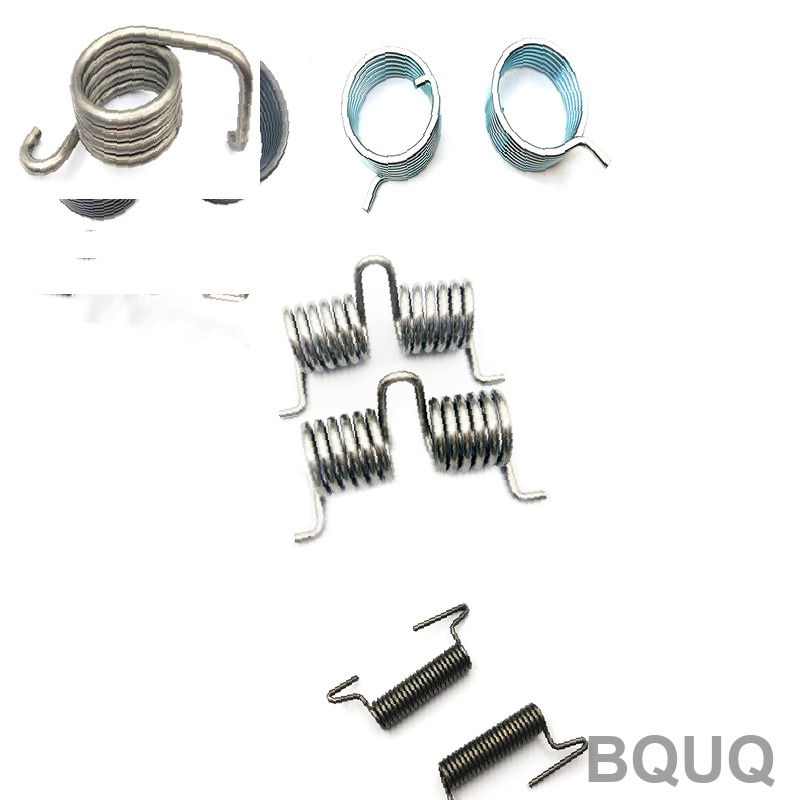
Every spring drawing or specification sheet must include five geometric dimensions: wire diameter (d), outer diameter (OD) or inner diameter (ID), free length (Lf), number of active coils (Na), and total coils (Nt). For a compression spring, also specify solid height (Hs) and pitch (p) if the spring will be fully compressed in service. For extension springs, provide the inside hook length and the distance between hook centers. For torsion springs, give the leg length, leg angle, and the direction of wind (left-hand or right-hand). These dimensions directly determine the spring rate (k), which is calculated as k = (G × d⁴) / (8 × D³ × Na), where G is the shear modulus of the material (e.g., 79.3 GPa for music wire ASTM A228). If you omit the wire diameter, the spring rate calculation is impossible, and the manufacturer cannot quote a price.
How Do You Specify Load and Deflection Requirements Correctly?
You must state the load at a specific working height, not just a maximum load. For example, write "Load = 45 N at 20 mm compressed length" rather than "must hold 45 N." This is because spring rate is linear only within the elastic range, and the manufacturer needs a reference point to set the free length and coil count. Provide at least two load points if possible: load at preload height (L1) and load at maximum working height (L2). The tolerance on load is typically ±10% for standard commercial springs and ±5% for precision springs, per ISO 10243 and DIN 2095 standards. Also indicate the maximum deflection allowed before coil binding—typically 85% of maximum travel for compression springs to prevent stress peaking. For dynamic applications (cycling above 10,000 cycles), specify the fatigue life requirement, for example, "10⁷ cycles at 20% to 80% deflection range," because this changes the material selection and surface treatment.
Which Material Grades Are Suitable for Your Operating Environment?
Material selection depends on temperature, corrosion resistance, and electrical conductivity. For temperatures up to 120°C, use music wire (ASTM A228) or oil-tempered wire (ASTM A229), which offer tensile strengths from 2000 to 2300 MPa for 1.0 mm wire. For temperatures up to 250°C, use chrome silicon (ASTM A401), which retains 90% of its room-temperature strength at 200°C. For corrosive environments or food contact, use stainless steel 302 (ASTM A313) for general use, or 316 stainless for chloride exposure, though 316 has about 20% lower tensile strength than 302. For high-temperature applications above 300°C, use Inconel X-750 or Nimonic 90, which maintain useful strength up to 550°C but cost 8 to 12 times more than music wire. Also specify the surface finish: shot peening (typically 0.3 to 0.5 mm Almen intensity) increases fatigue life by 20% to 30%, and electroplating (zinc or nickel) is required for carbon steel in humid environments.
How Do You Define End Types and Their Effect on Performance?
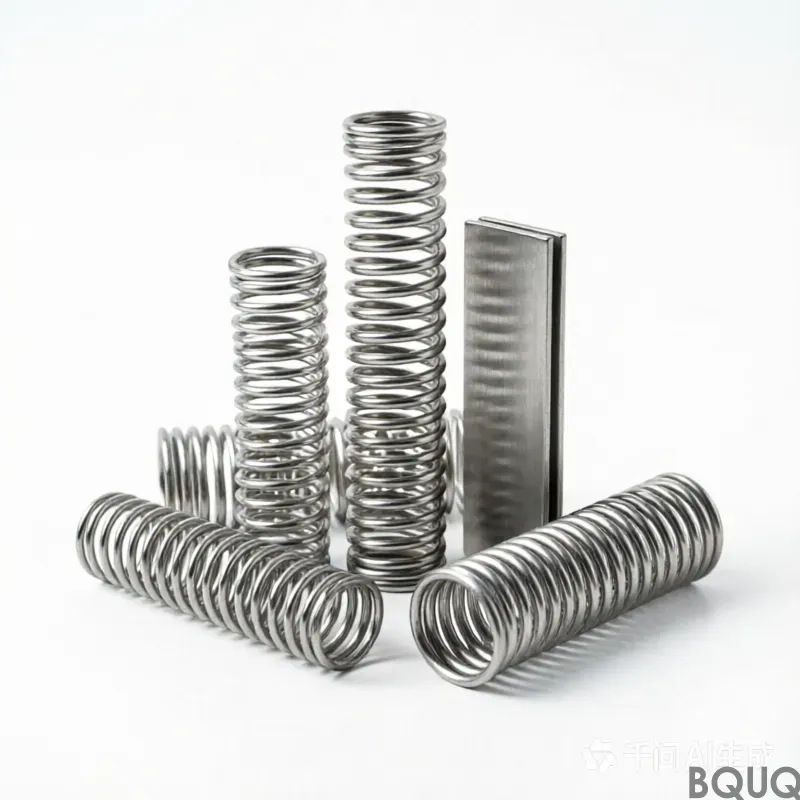
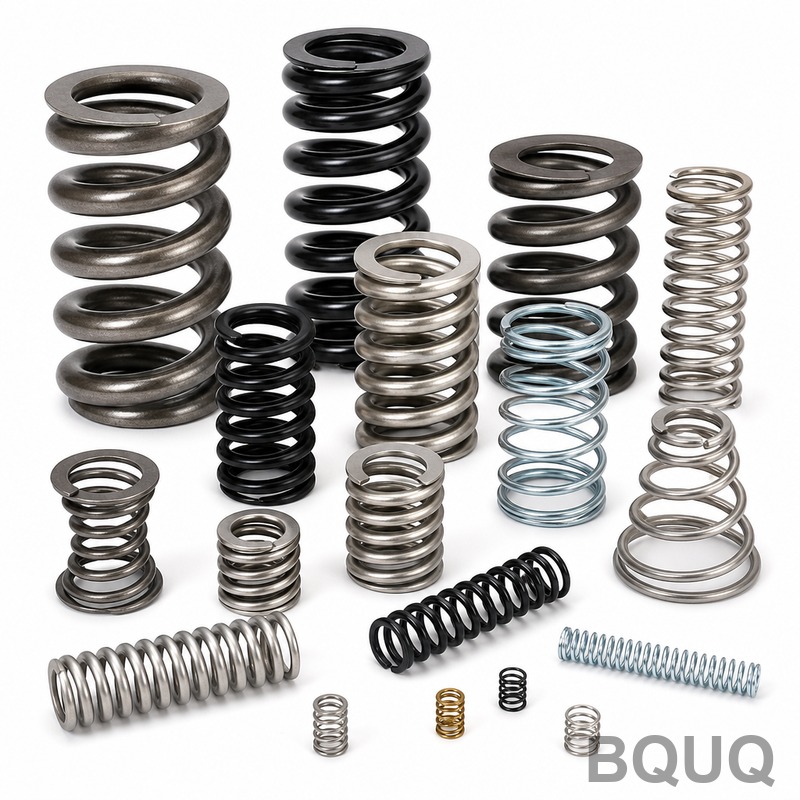
Compression springs have four standard end types: closed and ground, closed and not ground, open, and open and ground. Closed and ground ends are mandatory when the spring must stand square, with a flatness tolerance of 1° to 2° between the end plane and the spring axis. This end type adds about two inactive coils, so the total coil count is Nt = Na + 2. Closed and not ground ends are acceptable for light-duty springs but reduce the effective free length by about one coil diameter. Open ends are only for very light loads and are rarely used in precision assemblies. For extension springs, specify the hook style: full hook, side hook, or cross-over hook, and state the hook bend radius to avoid stress concentration. For torsion springs, define whether the ends are straight torsion legs, hinged, or with loops. Incorrect end type selection changes the solid height and can cause buckling: for a compression spring with free length to mean diameter ratio (Lf/D) greater than 4, the spring will buckle sideways unless guided, so specify an internal rod or external sleeve if your design exceeds this ratio.
What Tolerances Should You Specify for Spring Dimensions and Rates?
Standard commercial tolerances for custom springs follow DIN 2095 for cold-coiled springs and DIN 2096 for hot-coiled springs. For wire diameter up to 3.0 mm, the tolerance is ±0.03 mm; for 3.0 to 6.0 mm, it is ±0.05 mm. Free length tolerance is ±1.5% or ±0.5 mm, whichever is greater, for commercial grade. Outer diameter tolerance is ±1% for springs with D/d ratio above 4, and ±1.5% for lower ratios. Spring rate tolerance is ±5% for precision springs and ±10% for commercial springs. If your application requires tighter control, specify "precision grade" and expect a 15% to 25% price increase. The table below shows typical achievable tolerances for a 2.0 mm wire compression spring with 30 mm OD and 80 mm free length.
| Parameter | Commercial Tolerance | Precision Tolerance | Unit |
| Wire diameter | ±0.03 | ±0.01 | mm |
| Outer diameter | ±0.30 | ±0.10 | mm |
| Free length | ±1.20 | ±0.40 | mm |
| Spring rate | ±10% | ±5% | % |
| Load at 60 mm | ±10% | ±3% | % |
| Solid height | ±0.50 | ±0.20 | mm |
| Total coils | ±0.25 | ±0.10 | coils |
When Do You Need to Provide a 2D Drawing versus a 3D Model?
For any spring with more than two critical dimensions, you must provide a 2D engineering drawing with GD&T callouts, because a 3D model does not convey tolerances, surface texture, or edge conditions. A STEP or IGES file is useful for checking assembly interference, but the manufacturing floor works from the 2D print. If you have no drawing, provide a sample spring and the manufacturer will reverse-engineer it within 24 hours, including measuring wire diameter with a laser micrometer, free length with a height gauge, and spring rate with a compression tester. For prototype orders, a 3D model alone is acceptable if you also state the load and deflection requirements in the RFQ text. However, for production orders above 1,000 pieces, a signed 2D drawing is mandatory to avoid disputes over acceptance criteria. BQUQ accepts PDF, DWG, and DXF formats, and our engineering team will flag any missing dimension within 4 hours of receiving your RFQ.
How Much Lead Time and Cost Should You Expect for Custom Springs?
Standard lead time for custom springs is 5 to 7 working days for prototypes (1 to 100 pieces) and 15 to 20 working days for production runs (1,000 to 100,000 pieces), depending on wire diameter and material availability. Tooling cost is zero for most cold-coiled springs because the CNC coiling machine is numerically programmed, not die-based. However, if you need hot-coiled springs above 12 mm wire diameter, expect tooling charges of USD 300 to USD 800 for mandrel fabrication. Unit prices are highly volume-dependent: a 2.0 mm music wire compression spring costs approximately USD 0.35 per piece for 500 pieces, USD 0.18 per piece for 5,000 pieces, and USD 0.09 per piece for 50,000 pieces. Stainless steel 302 springs cost 40% more, and Inconel springs cost 800% more. Surface treatments add USD 0.02 to 0.05 per piece for zinc plating and USD 0.05 to 0.10 per piece for shot peening. For fastest quoting, send your RFQ before 3 PM China Standard Time, and you will receive a formal quotation with full dimensional and load verification within 12 hours.
FAQ
What Happens If I Only Provide Free Length and Wire Diameter?
The manufacturer will assume a standard spring index (D/d) of 6 to 8 and a closed and ground end type, which may not fit your assembly. You will receive a functional spring, but the load at your working height could deviate by up to 30%, risking premature failure or improper function. Always provide at least the load at a specific height to lock the spring rate.
Can You Manufacture Springs with Non-Circular Wire Cross-Sections?
Yes, we can produce rectangular wire springs, which are used for high-force, low-solid-height applications. You must specify the width and thickness of the wire, the edge radius (typically 0.1 to 0.3 mm), and the ratio of width to thickness, which should be between 1.5 and 3.0 to prevent twisting during coiling.
Do You Provide Certificates of Conformance or Material Certificates?
Yes, we provide a Material Test Certificate (EN 10204 3.1) for every production batch, including chemical composition and tensile strength values. For medical or automotive applications, we also provide PPAP Level 3 documentation and first article inspection reports with CMM measurements, at no extra cost for orders above 5,000 pieces.
What Is the Maximum Wire Diameter You Can Coil?
Our CNC coiling machines handle wire diameters from 0.1 mm to 20 mm for cold-coiled springs and up to 60 mm for hot-coiled springs. For wire above 20 mm, the spring is heated to 900°C and coiled on a mandrel, then quenched and tempered to achieve the required hardness of 44 to 52 HRC.
How Do You Ensure Spring Ends Are Ground Square?
We use double-disc grinding machines that grind both ends simultaneously, achieving a squareness tolerance of 0.5° and a flatness of 0.05 mm on the end planes. This process is verified with an optical comparator and a surface plate check for every lot of precision springs.
Can You Match the Spring Rate of an Existing Competitor Spring?
Yes, send us the physical sample or its dimensions, and we will reverse-engineer the spring rate within 24 hours. We will measure the wire diameter, OD, free length, and coil count, then calculate the material modulus based on the surface finish. We guarantee the replacement spring will match the original load within ±5% at your specified working height.
What Is the Minimum Order Quantity for Custom Springs?
The minimum order quantity is 1 piece for prototypes, but the unit price will be higher due to setup time of approximately 30 minutes per machine. For economic production pricing, order at least 1,000 pieces; below this quantity, the setup cost dominates the unit price. We do not charge any tooling or engineering fees for standard cold-coiled springs.
For a fast and accurate quotation on your custom spring, send your 2D drawing, 3D model, or sample with your load and deflection requirements to our engineering team. We provide a formal quotation with full dimensional verification within 12 hours, and production lead times start from 5 working days for prototypes. Contact us at sc@bquq.com or WhatsApp +86 13713157787, or visit www.bquq.com for more information.
Related Articles
- Lightweight Design and Material Upgrade of New Energy and Automobile Chassis Spring
- In-depth analysis of technology and process in the hardware spring industry in 2026: a full-dimensional interpretation of high stress, functional integration and engineering certification
- From "standard parts" to "functional parts": 2026 hardware spring industry technology trends and functional innovation engineering direction