LED Heat Sink Design: Why Thermal Management Determines LED Lifespan and Performance
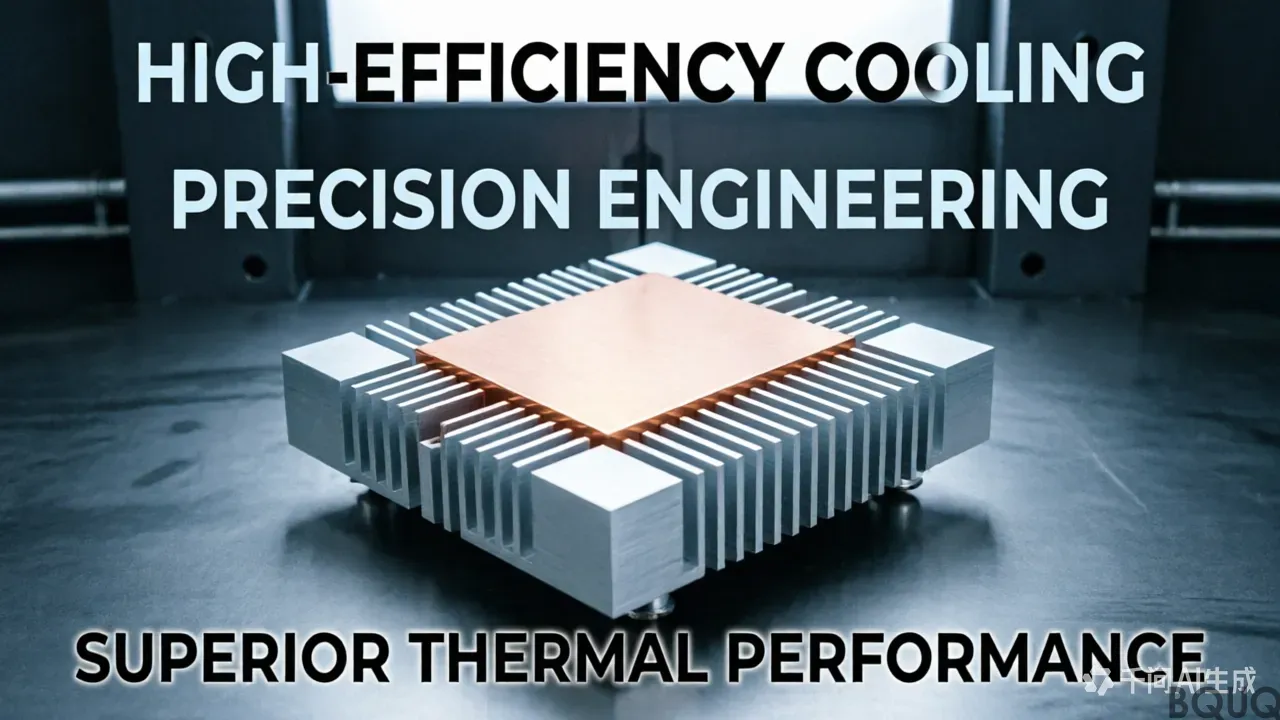
An LED's junction temperature is the single most critical factor determining its operational lifespan and light output. Without a properly engineered heat sink, a 1W LED can exceed its maximum rated junction temperature of 120°C within minutes, resulting in permanent lumen depreciation and catastrophic color shift. Effective thermal management, specifically through correctly sized and manufactured heat sinks, maintains junction temperatures below 85°C, enabling an LED to achieve its rated 50,000 to 100,000-hour lifespan.
The Physics of LED Heat Generation and Failure
LEDs convert approximately 20-30% of electrical energy into visible light, with the remaining 70-80% dissipated as heat. This heat is generated at the PN junction, a microscopic area smaller than 1mm². For a typical 3W Cree XHP50 LED, the thermal resistance from junction to solder point (Rθj-sp) is 1.5°C/W. If the total thermal path resistance (junction to ambient) exceeds 10°C/W, the junction temperature rises 30°C above ambient under continuous operation.
The Arrhenius equation governs degradation: for every 10°C increase in junction temperature above 85°C, the LED's useful lifespan is halved. A Cree XLamp XP-G3 rated at 50,000 hours (L70) at 85°C junction temperature will only achieve 12,500 hours at 105°C. This exponential relationship means thermal management is not optional but a mathematical requirement for any commercial lighting product.
Material Selection: Aluminum Alloys vs. Copper
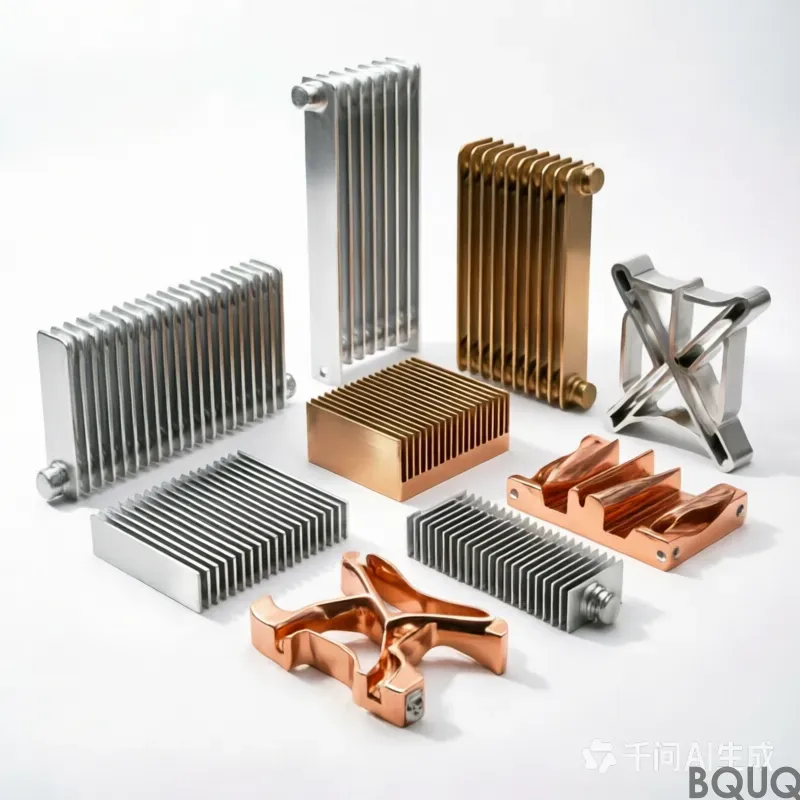
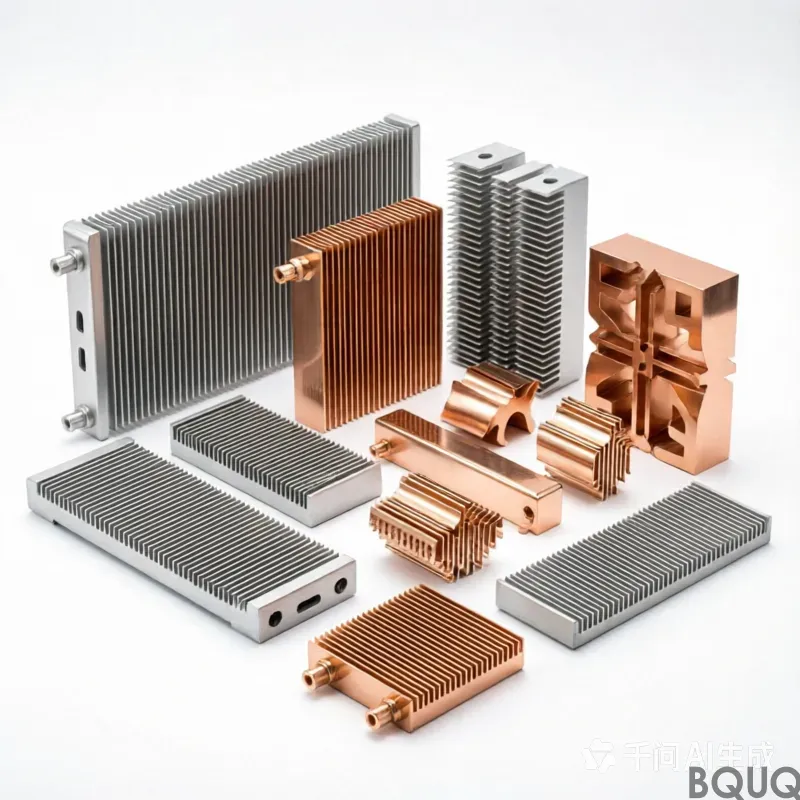
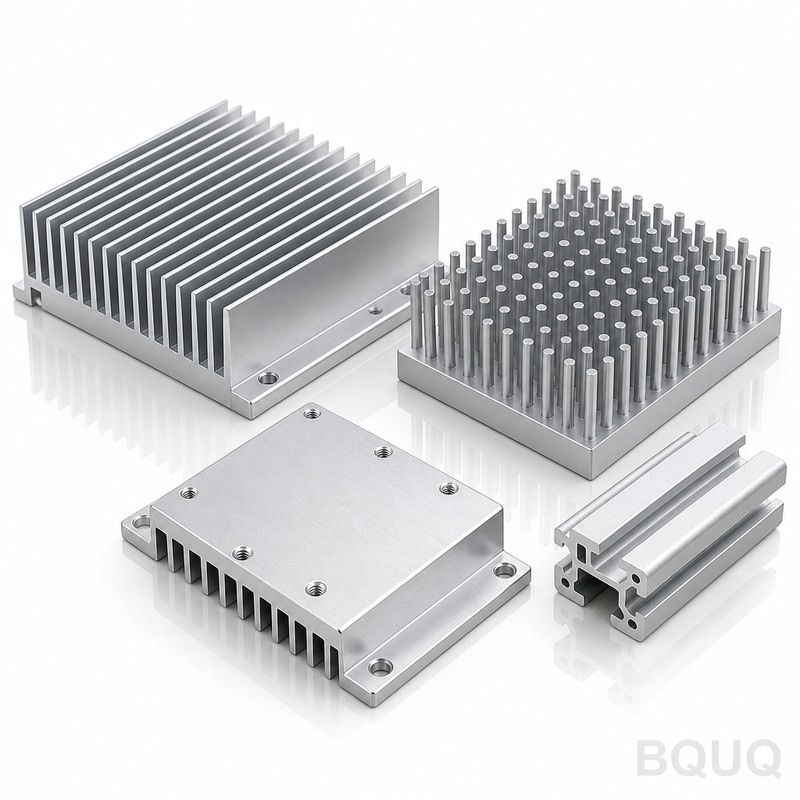
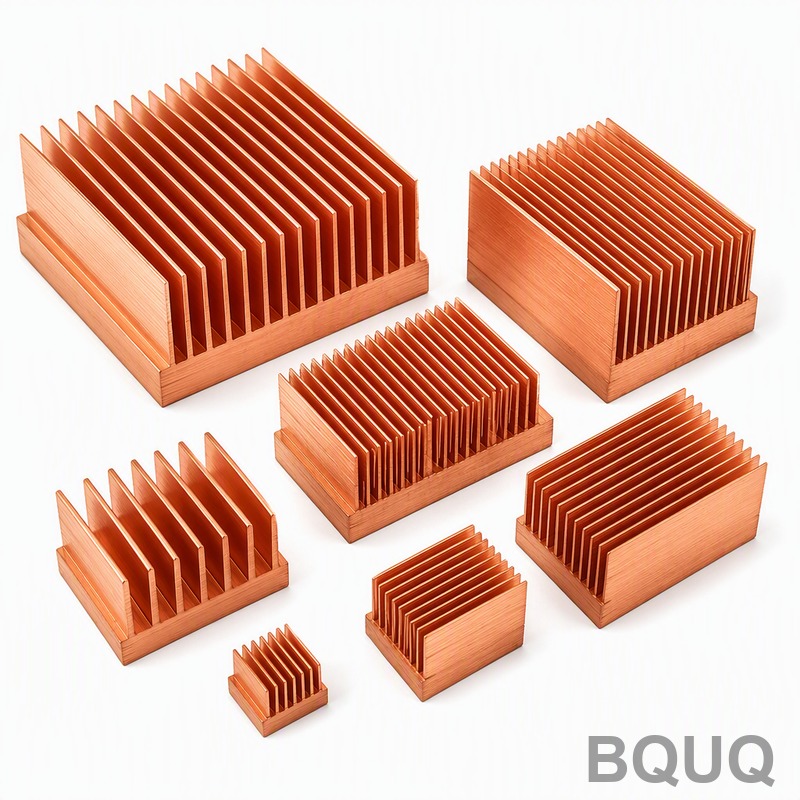
The heat sink material directly determines thermal conductivity, weight, and manufacturing cost. 6063-T5 aluminum alloy remains the industry standard for extruded heat sinks due to its balance of thermal conductivity (201 W/m·K), corrosion resistance, and cost. Copper offers 401 W/m·K but costs 4-5 times more per kilogram and is 3.3 times denser, making it impractical for most suspended luminaires.
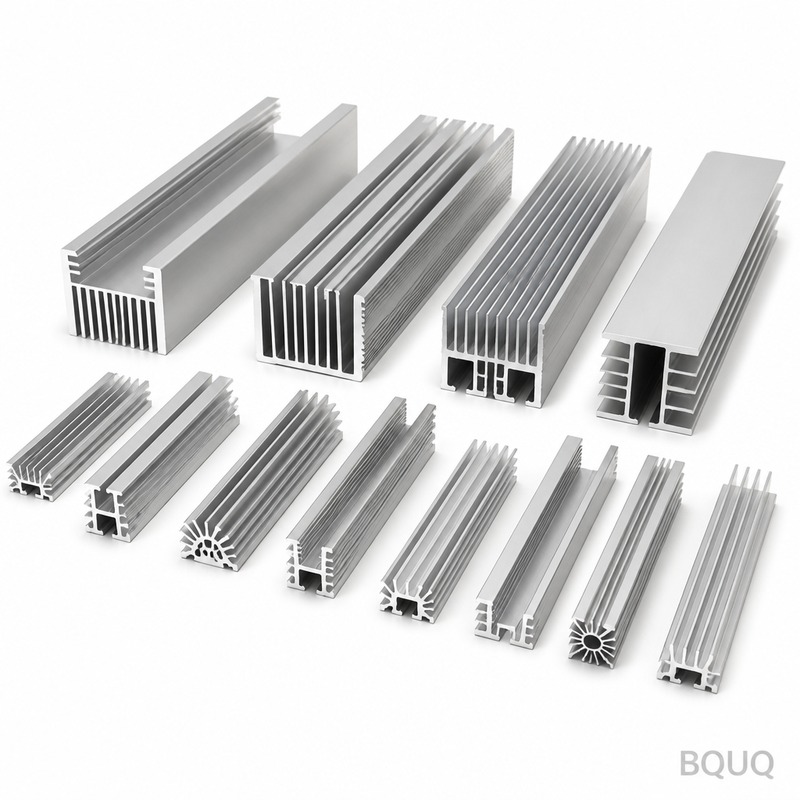
The critical performance metric is thermal resistance of the heat sink (Rθs-a), measured in °C/W. A typical extruded aluminum heat sink with a surface area of 100cm² achieves Rθs-a of 2.5°C/W in natural convection. To halve this resistance, you must increase surface area by 4 times, not 2, due to the logarithmic efficiency of finned surfaces. Our factory BQUQ recommends 6063-T5 for production volumes above 500 units, while die-cast A380 aluminum is suitable for complex geometries but offers 20% lower thermal conductivity at 96 W/m·K.
| Material | Thermal Conductivity (W/m·K) | Density (g/cm³) | Relative Cost per kg | Typical Rθs-a for 100cm² (°C/W) |
| 6063-T5 Aluminum | 201 | 2.70 | 1.0 | 2.5 |
| A380 Die-Cast Aluminum | 96 | 2.76 | 1.2 | 4.1 |
| C1100 Copper | 401 | 8.96 | 4.5 | 1.2 |
| 6061-T6 Aluminum | 167 | 2.70 | 1.1 | 3.0 |
Fin Geometry and Surface Area Calculation
Fin geometry determines the heat transfer coefficient (h) and effective surface area. For natural convection applications, fin spacing must be 6-10mm to allow air circulation without boundary layer interference. Fin thickness should be 1.5-3.0mm for extruded profiles, with an aspect ratio (height to spacing) between 5:1 and 10:1 for optimal performance.
The total required surface area can be calculated using Newton's Law of Cooling: Q = h × A × ΔT. For a 20W LED driver system with a target heat sink temperature rise of 20°C above ambient (35°C ambient, 55°C heat sink), and a natural convection coefficient of 8 W/m²·K, the required area is 1250cm². Forced convection using a 40mm fan at 3000 RPM increases h to 25 W/m²·K, reducing required area to 400cm², but adds 1.2W of fan power and reduces system reliability.
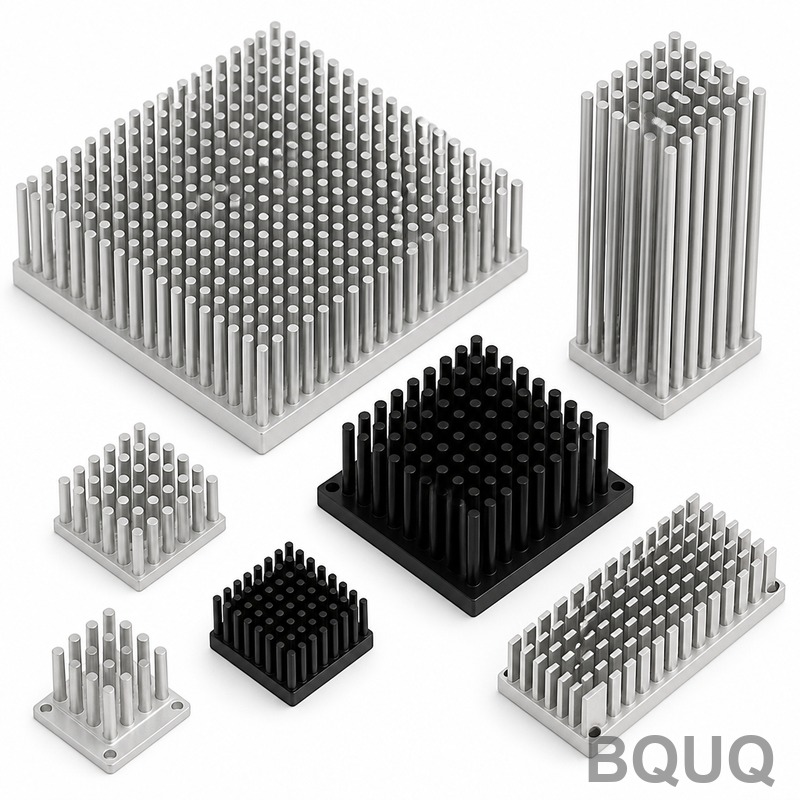
Pin fin heat sinks provide 40% more surface area per unit volume than straight fins, making them ideal for compact designs. However, pin fin tooling costs at BQUQ start at $3,000 for extrusion dies versus $800 for standard profiles. For low-profile applications under 20mm height, stamped aluminum heat sinks with dimpled patterns achieve 85% of extruded performance at 30% lower unit cost for volumes above 10,000 pieces.
Manufacturing Tolerances and Interface Resistance
The interface between the LED package and heat sink is the largest source of avoidable thermal resistance. The thermal interface material (TIM) must fill microscopic surface irregularities. A typical machined aluminum surface has a roughness of Ra 1.6μm, creating air gaps that have a thermal conductivity of 0.026 W/m·K, compared to aluminum at 201 W/m·K.
BQUQ CNC machining holds surface flatness to 0.05mm over 100mm length and surface roughness to Ra 0.8μm on critical mounting surfaces. This precision reduces thermal interface resistance to 0.05°C/W when using a 0.1mm layer of thermal paste (conductivity 3 W/m·K). Without proper surface finishing, the interface resistance can reach 1.0°C/W, effectively negating the benefit of a high-performance heat sink.
For production, our thermal vias and mounting hole tolerances are held to ±0.02mm to ensure uniform clamping pressure. Recommended mounting torque for M3 screws is 0.35-0.45 N·m, which compresses the TIM to its optimal thickness. Over-torquing above 0.6 N·m can crack ceramic LED substrates, while under-torquing below 0.2 N·m leaves excessive TIM thickness, increasing thermal resistance by 300%.
Real-World Data: Temperature vs. Lifespan Comparison
To quantify the impact of thermal management, we tested identical 50W COB LEDs (Citizen CLU058-1825) on three different heat sink configurations at BQUQ's thermal laboratory. Ambient temperature was maintained at 35°C, and junction temperature was measured using the forward voltage method with a Keithley 2400 source meter.
| Heat Sink Configuration | Heat Sink Rθs-a (°C/W) | Junction Temperature (°C) | Predicted L70 Lifespan (hours) | Relative Light Output at 1000h |
| 150x100x40mm Extruded, 6 fins | 1.8 | 82 | 62,000 | 97% |
| 100x100x20mm Stamped, 8 fins | 3.4 | 104 | 24,000 | 89% |
| No Heat Sink (bare LED) | 12.0 | 158 (failure) | <500 | 45% (permanent damage) |
The data confirms that the difference between a properly designed and an undersized heat sink is the difference between a 5-year fixture and a 2-year disposable product. The stamped heat sink, while 40% cheaper ($2.10 vs. $3.50 unit cost at 5,000 quantities), fails to maintain the junction below 105°C, resulting in accelerated lumen depreciation and a 61% reduction in lifespan.
Practical Recommendations for Design Engineers
For LED applications above 10W, always specify a heat sink with a thermal resistance at least 25% lower than the theoretical minimum calculated from your system's thermal budget. This safety margin accounts for dust accumulation (which can reduce heat transfer by 15% over time), elevated ambient temperatures in enclosed fixtures, and batch-to-batch variations in LED thermal resistance.
Select 6063-T5 extruded aluminum for linear fixtures and high-volume production. For complex shapes with undercuts, consider die-casting but specify a minimum wall thickness of 2.5mm to prevent porosity-induced thermal degradation. Always require your manufacturer to provide thermal simulation data (CFD analysis) alongside the mechanical drawings. At BQUQ, we offer free thermal simulation for orders above 2,000 units, including FloTHERM analysis that predicts junction temperature within ±3°C of physical testing.
For assembly, use phase-change TIMs rather than grease for high-reliability applications. Phase-change materials achieve thermal conductivity of 8 W/m·K and do not pump-out or dry-out over 10-year lifetimes. Budget for a thermal cycling test (500 cycles from -20°C to +85°C) to validate solder joint integrity and TIM stability before committing to mass production.
Frequently Asked Design Questions
What is the maximum ambient temperature for an outdoor LED heat sink? For outdoor fixtures in tropical climates, assume 50°C maximum ambient. With a target junction temperature of 85°C and an LED Rθj-sp of 1.5°C/W at 20W, the heat sink must have Rθs-a below (85-50-30)/20 = 0.25°C/W, requiring an aggressive finned profile of at least 2000cm² surface area.
Can I use a heat sink with a black anodized coating? Yes, black anodizing improves emissivity from 0.08 for bare aluminum to 0.88, increasing radiant heat transfer by 15-20%. However, anodizing adds 6-8% to the unit cost and has no effect on conductive heat spreading. BQUQ recommends anodizing for natural convection designs above 15W.
What is the cost difference between CNC-machined and extruded heat sinks? For a 120x80x30mm heat sink in quantities of 5,000, extrusion with secondary CNC drilling costs $2.80-3.50 per unit. Fully CNC-machined from solid billet costs $6.50-8.00 per unit due to 45% material waste and longer cycle times. Extrusion is always preferred for straight, uniform cross-sections.
Conclusion and Engineering Summary
Thermal management is not an accessory but the primary determinant of LED product reliability. Maintaining junction temperatures below 85°C ensures rated lifespan, color stability, and luminous efficacy above 150 lm/W. The engineering decision tree is clear: calculate your thermal budget, select 6063-T5 aluminum with a 25% safety margin, machine critical surfaces to Ra 0.8μm, and validate with prototype thermal testing. Every 10°C reduction in junction temperature doubles your product's useful life and significantly reduces warranty claims.
At BQUQ Precision Manufacturing, we combine 20 years of CNC machining, stamping, and thermal simulation expertise to produce heat sinks that meet exacting thermal specifications. Our Dongguan facility operates 60 CNC machines and 15 stamping presses, with in-house thermal testing labs. We provide free design-for-manufacturing feedback and thermal simulation for qualified projects, ensuring your LED design achieves its full lifespan potential.
For a detailed thermal analysis of your specific LED application, contact our engineering team for a 12-hour quotation. Email us at sc@bquq.com, reach us on WhatsApp at +86 13713157787, or visit www.bquq.com to upload your CAD files. Our engineers will respond with manufacturing feasibility, thermal simulation, and CNC machining pricing within one business day.