Music Wire vs Stainless Steel vs Oil Tempered Spring Wire: Which to Choose?
Selecting the correct spring wire material is a critical engineering decision that directly impacts fatigue life, corrosion resistance, operating temperature range, and unit cost. For most general-purpose compression, extension, and torsion springs, **Music Wire (ASTM A228)** offers the highest tensile strength and lowest cost, but **Stainless Steel (ASTM A313)** is mandatory for corrosive or high-temperature environments, while **Oil Tempered (ASTM A229)** provides a cost-effective middle ground for heavier wire diameters and dynamic loads. The final choice depends on a tri-variable analysis: stress environment, ambient conditions, and budget per thousand pieces.
Material Property Benchmark
To make an informed choice, engineers must compare mechanical properties at standard wire diameters. The table below summarizes typical values for cold-drawn wire in the 1.0 mm to 6.0 mm diameter range, which covers 80% of industrial spring applications.
| Property | Music Wire A228 | Stainless Steel A313 (302/304) | Oil Tempered A229 |
| Tensile Strength (MPa) | 2300 - 2600 | 1200 - 1600 | 1400 - 1700 |
| Max Operating Temp (°C) | 120 | 250 (continuous) | 180 |
| Min Operating Temp (°C) | -40 | -200 | -40 |
| Modulus of Elasticity (GPa) | 207 | 193 | 207 |
| Shear Modulus (GPa) | 79.5 | 69 | 79.5 |
| Corrosion Resistance | Poor | Excellent | Fair (requires plating) |
| Relative Cost per kg (USD) | 2.5 - 3.5 | 8.0 - 12.0 | 2.0 - 3.0 |
| Typical Wire Diameter Range (mm) | 0.1 - 6.0 | 0.1 - 12.0 | 1.0 - 12.0 |
| Surface Finish | Bright, smooth | Bright, matte | Oxidized or oiled |
Note: Tensile values are for wire under 3.0 mm diameter. Larger diameters will show reduced tensile strength due to the mass effect during drawing.
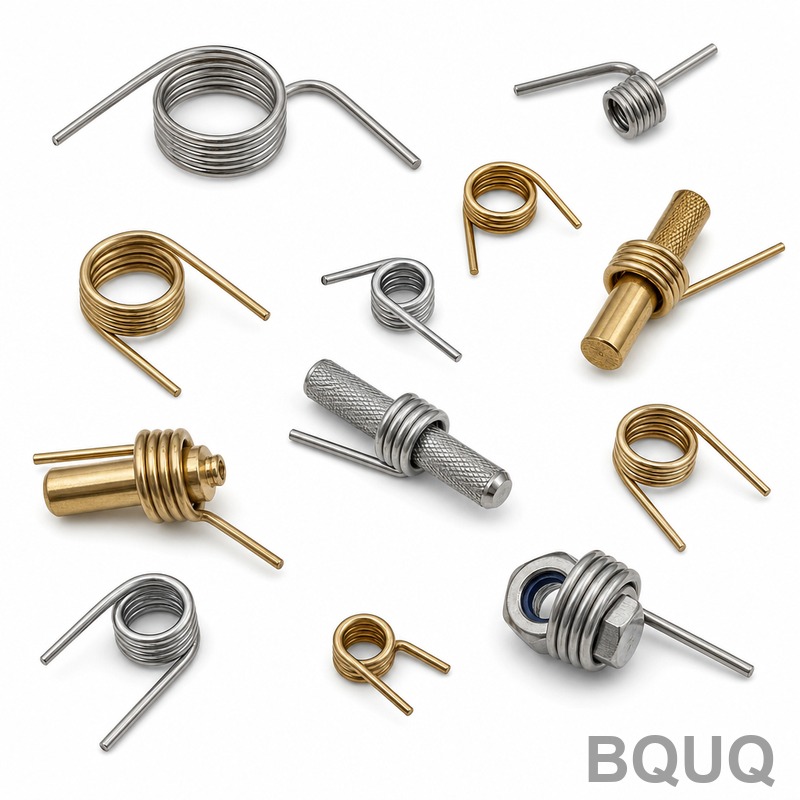
Music Wire A228: Maximum Strength for Compact Design
Music wire is the industry standard for small precision springs where space is limited and load requirements are high. Its carbon content (0.70% - 1.00%) and cold-drawing process produce a tensile strength that is 40-50% higher than stainless steel at the same diameter. This allows designers to reduce wire diameter by up to 20% while maintaining the same spring rate, resulting in a smaller outer diameter and lighter overall assembly.
However, music wire has a zinc phosphate or oil coating that offers zero corrosion protection. In a humid factory environment or outdoor application, surface rust will appear within 24-48 hours of exposure. For this reason, BQUQ recommends music wire only for sealed assemblies, dry interiors, or applications where a protective plating (zinc, nickel, or powder coat) is applied after coiling. The maximum safe operating temperature is 120°C; beyond this, the wire begins to stress-relax, losing set and reducing free length permanently.
Practical case: A consumer electronics latch spring requiring 5N force at 10mm deflection uses 0.8mm music wire. The same spring in stainless steel would require 1.0mm wire, increasing weight by 56% and cost by 300%.
Stainless Steel A313: Corrosion Resistance and Temperature Range
Stainless steel spring wire, typically Type 302 or 304, contains 18% chromium and 8% nickel. This alloy forms a passive oxide layer that resists oxidation, mild acids, and salt spray. For medical devices, marine hardware, food processing equipment, and pharmaceutical machinery, stainless steel is not optional—it is a regulatory requirement.
The trade-off is significant: tensile strength is roughly half that of music wire, and the shear modulus is 13% lower (69 GPa vs 79.5 GPa). This means that for identical spring dimensions, a stainless steel spring will deflect 13% more under the same load. Engineers must adjust coil count or wire diameter to compensate. The cost penalty is severe—stainless steel wire costs 3-4 times more per kilogram than music wire, and its slower drawing speed increases manufacturing lead time by 2-3 days for custom orders.
One advantage beyond corrosion: stainless steel maintains useful spring properties up to 250°C, and down to cryogenic temperatures (-200°C) without embrittlement. If your spring operates near a motor, exhaust manifold, or sterilization autoclave, stainless steel is the only viable choice among these three.
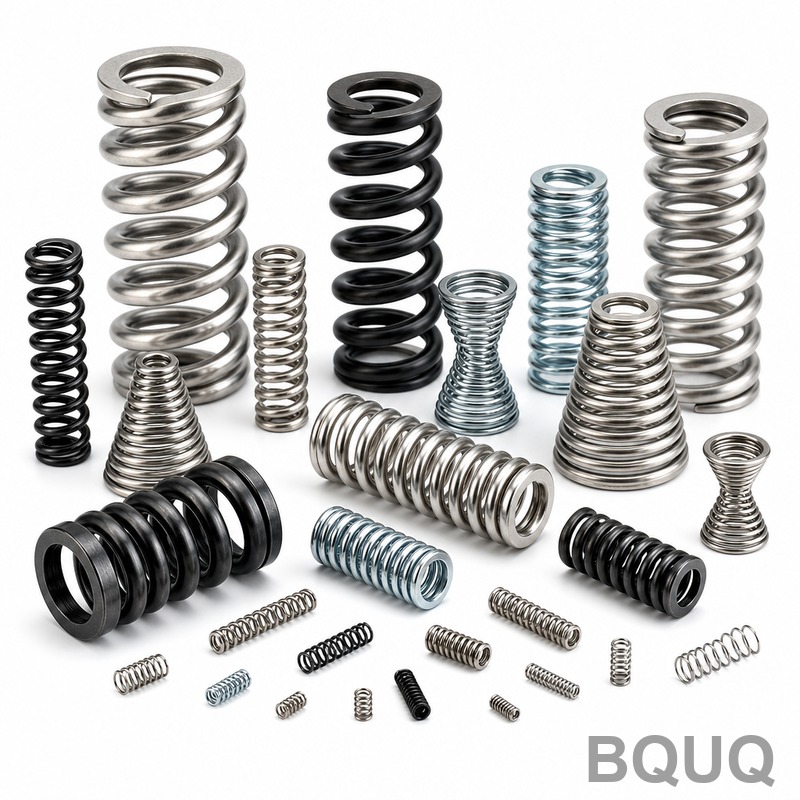
Oil Tempered A229: Best for Heavy Duty and Dynamic Loading
Oil tempered wire is quenched in oil and then tempered to achieve a uniform through-hardness. Unlike music wire, which is hardened only at the surface, oil tempered wire has consistent mechanical properties across its entire cross-section. This makes it the preferred choice for wire diameters above 3.0 mm, where music wire's surface-hardening effect becomes less reliable.
For automotive suspension springs, valve springs, and heavy machinery counterbalance springs, oil tempered wire offers: - Higher ductility than music wire, reducing fracture risk during coiling - Better fatigue life under cyclic loading (tested to 10^7 cycles) - Lower cost per kilogram than stainless steel - Compatibility with shot peening for enhanced surface compressive stress
The primary limitation is corrosion. Oil tempered wire is delivered with a thin oxidation layer that provides temporary rust protection only. For outdoor or wet applications, it must be electroplated (zinc or cadmium) or painted. Operating temperature is capped at 180°C, which is acceptable for most hydraulic and pneumatic systems but insufficient for engine exhaust components.
Cost and Lead Time Comparison
Price volatility in raw materials (especially nickel for stainless steel) means quotes are only valid for 30 days. Based on Q3 2024 market data from BQUQ's procurement department, the following unit prices apply for 2.0 mm wire, 10,000-piece order quantity:
| Wire Material | Material Cost per kg (USD) | Coiling Cost per 1000 pcs (USD) | Total Cost per 1000 pcs (USD) | Lead Time (working days) |
| Music Wire A228 | 3.00 | 45 | 85 | 5 - 7 |
| Stainless Steel A313 | 10.50 | 60 | 165 | 8 - 12 |
| Oil Tempered A229 | 2.50 | 50 | 95 | 7 - 10 |
Note: Prices include wire straightening, coiling, and basic stress relief. Additional operations (grinding, shot peening, plating, or passivation) add 10-30 USD per 1000 pieces and extend lead time by 3-5 days.
For a typical 10mm outer diameter spring, 20mm free length, 8 active coils, the material weight is approximately 8 grams. At 10,000 pieces, the material cost difference between music wire and stainless steel is 600 USD. If corrosion is not a design requirement, that 600 USD could cover the cost of a zinc plating line for the entire batch, making music wire the economically superior choice.
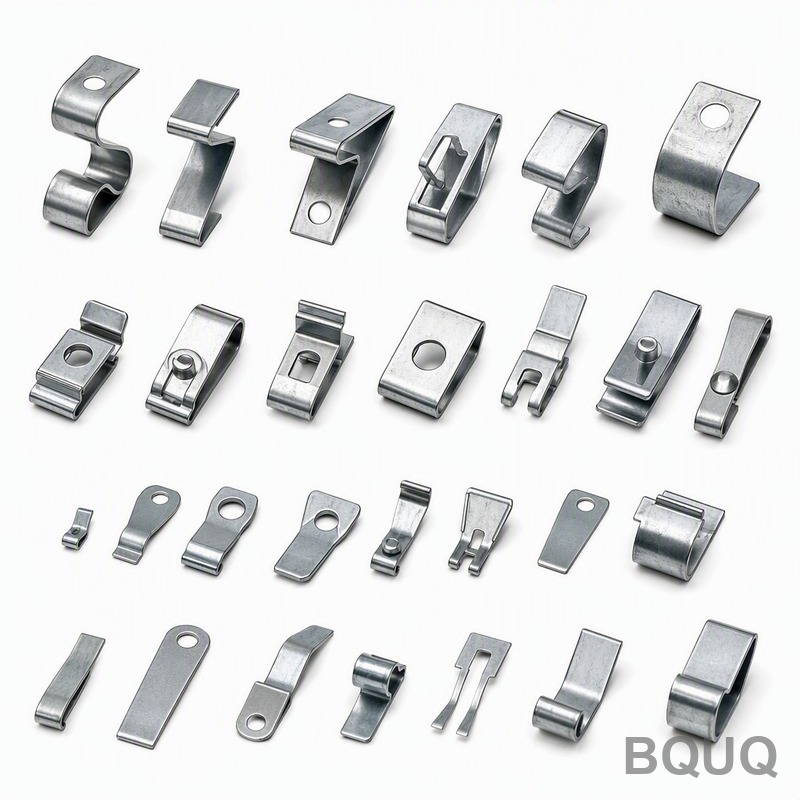
Selection Decision Matrix
Engineers should use the following logic sequence rather than a simple checklist. First, define the maximum operating temperature. If above 120°C, exclude music wire. If above 180°C, exclude oil tempered, leaving stainless steel as the only option. Second, assess the environment. If salt spray, humidity, or chemical exposure is present, stainless steel is required unless a protective coating is acceptable. Third, calculate the required tensile strength. If the calculated stress exceeds 60% of the material's tensile strength, choose the higher-strength option—music wire for diameters under 3.0 mm, oil tempered for larger diameters.
For dynamic springs (cycling above 100,000 cycles), oil tempered wire with shot peening is preferred over music wire due to its superior internal structure and residual stress distribution. For static springs (one-time compression or low-frequency actuation), music wire offers the best strength-to-cost ratio.
Practical Recommendations from BQUQ
Based on 20 years of manufacturing springs for automotive, electronics, and industrial clients, BQUQ offers these specific guidelines:
1. Use music wire for springs under 3.0 mm diameter, operating below 100°C, in dry or sealed environments. This covers 70% of consumer product applications. 2. Use stainless steel for any spring that may contact water, cleaning agents, or body fluids. The extra cost is justified by avoiding field failures and warranty claims. 3. Use oil tempered for wire diameters above 4.0 mm, especially in suspension or vibration isolation systems. The fatigue life improvement over music wire is measurable in accelerated life testing. 4. Always request a stress relief heat treatment after coiling. For music wire, this is 30 minutes at 200-230°C; for stainless steel, 30 minutes at 350-400°C; for oil tempered, 30 minutes at 300-350°C. Skipping this step reduces fatigue life by up to 50%. 5. If you are uncertain, provide BQUQ with your load requirements, space envelope, and environmental conditions. Our engineers will calculate the stress and recommend the optimal material without bias toward any particular wire type.
FAQ-Style Tips for Material Selection
Why is music wire not recommended for outdoor springs? Music wire's carbon steel composition will rust within days of exposure to moisture. The rust acts as a stress raiser, initiating cracks that lead to premature fatigue failure. Always specify stainless steel or add protective coating.
Can I substitute oil tempered for music wire in a small spring? Not directly. Oil tempered wire has lower tensile strength and a rougher surface finish. For a 0.5 mm diameter spring, music wire will achieve 2400 MPa tensile, while oil tempered will only reach 1500 MPa. The spring will require more coils or a larger wire diameter, changing the space envelope.
Does stainless steel spring wire have a smaller tolerance on wire diameter? Yes. A313 stainless steel is typically drawn to a tighter tolerance (+/- 0.01 mm for wire under 1.0 mm) compared to A228 music wire (+/- 0.02 mm). This can improve spring rate consistency in high-volume production.
What is the maximum spring index for each material? Spring index (D/d, mean diameter divided by wire diameter) should not exceed 16 for music wire, 14 for oil tempered, and 12 for stainless steel. Higher indices cause excessive stress concentration on the inner coil surface.
Conclusion
Choose music wire for maximum strength at minimum cost in benign environments, choose stainless steel for corrosion resistance and extreme temperatures, and choose oil tempered for heavy-duty dynamic applications with large wire diameters. The decision is not about which material is "best" in absolute terms, but which is optimal for your specific stress, temperature, and corrosion profile. BQUQ manufactures all three types of springs in our Dongguan facility, with in-house wire straightening, CNC coiling, and heat treatment lines. We provide free engineering consultation on material selection, including stress calculations and fatigue life estimates. Send us your drawings or specifications today for a 12-hour quotation. Email: sc@bquq.com, WhatsApp: +86 13713157787, www.bquq.com.
Related Articles
- Lightweight Design and Material Upgrade of New Energy and Automobile Chassis Spring
- In-depth analysis of technology and process in the hardware spring industry in 2026: a full-dimensional interpretation of high stress, functional integration and engineering certification
- From "standard parts" to "functional parts": 2026 hardware spring industry technology trends and functional innovation engineering direction