Shot Peening for Springs: Fatigue Life Gains and Process Specs
Direct Answer: Does Shot Peening Improve Spring Fatigue Life?
Yes, shot peening is the single most effective surface treatment for extending the fatigue life of compression, torsion, and extension springs. By inducing a compressive residual stress layer of 400 to 800 MPa at the spring wire surface, shot peening delays crack initiation and propagation, typically increasing fatigue life by 100% to 500% under cyclic loading. For high-stress automotive valve springs and suspension coils, peening is not optional; it is a mandatory process step to achieve design life targets of 10 million cycles or more.
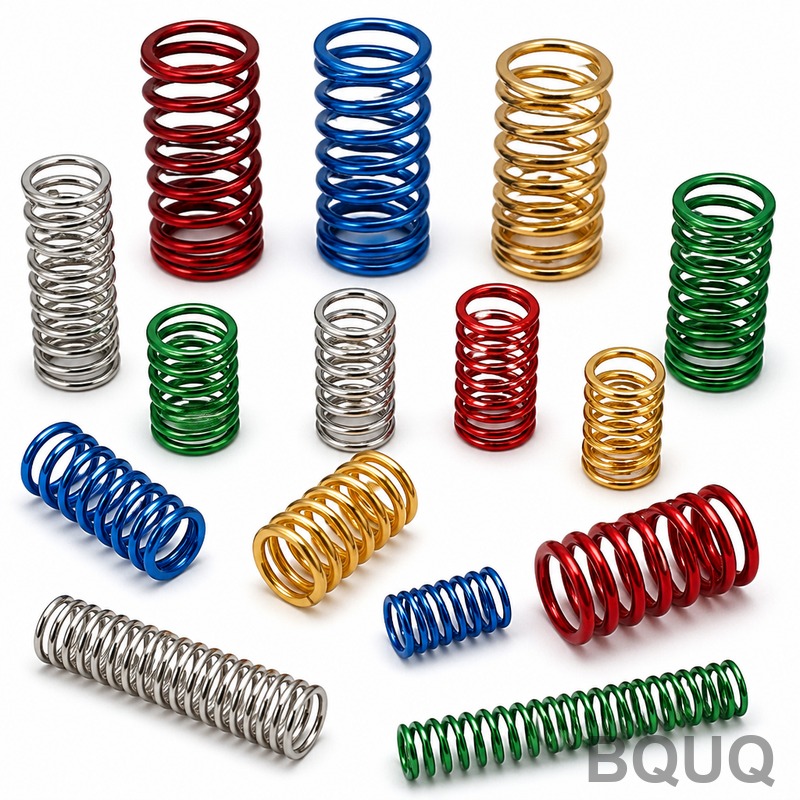
The Science of Compressive Stress in Spring Wire
Springs fail when surface tensile stresses exceed the material's endurance limit. During cyclic loading, the outer fibers of a spring experience maximum tensile stress. Shot peening bombards the surface with spherical media (steel shot, ceramic beads, or glass beads), causing localized plastic deformation. This deformation creates a cold-worked layer with compressive residual stress that counteracts applied tensile loads.
The depth of this compressive layer typically ranges from 0.1 mm to 0.5 mm depending on shot size, velocity, and material hardness. For music wire (ASTM A228) with a tensile strength of 2300 MPa, peening can produce surface compressive stresses of -600 to -900 MPa. This means the effective stress at the surface is reduced by 30% to 50%, which directly increases the number of cycles to failure.
Key Process Parameters for Spring Shot Peening
The Almen intensity (measured in mm or thousandths of an inch) is the primary control parameter. For spring applications, standard intensities range from 0.15 mmA to 0.45 mmA. Lower intensities are used for thin wire (0.5 mm diameter), while higher intensities are required for heavy-duty springs with wire diameters above 10 mm.
| Parameter | Light Duty Springs | Medium Duty Springs | Heavy Duty Springs |
| Wire Diameter Range | 0.5 - 3.0 mm | 3.0 - 8.0 mm | 8.0 - 20.0 mm |
| Almen Intensity | 0.10 - 0.20 mmA | 0.20 - 0.35 mmA | 0.35 - 0.50 mmA |
| Shot Size (S-70 to S-550) | S-70 to S-170 | S-230 to S-330 | S-380 to S-550 |
| Coverage Requirement | 100% minimum | 100% minimum | 100% minimum |
| Typical Cycle Life Gain | 100% - 200% | 150% - 300% | 200% - 500% |
Coverage must be verified using fluorescent tracer dye under UV light. Incomplete coverage creates unpeened zones that become preferential crack initiation sites. For critical applications, peening is performed in two passes with a 90-degree rotation of the spring to ensure uniform treatment across the entire circumference.
Material and Pre-Peening Heat Treatment Considerations
The effectiveness of shot peening depends heavily on the spring material's hardness and microstructure. Harder materials respond better to peening because they retain more residual stress without relaxation. For oil-tempered chrome silicon steel (ASTM A401), a hardness of 45-52 HRC is ideal. Softer materials (below 40 HRC) may lose 20% to 30% of the induced compressive stress during subsequent heat treatment.
If the spring requires stress relief after peening, the temperature must not exceed 250°C. Above this threshold, residual stress relaxation accelerates dramatically. At 300°C, up to 50% of the compressive stress can be lost within 30 minutes. For springs that require a protective coating after peening, use low-temperature curing powders (below 200°C) to preserve the peening effect.
Shot Peening vs Alternative Surface Treatments
| Treatment Method | Fatigue Life Improvement | Surface Compressive Stress | Cost per Spring (0.5 kg) | Lead Time | Best Application |
| Shot Peening | 100% - 500% | 400 - 800 MPa | $0.50 - $2.00 | 1 - 2 days | High-cycle springs, automotive, aerospace |
| Roller Burnishing | 50% - 150% | 300 - 600 MPa | $1.00 - $3.50 | 2 - 3 days | Large diameter torsion bars |
| Nitriding | 80% - 200% | 200 - 400 MPa | $3.00 - $8.00 | 5 - 7 days | Stainless steel springs, corrosion resistance |
| No Treatment | Baseline | 0 MPa (tensile) | $0.00 | 0 days | Low-stress, low-cycle applications |
Shot peening offers the best cost-to-performance ratio. Nitriding provides additional corrosion resistance but at double to triple the cost and significantly longer lead times. For most industrial spring applications, shot peening alone achieves the required fatigue performance without the complexity of thermal chemical treatments.
Post-Peening Quality Control and Verification
Verification of shot peening quality requires both process control and destructive testing. The Almen strip method must be performed at the start of each production batch and every 4 hours during continuous operation. The saturation curve must show less than 10% change in arc height when peening time is doubled.
For fatigue validation, BQUQ uses rotating beam fatigue testing per ISO 1143. A sample of 10 springs per batch is tested to 10 million cycles at 70% of the design stress. Acceptance criteria require zero failures. Additionally, X-ray diffraction (XRD) is used on critical aerospace and automotive springs to measure actual residual stress values. The XRD measurement must show a minimum surface compressive stress of -500 MPa at the spring inner diameter, which is the highest stress location.
Practical Recommendations for Spring Designers and Buyers
For new spring designs, specify shot peening whenever the calculated maximum shear stress exceeds 45% of the material's tensile strength. This is the threshold where fatigue crack initiation becomes dominant. For existing designs that fail prematurely, increasing Almen intensity from 0.20 mmA to 0.30 mmA can yield an additional 50% to 80% fatigue life improvement without changing wire diameter or material.
Consider the shot media hardness relative to the spring surface. Shot must be at least 90% as hard as the spring surface. Using softer shot creates burnishing rather than peening, reducing compressive stress by up to 60%. For springs above 50 HRC, use ceramic shot (Zirblast) or conditioned steel shot with a hardness of 55-62 HRC.
Do not shot peen springs that have been previously plated or coated. The peening process will damage the coating and create embedded debris. The correct sequence is: heat treat, shot peen, then apply coating. If corrosion protection is required before peening, use a temporary rust inhibitor that is removed prior to peening.
FAQ: Common Shot Peening Questions from Spring Engineers
What is the minimum Almen intensity for a 2 mm music wire spring? For 2 mm wire, use 0.12 to 0.18 mmA with S-110 shot. This produces a compressive layer depth of approximately 0.08 mm, sufficient for fatigue life improvement of 150% to 200%.
Can shot peening fix a spring that is already cracked? No. Shot peening prevents crack initiation but cannot stop cracks that have already propagated. If surface cracks are visible, the spring must be scrapped. Peening after crack initiation can actually accelerate failure by closing the crack mouth and creating hydrogen pressure.
How long does shot peening add to spring production lead time? For standard production runs, shot peening adds 1 to 2 days to lead time. This includes setup, Almen strip calibration, peening, coverage inspection, and documentation. BQUQ integrates peening into the manufacturing flow to minimize added time.
What is the maximum service temperature for shot-peened springs? The residual compressive stress remains stable up to 200°C for chrome silicon steel and up to 250°C for chrome vanadium steel. Above these temperatures, dislocations anneal out and compressive stress decreases. For high-temperature applications above 300°C, consider shot peening combined with a pre-stressing (set) operation at the operating temperature.
Conclusion and Engineering Recommendation
Shot peening is a proven, cost-effective process that delivers quantifiable fatigue life improvements of 100% to 500% for springs. The process is fully controllable through Almen intensity, coverage, and shot media selection. For any spring subjected to cyclic loading above 45% of tensile strength, shot peening must be specified in the engineering drawing. The additional cost of $0.50 to $2.00 per spring is negligible compared to the cost of field failures, warranty claims, and downtime.
At BQUQ, our 20 years of spring manufacturing experience includes in-house shot peening with full process documentation. We provide Almen intensity certificates, coverage reports, and fatigue test data with every shipment. For new designs, we recommend a prototype batch of 50 pieces with peening parameters optimized for your specific wire diameter and material grade.
For a fast, accurate quote on shot-peened springs, send your drawings and load specifications to our engineering team. We respond within 12 hours with pricing, lead time, and a recommended peening specification. Email: sc@bquq.com, WhatsApp: +86 13713157787, www.bquq.com.