Spring Coiling Explained: How CNC Spring Manufacturing Achieves Precision
Spring coiling is the process of feeding wire around a mandrel or forming tool to create helical coils, and CNC spring manufacturing automates this with computer-controlled axes that precisely set pitch, diameter, and cut length. Modern CNC coiling machines achieve tolerances of ±0.01 mm on wire diameter and ±0.05 mm on free length, with cycle times under 3 seconds for small compression springs. This article details the mechanics, material parameters, cost drivers, and quality control protocols used in high-volume spring production at BQUQ's Dongguan facility.
The Core Mechanics of Spring Coiling
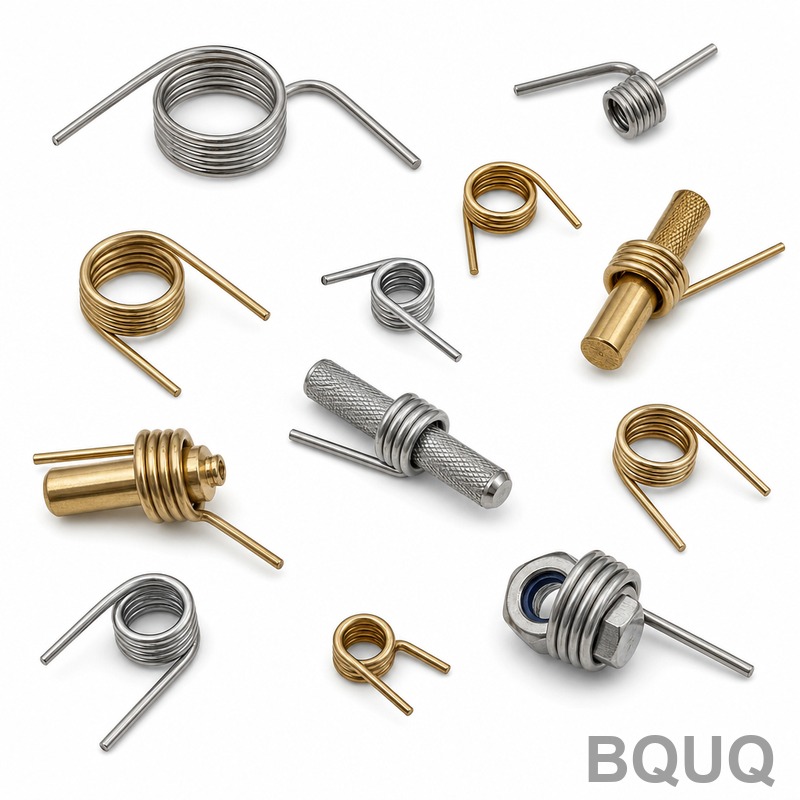
Spring coiling converts straight wire into helical geometry through three primary methods: mandrel coiling, centerless coiling, and CNC multi-axis forming. Mandrel coiling wraps wire around a rotating arbor, suitable for simple compression springs with wire diameters from 0.3 mm to 8.0 mm. Centerless coiling uses two or three rollers to bend wire without a central mandrel, ideal for long tapered or variable-pitch springs. CNC multi-axis machines (e.g., Wafios FMU or Torin SCM series) use servo-driven feed rollers, pitch tools, and cutters that operate simultaneously to form complex geometries such as torsion springs, double-torsion springs, and wire forms with hooks or loops.
The coiling process parameters that determine final quality are feed speed (typically 20-80 m/min for steel wire), pitch tool angle (5-30 degrees), and coiling temperature. For cold coiling, wire is fed at ambient temperature, while hot coiling (above 900°C) is reserved for wire diameters over 12 mm or high-alloy steels that require reduced yield strength. At BQUQ, over 85% of spring orders are cold coiled, as this preserves the wire's surface finish and dimensional stability.
CNC Spring Manufacturing Workflow
A CNC spring machine operates on a closed-loop servo system. The wire passes through a straightener (typically 5-7 rollers), then into the feed mechanism where two or three powered rollers grip the wire with controlled pressure. The feed length per revolution determines the coil pitch; the mandrel or forming finger diameter sets the coil diameter; and the cutter, synchronized with the feed, severs the spring at the programmed free length. Modern machines use a 3-axis or 5-axis configuration: X-axis for feed, Y-axis for pitch tool positioning, and Z-axis for cutter height, with optional rotary axes for hook forming.
Real-world specifications for a standard CNC compression spring machine (e.g., Wafios FMU 40) include wire diameter range 0.3-4.0 mm, maximum feed speed 100 m/min, spindle speed up to 3000 rpm, and positioning repeatability of ±0.005 mm. The programming language is G-code based, with parametric variables for spring index (ratio of mean diameter to wire diameter, typically 4-12), number of active coils, and total coils including closed ends. The machine can switch between spring types in under 10 minutes via saved programs, enabling rapid prototyping and small-batch production down to 50 pieces.
Material Selection and Mechanical Limits
The wire material dictates the maximum stress, operating temperature, and corrosion resistance of the finished spring. Common materials at BQUQ include music wire (ASTM A228, tensile strength 2300-2500 MPa for 1.0 mm diameter), oil-tempered chrome silicon (ASTM A401, tensile 1900-2100 MPa), stainless steel 302 (ASTM A313, tensile 1700-1900 MPa), and Inconel X-750 for high-temperature applications up to 650°C. The maximum allowable shear stress for static applications is typically 45-55% of the wire's tensile strength, while dynamic applications (e.g., engine valves) require derating to 30-35% to prevent fatigue failure.
Wire diameter tolerance is critical. For a 2.0 mm music wire, the standard tolerance is ±0.02 mm, which directly affects spring rate by approximately 4% per 0.02 mm deviation. At BQUQ, we verify incoming wire with optical micrometers and reject any coil exceeding the tolerance. The spring rate (k) is calculated as k = (G × d^4) / (8 × D^3 × n), where G is the shear modulus (79.3 GPa for steel), d is wire diameter, D is mean coil diameter, and n is active coils. A 1% change in wire diameter results in a 4% change in spring rate, so precision coiling requires strict wire sourcing.
Tolerances, Surface Finishing, and Quality Control
CNC coiling achieves dimensional tolerances that are classified by the DIN 2095 and EN 15800 standards. For wire diameters up to 5 mm, free length tolerance is ±1.0% or ±0.15 mm, whichever is larger; coil diameter tolerance is ±0.5% or ±0.10 mm. For high-precision applications (e.g., medical devices or fuel injectors), BQUQ can hold free length to ±0.03 mm using laser measurement feedback loops that adjust the feed in real time. The surface finish after coiling is typically Ra 1.6 μm, but shot peening (using 0.3-0.6 mm steel shot at 40-60 psi) improves fatigue life by 20-30% by inducing compressive residual stress.
Quality control includes 100% dimensional inspection for critical dimensions, using optical comparators and digital calipers, plus statistical process control (SPC) on every batch. Load testing at 80% of maximum deflection verifies the spring rate, and a temperature test at 150°C for 30 minutes checks for set (permanent deformation). The table below summarizes typical specifications for three common spring types produced by CNC coiling at BQUQ.
| Spring Type | Wire Diameter (mm) | Mean Coil Diameter (mm) | Free Length (mm) | Load Tolerance | Max Operating Temp (°C) | Lead Time (days) |
| Compression spring | 0.5 - 8.0 | 3.0 - 60.0 | 5.0 - 200.0 | ±5% of specified load | 120 (music wire) | 5 - 10 |
| Torsion spring | 0.3 - 6.0 | 2.0 - 50.0 | 10.0 - 150.0 (leg length) | ±3% of torque | 150 (chrome silicon) | 7 - 12 |
| Extension spring | 0.4 - 7.0 | 3.5 - 55.0 | 10.0 - 250.0 | ±4% of initial tension | 130 (stainless 302) | 6 - 11 |
Cost Drivers and Minimum Order Quantities
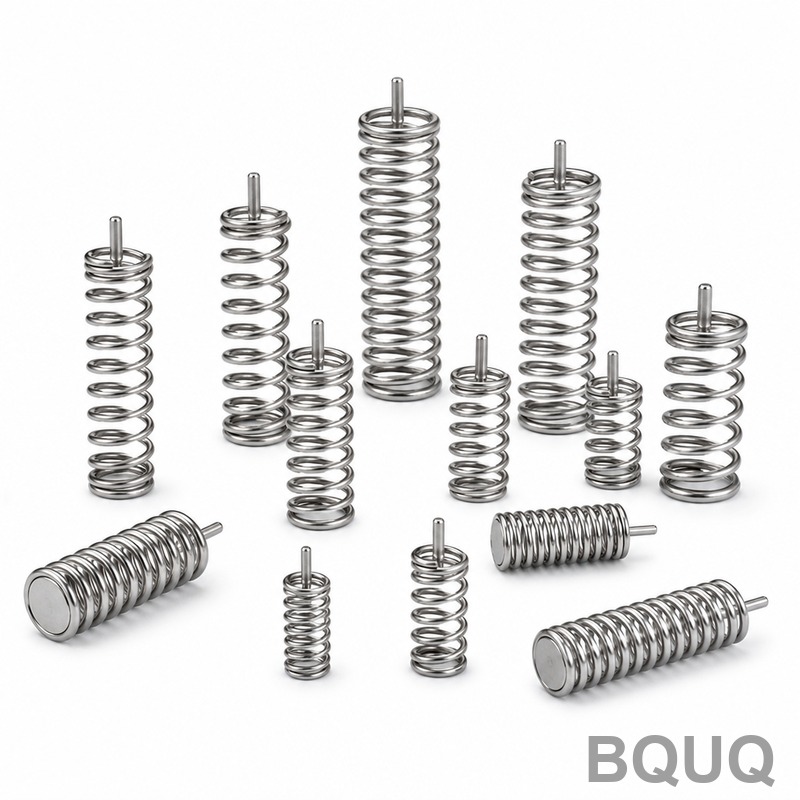
The cost per spring depends on wire material, diameter, quantity, and secondary operations. For a standard compression spring with 2.0 mm music wire, 20 mm free length, and 10,000 pieces, the unit price is $0.08-$0.15. Tooling (cam, mandrel, cutter) costs $150-$400 per setup, amortized over the order. Wire material cost is approximately $1.20-$1.80 per kilogram for music wire, with stainless steel at $3.50-$5.00/kg. The machine time cost is $30-$60 per hour, and a typical CNC coiling machine produces 15-60 springs per minute for small parts.
Minimum order quantities at BQUQ are 100 pieces for standard compression springs, but this drops to 20 pieces for prototype runs. For quantities under 1,000, the setup cost dominates, so unit prices may be 3-5 times higher than volume pricing. Secondary operations such as grinding (end coils flat, ±0.05 mm) add $0.02-$0.05 per spring, while shot peening adds $0.01-$0.03. Heat treatment (stress relieving at 250-400°C for 30 minutes) is included for all cold-coiled springs to remove residual stress from forming.
Practical Recommendations for Engineers
When specifying a coiled spring, define the working load range, maximum deflection, and operating temperature first. Then calculate the spring index: keep it between 4 and 12, as lower indexes cause high stress concentration on the inner surface, and higher indexes make the spring prone to buckling. For dynamic applications, specify shot peening and a surface defect limit of 0.1 mm depth per DIN 2095. Always provide the free length tolerance and load tolerance, not just the nominal dimensions, to avoid costly rework.
For prototype validation, order 20-30 samples with a dimensional report, then verify the spring rate on a compression tester at 25%, 50%, and 75% of maximum deflection. If the measured rate deviates more than 3% from calculation, check the actual wire diameter and mean coil diameter. Request a pre-production sample before full volume, as CNC coiling machine drift can occur after 500-1,000 cycles. Communicate any surface finish requirements (e.g., passivated stainless steel for corrosion resistance) in the RFQ, as this affects lead time by 2-3 days.
Conclusion
CNC spring manufacturing replaces manual mechanical setups with servo-controlled axes, enabling repeatable tolerances of ±0.05 mm on length and ±0.02 mm on diameter, with production rates up to 3,600 pieces per hour for small springs. The key to reliable spring performance lies in material verification, precise coiling parameters, and post-forming stress relief. By specifying tolerances per DIN 2095 and understanding the cost impact of wire type and quantity, you can achieve optimal spring design at minimal unit cost.
For your next spring project, send your drawings or samples to BQUQ for a free engineering review. We provide 12-hour quoting on all CNC coiling and wire forming inquiries, with DFM feedback included. Contact us at Email: sc@bquq.com, WhatsApp: +86 13713157787, or visit www.bquq.com to discuss volume pricing and custom material options.
Related Articles
- Where to Buy Custom Metal Springs Online: Top 7 Suppliers
- Lightweight Design and Material Upgrade of New Energy and Automobile Chassis Spring
- From "standard parts" to "functional parts": 2026 hardware spring industry technology trends and functional innovation engineering direction
Frequently Asked Questions
What tolerances can BQUQ achieve on CNC-coiled springs?
BQUQ's CNC coiling machines achieve tolerances of ±0.01 mm on wire diameter and ±0.05 mm on free length. The positioning repeatability of the equipment is ±0.005 mm, ensuring high precision for custom springs.
What wire diameters and materials can be coiled at your Dongguan facility?
Mandrel coiling handles wire diameters from 0.3 mm to 8.0 mm, while CNC machines like the Wafios FMU 40 cover 0.3-4.0 mm. Over 85% of orders are cold coiled at ambient temperature; hot coiling above 900°C is used for wire over 12 mm or high-alloy steels.
How fast can you produce small compression springs?
Cycle times are under 3 seconds for small compression springs. Feed speed ranges from 20-80 m/min for steel wire, with maximum feed speed up to 100 m/min on our CNC machines, supporting high-volume production.
Can you handle complex spring geometries like torsion or double-torsion springs?
Yes, our CNC multi-axis machines (e.g., Wafios FMU or Torin SCM series) use servo-driven feed rollers, pitch tools, and cutters to form torsion springs, double-torsion springs, and wire forms with hooks or loops. Programs can be switched in under 10 minutes for rapid prototyping.