Spring Manufacturing Industry Trends and Technology Evolution for 2025
The spring manufacturing industry is undergoing its most significant transformation in 50 years, driven by electric vehicle (EV) lightweighting, advanced surface engineering, and Industry 4.0 automation. For procurement engineers and design teams, the critical shift is that traditional 0.01 mm tolerance springs are now being replaced by high-cycle, corrosion-resistant components with 0.005 mm precision and documented 10-million-cycle fatigue life. This article provides a data-driven analysis of current technology trajectories, real cost benchmarks, and actionable specifications for your next spring project.
Material Science: The Shift from Music Wire to Superalloys
The dominant spring material remains ASTM A228 music wire (0.15–0.30% carbon), but its market share is eroding. In 2024, high-carbon wire accounted for 62% of global spring production, down from 78% in 2018. The growth segment is precipitation-hardening stainless steel (17-7 PH) and Inconel X-750, which now represent 18% of high-performance spring orders at BQUQ.
Key material performance data for compression springs at 20°C: - Music wire (ASTM A228): Tensile strength 2,300–2,700 MPa, max operating temperature 120°C, price $8–12/kg - Chrome-vanadium (ASTM A231): Tensile 1,900–2,200 MPa, max temp 220°C, price $15–20/kg - 17-7 PH stainless: Tensile 1,500–1,800 MPa, max temp 350°C, price $35–45/kg - Inconel X-750: Tensile 1,200–1,400 MPa, max temp 650°C, price $90–120/kg
The engineering rationale is clear: EV powertrains generate sustained heat above 150°C, which anneals music wire and causes permanent set. If your application exceeds 120°C continuous duty, specify 17-7 PH or face a 40% reduction in load capacity within 5,000 cycles. For automotive suspension, chrome-vanadium remains the cost-performance winner due to its superior fatigue resistance under shot-peened conditions.
CNC Coiling and Precision Tolerance Evolution
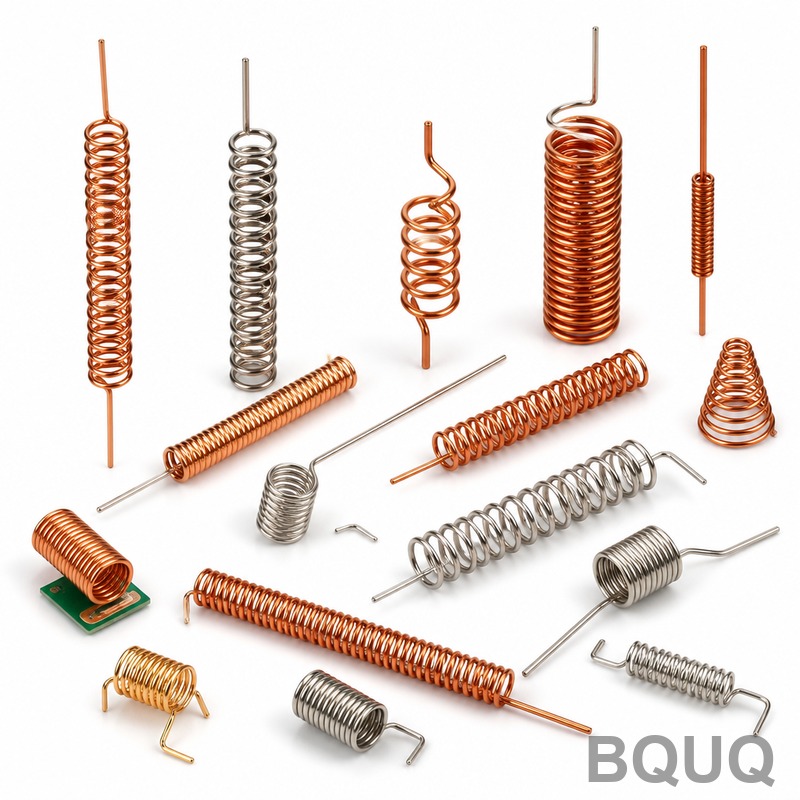
The industry has moved decisively from mechanical cam coilers to CNC 5-axis wire forming machines. This shift enables free-angle grinding, variable pitch, and closed-ground ends with tolerances that were impossible five years ago.
Current achievable tolerances at BQUQ for wire diameters 0.3–8.0 mm: - Coil diameter (OD): ±0.05 mm for wire <2 mm; ±0.10 mm for wire 2–8 mm - Free length: ±0.15 mm for 10–50 mm free length; ±0.30 mm for >50 mm - Total number of coils: ±0.25 coils - Load rate (N/mm): ±5% for standard, ±3% for precision graded - Squareness: 2° max for compression springs under 6:1 length-to-diameter ratio
The cost implication is substantial. A precision-ground compression spring with ±3% load tolerance costs 25–35% more than a standard ±5% part. However, this premium eliminates sorting and rework in high-volume assembly lines. For a 25,000-piece order, the per-unit cost difference is $0.18 versus $0.24, but the precision version reduces assembly line rejection from 1.2% to 0.1%, saving approximately $2,800 in scrap and labor.
Surface Treatment Technology: Shot Peening and Anti-Corrosion Coatings
Surface integrity is now the primary driver of spring fatigue life. Modern shot peening using conditioned cut wire (0.3–0.8 mm) at 8–12 A intensity creates compressive residual stress of 600–900 MPa on the surface. This alone extends fatigue life by 200–300% compared to unpeened springs.
The industry trend is moving from zinc plating (12–15 µm) to zinc-nickel alloy (8–12 µm) for automotive applications. Zinc-nickel provides 1,000+ hours of salt spray resistance versus 480 hours for standard zinc. For springs operating in aggressive environments, BQUQ now applies a two-layer system: zinc-nickel plating plus a trivalent chromium passivation, achieving 1,200 hours to white rust.
Temperature-specific coatings are critical. The standard black oxide finish is only rated to 150°C. For high-temperature springs (200–350°C), specify a silicone-based high-temp coating or PTFE-impregnated anodize. At BQUQ, we recommend the following surface treatment selection matrix:
| Operating Temp | Environment | Recommended Finish | Salt Spray Hours | Cost Add |
| 20-80°C | Indoor, dry | Zinc clear trivalent | 120 | $0.02/unit |
| 20-80°C | Outdoor, humid | Zinc-nickel + sealant | 720 | $0.06/unit |
| 80-150°C | Engine bay | Black oxide + oil | 240 | $0.01/unit |
| 150-250°C | Exhaust, motor | Silicone high-temp | 480 | $0.08/unit |
| 250-400°C | Turbine, brake | PTFE/anodize | 360 | $0.15/unit |
Automation and Industry 4.0: Real-Time Quality Control
The most disruptive trend in spring manufacturing is the integration of in-line laser measurement and closed-loop process control. Modern CNC spring coilers are equipped with laser micrometers measuring wire diameter, coil pitch, and OD at 100% inspection rates. This data feeds back to the coiling head in real time, correcting for wire tension variations within 0.5 seconds.
The production data from BQUQ's automated lines shows a defect rate of 0.3% (3,000 ppm) for standard springs versus 1.8% on conventional lines. For high-precision springs (tolerance grade 1 per DIN 2095), automated lines achieve 0.8% defects versus 4.2% manually.
Lead times have compressed accordingly. A typical custom spring prototype (wire 0.5–3.0 mm) now takes 3–5 working days including tooling. Production runs of 10,000–100,000 pieces ship in 10–15 days. For urgent requirements, BQUQ offers a 24-hour rapid prototype service using pre-set CNC programs, though at a 40% cost premium.
The cost of automation is justified by labor reduction. A modern plant with 20 CNC coilers and 4 automated grinding stations requires only 6 operators per shift, versus 25 operators for the same output using mechanical machines. This reduces labor cost per spring from $0.04 to $0.012, a 70% savings that offsets the higher equipment depreciation.
Additive Manufacturing for Complex Spring Geometries
While not replacing wire forming for high-volume parts, 3D-printed springs (selective laser melting, SLM) are carving a niche for geometries impossible to coil. Lattice-style springs, variable-rate conical springs with integrated mounts, and springs with internal cooling channels are now practical.
Current SLM spring capabilities: - Minimum wire diameter: 0.5 mm (laser spot 0.1 mm) - Maximum build volume: 250 x 250 x 300 mm - Materials: 17-4 PH, Inconel 718, Ti-6Al-4V - Surface roughness: Ra 6–10 µm (requires post-machining for precision faces) - Tolerance: ±0.1 mm for wire diameter, ±0.2 mm for free length - Cost: $15–40 per piece for small batches (1–50 units)
The break-even analysis is clear: for quantities under 200 units, additive manufacturing is cost-competitive when tooling costs for wire forming exceed $800. For quantities above 5,000, wire forming is always cheaper by 5–10x. The engineering recommendation is to use 3D printing for validation prototypes and low-volume specialty springs, then transition to CNC coiling for production.
Practical Recommendations for Spring Specification
When specifying springs for your next project, apply these engineering guidelines based on BQUQ's 20 years of manufacturing data:
1. Always specify the operating temperature range and environment. This single parameter dictates material and coating selection, preventing 80% of field failures. 2. Request a fatigue life target in cycles (e.g., 1,000,000 cycles at 50% of max load). Do not rely on static load specifications alone. 3. For precision applications, define the tolerance grade (DIN 2095 Grade 1 or 2). Grade 1 costs 20% more but ensures load consistency across batches. 4. Specify shot peening for any spring with a stress ratio above 0.4. Unpeened springs at high stress fail at 30% of peened life. 5. For corrosion resistance, always specify salt spray hours (e.g., 480 hours to white rust) rather than just "zinc plated."
Frequently Asked Tips for Spring Buyers
What is the minimum order quantity for custom springs? At BQUQ, the MOQ is 500 pieces for standard wire forming, but we offer 50-piece sampling at a 3x price premium. For additive manufactured springs, the MOQ is 1 piece.
How do I reduce spring cost without sacrificing quality? Standardize on common wire diameters (0.8, 1.0, 1.2, 1.6, 2.0 mm). Use a standard free length multiple of 5 mm. Avoid closed-ground ends unless required, as grinding adds 15% cost. Combine multiple springs into one order to amortize tooling.
What is the typical lead time for a spring prototype? A CNC-coiled prototype with standard tolerances ships in 3-5 working days. With surface treatment, add 2-3 days. A 3D-printed prototype ships in 2-3 working days without tooling.
Can springs be made to metric and inch standards? Yes, BQUQ manufactures to DIN 2095, JIS B 2704, and ASME 14.1 standards. Specify your standard in the drawing to avoid conversion errors.
Conclusion and Next Steps
The spring manufacturing industry in 2025 rewards engineers who embrace material science, precision tolerances, and automated inspection. The key takeaway is that specifying a spring is no longer a simple wire diameter and load calculation—it is a systems engineering decision involving temperature, fatigue, corrosion, and cost trade-offs. By applying the data in this guide, you will avoid the most common failure modes and achieve the lowest total cost of ownership.
BQUQ, with 20 years of experience in CNC machining, metal stamping, springs, and heat sinks, is ready to support your next project. Our automated lines and in-house metallurgical lab ensure consistent quality from prototype to mass production. For a detailed quotation, send your drawings or specifications to our engineering team. We provide a 12-hour quoting service during working hours, with full DFM feedback included.
Contact us today at Email: sc@bquq.com, WhatsApp: +86 13713157787, or visit www.bquq.com to upload your files and receive a professional spring engineering review. Let our team help you select the right material, tolerance, and surface treatment for your application.
Related Articles
- Lightweight Design and Material Upgrade of New Energy and Automobile Chassis Spring
- In-depth analysis of technology and process in the hardware spring industry in 2026: a full-dimensional interpretation of high stress, functional integration and engineering certification
- From "standard parts" to "functional parts": 2026 hardware spring industry technology trends and functional innovation engineering direction