Spring Rate Explained: Calculation Formula and Engineering Tolerances
What Is Spring Rate and How Do You Calculate It?
Spring rate, expressed in Newtons per millimeter (N/mm) or pounds per inch (lb/in), is the measure of force required to compress or extend a spring by one unit of distance. The calculation is straightforward: divide the applied force by the resulting displacement (k = F/x), but real-world precision manufacturing requires accounting for material modulus, coil geometry, and end-condition effects that can shift theoretical values by 3-8 percent. This article provides the exact formulas, practical tolerance data, and CNC machining considerations for springs produced at BQUQ's Dongguan facility.
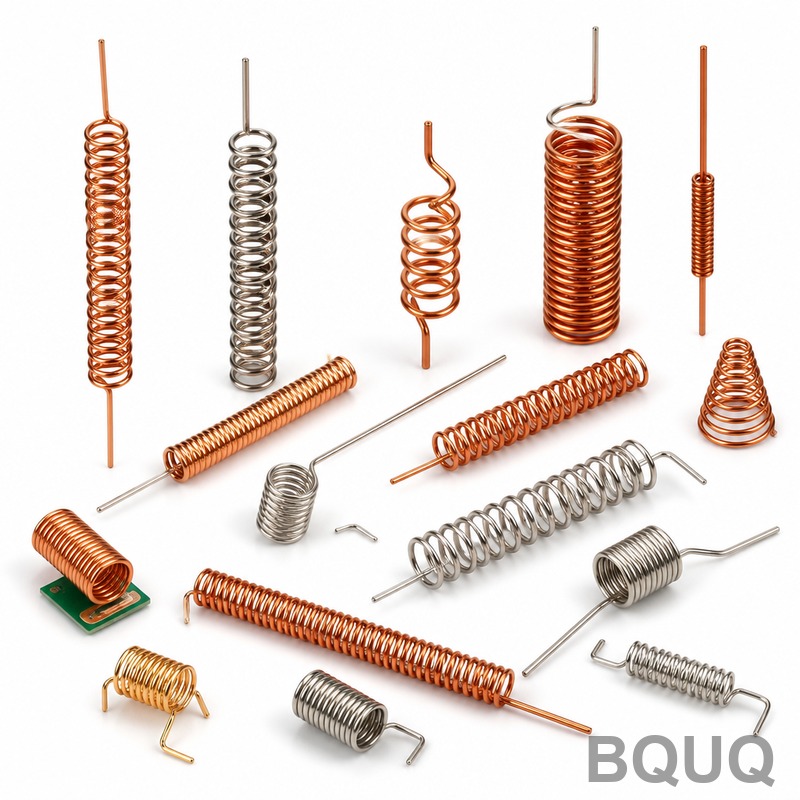
The Fundamental Spring Rate Equation
For compression and extension springs, the standard rate formula per Hooke's Law and mechanical engineering reference (Shigley's Mechanical Engineering Design, 10th Edition) is:
k = (G x d^4) / (8 x D^3 x N_a)
Where: - k = spring rate (N/mm) - G = shear modulus of material (MPa) — for music wire ASTM A228, G = 79,300 MPa - d = wire diameter (mm) - D = mean coil diameter (mm) = outer diameter minus wire diameter - N_a = number of active coils (total coils minus 2 for closed and ground ends)
Example calculation: A spring with 2.0 mm wire, 18.0 mm mean diameter, 6 active coils, and music wire: k = (79,300 x 2.0^4) / (8 x 18.0^3 x 6) = (79,300 x 16) / (8 x 5,832 x 6) = 1,268,800 / 279,936 = 4.53 N/mm
For torsion springs, the rate formula changes to: k_t = (E x d^4) / (10.8 x D x N_a) where E is Young's modulus (206,000 MPa for spring steel)
Measuring Spring Rate: Test Methods and Tolerances
In production, we do not rely solely on calculated values. BQUQ uses a digital spring tester (accuracy ±0.5 percent of full scale, calibrated to ISO 7500-1) to measure actual force at 20 percent, 50 percent, and 80 percent of maximum deflection. The measured rate is the slope between any two points on the force-deflection curve.
Standard manufacturing tolerances per DIN 2095 for cold-coiled compression springs:
| Spring rate range (N/mm) | Tolerance grade 1 (±%) | Tolerance grade 2 (±%) | Load tolerance at specified height (±%) |
| 0.1 to 1.0 | ±5 | ±10 | ±5 to ±8 |
| 1.01 to 5.0 | ±4 | ±8 | ±4 to ±6 |
| 5.01 to 15.0 | ±3 | ±6 | ±3 to ±5 |
| 15.01 to 50.0 | ±2.5 | ±5 | ±2.5 to ±4 |
| 50.01 to 200.0 | ±2 | ±4 | ±2 to ±3 |
For precision applications such as automotive fuel injectors or medical valves, BQUQ holds rate tolerance to ±2 percent by selecting wire batches with consistent tensile strength and using CNC coiling machines with servo-controlled pitch accuracy of ±0.01 mm.
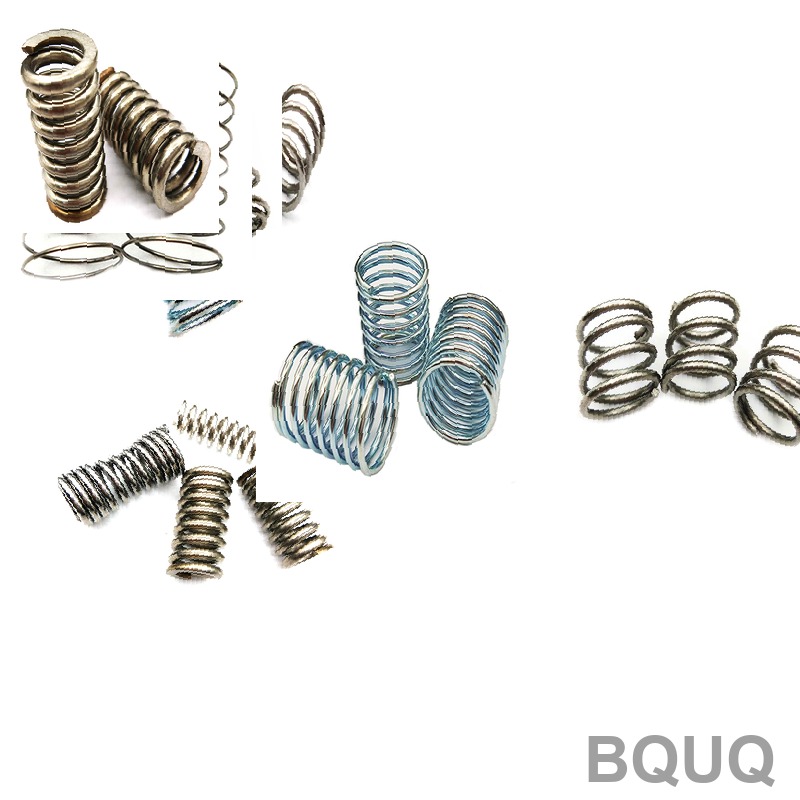
Material Selection and Its Impact on Spring Rate
The shear modulus (G) is temperature-dependent and varies by alloy. At 20°C, the following G values apply:
| Material | G at 20°C (MPa) | Max operating temperature (°C) | Relative cost factor |
| Music wire ASTM A228 | 79,300 | 120 | 1.0 |
| Oil-tempered wire ASTM A229 | 79,300 | 150 | 0.9 |
| Chrome silicon ASTM A401 | 78,500 | 220 | 1.4 |
| Chrome vanadium ASTM A231 | 79,200 | 200 | 1.5 |
| Stainless 302/304 | 69,000 | 250 | 2.1 |
| Inconel X-750 | 77,000 | 550 | 8.5 |
| Elgiloy (Co-Cr-Ni) | 77,500 | 400 | 12.0 |
A critical engineering note: stainless steel's lower G value (69,000 MPa) means a stainless spring must use a 2.8 percent larger wire diameter or 8.5 percent more active coils to achieve the same rate as music wire. At BQUQ, we adjust coil counts during CNC programming rather than changing wire diameter when material substitution is required, because wire diameter changes affect the stress correction factor (Wahl factor) and fatigue life.
How Coil Geometry Affects Rate: Diameter, Pitch, and End Conditions
The mean coil diameter D appears cubed in the denominator, making it the most sensitive parameter. A +2 percent error in D produces a -5.9 percent change in rate (since 1.02^3 = 1.061, inverse = 0.941). Therefore, BQUQ's CNC coiling machines hold mandrel diameter tolerance to ±0.02 mm for wire up to 6 mm diameter.
Active coil count N_a is determined by end conditions: - Closed and ground ends (common for high-load): N_a = total coils - 2 - Closed ends not ground: N_a = total coils - 1.5 - Plain ends: N_a = total coils
Pitch angle also affects rate indirectly. For springs with pitch angle above 12 degrees, the rate decreases slightly due to curvature effects. Our engineering team applies a correction factor of 1 - (3/16) x (d/D)^2 for D/d ratios below 4. When D/d ratio falls below 4, the stress concentration rises sharply, and we recommend redesigning with a larger diameter or smaller wire.
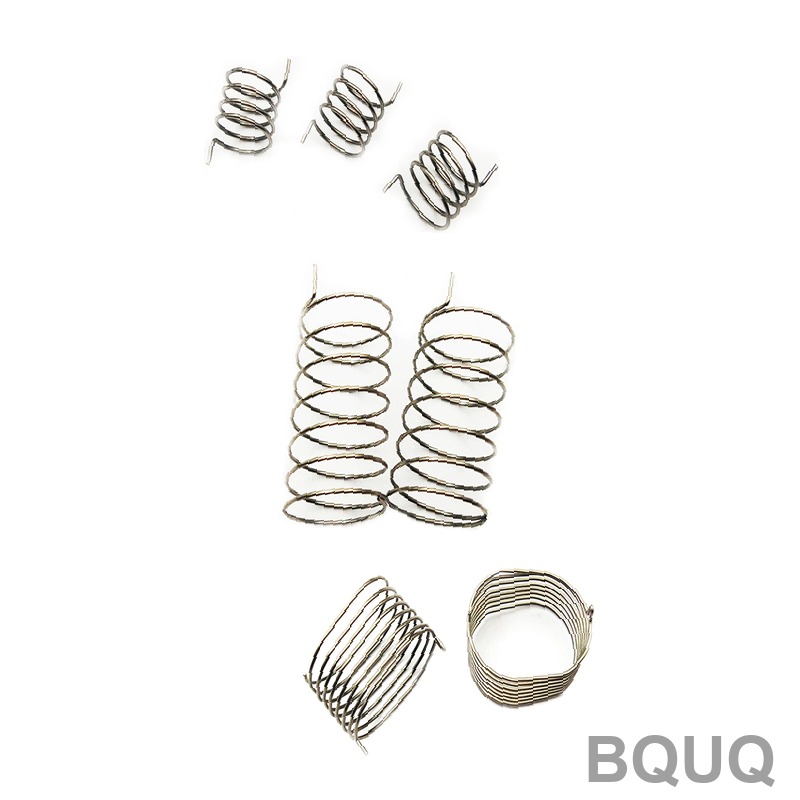
CNC Machining and Coiling Precision at BQUQ
BQUQ operates 12 CNC spring coilers (Torrington and Wafios models) with the following production capabilities:
| Parameter | BQUQ capability | Industry standard |
| Wire diameter range | 0.15 mm to 12.0 mm | 0.10 mm to 15.0 mm |
| Coil diameter tolerance | ±0.02 mm up to 50 mm OD | ±0.05 mm |
| Free length tolerance | ±0.15 mm for lengths under 100 mm | ±0.30 mm |
| Spring rate tolerance (precision grade) | ±2 percent | ±5 percent |
| Surface finish | Ra 0.4 µm after shot peening | Ra 0.8 µm |
| Production lead time | 3-5 days for prototypes, 10-15 days for production | 7-10 days prototypes |
Post-coiling operations include stress-relief heat treatment at 260°C for 20 minutes (music wire) or 370°C for 30 minutes (chrome silicon), followed by shot peening to increase fatigue life by 20-30 percent. For springs requiring precise rate matching in sets (e.g., valve springs), we sort springs into bins of ±1 percent rate deviation using automated load testing at a rate of 1,200 pieces per hour.
Practical Recommendations for Engineers
When specifying spring rate, provide the operating deflection range (minimum and maximum working height) rather than only a target rate at free length. This allows the manufacturer to optimize the pitch distribution and avoid coil binding. For dynamic applications exceeding 10 million cycles, specify a maximum stress of 45 percent of tensile strength for music wire and 40 percent for stainless steel.
If you need a rate tolerance tighter than ±3 percent, request matched sets or individual rate testing. This adds approximately $0.05 to $0.15 per piece depending on quantity, versus a standard tolerance which adds no cost. For high-volume production over 50,000 pieces, BQUQ can hold ±1.5 percent rate by using in-process feedback from load testers to adjust coiling parameters automatically.
Temperature compensation matters: a music wire spring operating at 100°C will have a rate 3-4 percent lower than at 20°C because G decreases by approximately 0.025 percent per °C. For applications above 150°C, use chrome silicon or Inconel, but expect 15-30 percent higher material costs and longer lead times (2-3 weeks for Inconel due to procurement).
Common Spring Rate Calculation Errors
Three frequent mistakes occur in practice. First, using the outer diameter instead of mean diameter in the formula — this overestimates rate by 20-30 percent for typical D/d ratios of 5-8. Second, miscounting active coils when ends are closed but not ground; always verify with a coil count gauge. Third, ignoring the effect of spring index (D/d) on stress — a spring with D/d below 4 will yield prematurely even if the calculated rate is correct.
Another subtle error is assuming the rate is linear across the entire deflection range. All springs become progressively stiffer near solid height due to coil contact. For critical applications, specify the rate at the operating height, not at free length. Our test reports include rate values at three points: 20 percent, 50 percent, and 80 percent deflection, with a linearity check showing deviation from ideal straight line (typically under 2 percent for well-designed springs).
Conclusion
Spring rate is a simple ratio of force to deflection, but achieving it reliably in production requires precise wire control, correct material selection, and rigorous testing. By using the formula k = (G x d^4) / (8 x D^3 x N_a) and understanding tolerance grades per DIN 2095, you can specify springs that meet your performance requirements without overpaying for unnecessary precision. BQUQ's 20 years of manufacturing experience in CNC machining, metal stamping, and spring production ensures your springs are made to the exact rate you calculate, with measurable quality at every step.
For a fast and accurate quote on custom springs, heat sinks, or CNC machined components, contact BQUQ today. We provide 12-hour quoting for standard inquiries and can suggest design modifications to reduce cost while maintaining your spring rate targets.
| Email: sc@bquq.com | WhatsApp: +86 13713157787 | www.bquq.com |
Related Articles
- Size control and online intelligent detection technology of precision spring
- In-depth analysis of technology and process in the hardware spring industry in 2026: a full-dimensional interpretation of high stress, functional integration and engineering certification
- From "standard parts" to "functional parts": 2026 hardware spring industry technology trends and functional innovation engineering direction